
Get the first-hand rules sheet
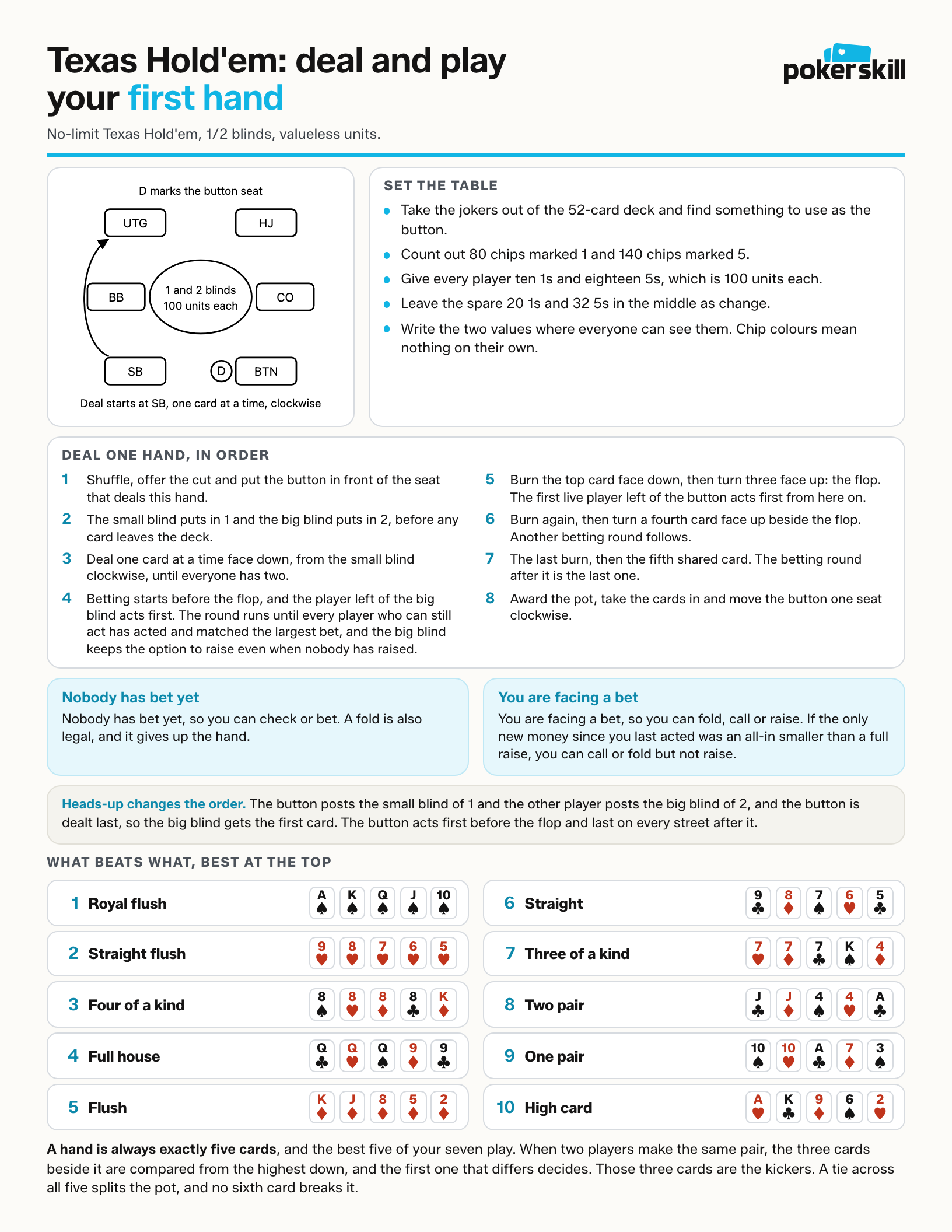
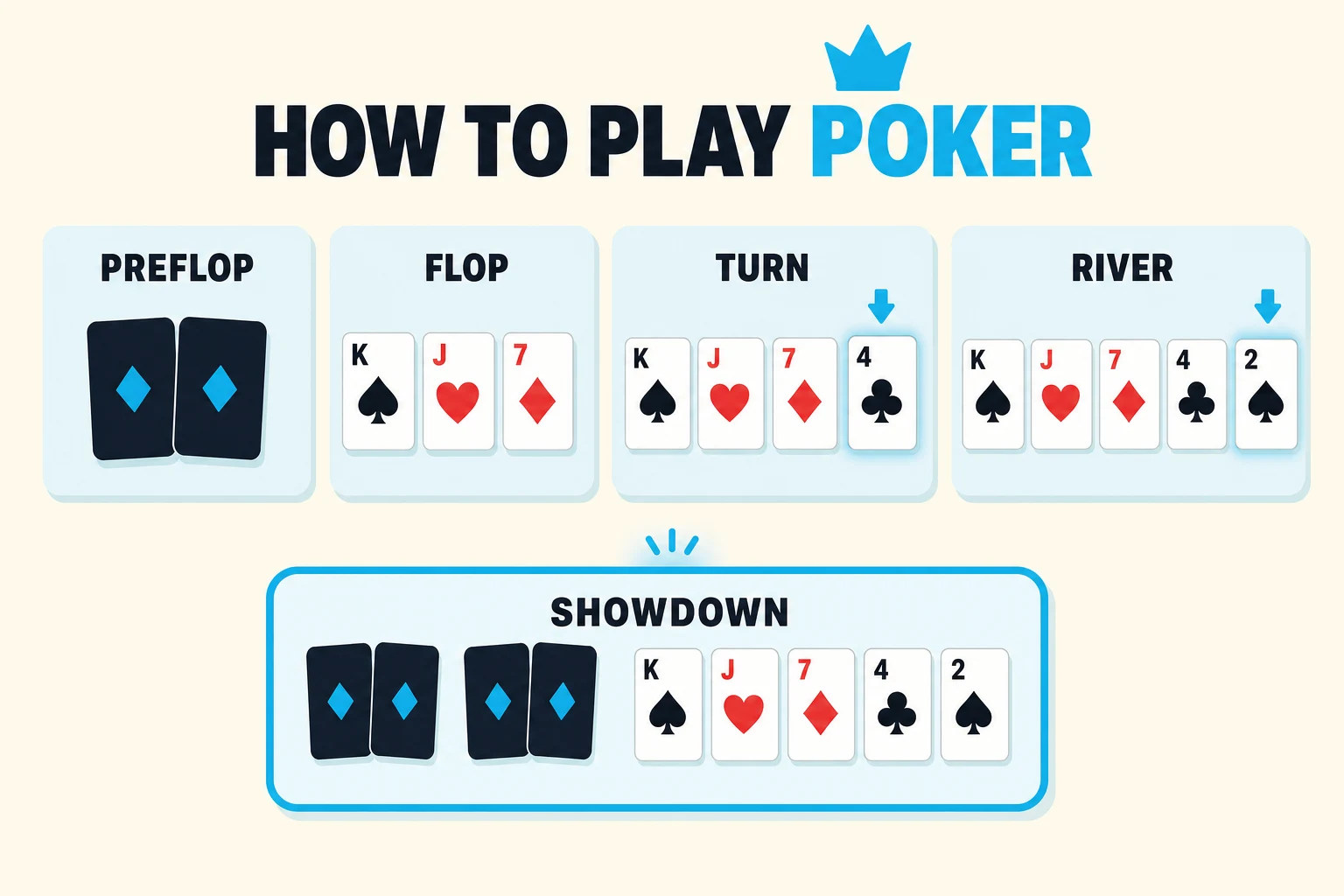
To play poker, you get cards, you bet in rounds and the best hand still standing at the end wins the pot. Hold’em, Omaha, stud and draw all run on that loop.
Poker is a family of card games. What changes between them is the deal, the forced bet and the rule for making a hand out of the cards.
What every poker game has in common
| The part | What it means | Where games differ |
|---|---|---|
| The deal | You get cards, some private, some shared | Two private cards in Hold’em, four in Omaha, seven of your own in stud |
| Forced bets | Money in the middle before the cards are dealt | Blinds in Hold’em and Omaha, an ante and a bring-in in stud |
| Betting rounds | Everyone still holding cards gets a turn, and the round ends when every player who can still act has acted and matched the largest bet | Four rounds in Hold’em, five in stud, two in draw |
| The showdown | The remaining players compare hands and the best one wins | Some games split the pot between the best high hand and the best low hand |
| Hand rankings | Which five cards beat which | Identical in Hold’em, Omaha and stud. Lowball games read the same cards low |
Which game are you learning?
How many cards are yours, whether any are shared and which hand wins tell you the game before anyone names it.
| What you were dealt | The game, and how a hand is made | The full rules |
|---|---|---|
| Two private cards, five shared | Texas Hold’em. Any five of your seven cards play | Texas Hold’em rules |
| Four private cards, five shared | Omaha. Exactly two of your four with three from the board | Pot-limit Omaha |
| Five private cards, with a chance to replace some | Five-card draw. You replace cards once, and the rankings are the standard ones | Five-card draw |
| Seven cards of your own, some face up | Seven-card stud. No button and no shared board, so the four Hold’em streets do not apply | Seven-card stud |
| The lowest hand wins | Get the name of the lowball game first. Razz reads lows ace to five, where a straight or a flush does not count against you | Razz |
Classic, traditional and regular are not names of games. Match the cards being dealt to a row above.
The forced bets
A forced bet puts money in the middle before the cards are dealt, so every hand starts with something to play for.
Games with a dealer button, which includes Hold’em and Omaha, use blinds: the two players clockwise from the button post a small blind and a big blind before the deal. The button moves one seat each hand, so the blinds reach every seat in turn and a player who folds all night still pays them.
Stud games have no button, so they use an ante from everyone plus a bring-in, a forced first bet from the player showing the lowest card in seven-card stud. Tournaments often add an ante to the blinds as the levels climb.
The loop: deal, bet, showdown
A hand of poker is a sequence of deals with a betting round after each one. When the last betting round finishes, the players still holding cards show them and the best hand wins the chips.
A hand can also finish early. The moment everyone but one player folds, that player takes the pot and the cards stay face down.
Why Texas Hold’em is where beginners start
Hold’em deals the fewest private cards of the common games: two cards down to each player, five shared cards in the middle, best five-card hand wins. The street-by-street rules, the minimum raise sizes and the dealing details are on Texas Hold’em rules.
Set up a home game
This setup is for six players. A shorter or longer table uses the same deck, button, blinds and street order. Two players change the order of the blinds and the deal.
Before the first deal
Agree the terms before the cards come out: the units have no cash value, the blinds stay at 1 and 2 for every hand, there is no ante and nothing is raked out of the pot. Nobody adds chips in the middle of a hand, and a player who wants more waits for the next deal.
If your home set does not match this one, give everyone the same total and write the values where players can see them.
How to deal a hand
Shuffle, offer the cut and put the button in front of the seat that deals this hand.
The small blind puts in 1 and the big blind puts in 2, before any card leaves the deck.
One card at a time, face down, starting with the small blind and moving clockwise, until everyone has two.
The player left of the big blind acts first. The round runs until every player who can still act has acted and matched the largest bet, and the big blind keeps the option to raise even when nobody has raised.
Burn the top card face down, then turn three cards face up in the middle. The first live player left of the button acts first from here on.
Burn again, then turn a fourth card face up beside the flop. Another betting round follows.
The last burn, then the fifth shared card. The betting round after it is the last one.
Award the pot, take the cards in and pass the button to the next seat clockwise.
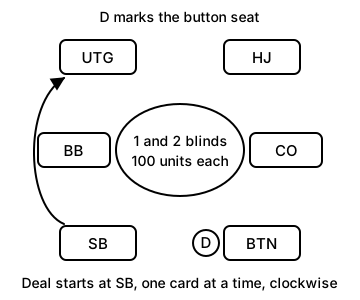
The six labels are the seat names. UTG is under the gun, the first seat to act before the flop. HJ is the hijack and CO is the cutoff, the two seats before the button. BTN is the button, SB is the small blind and BB is the big blind.
Keep each player’s bet in front of them until the round is over. A player who asks what the raise costs them can then count it on the table.
Heads-up play changes the order. The button posts the small blind of 1 and the other player posts the big blind of 2, and the button is dealt last, so the big blind gets the first card. If the button calls by adding 1, the pot is 4 and the big blind can check or raise, with a normal minimum raise to 4. The button acts first before the flop and last on every street after it, so the big blind is the one who acts first once the flop is out.
First hand
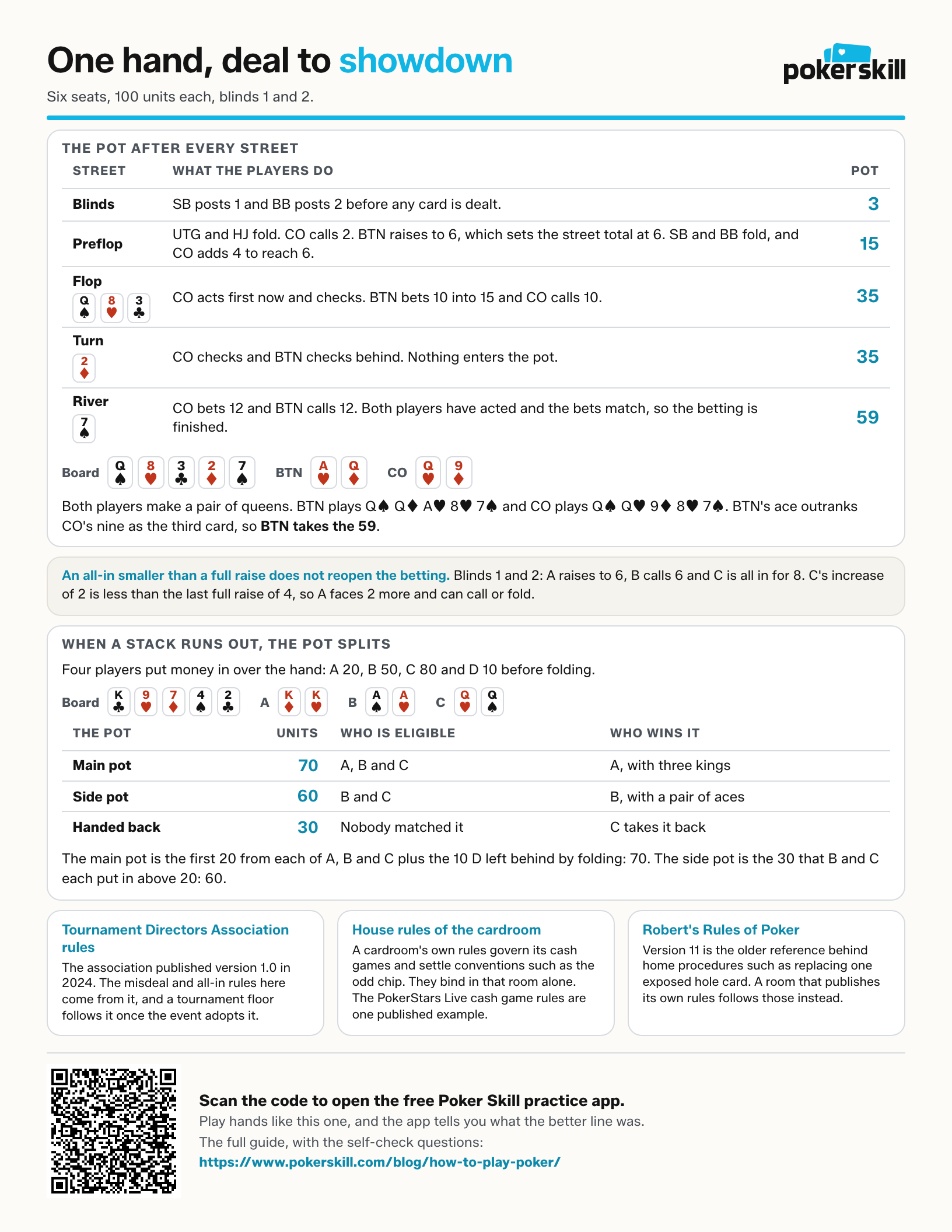
Six seats and 100 units in front of everybody, with blinds of 1 and 2. The seats are UTG, HJ, CO, BTN, SB and BB, clockwise.
SB puts in 1 and BB puts in 2 before any card is dealt. Both count as bets on this street, and both stay in the pot if those players fold.
UTG folds. HJ folds. CO calls 2. BTN raises to 6. SB and BB fold, and CO adds 4 to reach 6.
CO acts first now that the flop is out, and checks. BTN bets 10 into 15. CO calls 10.
CO checks and BTN checks behind. Nothing enters the pot, so the river comes straight out.
CO bets 12 and BTN calls 12. Both players have acted and the bets match, so the betting is finished and the hands are compared.
Both players make a pair of queens. BTN’s ace outranks CO’s nine as the third card, so the 59 goes to BTN.
BTN wins: the ace decides
| Where the hand stands | Who acts, and what goes in | Pot | What you can answer now |
|---|---|---|---|
| Before the deal | SB posts 1, BB posts 2 | 3 | UTG acts first before the flop |
| Preflop opens | UTG folds, HJ folds, CO calls 2 | 5 | BTN faces 2 with nothing of their own in the pot |
| BTN raises | BTN raises to 6, putting in 6 | 11 | A raise to 6 sets the street total at 6, so a player with 2 already in adds 4 |
| Preflop closes | SB folds, BB folds, CO adds 4 | 15 | CO’s call costs 4, because 2 was already in. The blinds’ 3 stays in the pot |
| Flop Q♠ 8♥ 3♣ | CO checks, BTN bets 10, CO calls 10 | 35 | CO acts before BTN after the flop, and a check adds nothing |
| Turn 2♦ | CO checks, BTN checks | 35 | Both players have acted with no bet in front of them, so the river comes out |
| River 7♠ | CO bets 12, BTN calls 12 | 59 | The call costs 12 and ends the betting |
| Showdown | BTN is awarded the pot | 59 | Both play a pair of queens, and the ace beats the nine |
BTN put in 28 across the hand, CO put in 28 and the blinds were 3, which is the 59 BTN collects. Afterwards UTG and HJ still have 100 each, CO has 72, BTN has 131, SB has 99 and BB has 98. The table still holds the 600 units it started with.
The betting rounds
A betting round ends when only one player still holds cards, or when every player who can still act has acted and matched the largest bet in front of them. A raise sends the action round again, so a round can take several laps of the table.
A player who is all in has nothing left to match, so the round finishes around them and their chips stay in for the part of the pot they covered. A blind is a live bet, so a big blind who is only called still has the option to raise when the action comes back.
Hold’em and Omaha have four rounds: before the shared cards, after the first three, after the fourth and after the fifth. Seven-card stud has five, because it deals five times. Five-card draw has two, one before the draw and one after it.
An opening bet after the flop is at least the size of the big blind, so the smallest bet in this game is 2. A raise has to add at least as much as the last bet or raise, so a bet of 10 can be raised to 20 or more. Texas Hold’em rules covers the rest of the sizing rules.
Action moves clockwise. Before the flop the player left of the big blind starts; after the flop the first active player left of the button starts and the button acts last.
Your five actions on any street
An all-in counts as smaller than a full raise when it adds less than the previous bet or raise did. The numbers are in when someone is all in.
What beats what
Hold’em, Omaha and stud rank hands the same way. Five cards make a hand, and this order settles which one wins.
A hand is always exactly five cards, so a pair of aces is really the pair plus the three highest cards left over, which is how one pair of aces beats another. When two players make the same pair, the three cards beside it are compared from the highest down, and the first one that differs decides. Those three cards are the kickers. When both players hold the same best five, the pot splits and no sixth card breaks the tie. The poker hand rankings page covers the tie-break cases, what beats what in poker takes the pairings one at a time and the same order comes as a one-page chart to print.
Self-check
The deal order and this hand are also on the printable rules sheet.
When someone is all in
You can only bet the chips you have on the table. When a player is all in for less than the others are betting, the extra goes into a side pot that the all-in player cannot win. They stay live for the main pot, which is the part everyone matched.
Example: an all-in too small to reopen the betting
Blinds are 1 and 2. A raises to 6, B calls 6 and C moves all in for 8. Everyone else folds. A now faces 2 more and can call or fold, because the increase of 2 is short of the last full raise, which was 4. Had C made it 10 instead, the increase would have been a full 4 and A could raise again. The name for that is reopening the betting.
Example: the same all-in, reaching a player who has not acted
Same hand, one more seat. A raised to 6, B called, C is all in for 8 and the action reaches D, who has chips and has not acted in this round. D may raise, and the smallest legal raise is to 12, because the last full increment was 4. What A and B can do next then depends on what D does.
Different all-in amounts split the pot into layers, one for each amount everybody still in has matched.
Example: a main pot, a side pot and money handed back
Four players put money in over the course of the hand: A 20, B 50, C 80 and D 10 before folding.
| The pot | Units | Who is eligible | Who wins it |
|---|---|---|---|
| Main pot | 70 | A, B and C | A, with three kings |
| Side pot | 60 | B and C | B, with a pair of aces |
| Handed back | 30 | Nobody matched it | C takes it back |
The main pot is the first 20 from each of A, B and C plus the 10 D left behind by folding: 70. The side pot is the 30 that B and C each put in above 20: 60. Nobody matched C’s last 30, so it never becomes a pot and comes straight back. Side pots explained works through more of these.
Showdown and settling the pot
When a river bet is called, the tournament convention is that the last player who bet or raised shows first, which in the hand above means CO reveals before BTN. When the last round is checked through, the first remaining player left of the button shows first and the rest follow clockwise. A player who has been called may still muck instead of showing, and mucking concedes the pot. In a tournament, once a player is all in and all the betting is complete, every remaining hand is turned face up rather than mucked. The showdown entry covers who may ask to see a called hand and what happens when two players disagree.
A tied pot splits evenly, and an odd unit is left over when it will not halve.
Example: both players play the board, and the pot will not divide
Split pot: all five match
Neither player can beat what is already in the middle, so both play the five board cards and the pot is split. The pot in this example is 11 units, which does not halve, so each player takes 5 and the odd unit goes to A as the first eligible seat clockwise from the button. The odd-chip rule is a house convention: the PokerStars Live cash rules settle it that way, and another room may settle it differently.
Dealing errors and what to do
| What happened | What to do | Where the rule comes from |
|---|---|---|
| The dealer exposes the first or second card off the deck during the initial deal, before any substantial action | Misdeal. Keep the same button and the same blinds, then shuffle and deal again | Tournament Directors Association rule 35 |
| The dealer exposes one later hole card, and nothing else in the initial deal went wrong | Finish dealing, replace that card from the top of the deck and use the exposed card as the first burn | Robert’s Rules of Poker version 11, Hold’em clause 1 |
| The dealer exposes two of the initial hole cards, again before substantial action | Misdeal. Shuffle and deal again | Tournament Directors Association rule 35; Robert’s Rules of Poker version 11, Hold’em clause 1 |
| The error only comes to light after a bet and a call | Stop and work out what happened. Do not call a misdeal on a hand that has already had real action | Tournament Directors Association rules on substantial action |
The two rulebooks measure the timing differently, so a table follows one of them. A home game can adopt the replacement procedure in the second row. A tournament follows the current Tournament Directors Association rules, and a cardroom follows its own house rules.
The rules beginners break by accident
Acting before your turn gives the players behind you information they have not paid for, and a dealer can hold you to an action made out of turn. Wait for the action to reach you.
A hand that goes into the muck is dead even when it was the best one, so turn your cards face up when you are called at showdown.
A call you have already made belongs to the pot. Folding later takes nothing back out.
Your first session
At the table, first session
Poker etiquette covers the rest of the table habits. Online the software deals the cards, enforces turn order and bet amounts and counts the pot.
What to practice first
Before your next session
Playing without money, or without betting
The first version keeps the betting and removes the money. Deal the six-seat hand with counters that have no cash value and follow the pot table above: the bets, calls and folds all happen, and the units are only ever counted.
The other drops the betting. Deal two hands and a board, ask which five cards win, then turn everything over and compare. The two examples to start with are the shared royal flush, which is a tie, and the pair of queens where an ace outkicks a nine.
The other games you will meet
| The game | The deal | What changes |
|---|---|---|
| Pot-limit Omaha | Four private cards, five shared | You must use exactly two of your four with three from the board |
| Seven-card stud | Seven cards each, three down and four up | No shared cards, and the lowest upcard makes the forced first bet |
| Five-card draw | Five private cards | You swap cards once, and no card is dealt face up |
| Razz | Seven cards each, stud style | The lowest hand wins, read ace to five, so straights and flushes do not count against you |
| Short deck | Two private cards, five shared | The deck loses its low cards, so a flush beats a full house |
Omaha hi-lo and its stud cousin split the pot between the best high hand and the best qualifying low, and HORSE rotates through five games in one session. The formats that rotate several games at one table are covered together in mixed games in poker.
Betting structure changes too. No-limit lets you bet any amount up to your whole stack, while fixed-limit sets the size of every bet and raise in advance. Tournament blinds climb through set levels and busting ends your day, while a cash game keeps the same blinds for as long as you sit there. Cash games versus tournaments works through what that does to your decisions.
Where the official rules live
The Tournament Directors Association rules, version 1.0 of 2024, are published by the association. The misdeal conditions and the all-in language above come from there, and a tournament floor rules from them once the event adopts them.
A cardroom’s own house rules govern its cash games and settle table conventions such as the odd chip. The PokerStars Live cash game rules are one published example, binding in that room and nowhere else.
Robert’s Rules of Poker version 11, archived at homepokertourney.org, is the older reference behind the replacement of a single exposed hole card.
A home game runs on whichever of the three its players agree on before the deal.
Frequently asked questions
What are the basic rules of poker?
Every player gets cards, there are betting rounds between the deals and the best five-card hand still in the game wins the pot. On your turn you check or bet when nobody has bet, and fold, call or raise when somebody has. A hand ends at showdown, or the moment everyone but one player folds.
How do you play poker for beginners?
Start with Texas Hold'em. It deals the fewest private cards, two each, with five shared. Deal one hand with counters that have no cash value and follow every unit into the pot, then drill the hand rankings until you can read a board without stopping.
What beats what in poker?
From the top: royal flush, straight flush, four of a kind, full house, flush, straight, three of a kind, two pair, one pair, high card. Every hand is exactly five cards, so when two players hold the same pair the three cards beside it are compared from the highest down and the first one that differs decides. Hold'em, Omaha and stud all use that order. Lowball games such as Razz read the same cards by their own low-hand method, so in Razz a straight or a flush does not count against a low hand.
Can you win a poker hand without showing your cards?
Yes. If everyone else folds, the pot is yours and the cards never get turned over. Do not turn your hand over when nobody has called you, because an uncalled hand shows the table what you played for nothing.
What happens if two players run out of chips?
You can only win the chips you covered. When a player is all in for less than the current bet, the extra money goes into a side pot they cannot win, and any player who matched it plays for that part separately. The all-in player is still fully live for the main pot, which is the part everyone matched. Money that nobody matched at all comes back to the player who bet it.