
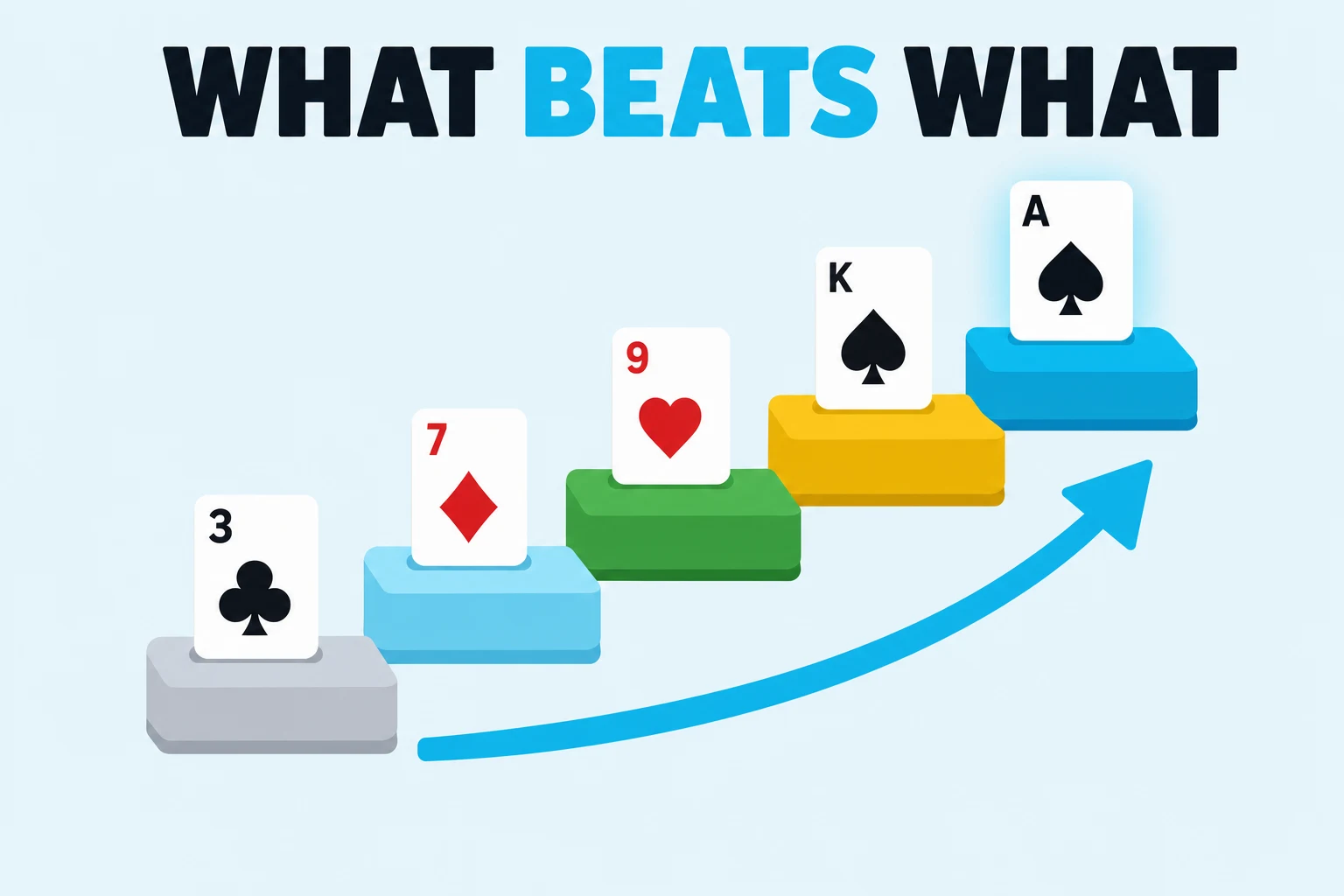
In Texas Hold’em the hand names run in one fixed order, best to worst: royal flush, straight flush, four of a kind, full house, flush, straight, three of a kind, two pair, one pair, high card. That is ten names and nine categories, because the royal flush is the highest straight flush rather than a class of its own. The order is what beats what in poker, and every “does X beat Y” question is one lookup in it.
The higher category wins even when the losing hand is the best of its own kind: aces and kings is the strongest two pair there is, and the smallest straight beats it.
A wins: two pair beats one pair
The what-beats-what ladder
Read it top to bottom. Anything higher beats anything lower in every Hold’em pot.
Every rung has its own page: royal flush, straight flush, four of a kind, full house, flush, straight, three of a kind, two pair, one pair and high card. Quads is the same hand as four of a kind under a shorter name.
If you want the order taught from the top rather than looked up, the poker hand rankings page does that.
Two players can also land in the same row. Then the bigger version of that hand wins: a higher straight beats a lower one and a higher full house beats a lower one. The tie-break rules at the end of the page cover how those comparisons run.
Each hand sits above the next because it is harder to make. There are fewer ways to be dealt a full house than a flush, and fewer flushes than straights, so the rarer hand wins. The hand probability table has the frequency behind every row.
Full house matchups
Does a full house beat a straight?
Yes, a full house beats a straight every time. Below, eights full of nines takes the pot from a jack-high straight.
Once the board pairs, your straight is no longer the nuts: anyone holding the right two cards now makes a full house, and you cannot know whether they do.
Does a full house beat a flush?
Yes, a full house beats a flush, and that includes the ace-high flush.
The hand below is an ace-high flush that loses to queens full.
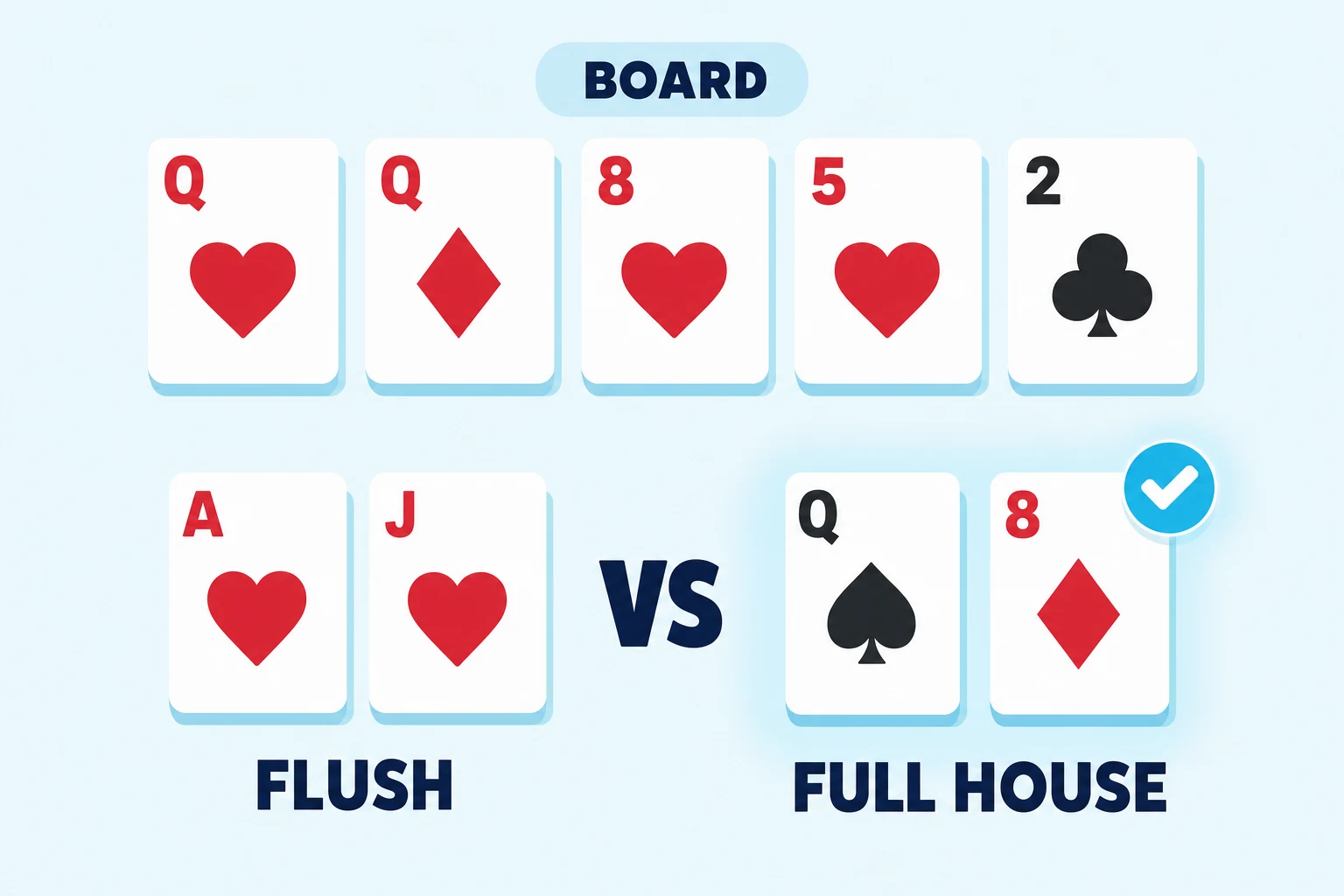
Once a rank appears twice on the board, a full house is possible.
What beats a full house?
Four of a kind, a straight flush and a royal flush. A bigger full house beats yours as well, which the tie-break rules below settle.
So when you hold a full house, check the board for four of a kind and for a straight flush. Quads needs an opponent holding the other two cards of a rank the board already paired, which is that exact pocket pair. A straight flush takes three cards of one suit in a run, which the K♠ K♦ 7♣ 7♥ 2♠ board above does not have. If the board offers neither, only a bigger full house beats you.
Full house vs full house: who wins?
The higher three of a kind wins. Compare the trips first, and only if those are identical does the pair decide.
Both hands use the same four cards from the board. Anyone holding a nine outranks anyone holding a four, and aces full beats every full house below it. Why a full house is called a boat explains where the nickname came from.
Self-check: which full house wins?
Both hands below made a full house on the same board.
Show the answer
Hand B. The king makes kings full of sevens and the seven makes sevens full of kings. Full houses compare the three of a kind first, so kings beat sevens and the ace in hand A never reaches the five.
Flush matchups
A flush is five cards of one suit, in any order.
Does a flush beat a straight?
Yes, every flush beats every straight, so Broadway loses to the smallest flush on the board.
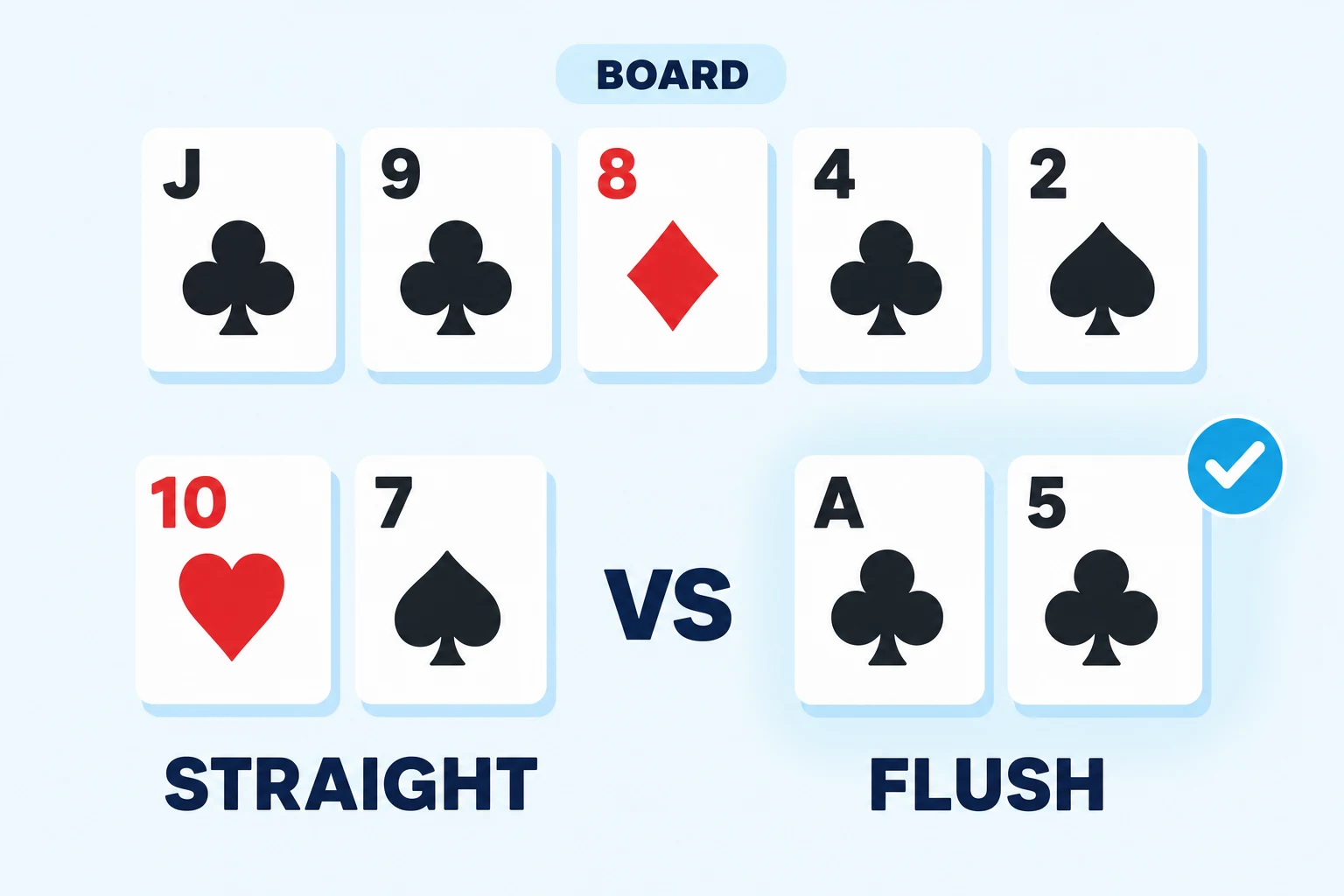
Once a third card of one suit lands on the board, anyone holding two of that suit beats your straight.
Does a flush beat three of a kind?
Yes, a flush beats three of a kind, two pair and everything under them.
Three clubs are showing on the board above, so any two clubs in an opponent’s hand beat trip nines.
Does three of a kind beat a flush?
No, three of a kind loses to a flush every time, whichever cards made the trips.
If the board pairs on a later card, your three of a kind becomes a full house and beats the flush.
Without that second eight the nines are still trips. Trips versus a set covers how the two versions of three of a kind play differently.
What beats a flush?
Four hand names: a full house, four of a kind, a straight flush and a royal flush. A bigger flush takes the pot as well, and the highest card in each flush settles that one.
A flush beats every straight, so no straight can take the pot from you. On a finished board the check is quick: no pair among the community cards means nobody has a full house or quads, and suited cards that cannot sit inside a five-card run mean nobody has a straight flush. When the board passes both checks, a bigger flush is the only hand left that beats you.
Flush vs flush: who wins?
The highest card in the flush wins. If those tie, compare the second card, then the third, and so on down to the fifth.
Suits never break the tie, so the ace plays and takes the pot. The nut flush is the best flush a board allows, which means no other flush can beat it. How to play the nut flush covers what to do when you hold one.
Four of a kind and straight flush matchups
Both of these hands need help from the board: a pair for four of a kind, three suited cards in a run for a straight flush.
Does a straight flush beat four of a kind?
Yes, a straight flush beats four of a kind, and that includes four aces.
The board has to show three cards of one suit in a tight run before this matchup is possible.
What beats four of a kind?
A straight flush and a royal flush beat it outright. So does a bigger four of a kind, which needs a board carrying two pairs so that two players can each fill one.
Both players started with a pocket pair and both finished with four of a kind. Quads are compared by rank, so the nines take the pot.
Does four of a kind beat a straight?
Yes. Four of a kind sits three rows above a straight, and the quad eights below beat the ten-high straight.
The only hands above four of a kind are the straight flushes, royal included, and they need three cards of one suit sitting in a run on the board. Without that, quads is the best hand anyone can hold.
What beats four aces?
Only a straight flush or a royal flush. No other four of a kind beats four aces, because aces are the highest rank.
Four aces are unbeatable unless the board shows three cards of one suit in sequence, which is what a straight flush needs. A board that holds all four of a kind is a separate case, and there the fifth card decides.
Does a royal flush beat quad aces?
Yes, nothing outranks a royal flush, so four aces loses when both hands are out.
The royal flush is A-K-Q-J-10 of one suit, the highest possible straight flush. If two players share one using the board, the hands are identical and the pot is split. The odds of a royal flush give the exact frequency.
What beats a royal flush?
Nothing does. There are four royal flushes in the deck, one per suit, and each is the top straight flush in its suit, so no hand in poker outranks them.
Self-check: quads or a straight flush?
The board below holds three hearts in a run and three sevens.
Which hand is in front?
Hand A. Nine-eight of hearts makes 9-8-7-6-5 all in hearts, a straight flush, and that is the one hand class that beats four of a kind. Quad sevens is the second-best hand on the board.
Straight and lower matchups
What beats a straight?
A flush, a full house, four of a kind, a straight flush and a royal flush. A higher straight beats yours too, and the top card of each straight settles that.
Everything else loses to a straight. When you hold one, read the board for what beats it: three cards of one suit put a flush in play, and a pair puts a full house or four of a kind in play. A run that climbs past your own top card puts a bigger straight in play. The board above is unpaired, so no full house is available on it, but king-ten makes K-Q-J-10-9, and the king and ten of clubs make a straight flush.
Does a straight beat three of a kind?
Yes, five in sequence outranks three of a rank, and two pair and one pair as well.
The trip nines above lose to the jack-high straight, and every straight beats every three of a kind.
Does trips beat a straight?
No, and the board below shows it: pocket sevens make a set and still lose to jack-ten, because a straight beats three of a kind.
The way out is the board pairing again, which turns three of a kind into a full house. On the board above, anyone holding jack-ten, ten-six or six-five is already ahead of your sevens.
Does a straight beat two pair?
Yes, the smallest straight outranks the biggest two pair.
Aces and kings is the best two pair this board allows, and the ten-high straight beats it. So would the eight-high straight that five-four makes on the same five cards.
Does two pair beat three of a kind?
No, it runs the other way: three of a kind outranks two pair.
On a paired board, the danger is that somebody holding a card matching that board pair already has three of a kind. Two queens are unaccounted for here, and either one in an opponent’s hand beats queens and eights.
What beats a pair?
A higher pair first, then two pair and everything above it: three of a kind, a straight, a flush, a full house, four of a kind, a straight flush and a royal flush. When two players hold the same pair, the side cards decide.
Below one pair there is only high card.
Self-check: which hand takes this pot?
The board below is unpaired and runs 9-8-7.
See the winner
Hand B. Jack-ten completes J-10-9-8-7, a straight. Pocket nines make trip nines, and three of a kind sits one row below a straight.
The tie-break rules that decide close calls
Once both players land in the same row of the matrix, the category stops deciding and these five rules take over. Category first, kickers only if you need them: that is the order Poker Skill’s hand-ranking drills teach.
Only the best five cards count. A sixth card never breaks a tie, so an ace sitting outside your best five does nothing at showdown.
Suits never break a tie. Spades are not worth more than clubs, and two players with the same five ranks split the pot. What the suits actually do covers what they are for.
Split pot: all five match
The kicker decides when the made part matches. With one pair, compare the pair rank, then the three side cards in order. With two pair, compare the higher pair, then the lower pair, then the single kicker. With four of a kind, the fifth card decides.
Inside a category, ranks decide in a fixed order. Straights and flushes compare from the highest card down. Full houses compare the three of a kind first. Trips compare the trips, then the two side cards. The best five-card hand rule shows how to pick the right five cards out of seven.
When the board is the best hand, everybody chops. If nobody can beat the five community cards, the players still in the pot are playing the board and the pot is split evenly. In a pot with an all-in for less, the same comparison happens in each pot separately, which is what side pots exist to handle.
A-2-3-4-5 is a straight, called the wheel, and the ace plays low there, making it a five-high straight and the weakest one possible. A-K-Q-J-10 is Broadway, the highest straight. The ace is either high or low in a given hand, never both, so a straight cannot wrap around from king to ace to two.
B wins: one pair beats high card
Where to look next
The poker hand rankings chart lists every hand with example cards and odds. The poker hand rankings page teaches the order from the top.
Frequently asked questions
Does a flush beat a straight?
Yes. A flush beats a straight, and the size of the straight never changes that.
What beats a flush?
A full house, four of a kind, a straight flush and a royal flush. A higher flush beats yours as well, and the tie-break rules at the end of the page decide that one.
Does trips beat a straight?
No. Three of a kind loses to a straight, whether you made it with a pocket pair or with one card that matches a pair on the board.
What beats four of a kind?
A straight flush and a royal flush, plus any four of a kind bigger than yours. That last one needs a second pair on the board, so two players can each fill quads.
Does a royal flush beat quad aces?
Yes. A royal flush beats four aces, and it beats every other hand in the deck.