
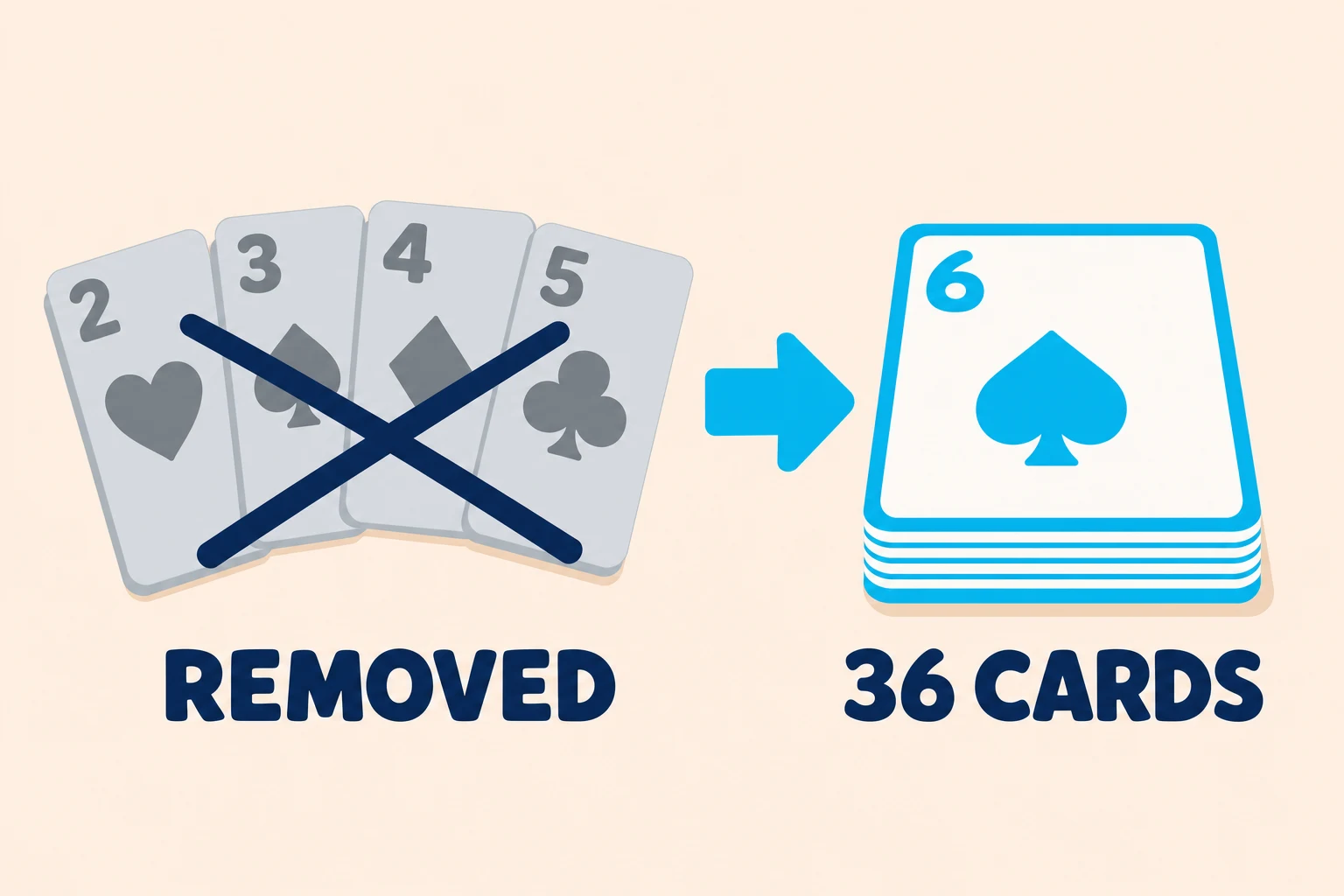
Short deck poker is Texas Hold’em played with a 36-card deck. The twos, threes, fours and fives are taken out, sixteen cards in all, and everything else runs the same way: two hole cards each, a flop, a turn, a river, four betting rounds, and the best five-card hand at showdown. Taking those cards out swaps two hand rankings and gives the ace a new straight at the bottom.
Two hole cards each and the best five at showdown, exactly as you know it. What changes is which hands are hard to make, which is why two rankings swap places and why the equities between hands run much closer than they do in a full-deck game. It is also called six plus Hold’em, because the six is now the lowest card in the deck.
The shortcut, in one line
A flush is now better than a full house, the ace makes a straight with 6-7-8-9, and most starting hands run closer to each other than they do with a full deck.
Short deck at a glance
| Trait | Short deck (6+) | Texas Hold’em |
|---|---|---|
| Deck | 36 cards, sixes to aces | 52 cards |
| Cards removed | 2, 3, 4 and 5 | None |
| Hole cards | 2 | 2 |
| Board | Five community cards | Five community cards |
| Flush versus full house | Flush wins | Full house wins |
| Lowest straight | A-6-7-8-9 | A-2-3-4-5 |
| Forced bets | Commonly antes from every player | Blinds |
| Typical feel | Hands run close preflop | Wider gaps between hands |
Hand rankings: what changes
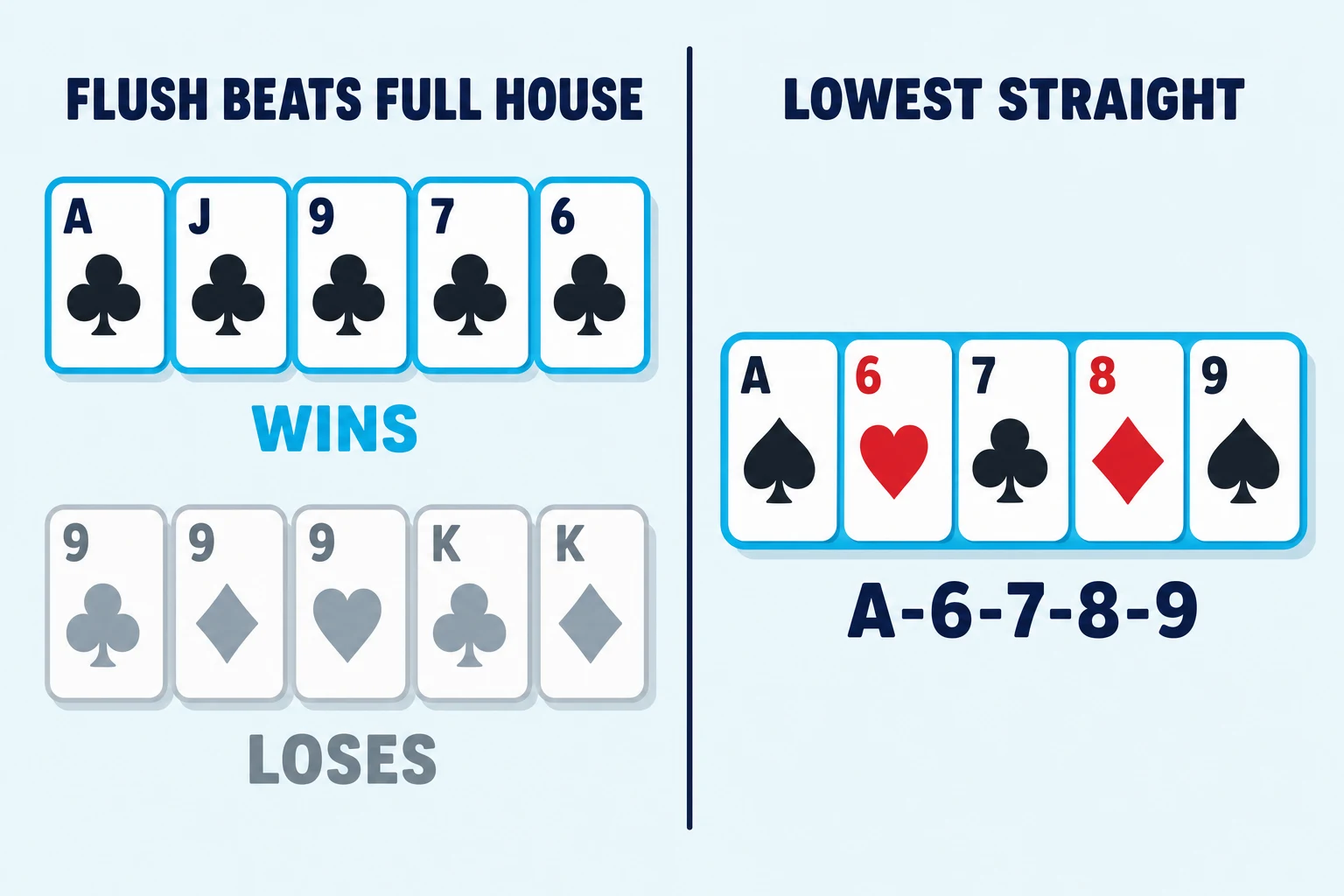
Two changes are standard, and one more is a table convention worth asking about.
A flush beats a full house. Pulling sixteen low cards out takes four cards out of every suit, so each suit now holds nine cards instead of thirteen. Flushes get much harder to make, and with only nine ranks left, full houses get easier. Count the five-card hands you can build from a 36-card deck: there are 480 plain flushes and 1,728 full houses.
That gap is what the promoted flush is for, and it is a rule the game sets rather than one the arithmetic enforces.
The ace makes a low straight with 6-7-8-9. In a stripped deck the ace sits next to the lowest card still in it, so with sixes low the smallest straight is A-6-7-8-9. The ace still plays at the top too, so A-K-Q-J-10 is unchanged.
There are six straights in the whole game instead of ten.
Three of a kind against a straight is the one to check. Most games keep the standard order, with a straight beating three of a kind, and among five-card hands the straight is also the rarer of the two: 6,120 straights against 16,128 three-of-a-kind hands.
Both orders are in use, so ask before the first hand and do not assume the table you played at last time is the table you are at now.
| Short deck ranking | Hold’em ranking | What moved |
|---|---|---|
| Straight flush | Straight flush | Unchanged |
| Four of a kind | Four of a kind | Unchanged |
| Flush | Full house | Promoted above the boat |
| Full house | Flush | Demoted below the flush |
| Straight | Straight | Unchanged, but check the table’s trips convention |
| Three of a kind | Three of a kind | Unchanged, same caveat |
| Two pair, one pair, high card | Same | Unchanged |
Short deck promotes the flush above the full house and, apart from the trips-versus-straight convention the table notes, leaves the standard poker hand rankings exactly as the rankings chart shows them.
The rules in one read
The deal and the betting rounds run like Texas Hold’em rules: two cards each, a betting round, the flop, another round, the turn, another round, the river, a last round, showdown. The forced bets are the part that usually differs.
The one structural difference you will meet at most short deck tables is the forced bets. Instead of blinds, the common format is an ante from every player, with the player on the button posting an extra one. The extra ante does the job the big blind used to do: it puts more in the pot before the cards come out, and it moves with the button.
Some games do use blinds, and some use antes plus a blind. Like the ranking convention above, this is a table setting rather than a rule of the game, so check it before the first hand.
Why hands run closer together
Take out the small cards and every hand keeps more of its usefulness. Two high cards are still two high cards, and the hands that used to be junk are simply gone, so what remains is a narrower band of hand strengths.
Two consequences matter at the table.
Straight draws are stronger, flush draws are weaker. An open-ended straight draw still has eight outs, but after the flop there are only 31 unseen cards instead of 47, so it comes in far more often. A flush draw is the opposite: each suit only holds nine cards now, so four of them in your hand and on the board leaves five outs, not nine. That is the same fact from both directions, and it is why the flush was promoted in the first place.
Pocket pairs are worth less. The three of a kind you flop runs into straights far more often, because straights are much easier to make in a nine-rank deck.
Close hands make for bigger decisions. When two hands are close in strength, a call or a fold is worth less than it is when one hand is far ahead, so more pots get played for stacks. Nothing about the betting rules changed to produce that; the deck did it.
What makes a starting hand strong
Suited aces and suited connectors gain, because the hands they make have been promoted or made easier to complete. An ace with a suited six is a straight card and a flush card at once, which is one shape that clearly benefits from the change.
Pairs lose relative value, and the small ones lose the most of it. Pocket sixes are the lowest pair in the game now, with every other pair above them.
High cards stay strong for the reason they always were: a hand that makes top pair with the best kicker still makes top pair with the best kicker. The difference is that top pair is a weaker holding here, because the board gives everyone more ways to have beaten it.
Two hands that only happen here
The full house that loses
You have nines full of kings. Your opponent has an ace-high flush, and in this game the flush is the better hand. The cards are the same ones you know. The ranking order is not.
The straight nobody sees
That is a straight, and it is the lowest one in the game. Hold’em instincts read the ace as a high card and the six as a spare, and the hand gets checked down or folded to a bet. The same two cards also make a flush draw when two more hearts land on the flop or turn, which is why suited aces with a low card attached are the shape that gains the most from the short deck.
The mistakes that cost new players
- Reading the board with Hold’em rankings. Betting a full house into an obvious flush is a common error here, and it is the one a fluent Hold’em player makes on autopilot.
- Missing the wheel. A-6-7-8-9 is a straight, and it is easy to miss because it does not look like one to an eye trained on A-2-3-4-5.
- Overvaluing a set. Sets are still good hands and they get beaten more often here than they do with a full deck.
- Playing pairs like they are premium. In the standard order a pocket pair is at best a coin flip against two overcards here, so the price it can pay to see a flop is lower.
- Assuming last game’s settings. The trips-versus-straight order and the forced-bet format both vary. Two questions before the first hand prevent a rules mistake that costs a whole pot.
Check yourself: which hand wins in short deck?
The board runs Q♦ J♦ 8♦ 8♠ 7♣. You hold Q♠ Q♣, so you have queens full of eights. Your opponent turns over A♦ 6♦. Who takes the pot?
Show the answer
Your opponent. They make the ace-high flush with A♦ Q♦ J♦ 8♦ 6♦, and in short deck the flush beats the full house. This is the exact hand that flips: play the same five community cards and the same two holdings at a Hold’em table and your queens full win a very large pot. Here they lose to a flush that uses a six, now the lowest card in the deck.
A live-play pattern
Three reads, in order, before you act.
A three-suited board is more dangerous here than it looks, because the promoted flush now beats the full house you were planning on.
Count the cards you can see, then remember the deck is 36. The same draw is a bigger share of what is left. Poker Skill’s draw-review lesson calls a flush out dirty on a paired board because a full house beats the flush, and in short deck that flush beats the full house instead.
The ranking convention for three of a kind against a straight, and whether this game runs on antes or blinds. Both are table settings, and both change how a hand plays.
Where this fits in your decision
Short deck is a clear example of a game where changing the deck changed the rules: the hand-ranking order is a list of hands sorted by how hard they are to make, so removing sixteen cards moved two entries and left the rest alone. The complete Texas Hold’em rules cover the shared machinery, and the hand rankings chart covers the standard order this game moves two entries in.
Frequently asked questions
What is short deck poker?
Short deck poker is Texas Hold'em with the twos through fives removed, leaving a 36-card deck of sixes through aces. The deal and the four betting rounds are the same, though most short deck games use antes instead of blinds. What changes on top of that is that a flush beats a full house, the ace makes a straight with 6-7-8-9, and hands run closer together in strength. It is also called six plus Hold'em.
Why does a flush beat a full house in short deck?
Because it is harder to make. Taking sixteen cards out leaves nine cards in each suit instead of thirteen, so flushes get rarer while nine ranks make full houses easier. Among five-card hands from a 36-card deck there are 480 plain flushes and 1,728 full houses, which is why this game ranks the flush above.
What is the lowest straight in short deck?
A-6-7-8-9. In a stripped deck the ace counts as adjacent to the lowest card left in the deck, so with sixes low the ace fills the bottom of the ladder. The ace still plays high as well, so A-K-Q-J-10 is unchanged.
Does three of a kind beat a straight in short deck?
It depends on the table. Most games keep the standard order, with the straight winning, and among five-card hands the straight is the rarer of the two: 6,120 against 16,128. Some games swap them on the argument that seven-card counts point the other way. Both orders are in use, so ask before the first hand.
How is short deck poker dealt?
Exactly like Hold'em: two hole cards each, a flop, a turn, a river, and four betting rounds. The common difference is the forced bets, since many short deck games use an ante from every player with an extra one from the button instead of blinds.