
This quiz covers the four things that decide most beginner pots: reading a showdown, counting outs and prices, knowing who acts when, and choosing hands before the flop. Every question is a real spot with one defensible answer.
Keep a tally as you go. Nothing here asks for an email, and nothing gets submitted. At the bottom, your score turns into one next step, and the section you missed matters more than the number.
The quiz
Commit to an answer before you open a reveal. Deciding first and then reading is what makes a question stick; opening the answer first turns ten minutes of work into ten minutes of nodding.
Questions 1 to 3: Hand rankings
Three showdowns. In each one, both players are turning their cards over and nobody is folding, so the only job is reading which five cards win.
Question 1. Which player wins this showdown?
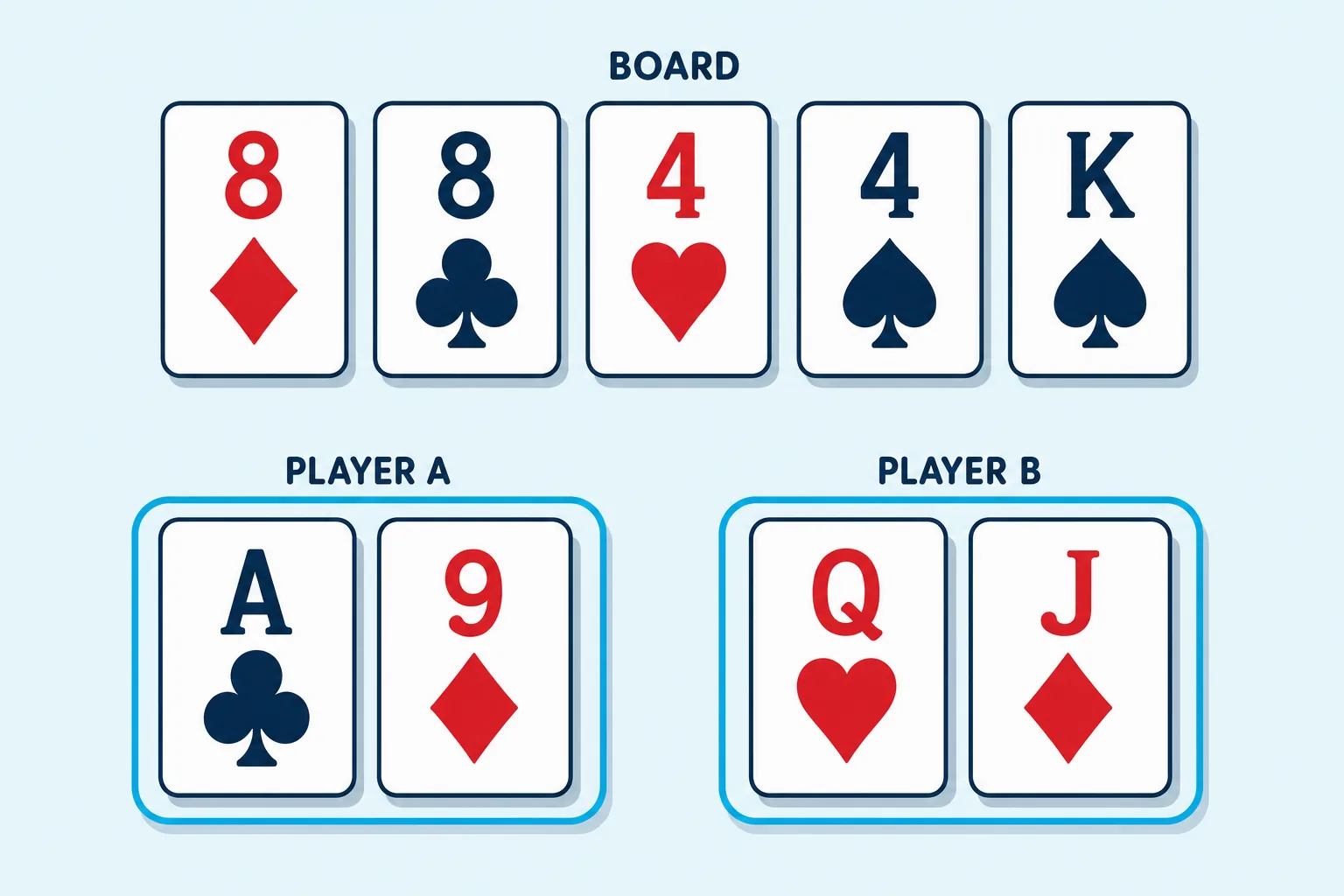
The board pairs twice, so both players already have two pair before their own cards do anything.
Show answer
Player A wins.
Both players play the board’s two pair, eights and fours, so the hand comes down to the fifth card. Player A’s ace outranks the king on the board and becomes the kicker. Player B’s queen and jack are both worse than that king, so B plays the board and loses by one card. More on how the fifth card gets chosen: the best five-card hand rule.
Question 2. Flush or full house: which one takes it?
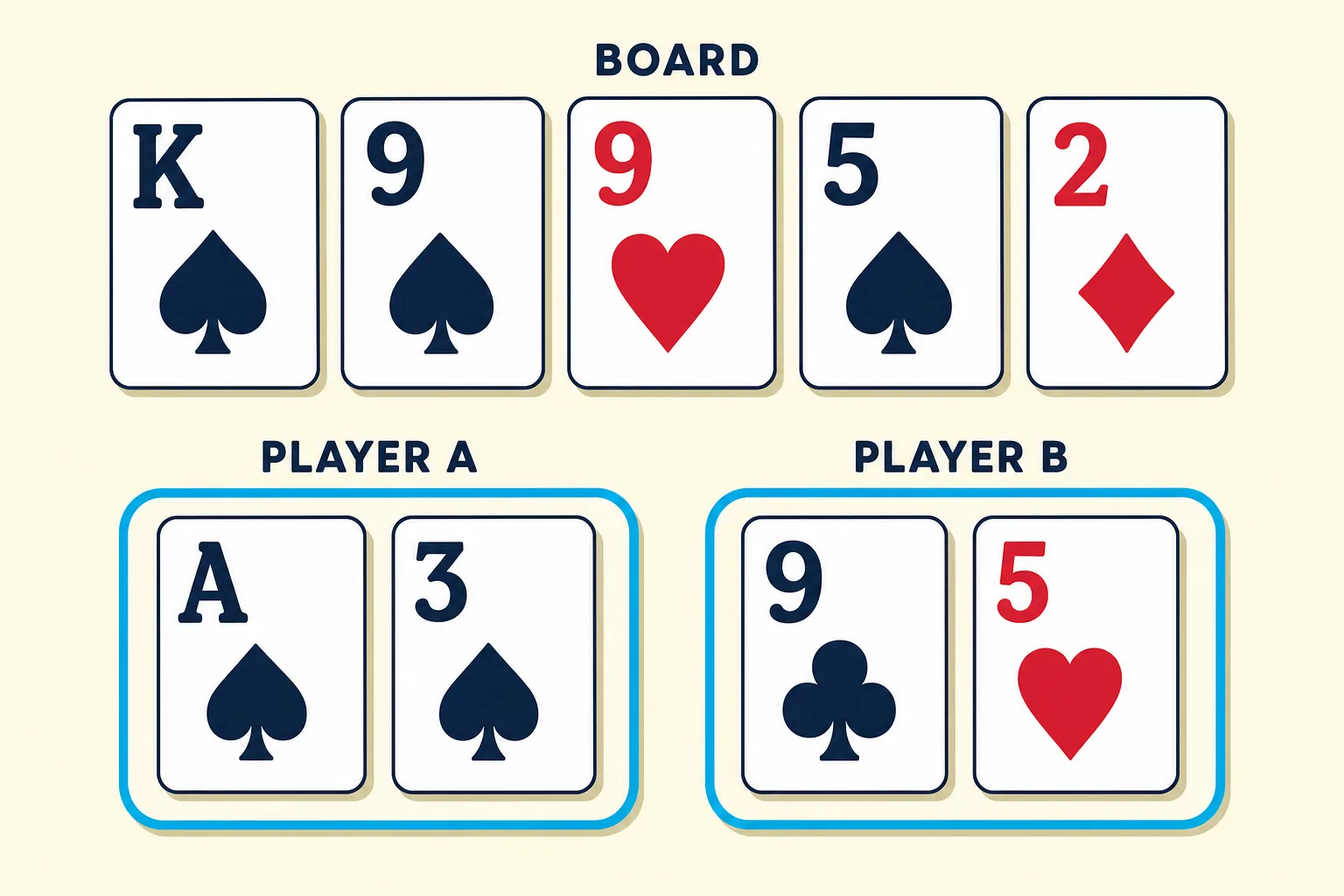
Player A has five spades. Player B’s two cards each hit the board.
Show answer
Player B wins with nines full of fives.
A full house outranks a flush every time, and the ace inside a flush changes nothing about that order. Player B makes 9-9-9-5-5 using both hole cards. Player A’s A-K-9-5-3 of spades is the second-best hand at the table. The full order lives on what beats what in poker.
Question 3. Both players made a straight. Who wins?
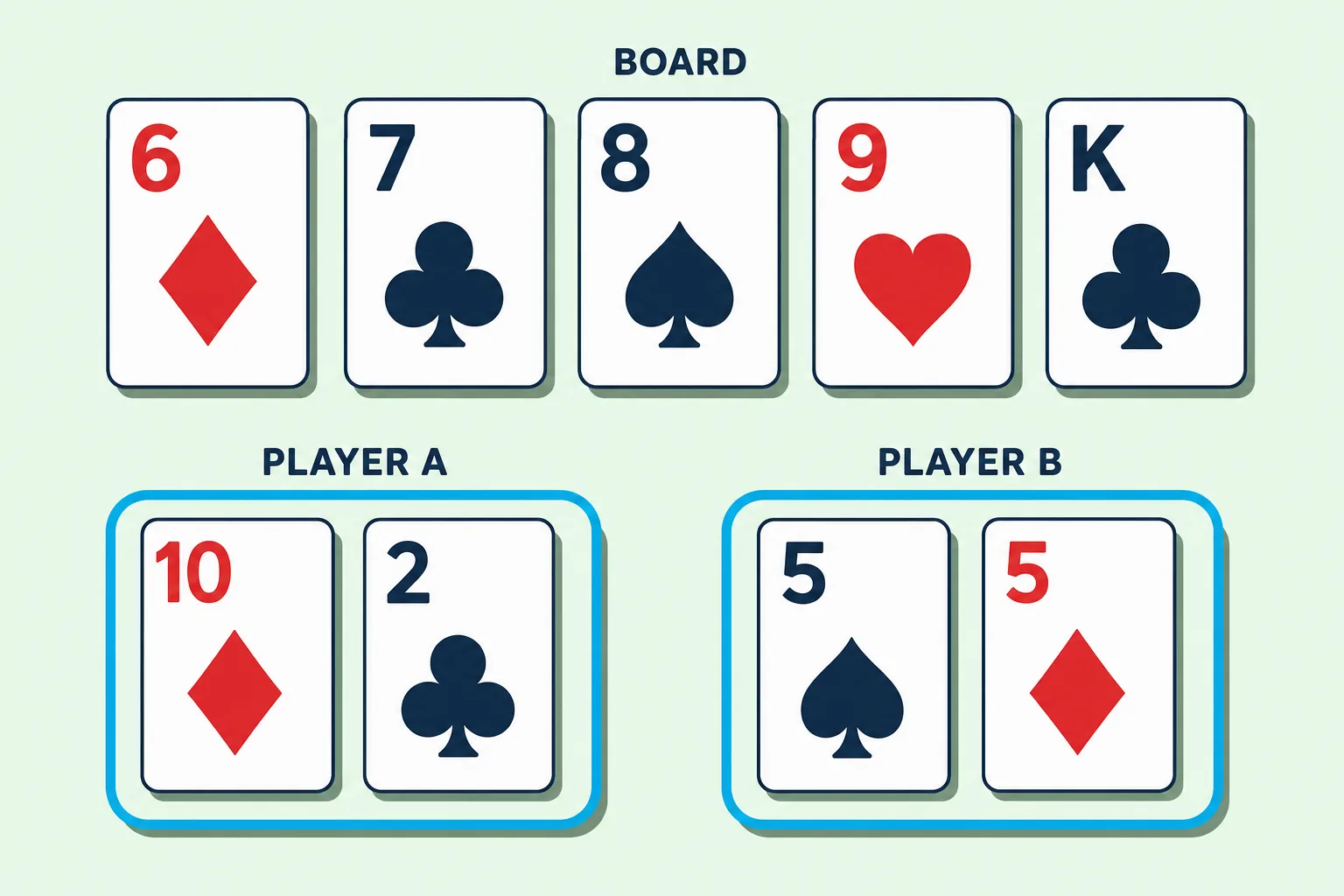
The board already holds four cards to a straight, so each player only needs one card from their hand to finish it.
Show answer
Player A wins with the ten-high straight.
Straights are compared by their top card, not by how many board cards they borrow. Player A makes 10-9-8-7-6 and Player B makes 9-8-7-6-5, so A is one rank higher and takes the whole pot. Pocket fives losing to a lone ten is the normal shape of a four-straight board. Ranking order and tie-breaks: the poker hand rankings chart.
Questions 4 to 6: Pot odds and outs
Three questions about price. Counting your outs is half the job, and the other half is what the bet is charging you.
Question 4. How many cards make your straight?
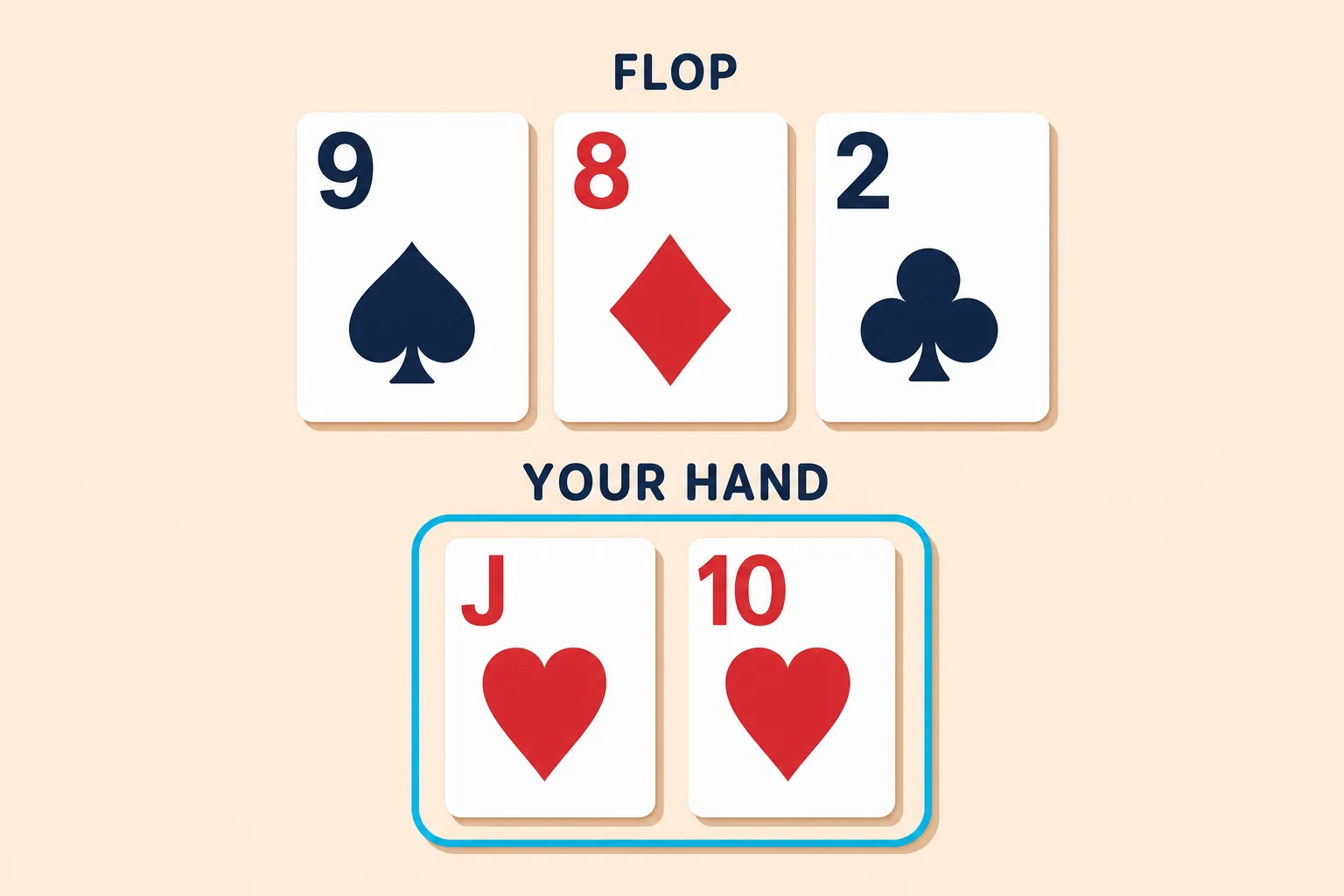
Count only the cards that finish the straight. Pairing the jack or the ten does not count here.
Show answer
Eight.
Any queen gives you Q-J-10-9-8 and any seven gives you J-10-9-8-7. Four queens plus four sevens is eight cards, which is the standard count for an open-ended straight draw. Nothing on this flop kills one of them, so all eight are clean. Practice separating clean from dirty: counting outs, clean vs dirty.
Question 5. What does that bet need you to win?
There is $60 in the pot on the river. Your opponent bets $30, so you are being asked to call $30. Ignore the cards for a moment: this question is only about the price.
Show answer
About 25 percent of the time.
You risk $30 to win the $90 already out there, which is 3 to 1. Break-even is your call divided by the pot once your call is in it: 30 divided by 120 is 25 percent. A half-pot bet always asks for 25 percent, a pot-sized bet asks for 33 percent, and knowing those two by heart settles most river spots. Worked examples: how to calculate pot odds.
Question 6. Call or fold on the turn?
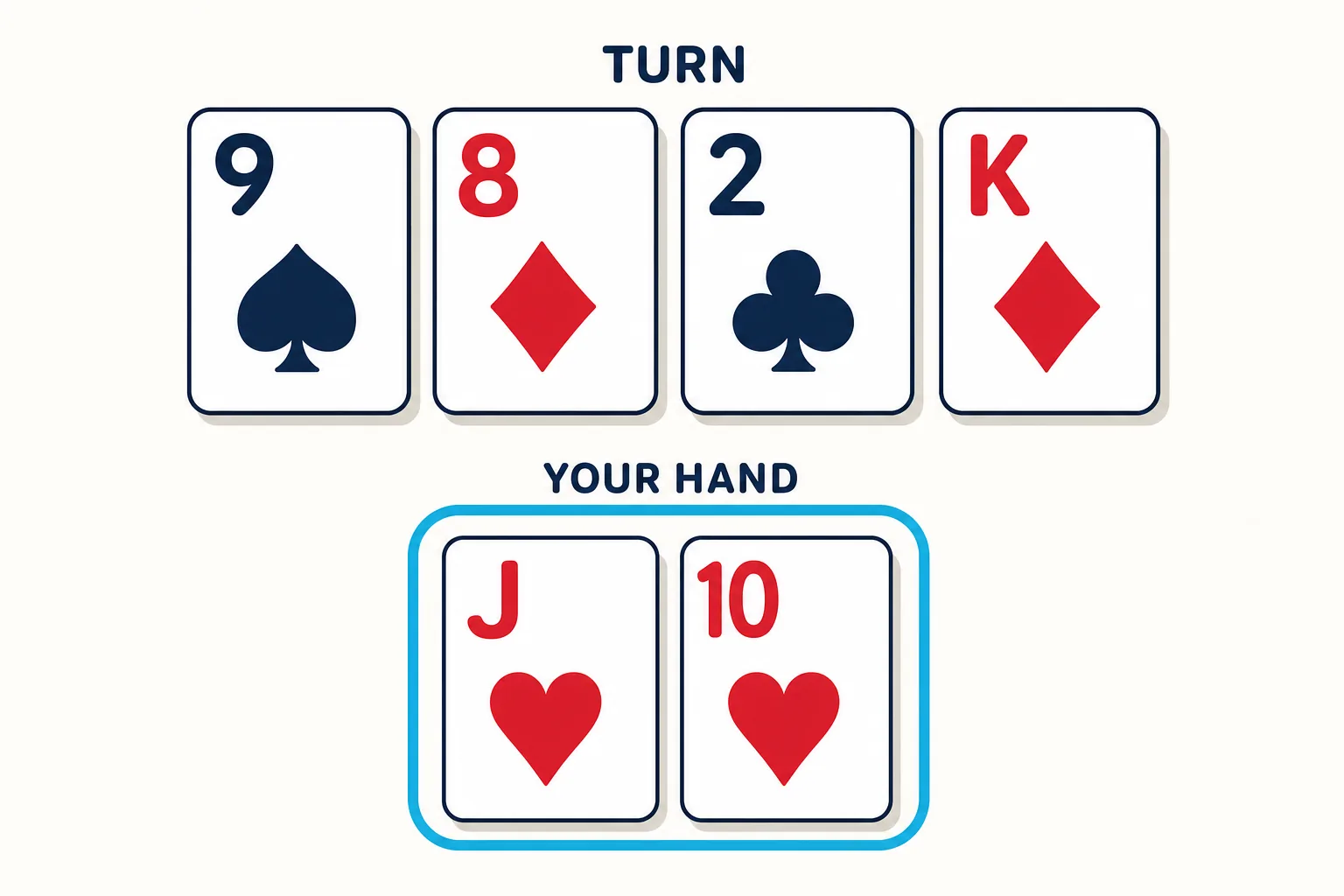
There is $100 in the pot and your opponent moves all in for their last $20. One card to come, no more betting after this. Say you win when the straight arrives and lose when it does not.
Show answer
Call.
Calling $20 into a pot that will hold $140 needs to be right about 14 percent of the time. Your eight outs are worth roughly 16 percent with one card to come using the rule of 2, and a shade over 17 percent exactly. Being behind is what a draw always is: the price is what decides it, and this price is cheap. The shortcut in full: the rule of 2 and 4.
Questions 7 and 8: Position
Two questions about who speaks when, because that order is fixed before anyone looks at a card.
Question 7. Who acts first after the flop?
Six-handed. You raise from the cutoff, the button calls, and both blinds fold. Two players see the flop.
Show answer
You act first on the flop, the turn and the river.
The button acts last on every betting round after the flop, and that order does not reset street to street. Raising from the cutoff wins you the pot uncontested plenty of times, but when the button calls you are speaking first for the rest of the hand. Late position is about the seat, not about who raised. Every seat and its order: poker positions explained.
Question 8. Same hand, two seats. Where is it worth more?
You are dealt 8♠ 8♥. In one hand you are under the gun at a nine-handed table. In another you are on the button. Same cards, same stakes.
Show answer
On the button.
On the button you watch everyone else act before every postflop decision you make, so you fold cheaply when the pot turns dangerous and bet when it does not. Under the gun you commit first before the flop with eight players still to speak, and you stay early on every street after. Same cards, different price on every mistake. The seat-by-seat breakdown: poker positions explained.
Questions 9 and 10: Preflop decisions
Two hands before the flop. Both are answerable from the action in front of you, with no chart to recall.
Question 9. Folded to you on the button. What now?
Six-handed, 100 big blinds deep. Everyone folds to you on the button and you look down at A♦ 7♦. Only the two blinds are left behind you.
Show answer
Raise.
First into the pot, the choice is raise or fold, and the button is the seat that opens widest. Raising can win the blinds now, and when you get called you have position for the rest of the hand. Limping gives up both of those and tells observant players exactly what kind of hand you hold. What opening ranges look like: poker ranges explained.
Question 10. Three limpers, and you look down at aces.
Nine-handed, blinds $1 and $2. Three players limp for $2 each and the action reaches you in the big blind holding A♠ A♦. You can check and see a flop for free, or raise.
Show answer
Raise.
Aces are at their best heads-up and lose value against every extra player who sees a flop, because one pair holds up less often as the field grows. Raising narrows that field and builds the pot while you hold the best hand. Slowplaying aces in a four-way limped pot is how a monster turns into a guessing game on the turn. Preflop hand selection in context: poker ranges explained.
Score yourself
One point per question, no partial credit. The bands below are honest about what a score means and each one names a single next step.
| Score | What it means | Next step |
|---|---|---|
| 0 to 4 | The fundamentals are still forming. That is a normal score for someone who has played a few home games and never studied. | Start with hand rankings until reading a showdown is instant. Hand rankings chart |
| 5 to 7 | You know the game and lose points on the math or the seat. That gap is the cheapest one on this page to close. | Drill the price questions until 25 and 33 percent are automatic. How to calculate pot odds |
| 8 to 10 | Your fundamentals are solid. The gap left is holding on to them at the table with money in front of you, which no quiz can measure. | Move to timed decisions with feedback on every hand. The 15-minute daily routine |
Whatever you scored, the fastest way to move up a band is short daily reps in the app. Free forever, no wagering.
Now look at where the misses clustered, because that tells you more than the total does. Rankings misses (questions 1 to 3) send you to the what beats what order. Price misses (4 to 6) send you to pot odds. Seat misses (7 and 8) send you to position. Preflop misses (9 and 10) send you to opening ranges. Fix one area at a time and retake this page in a week.
Keep testing yourself
Ten questions is one sitting. What actually moves fundamentals is the same loop repeated: face a spot, commit to an action, find out immediately whether it held up and why. That is what the daily puzzles in the Poker Skill app do, with a short explanation attached to every hand you play.
This page needs none of that to be useful. Answer, read the reveals, take the next step your band names, and come back when you want to see whether the misses moved.
Poker quiz FAQ
Is this poker quiz free?
Yes. There is no signup, no email, and no account. Every question, answer, and explanation is on this page, and nothing you do here is submitted anywhere.
What should I study if I scored low?
Study the section you missed rather than the total. Questions 1 to 3 point at hand rankings, 4 to 6 at pot odds and outs, 7 and 8 at position, and 9 and 10 at preflop hand selection. Each section links its own page above.
Where can I get harder questions?
These ten stay at fundamentals level on purpose, so a beginner can finish the page. Harder spots have to arrive at the right moment for the player answering them, which is the job the daily puzzles in the Poker Skill app do.