
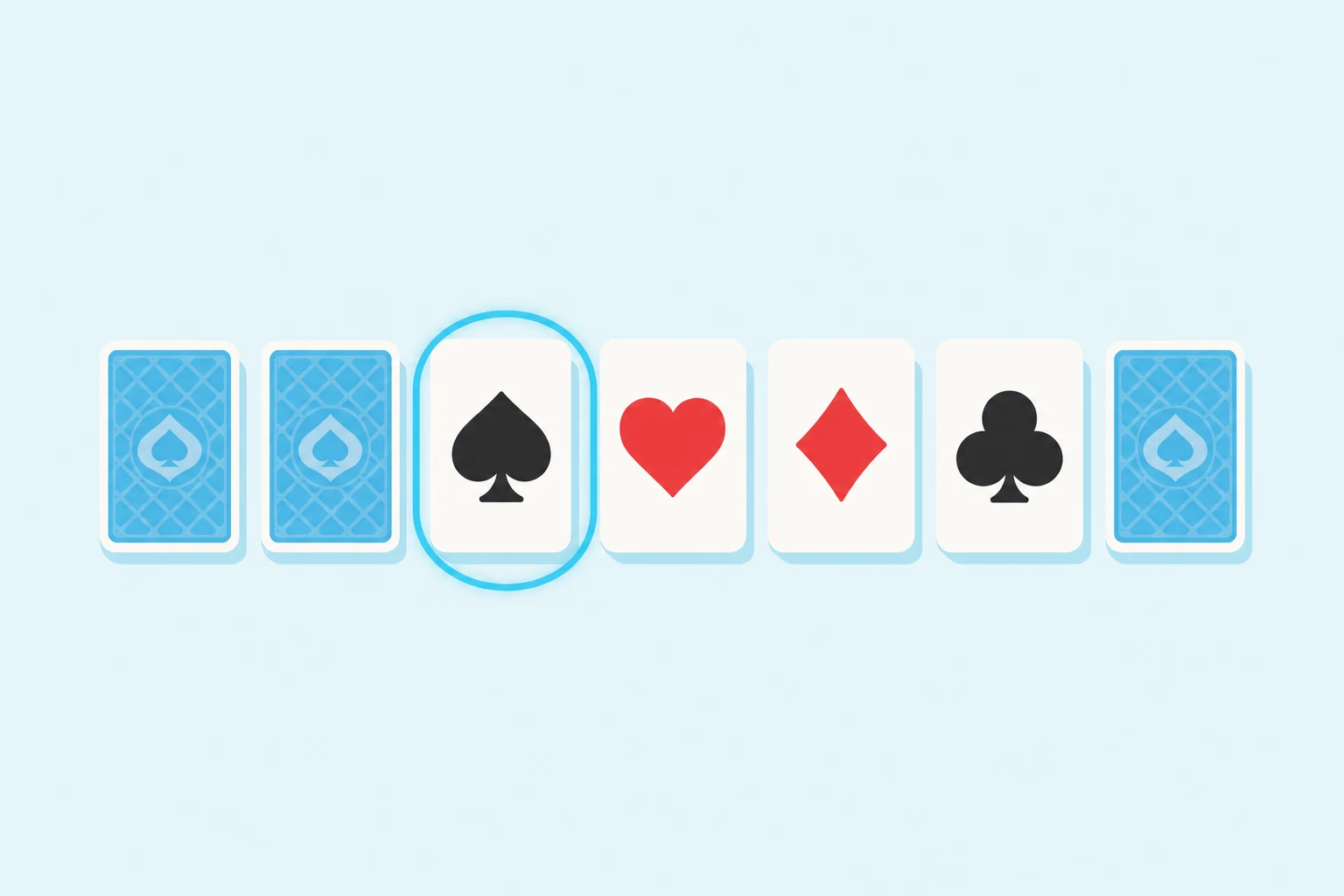
Seven card stud is a poker game with no community cards: each player is dealt seven cards of their own, three face down and four face up, and the best five-card hand from those seven wins the pot at showdown. There is no flop and no button. Everybody pays an ante before the deal, and a forced bet called the bring-in starts the action on third street.
The hand rankings are the ones you already know, and showdown works the same way. What changes is the information: four of your opponents’ seven cards are lying face up in front of them, and there is no button to tell you when you act. The ante does the job the blinds do elsewhere.
The shortcut, in one line
Play hands that are live, watch the cards on the table, and remember that the four cards you can see are only ever half of what your opponent has.
Seven card stud at a glance
| Trait | Seven card stud | Texas Hold’em |
|---|---|---|
| Cards per player | 7 (3 face down, 4 face up) | 2 face down |
| Community cards | None | 5, shared |
| Hand construction | Best five of your own seven | Best five of two plus five shared |
| Forced bets | Ante from everyone, plus a bring-in on third street | Small blind and big blind |
| Betting rounds | One after each of the five streets | Four |
| Betting structure | Usually fixed limit, small bet then big bet | Usually no limit |
| Who opens the betting | The lowest card showing posts the bring-in on third street; on fourth street the high board acts first | The small blind, then the seat left of the button |
| Table size | Commonly up to eight players | Up to ten |
The rules in one read
A stud hand runs across five streets. The cards arrive one at a time after the first three, and a round of betting follows every one of them.
Two cards face down and one face up. The face-up card is your door card, and the lowest one at the table pays the bring-in to start the betting. Small bet.
One more card face up, and the player showing the high board acts first. Stud’s action order is driven by cards, not by a seat. Still the small bet.
One more face up, and the bet doubles. In a $10/$20 game the $10 street becomes the $20 street here, which is why most of the money decisions live on fifth.
One more face up. Every player still in shows four of their six cards, so you can name most of the hands still possible for each of them. Big bet.
The last card comes face down, so nobody sees it until the hand is over. Final round of betting at the big bet, then the best five of each player’s seven takes the pot.
The ante and the bring-in
Every player posts an ante before a card is dealt, so there is money to play for from the start. There are no blinds. Once the first three cards are out, the player showing the lowest card must open the betting with the bring-in, a forced bet smaller than a full bet.
The house structure sets both the ante and the bring-in, and the two move together.
| $10/$20 stud | Ante | Bring-in | Small bet | Big bet |
|---|---|---|---|---|
| Lighter structure | $1 | $2 | $10 | $20 |
| Heavier structure | $4 | $5 | $10 | $20 |
Both are published structures for the same stakes. A bigger ante pushes the low card harder into the pot without changing what a bet costs. The player with the low card can also choose to complete straight to the full small bet instead of bringing it in small. After that, each player in turn folds, calls, or completes.
Third street: two down, one up
The deal starts with three cards to each player: two face down and one face up. The face-up card is your door card, and it is the only thing the table knows about you. What the table reads is your door card, not your hand.
Fourth street
The board in front of each player is now two cards wide, so the first pairs and the first flush and straight shapes become visible to everyone. The high board acting first is the moment stud stops feeling like Hold’em: your place in the betting order is a fact about your cards, and it can change on every street.
Fifth street: the bet doubles
Another card face up, and this is where the money changes size. Third and fourth street are usually played for the small bet; from fifth street onward the big bet applies. In a $10/$20 stud game, that is $10 bets early and $20 bets from fifth street on. Everything you call on fifth, sixth and seventh street costs twice what the early streets cost, which is why fifth street is where most of the money decisions get made.
Sixth street
Four visible cards each, which means you can see four of the six cards every opponent holds and name most of the hands still possible for them. This is the street where the counting you have been doing since third pays for itself.
Seventh street and showdown
The last card comes face down, so nobody sees it until the hand is over. Seventh street carries the final round of betting, and if two or more players are still in after it, the hands are shown and the best five cards out of each player’s seven takes the pot. Stud uses the standard poker hand rankings unchanged, so a flush still beats a straight and a full house still beats a flush. The same order is on a printable chart.
What makes a starting hand strong
The whole hand starts with three cards, so the question on third street is simple: do these three cards work together, and are the cards I need still available?
Rolled up is the premium starting hand in stud. It is strong enough that the usual advice is to keep it quiet on third street from early position rather than raising and announcing it, then build the pot on later streets.
A big pair with a strong side card is the standard strong start after rolled up: aces with a nine or a ten alongside, or a middle pair with a small card that keeps your hand hidden.
Three cards to a flush or a straight is a drawing hand, and it is only playable while it is live, meaning the cards you need are not already showing in other players’ boards. The same draw with two of your suit already dead in front of you is not the same hand.
Buried pairs, where both cards of the pair are face down, are generally worth more than split pairs where one of them is your door card. The table cannot see what it cannot see, and the third worked example below deals the same four cards both ways so the difference is visible.
Worked examples
Pocket aces when two aces are already showing
Two black aces in the hole and a seven showing is a monster on paper. Look around the table first. If two other players are showing an ace as their door card, all four aces are accounted for: two in your hand, two on the table. Three aces is off the menu, so this hand has to win as one big pair, as two pair, or by filling up through your other cards.
Three suited connectors when the board is clean
Three suited connectors are a genuine stud starting hand: it can grow into a flush, a straight, or a pair that keeps improving. The value depends on what the table shows. If no hearts are out and the cards that finish your straight are live, the hand is worth playing. If four hearts are already exposed in other boards, the same three cards are much weaker, because the flush half of the hand has been taken away.
A split pair against a buried pair
Take the same four cards and deal them two ways.
In the first version, opponents can read a king into your bet and the ones who improve will price you accordingly. In the second, they cannot. That difference is why stud players value buried pairs.
The mistakes that cost new players
- Ignoring the up cards. Four of every player’s cards are face up by sixth street. A player who does not track them is playing stud with Hold’em information.
- Playing dead draws. A flush draw is only worth its price if your suit is live. Two of your suit sitting in other players’ boards changes the hand.
- Paying big bets with a hand that needed help. The bet doubles on fifth street, so a hand that was cheap to see through fourth street becomes expensive exactly when it needs to improve.
- Treating your door card as decoration. It is the one card everyone sees, and it shapes how your bets read all hand long.
- Bringing Hold’em starting hands. There is no board to hit, and the seat you sit in does not fix your place in the betting order the way a button does. The question is whether your three cards work together and whether the cards you need are still live.
Stud’s information game
Stud rewards memory in a way Hold’em cannot. Every card shown, and every up card that goes to the muck when its owner folds, is a card you can subtract from what is left, and by fifth street that changes real decisions. Cards that were face down when a player folded stay unknown, so the count is never perfect.
Two habits carry most of the value. First, count your outs against what is visible: a nine-out flush draw is not a nine-out draw when three of your suit are showing in other players’ boards. Second, watch which cards die. A player who folds with your straight card showing has just changed the value of your draw, and tracking that is what makes the expensive streets cheaper.
Check yourself: is this draw live?
You hold (J♣ 9♣) 8♣ on third street, three clubs and an open-ended straight shape. Around the table you can see four other door cards: the K♣, the 4♣, the Q♥ and the 2♠. Is the flush half of this hand worth paying for?
Show the answer
No. Two of your clubs are already sitting in other players’ boards, which takes two of your flush cards off the table before a single bet goes in. Thirteen clubs exist, you hold three and two more are showing, so eight are left in the deck. That is mistake number two on the list above: a flush draw is only worth its price if the suit is live, and this one is down to an eight-card suit. The straight half is untouched, and it is the reason this hand is still playable at all.
The other stud games, briefly
Five card stud is the shorter, older cousin: five cards per player, one down and the rest up, and no community cards. It is rare today outside dealer’s-choice home games.
Stud eight-or-better, also called stud hi-lo, uses the same deal and betting but splits the pot between the best high hand and the best qualifying low hand of five unpaired cards eight or lower. If nobody qualifies for low, the high hand takes everything.
Razz, the lowball stud game keeps the deal and the streets and inverts the goal: the lowest hand wins. Stud high, stud eight-or-better and Razz all appear in the HORSE rotation, the best known of the mixed games; five card stud does not.
A live-play pattern
Three reads, in this order, every time the action reaches you.
First, my three cards: do they make a hand together, or are they three unrelated cards that happen to be pretty?
Second, the table: which of the cards I need are already showing, and which door cards are strong enough to worry about?
Third, the price: is this a small-bet street or a big-bet street? A hand worth a call on fourth street is often not worth a call on fifth, and stud punishes players who do not notice the change.
Where this fits in your decision
Stud is a good place to practice hand reading, because the cards you are reading are sitting face up instead of being guessed at. Poker Skill’s winner drills turn every hand face up too and ask which five cards win, in Hold’em, the only game the app teaches. If you want the version where the lowest hand wins, read the Razz rules. If you want to see stud inside a rotation with four other games, the HORSE rotation puts stud high, stud eight-or-better, and Razz next to Hold’em and Omaha. And the hand rankings chart still settles every stud showdown.
Frequently asked questions
How do you deal seven card stud?
Every player antes, then the dealer gives each player two cards face down and one face up. That face-up card is the door card. Fourth, fifth and sixth street each add one more card face up, and seventh street is dealt face down. Each player ends with seven cards, three hidden and four visible, and makes their best five-card hand from them.
What is the bring-in in seven card stud?
A forced bet on third street from the player showing the lowest card. It replaces the blinds. The size scales with the ante: in a $10/$20 game with a $1 ante the low card brings it in for $2, and with a $4 ante the bring-in is $5. The next player can call that amount or complete to the full small bet.
When does the bet double in seven card stud?
On fifth street. Third and fourth street are played for the small bet, and from fifth street on the big bet applies. In a $10/$20 game that means $10 bets early, then $20 bets on fifth, sixth and seventh street.
Are there community cards in seven card stud?
No. There is no flop, no turn and no river shared by the table. Every card you use is dealt to you, which is why four of your seven cards sit face up where everyone can see them.
Is stud poker the same as seven card stud?
When somebody says stud without qualifying it, they usually mean seven card stud. The family also includes five card stud, stud eight-or-better, and Razz, which uses the same deal and betting but awards the pot to the lowest hand.