
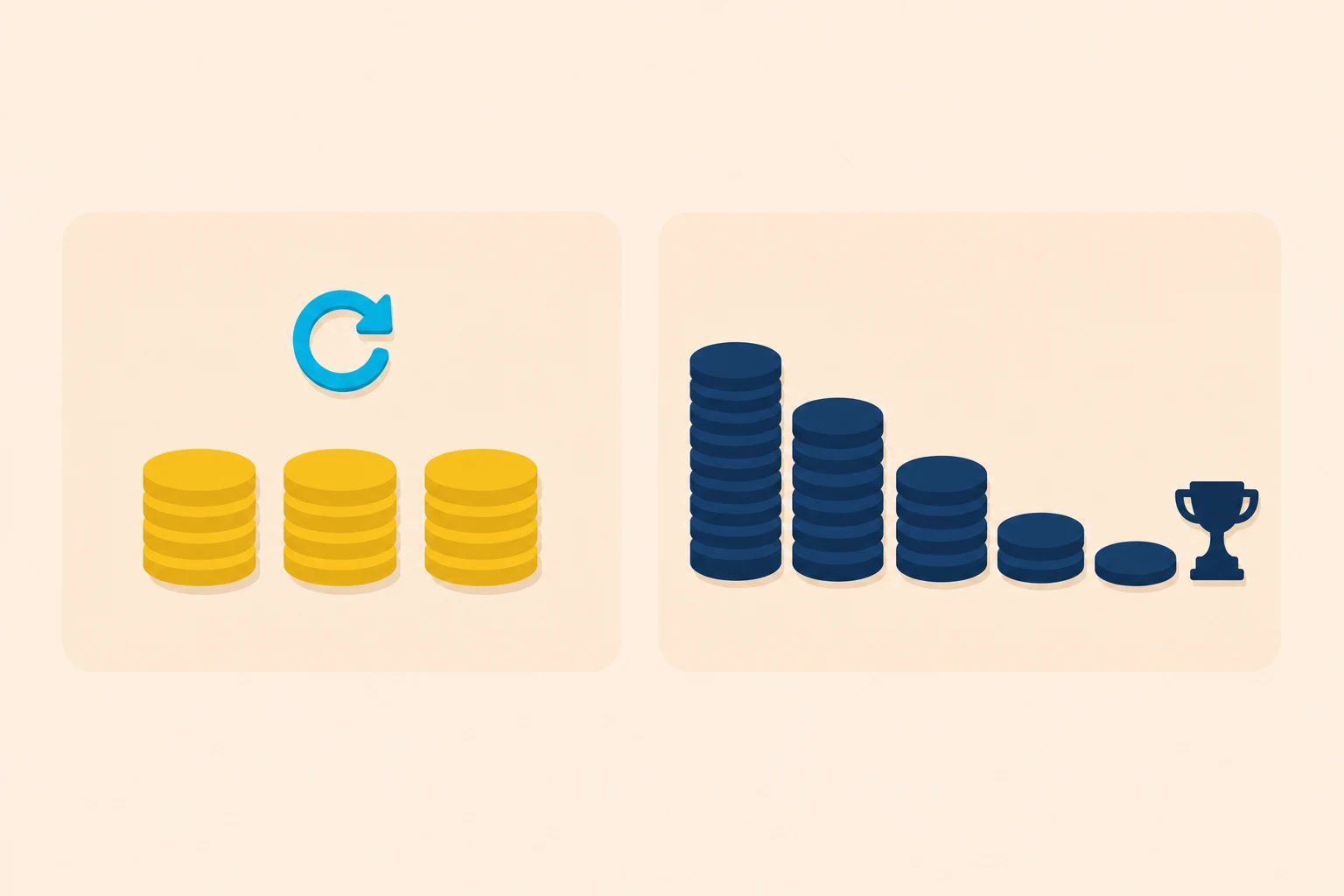
For a first format, cash games teach faster for most people, because the blinds stay put and the same decision comes back in a shape you recognise. If tournaments are what you actually want to play, start at a single table rather than in a field of 900.
The fundamentals you spend your first month on are the same either way, so this is a starting point rather than a verdict.
Cash games against tournaments, side by side
| Cash game | Tournament | |
|---|---|---|
| Stack depth | One setting, usually around 100 big blinds, and you can top back up | All of them, from deep to nearly out, in a single event |
| Blinds | Stay where they are | Rise on a timer, so the same two cards change value |
| Session length | Ends when you decide it ends | Ends when you bust or when it finishes, which can be five hours |
| Variance | Lower; a lost stack can be put straight back in front of you | Significantly higher; you finish in the money a small fraction of the time |
| When it ends | Your call | The structure’s call |
| What it teaches | One depth, very well, with the spots repeating | Every depth, plus short-stack play you cannot avoid |
Everything below is elaboration on that table. The strategy pages are the destination and this page is only the choice: cash game strategy and MTT strategy own the how, and neither of them cares which one you picked first.
Which one are you?
| If this is you | Start with | First stop |
|---|---|---|
| You play in short gaps, most days | Cash games | Cash game strategy |
| Your poker time is one planned evening a week | Tournaments, with the finish time checked first | MTT strategy |
| You want a known ceiling on the night | A single-table freezeout | Sit and go poker |
| You want the same decision to repeat until it clicks | Cash games | Cash game strategy |
| You do not know yet and want to start tonight | Cash games, because the spots repeat | The 30-day roadmap |
Every row is a starting point rather than a verdict. The fundamentals you spend your first month on are the same either way, which is why the last row is a real answer and not a dodge.
Self-check: twenty-five minutes tonight
You have one free block of about twenty-five minutes and you want to play, not study. Pick a format, then open the answer.
Show answer
A cash game. A cash session ends when you decide it ends, so twenty-five minutes is a complete session. A tournament ends when you bust or when it finishes, which can be five hours after you sat down, so it is not something you can start in a twenty-minute gap. This is the row of the table that decides the format for most people, and it has nothing to do with strategy.
And yes, studying is worth it at low buy-ins, which is the other question that keeps coming up. The players you meet there make large, repeatable errors, and large repeatable errors are the cheapest thing in poker to learn to punish. What changes with format is not whether study pays, it is what you have to study first.
The differences that matter for learning
Repetition, and how much of it you get
In a cash game the blinds stay where they are and you can top back up to the same stack, so most hands start you at a familiar depth and the same spot comes round again. Effective stacks still move with whoever is in the pot, but the range they move in is narrow. A tournament gives you a fixed starting stack and rising blinds, so the same two cards are a different decision in level two and level nine. Both formats give you recurring decisions. Cash gives you more of the same one.
Stack depth: one setting or all of them
Cash play clusters around one depth, and you get good at that depth. A tournament can take you from deep to nearly out in a single event, with the right play changing on the way down, though busting in level three skips that lesson entirely. The breadth is useful later. It is a lot to carry while you are still learning what beats what.
The depth you are at decides which chart is the right one to have open: the preflop opening ranges are the deep-stack reference, and the push-fold charts take over once a tournament has taken your stack under about 15 big blinds.
Variance, and what it does to your feedback
Poker books say tournaments swing significantly more than cash games, and the reason is structural. You finish in the money a small fraction of the time.
Losing a big pot late is also different: in a cash game you can put the same stack back in front of you, in a tournament you usually cannot. The learning cost is that results stop working as feedback. You can play a tournament well and go home with nothing for weeks. Variance covers the maths of that in full.
What it costs you in time
A cash session ends when you decide it ends. A tournament ends when you bust or when it finishes, which can be five hours after you sat down. If your poker time arrives in known blocks, that is fine. If it arrives in twenty-minute gaps, a tournament is not something you can start.
The case for starting with cash
Repeatable spots. This is the whole argument. You misplay a flopped flush draw at 100 big blinds on Tuesday, read about draws on Wednesday, and get a spot close enough to recognise on Thursday. That loop is the fastest study loop in poker, and a rising-blind structure does not offer it. Poker Skill’s lessons are built around it too: each one deals related cash-game hands on one theme and explains every answer.
You can leave whenever you want. That is tilt control built into the format. A bad twenty minutes does not have to become a bad night.
The money is countable at the end of the session. What you won or lost is in front of you the same night, which makes it easier to connect a decision to a cost. Be careful with that: one lost pot is not proof of a mistake, and you still have to look at the decision rather than the result. Tournament chips cannot be cashed out mid-event, so their value sits in the prize pool and the cost of an error is harder to see at the time.
Check your own week before you pick
Tick one of the first two and the format has mostly chosen itself.
The case for starting with tournaments
A loss you set in advance. In a freezeout, the entry fee is the worst case and you know it before the first hand. Check the format, because re-entry and rebuy events remove exactly that property. For a lot of new players a known ceiling is the difference between playing thoughtfully and playing scared, and playing scared teaches nothing.
Short-stack decisions arrive early. Survive a few levels and the rising blinds bring shallow stacks to you whether or not you went looking for them. Cash players can avoid that part of the game for years.
A schedule you can plan around. Registration times mean your poker fits into a calendar. That sounds small and it decides whether many people play at all.
The single-table middle path
Single-table tournaments are the compromise most learning players end up taking. They finish in about an hour instead of five, they still run you down the stack-depth ladder, and they end short-handed, which is a part of the game a big field only shows you if you last a long day. Books that teach tournament play often centre on the single-table online format, and treat the large multi-table field as the bigger, more complex environment you move up into rather than the place you start. Sit and go poker covers how that version runs.
Switching later is cheap
| Travels across untouched | Does not travel |
|---|---|
| Hand values and what beats what | What a chip is worth, once payouts start mattering |
| Reading a board and counting outs | Bet-sizing habits carried over without adjusting |
| Position, and what acting last is worth | How much you will risk with a marginal hand |
The parts that move across are the parts you learn first. What does not move across is what you do with that arithmetic. In a tournament the chips you are risking are worth more to you than the chips you stand to win once the payouts start mattering, so the same pot odds can point at a different decision. Books are direct about the danger: with similar stack sizes the two games are not that different, and players still go broke by carrying one format’s strategy into the other without adjusting. Switch whenever you like, and switch deliberately.
Frequently asked questions
Are tournaments easier than cash games?
No, and the difficulty sits in a different place. Entry-level tournament fields are often softer, which is the true part of the question, but the format then asks you to play well at stack depths you did not choose, under rising blinds, usually with no way to put the same stack back in front of you. A cash game asks you to play one depth very well against opponents who chose to sit there. Easier opponents and a harder structure do not add up to an easier game.
Do tournament skills transfer to cash?
Partly. Books put it two ways at once: with comparable stack sizes the two games are not that different, since you are still playing your range against theirs, and players still go broke by carrying one format's strategy into the other. Reading a board, hand values, position and counting outs move across untouched. What a chip is worth does not, and once payouts start mattering that changes which calls are worth making.
What stakes should a beginner start at?
The lowest one available, and lower than you think you need. The one piece of guidance the books are consistent about is the direction of travel: move down when your roll drops rather than keep playing a game you cannot sustain, and treat a tournament entry as a small slice of what you have rather than a large one. Poker Skill itself is play money, so this only matters when you go elsewhere. Start below the level you could afford, because early on you are paying for lessons rather than chasing a result.