
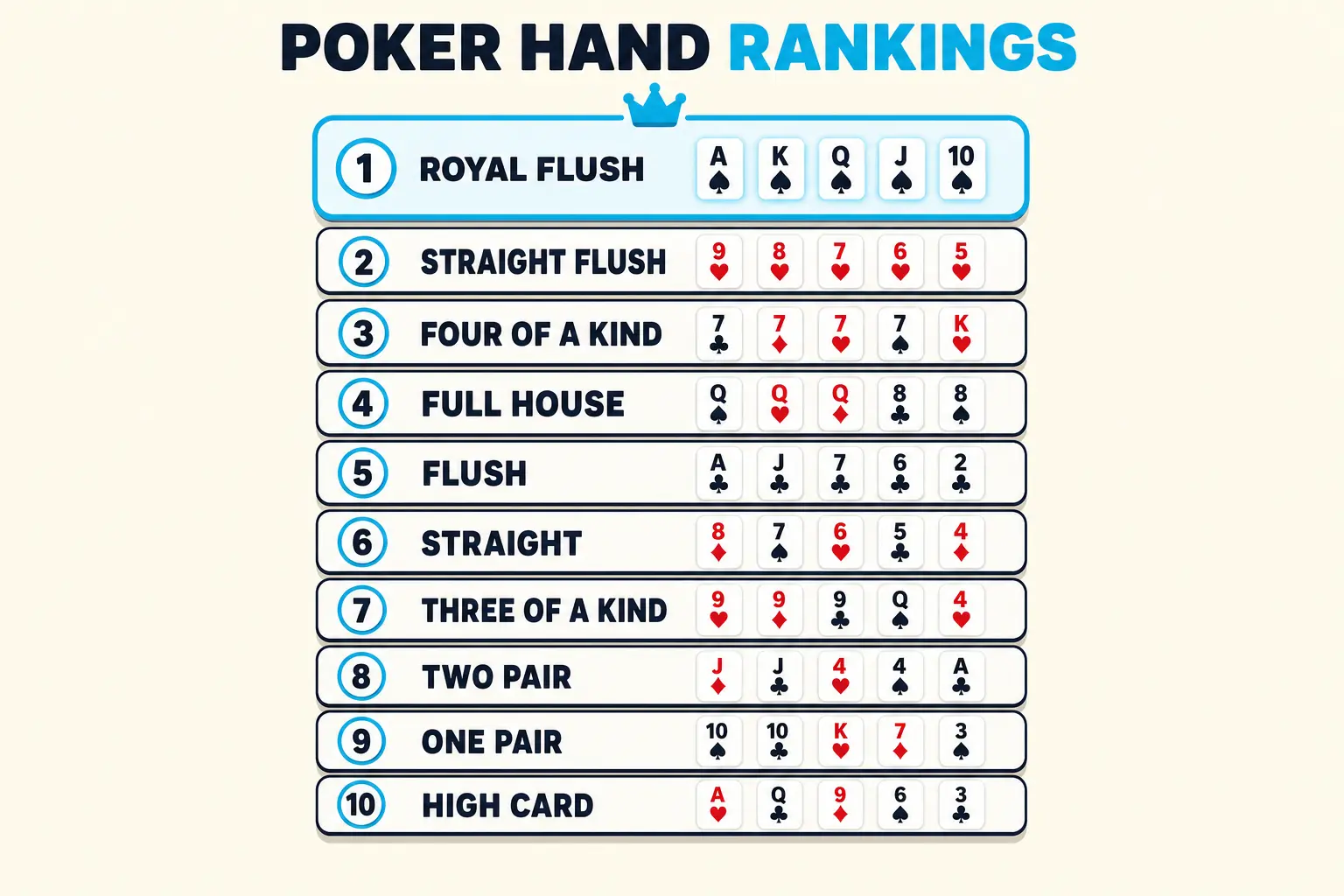
Get the chart: print it or save it
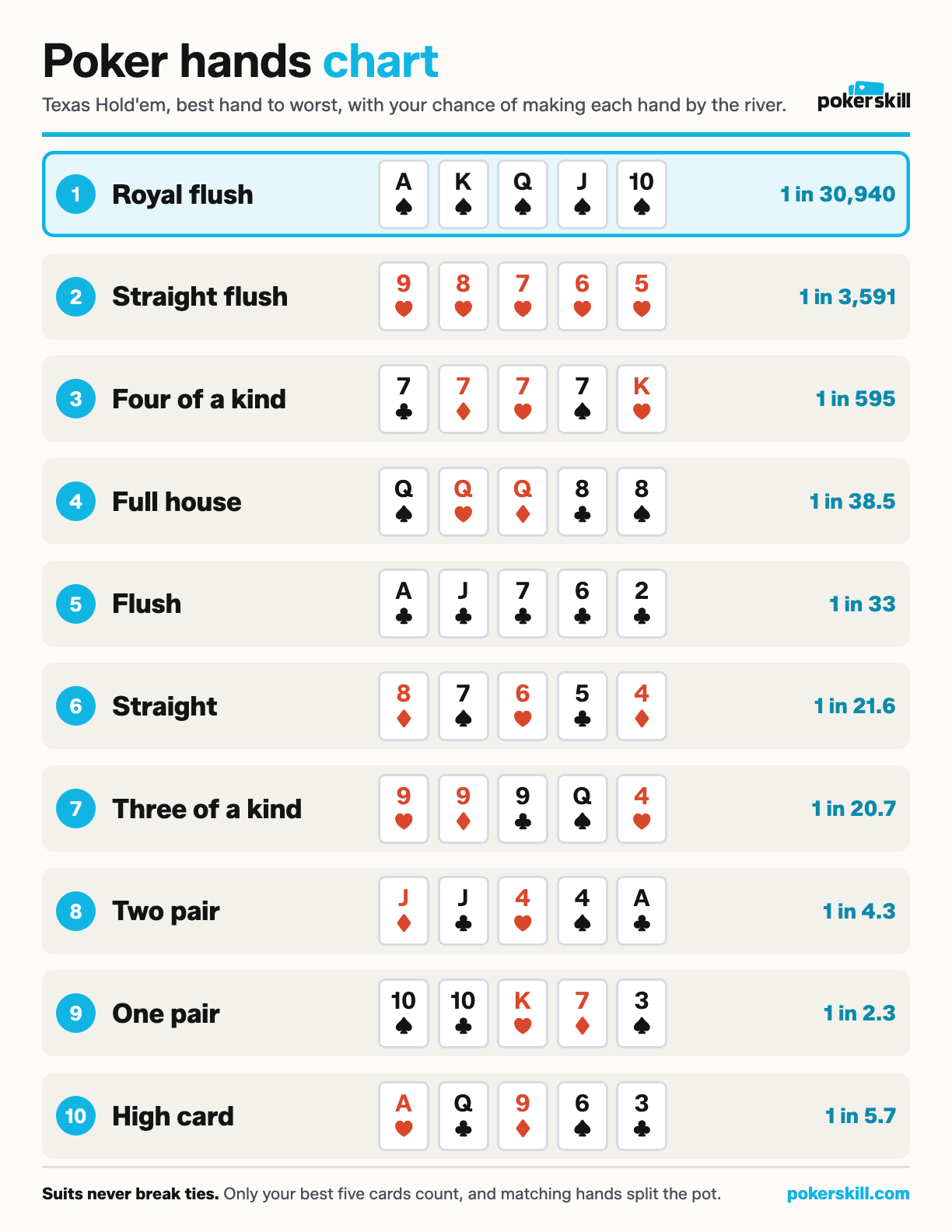
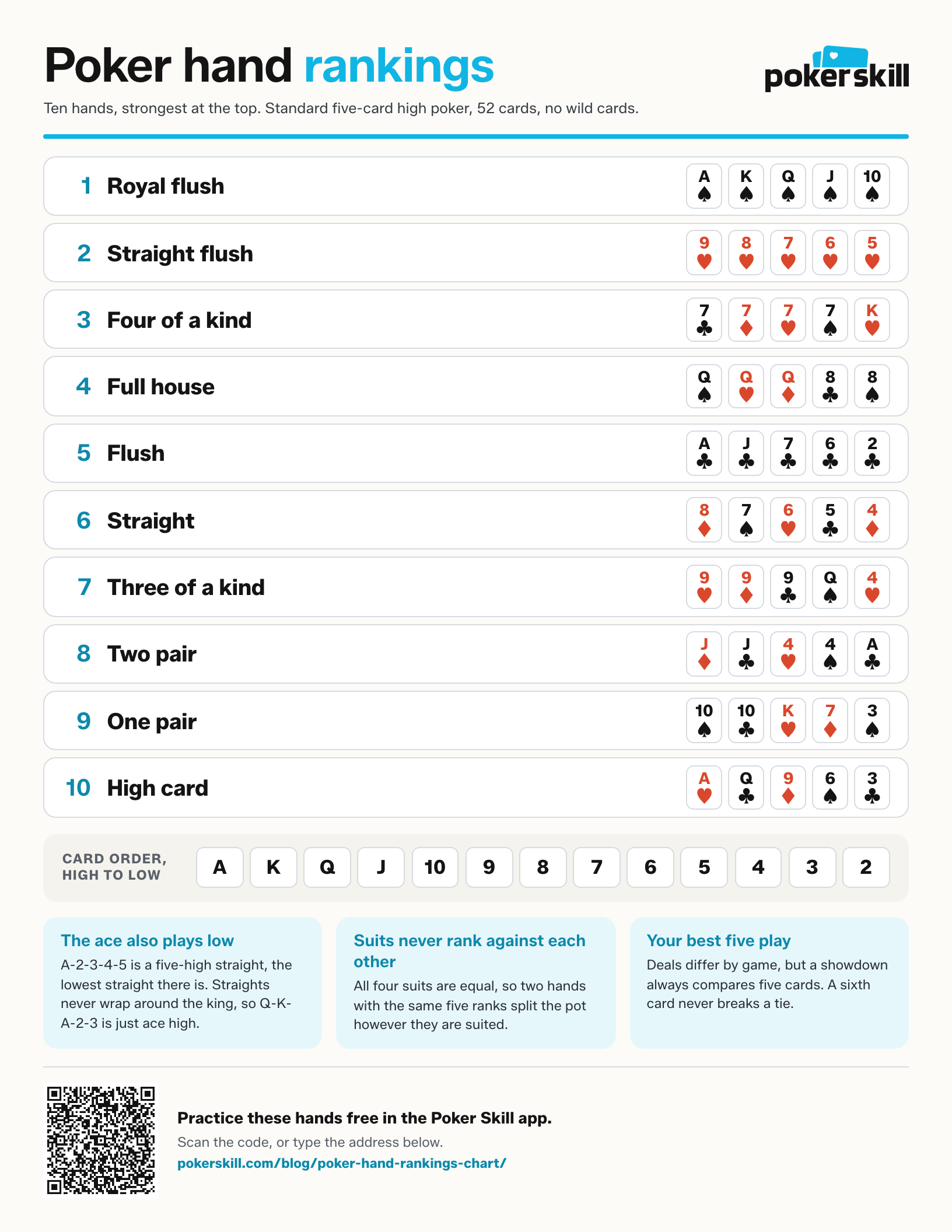
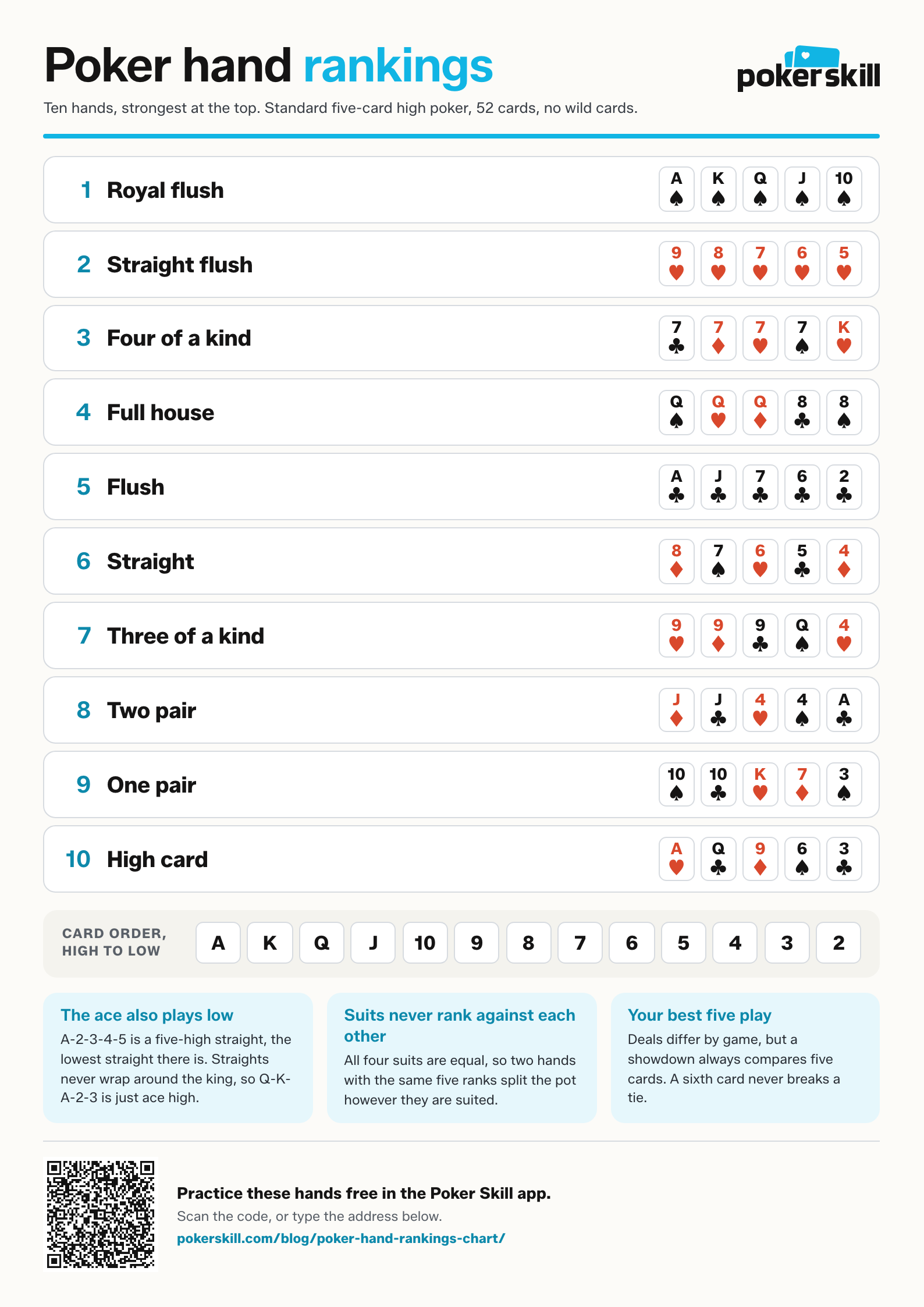
In Texas Hold’em, the ten hand categories rank from royal flush at the top down to high card at the bottom. This poker hands chart puts every one of them in order with example cards and the odds of finishing with each hand, and it prints on one page for the next home game where somebody asks whether a flush beats a straight.
Card ranks do all the deciding, because suits never break ties. The full probability table carries the exact numbers for both five-card deals and seven-card rivers.
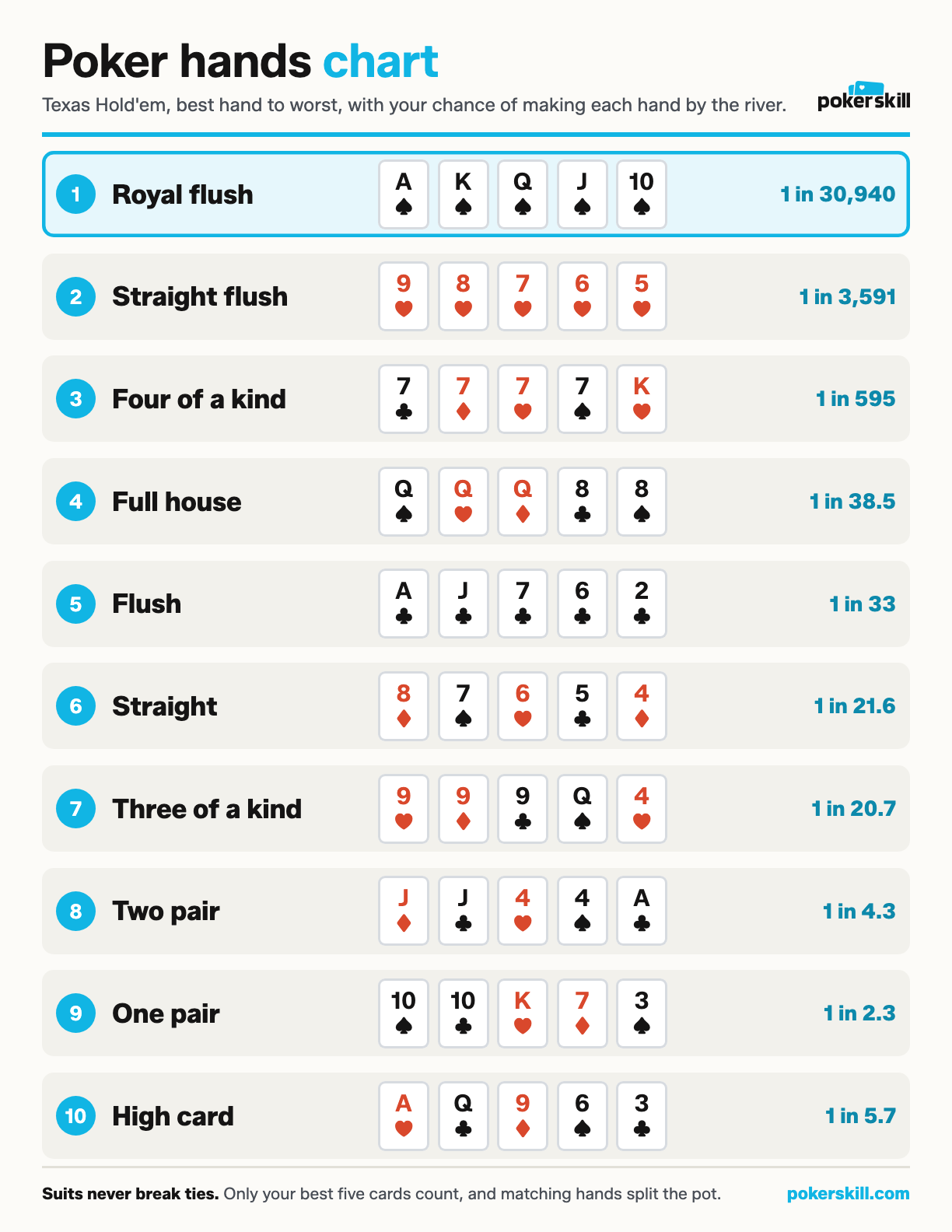
The odds column is the only difference between the two printable sheets: it counts how often a seven-card Hold’em deal finishes as each hand, so print the chart when those percentages help and the hand-order sheet when they do not. The poker cheat sheet adds the common draws, the seat order and pot odds. Poker hands ranked, in order takes the same ten hands one at a time.
The poker hand rankings chart
| # | Hand | Probability | About one in | What it is | Example |
|---|---|---|---|---|---|
| 1 | Royal flush | 0.0032% | 30,940 | A-K-Q-J-10, all the same suit | A♠ K♠ Q♠ J♠ 10♠ |
| 2 | Straight flush | 0.028% | 3,591 | Five consecutive cards, same suit | 9♥ 8♥ 7♥ 6♥ 5♥ |
| 3 | Four of a kind | 0.17% | 595 | Four cards of one rank, plus a kicker | 7♣ 7♦ 7♥ 7♠ K♥ |
| 4 | Full house | 2.6% | 38.5 | Three of a kind plus a pair | Q♠ Q♥ Q♦ 8♣ 8♠ |
| 5 | Flush | 3.0% | 33 | Five cards of one suit, not in sequence | A♣ J♣ 7♣ 6♣ 2♣ |
| 6 | Straight | 4.6% | 21.6 | Five consecutive cards, mixed suits | 8♦ 7♠ 6♥ 5♣ 4♦ |
| 7 | Three of a kind | 4.8% | 20.7 | Three cards of one rank, two unrelated | 9♥ 9♦ 9♣ Q♠ 4♥ |
| 8 | Two pair | 23.5% | 4.3 | Two of one rank, two of another, plus a kicker | J♦ J♣ 4♥ 4♠ A♣ |
| 9 | One pair | 43.8% | 2.3 | Two cards of one rank, three unrelated | 10♠ 10♣ K♥ 7♦ 3♠ |
| 10 | High card | 17.4% | 5.7 | No pair, no straight, no flush | A♥ Q♣ 9♦ 6♠ 3♣ |
Anything higher on the chart beats anything lower at showdown. A pair of aces, the strongest one-pair hand in the deck, loses to the weakest two-pair hand. A flush beats a straight even when the flush is two-three-four-six-eight of clubs and the straight is jack-high. Inside each category, tie-break rules decide who wins when both players land in the same row.
How to read the probabilities
The percentages are the chance that a random seven-card deal (your two hole cards plus the five community cards) finishes with that hand category at the top, and they sum to almost exactly 100% because every deal lands somewhere on the chart. They are not the rate at which a hand wins pots, because a hand that gets folded before showdown never wins one.
The ranking is a rule of the game and the column is a separate fact about seven cards: the order is the same in any standard high-poker game, while the percentages change with the deal. High card sits at the bottom of the chart and still turns up less often across seven cards than one pair or two pair, row 10 against rows 8 and 9.
Five cards come out of a 52-card deck 2,598,960 ways and seven cards come out 133,784,560 ways, which is the figure the column divides by. 41,584 of those seven-card deals contain a straight flush. The 4,324 royal ones are the one in 30,940 on the top row. The other 37,260 are the one in 3,591 on the row under it. The rest of the table, five-card deals included, is on poker hand probabilities.
The three rows in the middle of the chart sit closest together: straight, flush and full house are one row apart each and less than a factor of two apart in frequency. Each field below draws one hand’s “about one in” figure as dots, which puts the three at the same scale.
The two ends of the chart are too far apart to draw on the same scale. A royal flush is about one in 30,940 seven-card hands and one pair is about one in 2.3, so one pair turns up roughly thirteen thousand times as often.
How tie-breaks work at showdown
When two players land in the same hand category, the tie is broken card by card from the top down. Suits never break ties: a flush in spades and a flush in clubs of the same five ranks would split. A sixth card never breaks ties either, because only the best five count.
- Straight flush, straight, flush: highest card in the made hand wins. For flushes, if the top cards tie, compare the second card, then the third and so on.
- Four of a kind: higher quads win; if both players play the same quads off the board, the kicker decides.
- Full house: the rank of the three of a kind decides first. Aces full of twos beats kings full of queens.
- Three of a kind: higher trips wins; if the trips are identical, the two kickers decide in order.
- Two pair: higher pair, then the lower pair, then the kicker.
- One pair: the pair rank, then the three kickers in order.
- High card: highest card, then the next, all the way down to the fifth.
If after applying the rule the hands are still identical, the pot is split. That happens when the board supplies both best fives and no hole card separates them.
How does a kicker work in a tie?
A kicker is an unpaired card outside the made part of your hand. When two players have the same pair, two pair or three of a kind, the dealer compares the kickers in descending order until one player has a higher card. If every kicker matches, the pot is split.
Three showdowns, decided card by card
Both players make a straight; the higher card wins
Hero’s best five is J-10-9-8-7, a jack-high straight. Villain’s best five is 9-8-7-6-5, a nine-high straight. Both are straights, so the top card settles it, and Hero’s jack beats Villain’s nine.
Two pair, two pair, kicker decides
Both players make tens and fives. The board pairs the fives, and each player pairs the ten on the board with a ten in their hand. Their best fives are T-T-5-5-K and T-T-5-5-Q, the same two pair with a different fifth card, so Hero’s king takes the pot.
Playing the board, both players chop
Neither hole card improves the board, which already forms A-K-Q-J-10, Broadway, the highest possible straight. Each player’s best five is the board itself, so both are playing the board with identical hands and the pot splits.
You claim a chop by turning both hole cards face up. Announcing it does not count. Under standard cardroom rules a mucked hand is dead, and saying afterwards that you were playing the board does not bring it back, even though those cards would have chopped.
Check yourself: which kicker plays?
The board runs A♦ 9♠ 4♥ 4♣ 2♦. You hold A♣ 7♥. The player who called you down turns over A♥ 5♣. Who wins?
Show the answer
Nobody. The pot splits. You both make aces and fours, so the fifth card decides, and for both of you that card is the nine on the board, because only the best five count and a nine beats a seven and a five alike. Your best five is A-A-4-4-9 and so is theirs.
Cases the printed order does not settle
The ace is both the highest card and the lowest: A-K-Q-J-10 is the best straight, Broadway, and A-2-3-4-5 is a straight too, the wheel.
In the wheel the ace counts as the low card, so the hand tops out at the five. The two ways the ace plays are mutually exclusive on a single hand: the ace is high, or the ace is low, never both. That is why straights cannot wrap around the king, and why Q-K-A-2-3 plays as an ace-high hand.
Is A-2-3-4-5 a straight?
Yes, and it is called the wheel. The ace plays low, which makes the hand a five-high straight and the only Hold’em hand where the ace ranks below the two. It loses to a six-high straight, 6-5-4-3-2, and to every higher straight.
Three of a kind has two standard names, and which one you hold depends on where the pair sits. When your trips include both your hole cards as a pocket pair plus a third matching card on the board, the name is a set. When your trips use one hole card and a pair on the board, the name is trips. Both sit on row 7 of the chart. At the table they play differently: a pair in your hand is invisible, while a pair on the board puts trips in every player’s range, yours included.
At showdown the cards speak, so you cannot beat your own hand by misreading it. If you hold the nut flush and you say “I have a pair,” the dealer will read your cards correctly and award you the pot anyway. A declaration cannot win a hand you do not hold, so show both cards to claim the pot.
A live-play read in three steps
Everyone at the table sees the same cards, so read them first: three to a flush, three to a straight, a pair on the board, a four-flush, a four-straight.
Your two cards add to what the board already shows. The column on this page says how often each result arrives across seven cards: one pair 43.8%, two pair 23.5%, high card 17.4% and every hand from three of a kind up under 5%. Find the row on the chart your hand sits in, then ask whether the board allows anything higher.
The kicker matters only when a tie-break could reach your hand category. It settles the pot when two players hold the same pair, and it goes unread only when the board supplies both best fives.
Where this fits in your decision
The chart is the answer to “what beats what.” The best-five-card-hand rule settles which five of the seven cards you can see actually play. For how often a draw gets there, the rule of 2 and 4 turns outs into a percentage at the table.
What are the best starting hands in poker?
Pocket aces is the best starting hand, with kings, queens and ace-king behind it. How far past those you can open depends on your seat: in our free preflop charts the tightest 6-max seat, under the gun, still opens every pocket pair plus hands like A-J offsuit and A-T suited, and the button opens much wider. What is worth playing before the flop is a different question from what wins at showdown, and it belongs to preflop ranges.
Frequently asked questions
Is there a printable poker hands chart PDF?
Yes. The chart PDF at the top of this page holds the whole ranking on one sheet, and it prints in color or in black and white. Two more PDFs drop the odds column and print the same ten hands, one sized for Letter and one for A4. The same three sheets come as PNGs, which open on a phone without a PDF reader. All six files are free and none of them asks for an email address.
What are the poker hands in order?
Royal flush, straight flush, four of a kind, full house, flush, straight, three of a kind, two pair, one pair, high card. The poker hand rankings page takes that order one hand at a time.
What is the best hand in poker?
The royal flush: A-K-Q-J-10 of one suit. It is the top straight flush and nothing beats it. The only way to share one is when the board itself makes it and the pot chops. It arrives about once every 30,940 seven-card hands.
Does a flush beat a straight?
Yes, every time. The flush sits one row above the straight, so the weakest flush beats the best straight. It is the rarer hand across seven cards too, 3.0% against 4.6%.
Does a full house beat a flush?
Yes. The full house ranks a row above the flush, and across seven cards it is the rarer of the two, 2.6% against 3.0%. They meet at showdown when the board both pairs and shows three of a suit. Two cards of that suit make the flush. The boat needs a pocket pair that matches an unpaired board rank, or the case card of the paired rank plus a second card that pairs another board rank.