
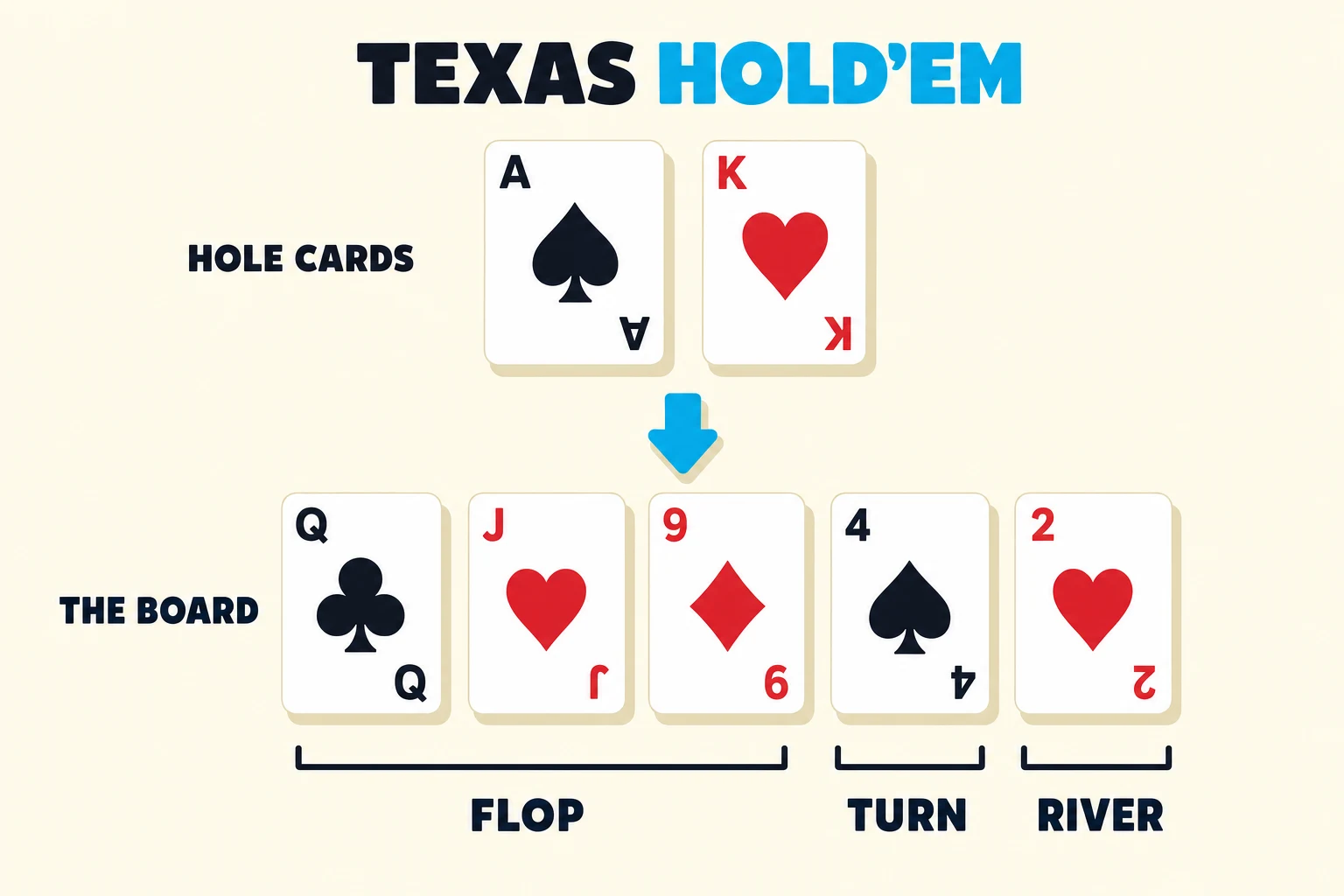
The rules of Texas Hold’em are short: every player gets two private cards, five shared cards land face up in the middle, each player makes the best five-card hand from those seven and the best hand at showdown wins the pot.
A hand plays out across four betting rounds: preflop, flop, turn and river. The dealer button rotates clockwise afterwards so the forced bets and the action order stay fair.
The rules below are the no-limit rules, and they are the same at a home table, in a cardroom and in the Poker Skill practice app.
The parts of a Hold’em game
| What | Texas Hold’em |
|---|---|
| Players at one table | Up to ten |
| Your private cards | 2 hole cards, face down |
| Shared cards | 5 community cards: flop 3, turn 1, river 1 |
| Betting rounds | 4: preflop, flop, turn, river |
| Forced bets | Small blind and big blind, left of the button |
| Your final hand | Best 5 cards from your 2 plus the board’s 5 |
| Betting structure | No-limit: bet anything up to your whole stack |
A small puck called the button marks the nominal dealer. In a cardroom a professional dealer handles the cards, but the button still decides whose turn it is to act. Before any card is dealt, the seat one to the left of the button posts the small blind and the next seat left posts the big blind. The big blind is usually twice the small blind, and the game takes its name from the two amounts: a “$1/$2 game” has a $1 small blind and a $2 big blind.
Your two hole cards are dealt face down and belong to you alone. The five community cards arrive face up across the four betting rounds, and every player at the table builds a hand from them.
How many players can play Texas Hold’em at one table?
A Hold’em table is dealt for between two and ten players. Heads-up is two-handed, “6-max” is six players and a “full ring” is nine or ten. Every size deals two cards to each player and runs the same four betting rounds.
Heads-up: the two-player exception
The button posts the small blind and acts first before the flop, then acts last on the flop, the turn and the river. The other player posts the big blind and takes the first card of the deal. In a $1/$2 heads-up hand the button puts in $1 and the big blind puts in $2. If the button calls the extra $1 the pot is $4, and the big blind can check or raise. The smallest raise makes it $4 to go.
The six-handed hand below runs on the ordinary order instead. The two-player game has its own guide, heads-up poker.
One hand, start to finish
This is a $1/$2 no-limit hand with six players, from the first forced bet to the pot being pushed. You are on the button. A full hand with a self-check puts a question at each decision.

The player to your left posts the $1 small blind and the player to their left posts the $2 big blind. Nobody else puts in a chip yet.
Every player gets two cards face down, one at a time, clockwise. You look down at the ace and queen of diamonds.
Action starts to the left of the big blind. Two players fold, the cutoff folds and it is on you. You raise to $7, the small blind folds and the big blind calls $5 more to match your $7.
The dealer burns one card face down, then turns three face up. You have top pair with an ace kicker. The big blind checks, you bet $8 and the big blind calls.
Burn again, then one more card. The big blind checks and you check behind, so the round ends with no chips added.
Burn, then the last card. Read it before you act: no flush is possible, because no three cards of one suit are showing, but a straight is, since 5-3-2 on the board means anyone holding A-4 or 6-4 has made one. The big blind bets $10 and you call.
The big blind made the last bet on the river, so the big blind shows first: a pair of queens with a nine kicker. You table the ace and queen of diamonds. Same pair, and your ace beats their nine as the next card. The dealer pushes the $51 pot to you.
The button moves one seat to the left, the blinds move with it and the next hand deals the same way.
That hand had no re-raise in it. Your preflop raise to $7 was a $5 raise on top of the $2 big blind, so the smallest legal re-raise would have been another $5 on top, making it $12 to go. You could then fold, call the extra $5 or raise again by at least the size of their raise. The round keeps going around the table until every player still in has called the last bet or raise or is all in, or until everyone else folds. The dealer turns the next card after that.
The four betting rounds
A single hand moves through four streets:
| Round | Cards dealt | First to act |
|---|---|---|
| Preflop | Two hole cards each, no community cards yet | The player left of the big blind |
| Flop | Three community cards face up | The first remaining player left of the button |
| Turn | One more community card, four total | Same: first player left of the button |
| River | One final community card, five total | Same: first player left of the button |
Preflop is the only round where the player left of the big blind acts first. The blinds have already paid in, so the action skips them and starts with the next live seat. From the flop on, the order resets and the button acts last. The seat names, from under the gun to the cutoff, are in the guide to poker positions.
The five actions on your turn
When the action gets to you, only five moves are legal. Which ones are available depends on whether anyone has already bet on this street.
Raising has one exception: an all-in smaller than a full raise.
Can I raise after a player checks?
Not on the same action. A check passes the turn without a bet, so there is nothing to raise yet. Someone else can bet, and players who already checked can fold, call or raise when the action returns.
What makes Texas Hold’em “no-limit”
In no-limit Hold’em, on your turn you can bet or raise any amount up to your whole stack. Nothing caps the top of that range. Two minimums set the floor:
- Minimum bet: the size of the big blind. In a $1/$2 game, the smallest legal bet on any street is $2.
- Minimum raise: the amount you raise by must be at least the last full bet or raise on that street. If the player before you bet $10, your raise has to make the new total at least $20. If someone then re-raises to $50 (a $30 raise on top of your $20), the next raise has to add at least another $30, making the new total at least $80.
A player can go all-in, pushing their whole stack in whenever a bet, raise or call would otherwise be legal. “Table stakes” means you only play with the chips you started the hand with. You cannot reach into your wallet mid-hand or pull chips off the table mid-session.
When an all-in is smaller than a full raise
An all-in smaller than a full raise decides who is allowed to raise next. Say the blinds are $1/$2, A raises to $6, B calls the $6, C moves all-in for $8 and everyone else folds. A now faces $2 more and can call or fold. That $2 is short of the last full raise, which was the $4 A put in on top of the big blind, so it does not reopen the betting for A. Had C made it $10 instead, A would be facing a full $4 increase and could raise again.
Blinds, stakes and betting structures
The two blinds set the smallest legal bet, the smallest raise and the size a full stack is measured against. Some games add an ante, a small forced bet from every player or from the button, on top of the blinds.
Hold’em is dealt in three betting structures. Only the size of the bets changes: the deal, the action order and the hand rankings are the same in all three.
Building your best five from seven cards
At showdown, your hand is the best five-card poker hand you can build from your two hole cards plus the five community cards. You may use both hole cards, just one or neither. A pair of fours beats a high-card hand however high its cards run. The best-five rule works through every combination with examples.
Only the ten plays from your hand. The three of clubs sits out.
You cannot make a flush unless three cards of one suit are showing, or a straight unless the board holds three cards from a five-card run.
Which hands win: the ranking order
Every Hold’em hand falls into one of ten classes, and a higher class always beats a lower one.
A flush beats a straight, and a full house beats a flush. When two players hold the same class, the higher cards inside it decide. The kicker breaks what is left. For the full list with the odds of making each one, see the full poker hand rankings chart or print the poker cheat sheet.
How the pot is awarded at showdown
If two or more players are still live after the river bet, the hand goes to showdown. The last player to bet or raise on the river shows their cards first; if no one bet the river, the first remaining player left of the button shows first. After that, the action moves clockwise. A player whose hand cannot beat the cards already on the table can muck by tossing their cards face-down, and a mucked hand is dead even if it would have won.
If two players land on the exact same five-card hand, the pot splits evenly. Suits never break ties.
If a player goes all-in for less than the current bet and other players have chips behind, the dealer creates a side pot. The all-in player stays eligible for the pot they matched, capped at that stack amount from every player still in. Nobody asks them to match chips they do not have. The betting carries on around them, and the chips beyond their stack go into the side pot, which only the deeper players compete for. Side pots explained runs the arithmetic on a hand with a main pot and a side pot.
Read this showdown and name the winner
Two players reach the river. Name the winner before you open the answer.
Show answer
You win. Both of you pair the queen on the board. Your five are the queen of diamonds, the queen of clubs, the ace of diamonds, the eight of diamonds and the five of spades. Theirs are the queen of spades, the queen of clubs, the nine of spades, the eight of diamonds and the five of spades. The pairs tie and the third card decides: an ace outranks a nine.
Rules that are easy to get wrong
- Acting out of order. Your turn comes when the player to your right is finished. Acting early gives information to the players behind you and can be ruled binding by the dealer.
- The ace plays high or low, never both in one hand. A-2-3-4-5 is a straight called the wheel. It is five-high, and it is the only time the ace ranks below the two. Q-K-A-2-3 is not a straight, because aces do not wrap around.
- Show both cards to claim a pot at showdown. If you table only one card and muck the other, the dealer can rule you out, even if your two cards together would have won.
- Cards speak. You cannot beat your own hand by misreading it. Say “I have a pair” while the cards in front of you actually form a flush, and the dealer reads the flush and ships you the pot anyway. If you are unsure which hand wins at showdown, the guide to what beats what in poker walks through the close calls.
The printable rules sheet on the beginner guide carries the deal order, the action choices and the ranking ladder on one page.
Where this fits in your decision
After the rules come two questions: what beats what and how often a draw gets there. The poker hand rankings chart lays out every hand from royal flush to high card with the seven-card odds. The rule of 2 and 4 gives you a mental shortcut for drawing decisions without doing real arithmetic.
Frequently asked questions
What beats what in Texas Hold'em?
From highest to lowest: royal flush, straight flush, four of a kind, full house, flush, straight, three of a kind, two pair, one pair and high card. A flush always beats a straight; a full house always beats a flush.
How many cards does each player get in Texas Hold'em?
Two. Every player is dealt two private hole cards face down. Five community cards then come face up in the middle: three on the flop, one on the turn and one on the river.
Can you play Texas Hold'em with 2 players?
Yes. Two-handed play is called heads-up: the button posts the small blind and acts first before the flop, then acts last on every street after it. Everything else holds, and the two-player game has its own guide: heads-up poker rules and strategy.
What is the burn card for?
Before the flop, the turn and the river, the dealer discards the top card face down. That is the burn card, and it never plays. If a player sitting near the dealer glimpsed the top card, or if a card was marked, it is gone before the board is exposed. A hand that reaches the river burns three cards.
What happens if everyone folds before the flop?
The last player still in the hand wins the pot without showing any cards. That player keeps the small and big blinds plus any other chips already in the middle. No flop is dealt, no community cards come out and the next hand begins with the button moving one seat left.