
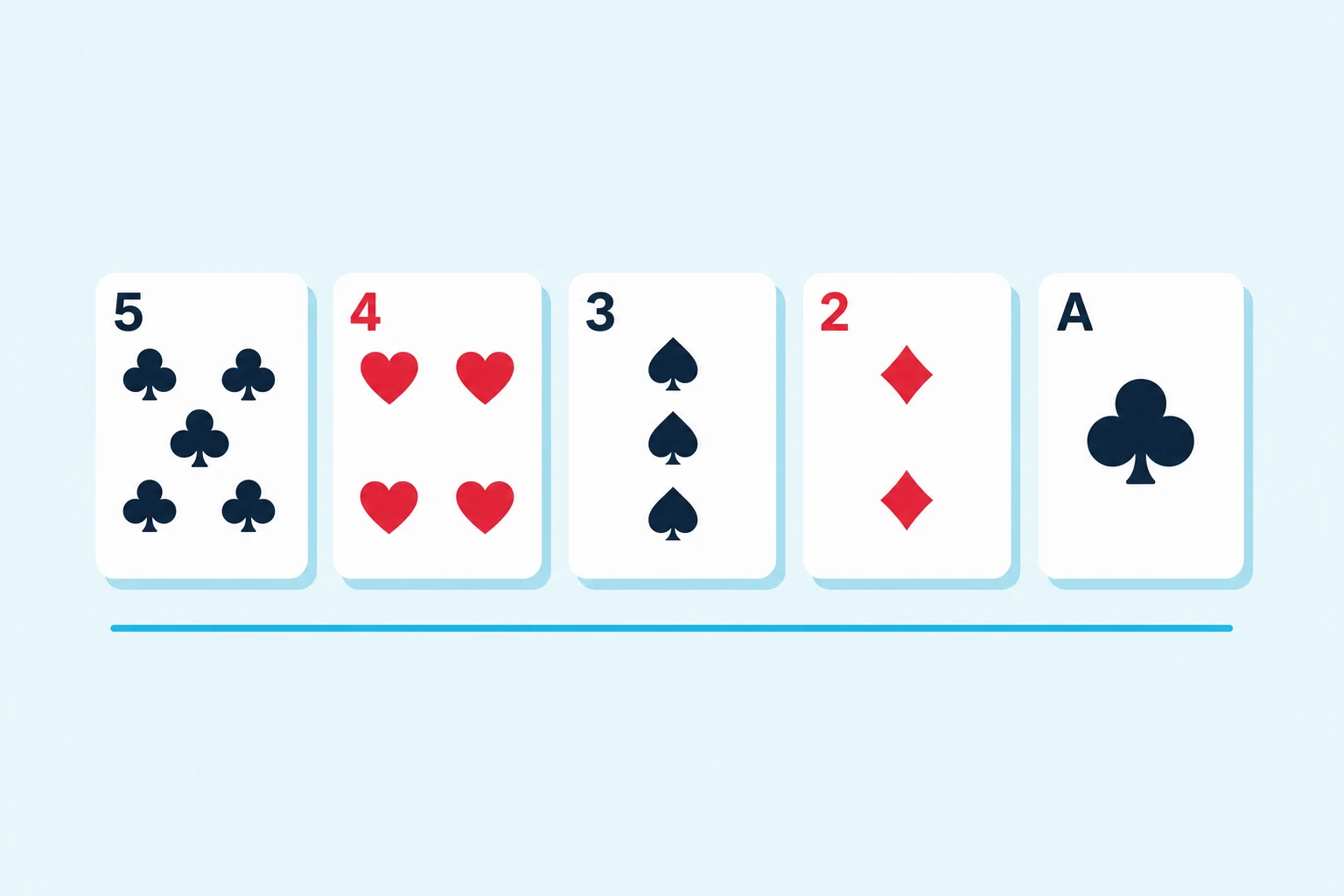
Razz is seven card stud played for the lowest hand. Every player is dealt seven cards over five streets, three face down and four face up, and at showdown the best five-card low hand takes the pot. Aces count as low, straights and flushes do not count against you, and the best possible hand is 5-4-3-2-A.
Three cards start face down as hole cards, the low hand wins at showdown, and 5-4-3-2-A is the wheel. If you have played seven card stud rules before, the shape of the game is familiar and every value judgment inside it is upside down.
The shortcut, in one line
Start with three cards eight or lower, keep watching the door cards, and remember that the hand you are chasing is the one that pairs nothing.
Razz at a glance
| Trait | Razz | Seven card stud (high) | Texas Hold’em |
|---|---|---|---|
| Cards per player | 7 (3 down, 4 up) | 7 (3 down, 4 up) | 2 down plus 5 shared |
| Who wins the pot | Lowest five-card hand | Highest five-card hand | Highest five-card hand |
| Aces | Always low | High or low in a straight | High or low in a straight |
| Straights and flushes | Do not count against you | Win pots | Win pots |
| Best hand | 5-4-3-2-A | Royal flush | Royal flush |
| Bring-in on third street | Highest card showing | Lowest card showing | No bring-in, blinds instead |
| Betting | Small bet early, big bet from fifth street | Same | Usually no limit |
| Community cards | None | None | Five |
Hand rankings: reading a low hand
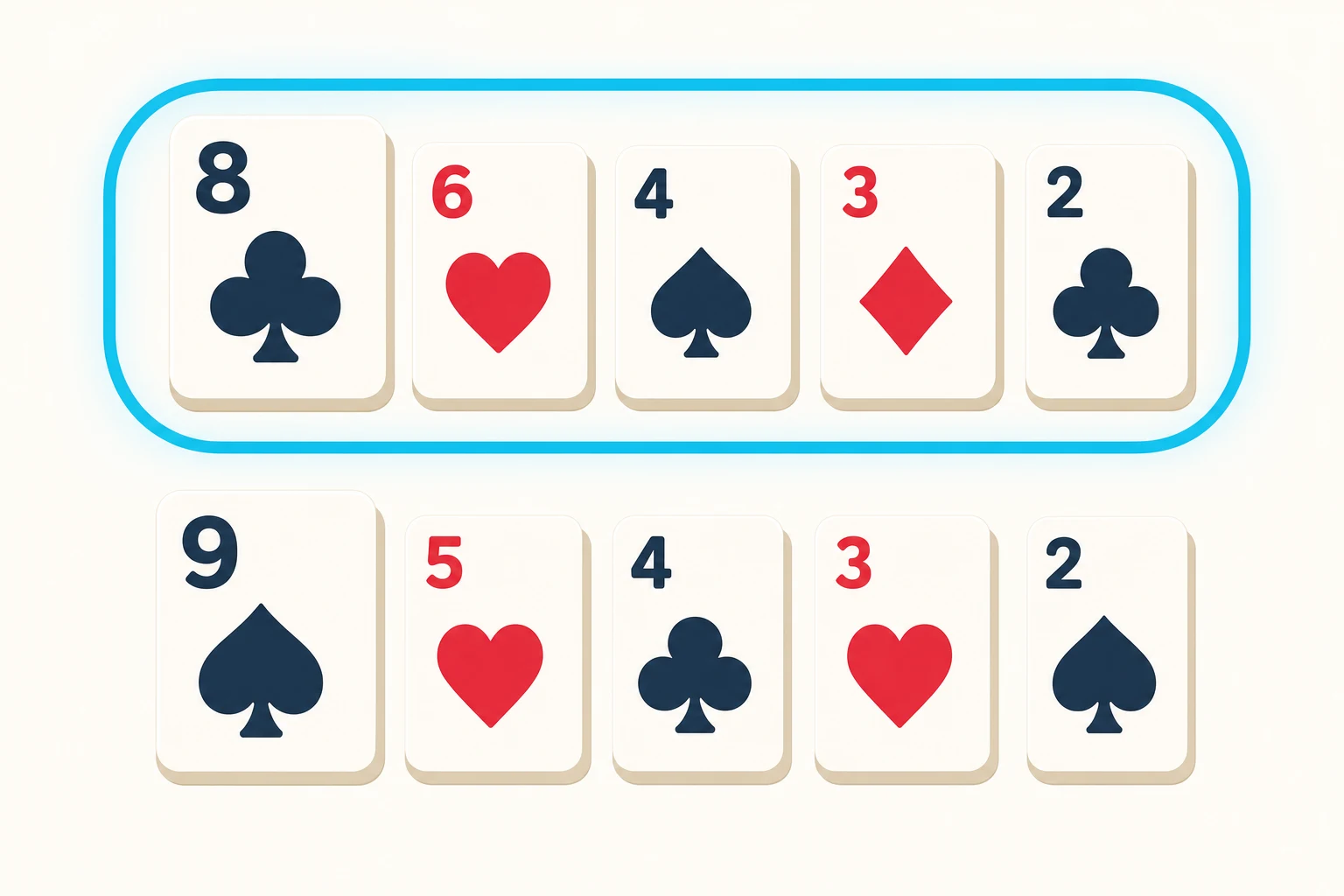
Razz uses the ace-to-five scale, which comes down to three rules.
- Aces are low. An ace is the best card in the deck here.
- Straights and flushes do not count against a low hand. They have no value beyond the ranks on the cards, so 5-4-3-2-A is not a straight for these purposes, it is simply the five lowest cards.
- A pair drops you into a losing class. This is the rule Hold’em players miss. Any five cards without a pair beat any hand that contains one, no matter how the individual cards compare. 9-8-7-6-5 beats 8-8-4-3-A: the nine-high hand looks worse card for card, but the pair of eights puts the other hand in a class below it. Card-by-card comparison only settles hands that are both unpaired.
That makes the best possible hand 5-4-3-2-A, the wheel. The next best is 6-4-3-2-A, then 6-5-3-2-A, and so on.
So comparing hands is a two-step job, the same shape lowball uses everywhere.
Step one: is either hand paired? An unpaired hand beats a paired one, full stop. A hand with two pairs is worse again, and trips worse still.
Step two, for two unpaired hands: read from the highest card down. Compare the top cards; the lower one wins. If they tie, compare the next card, and keep going.
Players name unpaired hands by their top two cards. An “eight-six” is 8-6-x-x-x, and it beats any nine-high hand no matter how the rest of the cards fall.
The rules in one read
Razz runs on the stud skeleton: antes, a bring-in, five streets, and a bet that doubles halfway through.
Antes, then two cards face down and one face up. The highest door card posts the bring-in, which is the reverse of stud played for high. Small bet.
One more card face up. Two of your cards are now visible, so opponents can see part of the low you are building and you can see part of theirs. Still the small bet.
One more face up, and the bet doubles. You have five of your seven cards, so you know whether you have a low or a project, and the price of finding out doubles at the same moment.
One more face up. Four of every player’s cards are showing, which is most of what you will ever know about them. Big bet.
The last card comes face down. Final betting round at the big bet, then the best five-card low takes the pot.
Third street: two down, one up
Every player antes, then receives three cards: two face down and one face up. The face-up card is your door card.
Here is the rule that catches everyone. In razz, the player showing the highest card must post the bring-in. In seven card stud played for high, the lowest card brings it in. The convention inverts because the goal inverts, and getting it backwards is the classic first mistake in a mixed game.
After the bring-in, each player in turn folds, calls, or completes the bet to the full small bet.
Fourth street
One more card face up for everyone still in the hand, followed by another betting round. Two of your cards are now visible, which means opponents can see part of the low you are building, and you can see part of theirs. That exchange is what stud games run on.
Fifth street: the bet doubles
Another card face up, and the money changes size: the small bet covers third and fourth street, and from fifth street on you are paying the big bet. In a $100/$200 razz structure, the early streets move in $100 units and every bet from the fifth card is $200.
Fifth street is where most razz hands get decided. You have five of your seven cards, so you know whether you have a low or a project, and the price of finding out doubles at the same moment.
Sixth street
One more card face up. Four of your cards are now visible to the table, and four of everyone else’s are visible to you.
Seventh street and showdown
The last card is dealt face down, then the final betting round. If two or more players remain, the best five-card low wins the pot. Suits never break ties in razz; identical ranks split the pot.
What makes a starting hand strong
The arithmetic sets the standard. A five-card low needs five different ranks, and a hand that has to include a nine or a ten is beaten by any hand that does not. You start with three cards, so the question on third street is whether those three are all low.
Three cards eight or lower is the working standard, and three babies is premium. The reason is arithmetic rather than taste: a finished low needs five different ranks, and every card above an eight in your hand is a rank the winner probably does not have. Against a table already showing strong low boards the bar rises, and the classic guidance is to need three cards to a seven before you get involved. A face card is a card you cannot replace, and a pair is a hand that still loses to every unpaired hand at the table if it does not break up.
Door cards change all of it. Your 7-4-2 is a strong start at a table showing kings and queens, and a harder one at a table where three opponents show deuces and treys, because the low cards you want to catch are already in play. Seeing a card you already hold is not all bad, since it cannot come back to pair you, but a table full of low boards means you are racing other low hands rather than running away from high ones.
The habits to unlearn from Hold’em
- Big cards are dead weight. A king in your hand is not a scare card, it is a card that cannot help. You have seven cards to find five low ones, and every high card is one fewer chance at that.
- Pairing up is a disaster, not a win. Catching a second seven does not make a pair worth having, it wastes a card. Poker Skill teaches Hold’em only, and its first hand-ranking lesson points the other way, with two pair a rung above one pair.
- A bluff has to match your board. Four of your cards are face up and your opponents read them, so betting a story your board cannot tell is how you get called.
- The lead changes with the cards. There is no button deciding who speaks first, so the boards on the table set the order and the player who leads the betting can change from street to street. Position still matters, but you do not own it the way you own a seat in Hold’em.
- Draws are not free. The bet doubles from fifth street, so a hand that needed two more low cards on fourth street is an expensive project by sixth.
A live-play pattern
Three reads, in order, before you put in a bet.
Are they all low, and are any of them paired? A pair in your first three is a rank you cannot use twice.
Which low cards are showing in other players’ boards? Every deuce and trey on display is a card that cannot come to me.
Small bet or big bet? A drawing hand on third street costs half what the same hand costs on fifth.
The price question is the one people skip, and razz punishes players who forget which street they are on.
Check yourself: which low wins?
Two hands go to showdown. One is 8♠ 7♦ 5♣ 4♥ A♦. The other is 7♣ 7♥ 4♦ 3♠ 2♣. Which one takes the pot?
Show the answer
The eight-high, 8♠ 7♦ 5♣ 4♥ A♦. Step one settles it before any card is compared: the second hand is paired and the first is not, and an unpaired hand beats a paired one no matter how the individual cards look. Card for card the paired hand seems lower at every position, which is exactly why this is the mistake a Hold’em player makes first.
Where this fits in your decision
Razz is a direct way to learn low-hand reading, because there is no high side of the pot to distract you. The high version of the same deal is covered in the seven card stud rules, and both games appear alongside Hold’em and Omaha in the HORSE rotation, the best known of the mixed games. Badugi takes the same low-hand instinct into a draw game with a ranking system of its own. If you want the shorthand for the best low hand in any lowball game, the wheel entry has it.
Frequently asked questions
What are the rules of razz poker?
Razz is seven card stud played for the lowest hand. Each player gets seven cards, three face down and four face up, and makes the best five-card low from them. Aces are low, straights and flushes do not count against you, and the player showing the highest card on third street posts the bring-in.
What is the best hand in razz poker?
5-4-3-2-A, often called the wheel or the bicycle. Aces play low, so that is the lowest possible five-card holding. Suits never matter, and a straight does not count against a low hand, which is why the wheel is the top of the ranking rather than a made straight.
Who brings it in on third street in razz?
The player showing the highest card. That is the reverse of seven card stud high, where the lowest exposed card brings it in, and it is the single easiest rule to get backwards when you sit down in a mixed game.
How do you compare two low hands in razz?
Check for a pair first: any unpaired hand beats any hand containing a pair, so 9-8-7-6-5 beats 8-8-4-3-A. When both hands are unpaired, read them from the highest card down. The hand with the lower top card wins, and if the top cards match you compare the next card down. An eight-high low beats a nine-high low even when every other card in the nine-high hand is smaller.
Is razz the same as seven card stud?
The deal and the betting are the same, and that is where the similarity stops. Stud awards the pot to the highest hand and razz awards it to the lowest, so the bring-in flips to the highest card and every instinct about big cards flips with it.