

A side pot exists so that nobody can win money they never risked. When a player is all-in for less than others are betting, the chips they matched form the main pot, and everything bet above that amount goes into a side pot (often written as one word, “sidepot”) that the all-in player cannot win.
Every side-pot situation, no matter how tangled it looks with five players and three all-ins, is generated by that single rule: you compete only for chips you matched. If you can hold onto that sentence, you can reconstruct any split at any table, and you will never need to trust a confused dealer or a loud friend at a home game again.
The one rule, restated slowly
Poker bets are matched money. When you put $25 in and I call $25, we have equal claims on that $50. But if you are all-in for $25 and I want to bet $100, you cannot match my extra $75, so it would be unfair for you to win it and equally unfair for me to take it back off the table. The solution: my extra money fights in a separate pot against anyone who can match it, and your $25 fights in its own pot against the $25 slices of everyone still in the hand.
That is all a side pot is: the overflow above what the shortest stack could match, walled off so only the players who funded it can win it.
A worked example with two pots
Three players see a flop. Player A has $25 left, Players B and C each have plenty.
A goes all-in for $25. B raises to $100 and C calls $100. Build the pots:

The main pot takes $25 from each player: $75, and all three players can win it. The side pot takes the remaining $75 from B and the $75 from C: $150, and only B and C can win it, because A never matched that money.
Now the payouts, and this is where the order matters. At showdown, suppose A has the best hand of the three, and B has the second-best. A wins the main pot: $75. A does not touch the side pot, no matter how good the winning hand was. The $150 side pot goes to the better hand between B and C only, so B collects it. B lost the hand, in the plain sense that A held the best cards, and still banks twice as much as A won. That is not a mistake; that is the system working exactly as designed. When Poker Skill pits you against AI players in Practice vs AI, the main pot and a side pot are paid as separate awards, so one player can take both or each can go to a different winner.
Two all-ins, two layers
Add a second all-in. A is all-in for $20, B is all-in for $50, and C, who covers everyone, calls $50.
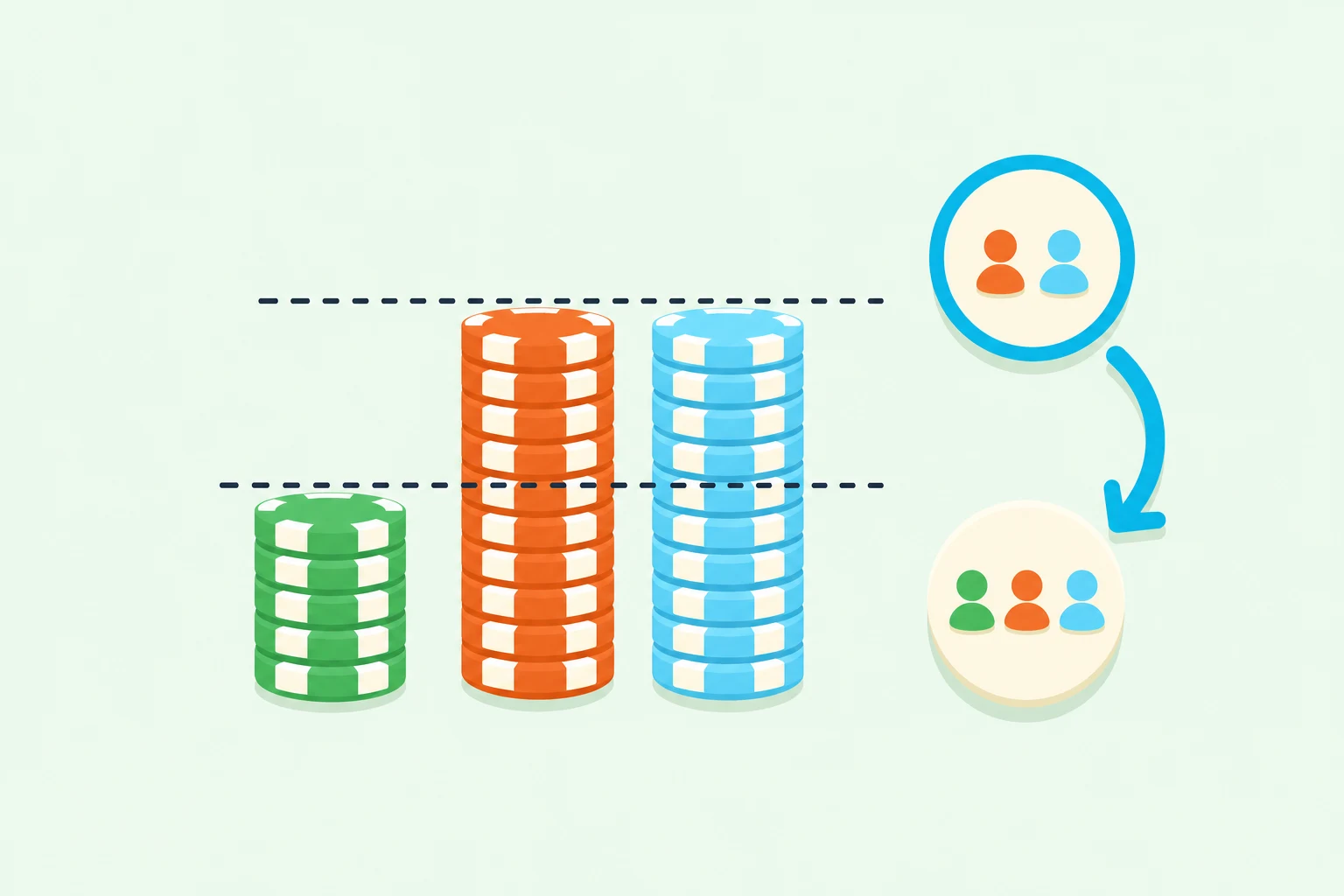
Layer one, the main pot: $20 from each of the three players, $60, everyone eligible. Layer two, the first side pot: B and C each had $30 more in ($50 minus the $20 A could match), so $60, and only B and C are eligible. C’s stack beyond $50 never went in, so there is no third layer of money in play and no second side pot.
Payouts run from the last side pot backward to the main pot. Best hand between B and C takes the $60 side pot first. Then the best hand among all three takes the $60 main pot. Two different comparisons, possibly two different winners, and each pot only ever answers its own question: who is the best among the people who funded me?
Any number of all-ins works the same way. Sort the all-in amounts from smallest to largest, slice the betting at each amount, and every slice becomes a pot owned by the players who reached it.
The procedure, step by step
When a hand gets messy, build the pots mechanically. First, find the smallest all-in amount still in the hand. Second, take that amount from every player’s bet, including the all-in player’s own, and pool it: that is the main pot, and everyone still holding cards is eligible. Third, look at what remains of the larger bets, find the next-smallest all-in among them, and repeat: each pass creates one more side pot with one fewer eligible player. Fourth, any money only one player bet, the amount nobody matched at all, never enters any pot: it simply goes back to that player. Uncalled bets are returned, not won.
Run the procedure on our three-way example and it reproduces the answer in seconds: smallest all-in $20 builds a $60 main pot for three players, next all-in $50 builds a $60 side pot for two, and C’s unmatched stack stays in front of C. If a fourth player had folded on the flop after putting in $20, their dead money would simply sit inside the main pot, because folded players’ chips stay in whatever pot they reached, they just can no longer win them.
That last line answers the most common home-game argument in one sentence: folding forfeits your claim, not your chips.
The famous injustice that is not one
The shape that stuns new players: the short stack turns over the stone-cold best hand, a straight flush even, and wins the smallest pot on the table while someone with one pair drags a side pot several times larger. It feels broken the first time you watch it. It is not. The short stack’s hand was only ever backed by a short stack’s money. Their cards beat everyone, so they win everything they were entitled to fight for: every chip they matched. The mountain of money in the side pot was a bet between two other people, and their private argument is settled by their hands alone.
Understand that once and the whole mechanism inverts from confusing to obviously fair: nobody wins money they did not risk, and nobody loses money to a player who could not cover it.
Showdown mechanics worth knowing
Side pots pay out first, working backward to the main pot last. That is the standard order, and you should insist on it at home games, because paying the main pot first is how mistakes creep in.
Betting also continues normally beside an all-in player. If A is all-in on the flop and B and C still have chips, B and C keep betting on the turn and river, and everything they add builds the side pot only. A simply waits, guaranteed a showdown for the main pot, which is why being all-in is sometimes the most relaxing position in poker: no decisions left, and the hand rankings do the rest.
One more boundary worth naming: winning a pot you are eligible for still requires the best five-card hand among the eligible players, and if two of them tie exactly, that pot splits between them. Ties and chopped pots have their own rules and their own confusions; the odd-chip rule and the boards that chop by themselves are covered below.
When the pot splits: the odd-chip rule
If a chopped pot does not divide evenly, the dealer cannot round. A 101-chip pot between two tied winners becomes 50 and 51, and the extra chip goes to the tied player nearest the dealer’s left, first to act clockwise from the button. That is the standard rule for hold’em in cash games and tournaments alike; breaking the tie by the suit of a high card is a stud rule. The rule applies inside every pot separately: if the main pot chops, the main pot’s odd chip goes left, and if a side pot chops, that side pot’s odd chip goes left too, chosen only from among that pot’s eligible winners.
When the board plays
Some boards chop by themselves, and they fool home games constantly. If the five community cards already form the best five-card hand and no hole cards improve on it, everyone still in chops. Board A♠ K♥ Q♦ J♣ T♥ is the canonical case: every active player plays the same Broadway straight. The subtler versions: kickers can run out before the cards do (board Q♣ J♦ 9♠ 9♥ 5♦, one player holding A♣ 7♣ and the other A♦ 6♠ both play 9-9-A-Q-J and chop, because the board’s queen and jack outrank the second hole cards), a five-card flush on the board chops unless someone holds a card of that suit higher than the board’s lowest flush card, and a paired-up board can hand everyone the same full house. Same five cards, chop, odd chip left.
You pick out the exception in Poker Skill’s winner drills: on eight-eight-five-five with a queen, the one player holding a five makes fives full while everyone else plays the board.
Where this fits in your game
Side pots are dealer mechanics, but they are also strategy. When a player is all-in and you still have a live opponent, every bet you make can only win the side pot, so bet because you can beat the other live player, not to “protect” against the all-in hand you can no longer fold out. Betting a hand that beats the all-in player but loses to the live one is lighting money on fire in a pot the all-in player is not even part of. Recognizing dry side pots, spots where there is nothing beside the main pot to fight for, is a small skill that quietly saves buy-ins.
What is a side pot in poker?
A side pot is the separate pot created when one player is all-in for less than others are betting: the all-in player’s matched chips form the main pot, and everything above that fights on in a pot only the deeper stacks can win.
Can an all-in player win the side pot?
Yes, if they paid into it. Nobody can win chips bet above their own all-in. In the three-way example above, A, all-in for $20, can win only the main pot, even with the best hand at the table, while B, all-in for $50, can also win the $60 side pot.
Can you ever win more than your stack?
You can win, from each opponent, at most the amount you had in play. All-in for $38 means each opponent’s first $38 is yours to fight for, and no more. That cap is the entire reason side pots exist.
What if two players tie within one pot?
That single pot splits evenly between them, and every other pot still resolves on its own. One tie never chops the whole table’s money, just the layer where the tie happened.