
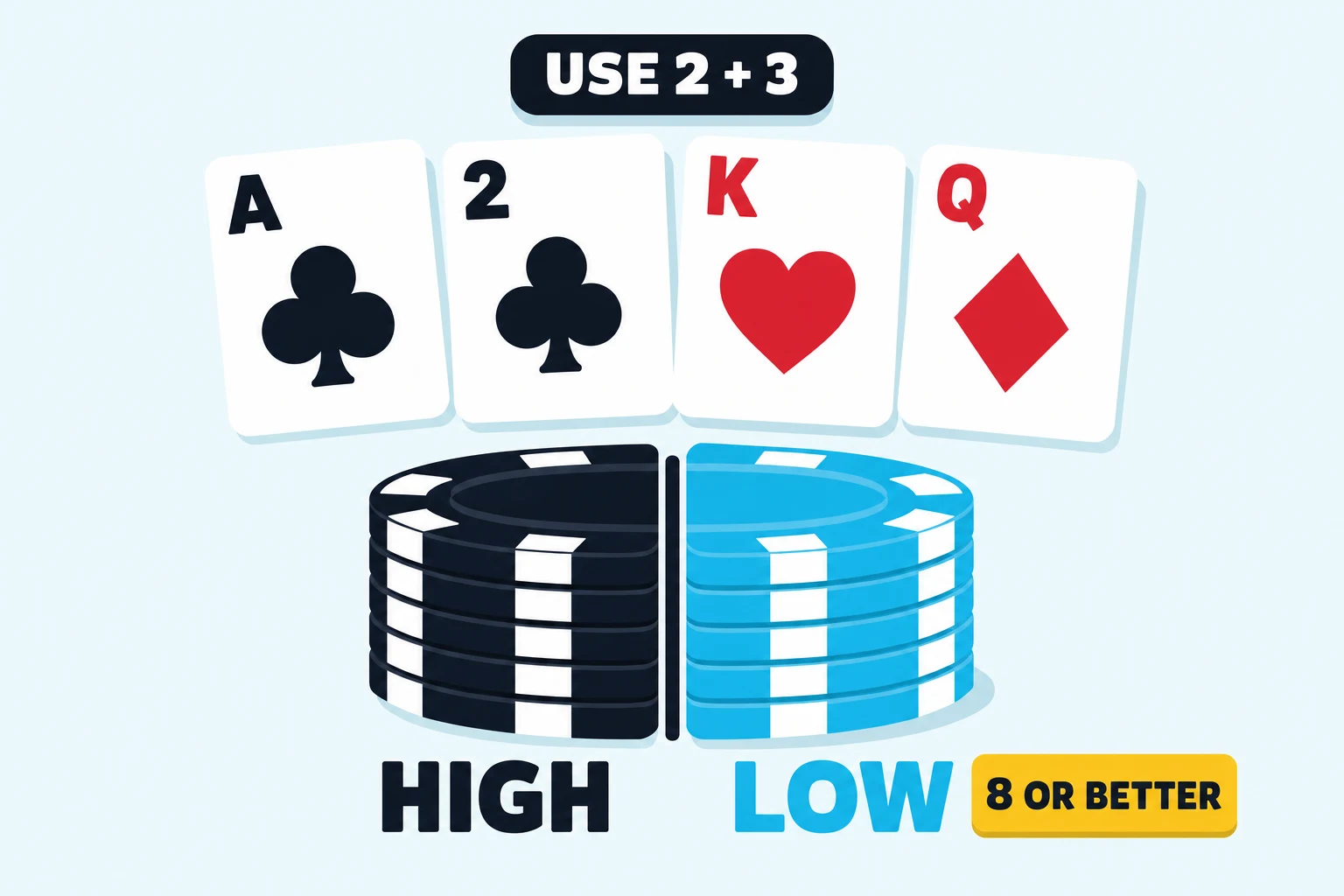
Omaha hi-lo is four-card Omaha with the pot split two ways at showdown: half to the best high hand, half to the best qualifying low hand. You get four hole cards and five community cards, and every hand you make uses exactly two cards from your hand plus exactly three from the board.
Four hole cards, five community cards, and the Omaha two-from-your-hand rule applied twice, once for each half. The extra rule is the low. To win the low half, a player needs five unmatched cards ranked eight or lower, which is why the game is also called Omaha eight-or-better, or O8. When nobody at the table can build that low, the best high hand takes the whole pot.
The shortcut, in one line
Play hands that can win both halves. An ace with a deuce is the anchor, high-card support is what turns half a pot into all of it, and a hand that can only win one way is the hand that quietly loses chips.
Omaha hi-lo at a glance
| Trait | Omaha hi-lo (O8) | Pot-limit Omaha | Big O |
|---|---|---|---|
| Hole cards | 4 | 4 | 5 |
| Hand construction | Exactly 2 hole cards plus 3 board cards | Exactly 2 hole cards plus 3 board cards | Exactly 2 hole cards plus 3 board cards |
| Pot award | Half high, half qualifying low | High only | Half high, half qualifying low |
| Low qualifier | Five unmatched cards, eight or lower | None | Five unmatched cards, eight or lower |
| Best low | 5-4-3-2-A | Not applicable | 5-4-3-2-A |
| Betting structure | Fixed limit or pot limit | Pot limit | Commonly pot limit |
| Typical table | Multiway, split pots | Multiway, big pots | Multiway, split pots |
This page is about the four-card eight-or-better game in the middle of that table.
The rules in one read
Each player is dealt four cards face down, one at a time, starting to the left of the button. The blinds, the action order and the four betting rounds match a Hold’em game of the same size: a round before the flop, then the flop, the turn and the river. Bet sizes are set in advance on each round in the limit version, and the pot is the cap in the pot-limit version.
At showdown you read the hand twice, once for each half of the pot.
For the high half, you take exactly two of your four cards plus exactly three board cards and make the best five-card poker hand. Standard rankings, no changes. Poker Skill teaches Texas Hold’em, where any five of your seven cards can play, so the exactly-two rule is the first Hold’em habit to drop here.
For the low half, you do the same thing again, and you are allowed to use different cards this time. Two hole cards plus three board cards, five unmatched ranks, all eight or lower. Aces count as the lowest card. Straights and flushes are ignored when the hand is read for low, so A-2-3-4-5 is both the best low and a five-high straight for the high half.
Half the pot goes to the best high hand and half goes to the best low hand. If no player can make a qualifying low, the high hand wins the entire pot, which is why boards full of picture cards play like a game of straight Omaha.
Reading a qualifying low
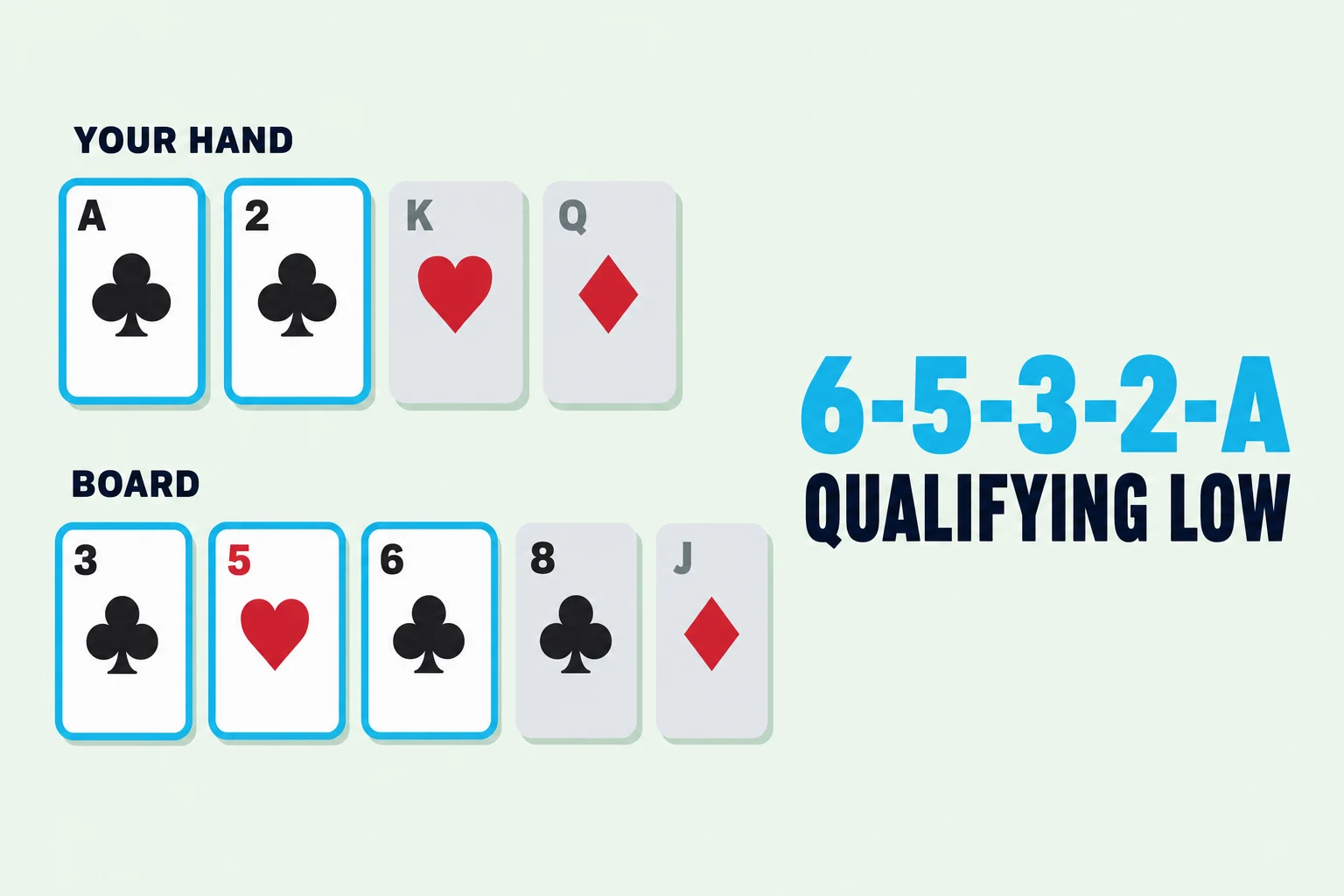
A qualifying low is five unmatched cards ranked eight or lower. No pair among the five, nothing above an eight, ace playing as the smallest card. The best possible low is the wheel, 5-4-3-2-A. The worst hand that still qualifies is 8-7-6-5-4.
Compare two lows from the top card down. The lower top card wins, and if those match you compare the second card, then the third, and so on. So 7-6-5-4-2 beats 8-5-4-3-2, because the seven at the top is lower than the eight, even though the rest of the second hand looks smaller. Beginners read lows from the bottom up and get this backwards all evening.
Because the ace is the lowest card for low and the highest card in the deck for high, A-2 does double duty. It anchors the nut low and the same ace can still play in your high hand.
Then there is counterfeiting. A board card can pair one of the low cards you were counting on, and the rank you were using becomes available to everybody else at the table. Your hand usually still qualifies. It just stops being the best low, and a hand with a spare low card can switch while a bare A-2 cannot. The worked example below runs one of these hand by hand.
Scooping, halving, and getting quartered
Scooping means winning both halves with one hand. It is the outcome to aim at, because winning one half of a pot you paid full price to contest is a thin result.
| Outcome | What you hold | What you collect |
|---|---|---|
| Scoop | The best high and the best low, or the best high with no low qualifying | The whole pot |
| Split | The best of one half, somebody else has the other | Half |
| Quartered | The best low, tied with one opponent, high goes elsewhere | A quarter, which can be less than you put in |
| Second-best low | A qualifying low that is not the best one | Nothing |
Getting quartered is the version that hurts, and it happens on a tie. When you and one opponent hold the same best low, the two of you split the low half and take a quarter of the pot each, while the high half goes to whoever wins it, often a third player. A second-best low is worse than that: it wins nothing at all. Two players holding A-2 in the same pot is not a rare accident, because every player is choosing two cards from four and sharing three board cards, so the books note that duplicate hands happen often here. In a three-handed pot, the player collecting a quarter can put in more chips than they get back.
The scoop version of the same math is the freeroll: when one half of the pot is locked up and you are drawing at the other, the locked half is the floor and the whole pot is the ceiling.
That is the case against one-way hands. A hand that can only ever win the low half is capped at half the pot and gets quartered often. A hand that can only win high has to survive every board that brings a low in. Hands that can win both halves are the ones worth building a session around.
What makes a starting hand strong
The beginner rule from the books is blunt: fold hands without an ace, and play hands that can make the nuts on at least one side. That is tighter than it sounds, and the same books say it is enough on its own in small games.
A-2 with high support is the shape the game is named for: the A-2 anchors the low, and the high cards or the flush give you a way to win the other half. A-2-3 and A-2-3-4 carry counterfeit insurance, and A-2-3-4 is strong enough to raise with. A-A-2 plays both halves instead of being a one-pair hand looking for a flop. A-3 shapes want friendly boards.
A suited ace does two jobs at once: the nut flush for the high half, and the ace for the low. The nut flush and the nut low in the same four cards is the shape that scoops.
The hands to fold are the ones that look busy and go one way. Four middling high cards are playing for the high half only, and often for the second-best version of it. Three low cards with a nine or a jack attached are mostly a low draw with a high side that rarely wins.
Worked examples
The hand that scoops
Low first. Your ace and deuce plus the 3, 5 and 6 from the board make 6-5-3-2-A, and no better low is available on this board, since the 3, 5 and 6 are the lowest three board cards anyone can reach. Another player holding A-2 would tie you and share the low half.
High second, with different board cards. A♣ 2♣ plus 3♣ 6♣ 8♣ is an ace-high flush, and nothing on this board beats it. So the hand takes the high half outright and scoops unless somebody turns up with the same low. That is the reason a suited A-2 is worth a raise.
The counterfeited low
Same A-2, no backup. You hold the best low on the flop, and the turn is the 2♠.
Your low is still 8-7-3-2-A, and it still qualifies. What changed is that everyone else can now use the board deuce. An opponent holding an ace and a four plays them with the 2, 3 and 7 for 7-4-3-2-A, which leads for the low half with one card still to come. Nothing about your own hand got worse. The board handed your best feature to the table, and you have nothing to switch to. Hold A-2-4 instead and you make the same 7-4-3-2-A yourself.
Check yourself: does this qualify for low?
The board runs 4♠ 7♦ 9♣ Q♥ 2♦. You hold A♥ 3♥ K♠ J♦. Do you have a qualifying low, and if so what is it?
Show the answer
Yes: 7-4-3-2-A. You play exactly two from your hand, the ace and the three, with exactly three from the board, the 2, the 4 and the 7. The nine and the queen are too high to use and you do not need them. Notice what the two-card rule does here: your king and jack are dead weight for the low no matter how the board falls, which is why a hand that can only reach one half is worth so much less than one that can reach both.
The mistakes that cost new players
- Chasing a low that cannot arrive. A low needs three different ranks of eight or lower on the finished board. With two of them out and one card to come, you are drawing to half a pot with one card, not to a hand.
- Playing a bare A-2 like a premium. It is the best low anchor in the game and it is one-way. Without high support, that hand collects halves and quarters.
- Reading the low with the wrong cards. Exactly two from your hand and exactly three from the board, every time. Three low cards in your hand do not make a low if only two of them can play.
- Paying a full bet for half a pot. Calling three streets to win half of a multiway pot is a losing habit unless you also have a live shot at the high.
- Checking down a high-only board. When the board cannot make a low, the high hand wins everything. That is the moment to bet, not to control the pot.
A live-play pattern
Three reads, in order, before you put chips in.
First, can a low even qualify here? Count the different ranks of eight or lower on the board. Fewer than three by the river and the whole pot goes one way.
Second, which half am I drawing at, and am I drawing at the nuts in it? A second-best low wins nothing, and a second-best high pays off flushes. In a multiway pot, non-nut draws on either side are expensive.
Third, how many players are still in? Nut-low value climbs as more opponents put chips in, and one-way hands get worse as the pot grows.
Where this fits in your decision
The split-pot format itself, including how the eight-or-better qualifier works across games, lives in the hi-lo glossary entry, and the low hand entry covers reading a low card by card. If you want the high-only sibling with no low half to worry about, read pot-limit Omaha rules. If you want the same split with five hole cards and even closer equities, read Big O, the five card hi-lo game.
Frequently asked questions
What is Omaha hi-lo?
Omaha hi-lo is Omaha with a split pot. You get four hole cards, you use exactly two of them with three board cards, and at showdown half the pot goes to the best high hand and half goes to the best qualifying low. It is also called Omaha eight-or-better, or O8, because the low half has to be five unmatched cards ranked eight or lower.
What qualifies as a low hand in Omaha hi-lo?
Five unmatched cards, all eight or lower, built from exactly two of your hole cards and exactly three board cards. Aces play as the lowest card, and straights and flushes are ignored for the low. The best qualifying low is 5-4-3-2-A and the worst is 8-7-6-5-4.
What happens if nobody makes a low?
The best high hand wins the whole pot. That happens whenever the finished board does not show three different ranks of eight or lower, so a board like K-Q-9-J-4 plays as a high-only pot.
What does it mean to be quartered?
You are quartered when another player has the same low as you. The two of you split the low half and take a quarter of the pot each, while the high hand takes the other half. It happens often in this game, and it is the main reason a bare A-2 is worth less than it looks.
Is Omaha hi-lo the same as pot-limit Omaha?
No. Pot-limit Omaha, the game people mean when they say PLO, is high only: the best five-card hand wins the whole pot. Omaha hi-lo splits the pot with a qualifying low. Both deal four hole cards and both use the exactly-two-plus-three rule, so the mechanics carry over and the hand selection does not.