
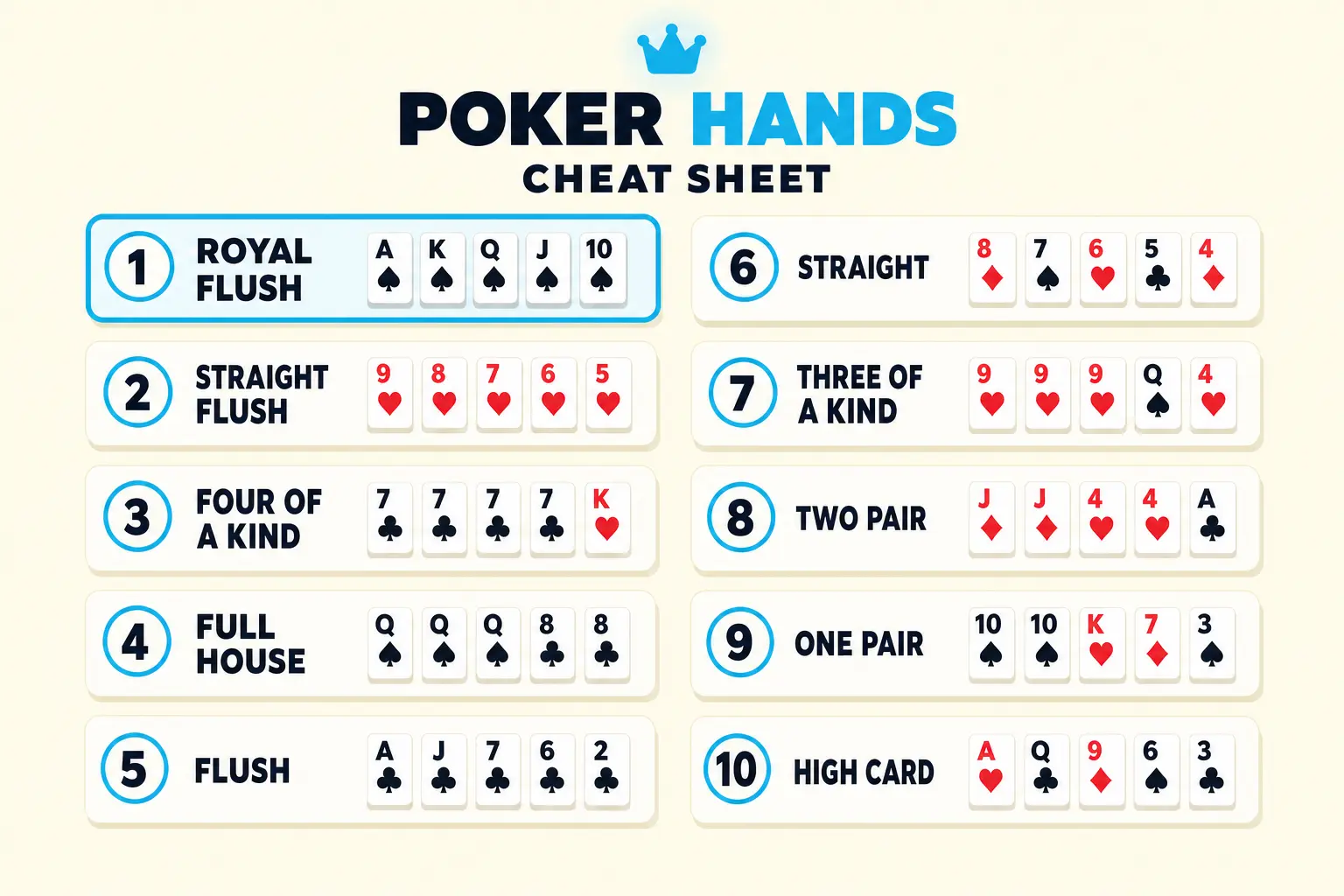
Get the cheat sheet
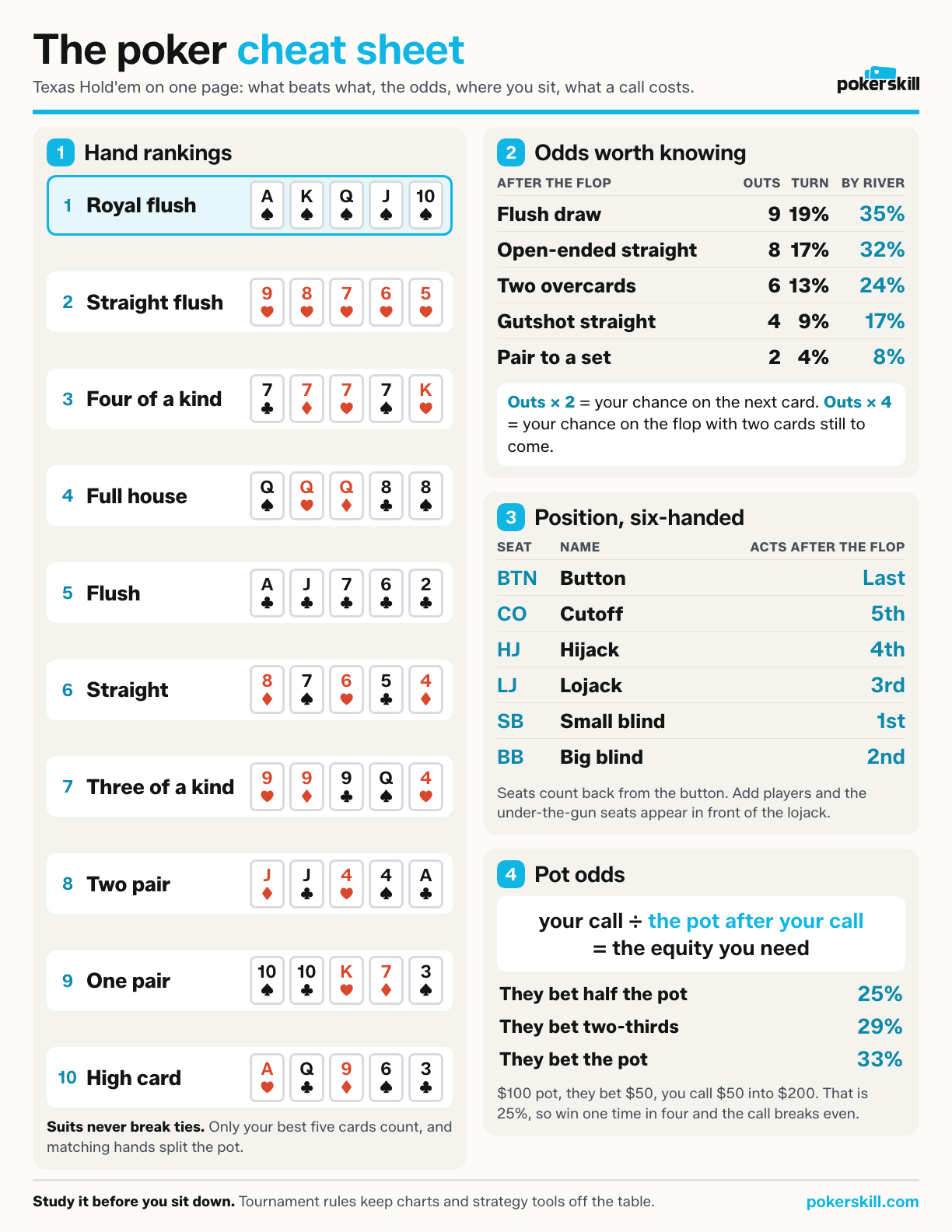
This poker cheat sheet is everything a beginner needs at a Texas Hold’em table, on one page: what beats what, the odds worth knowing, where you sit, what a call costs and which hands to raise before the flop. The PDF prints on one sheet in color or black and white. The PNG is the one to keep on your phone. No email, no download form, no course attached.
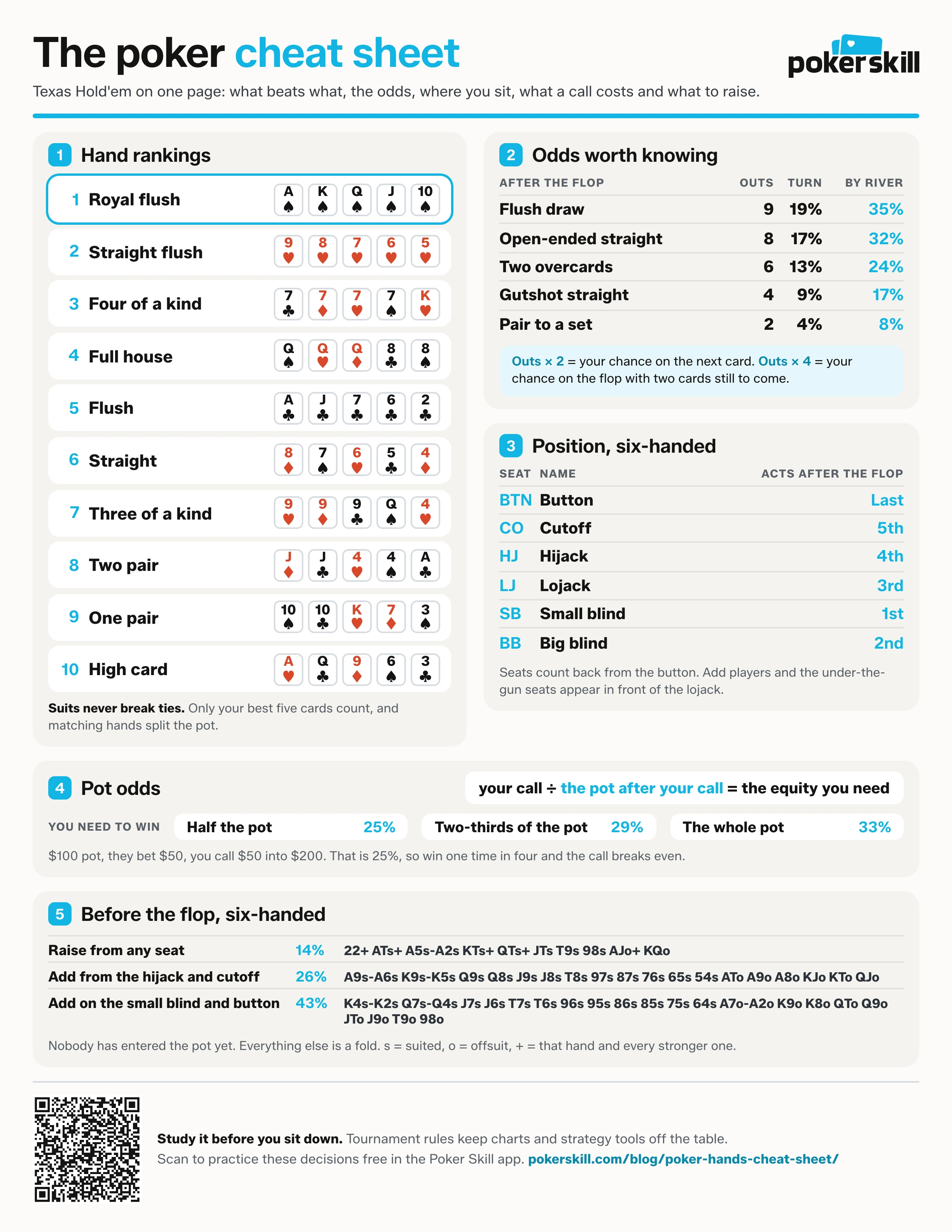
Both files carry the same five blocks as the tables below, so nothing on paper disagrees with the page. Each block below opens with its own region of the sheet, so you can see the piece you are about to print before you read it. If you only need the hand order, the rankings sheet prints those ten hands and their example cards on one page, at Letter or A4. The first-hand rules sheet on the beginner guide covers the deal order, what you can do on your turn and one whole hand with the pot after every street.
Block 1: hand rankings at a glance
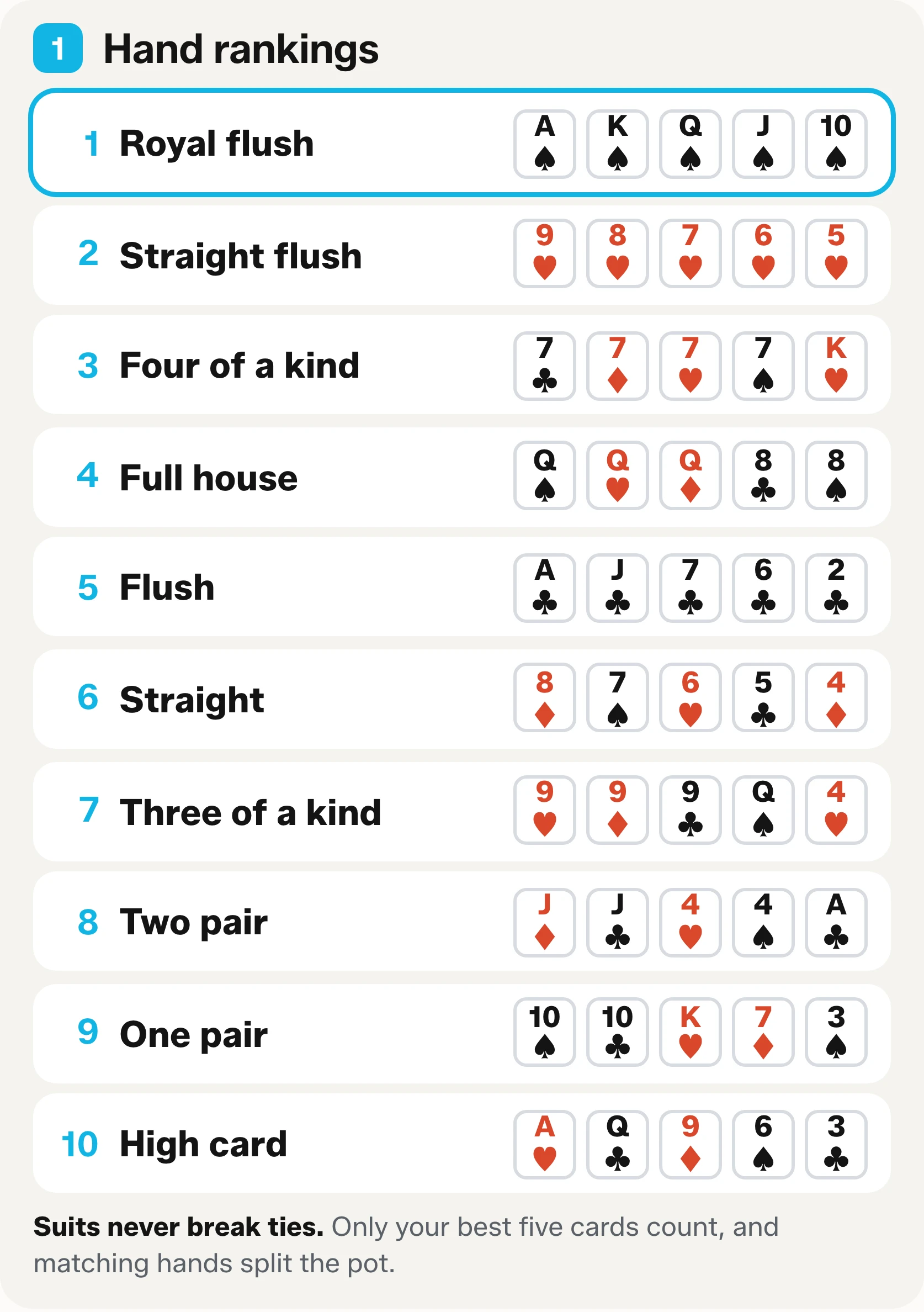
| # | Hand | Example | Tie-break in one line |
|---|---|---|---|
| 1 | Royal flush | A♠ K♠ Q♠ J♠ 10♠ | Cannot be beaten; only a board royal can tie |
| 2 | Straight flush | 9♥ 8♥ 7♥ 6♥ 5♥ | Highest top card wins |
| 3 | Four of a kind | 7♣ 7♦ 7♥ 7♠ K♥ | Higher quads, then the fifth card |
| 4 | Full house | Q♠ Q♥ Q♦ 8♣ 8♠ | Higher trips, then the higher pair |
| 5 | Flush | A♣ J♣ 7♣ 6♣ 2♣ | Top card down; suit never breaks it |
| 6 | Straight | 8♦ 7♠ 6♥ 5♣ 4♦ | Highest top card wins |
| 7 | Three of a kind | 9♥ 9♦ 9♣ Q♠ 4♥ | Higher trips, then two kickers |
| 8 | Two pair | J♦ J♣ 4♥ 4♠ A♣ | High pair, low pair, then the kicker |
| 9 | One pair | 10♠ 10♣ K♥ 7♦ 3♠ | Pair rank, then three kickers |
| 10 | High card | A♥ Q♣ 9♦ 6♠ 3♣ | Top card down to the fifth |
The order is absolute. Anything higher beats anything lower, no exceptions. A pair of aces, the best one-pair hand there is, loses to the weakest two pair. A flush always beats a straight, even when the flush is two-three-four-six-eight of clubs and the straight is jack high.
Two rules sit underneath the whole column. Suits never break a tie, so a king-high flush in spades and a king-high flush in clubs with the same five ranks split the pot. And only five cards count, which is why the kicker decides so many hands: your sixth and seventh cards are furniture. When two players land in the same row and you want the tie-breaks shown card by card, the poker hands chart is the long version of this block, and the poker hand rankings hub teaches the order rather than handing it to you.
Block 2: the odds worth memorizing
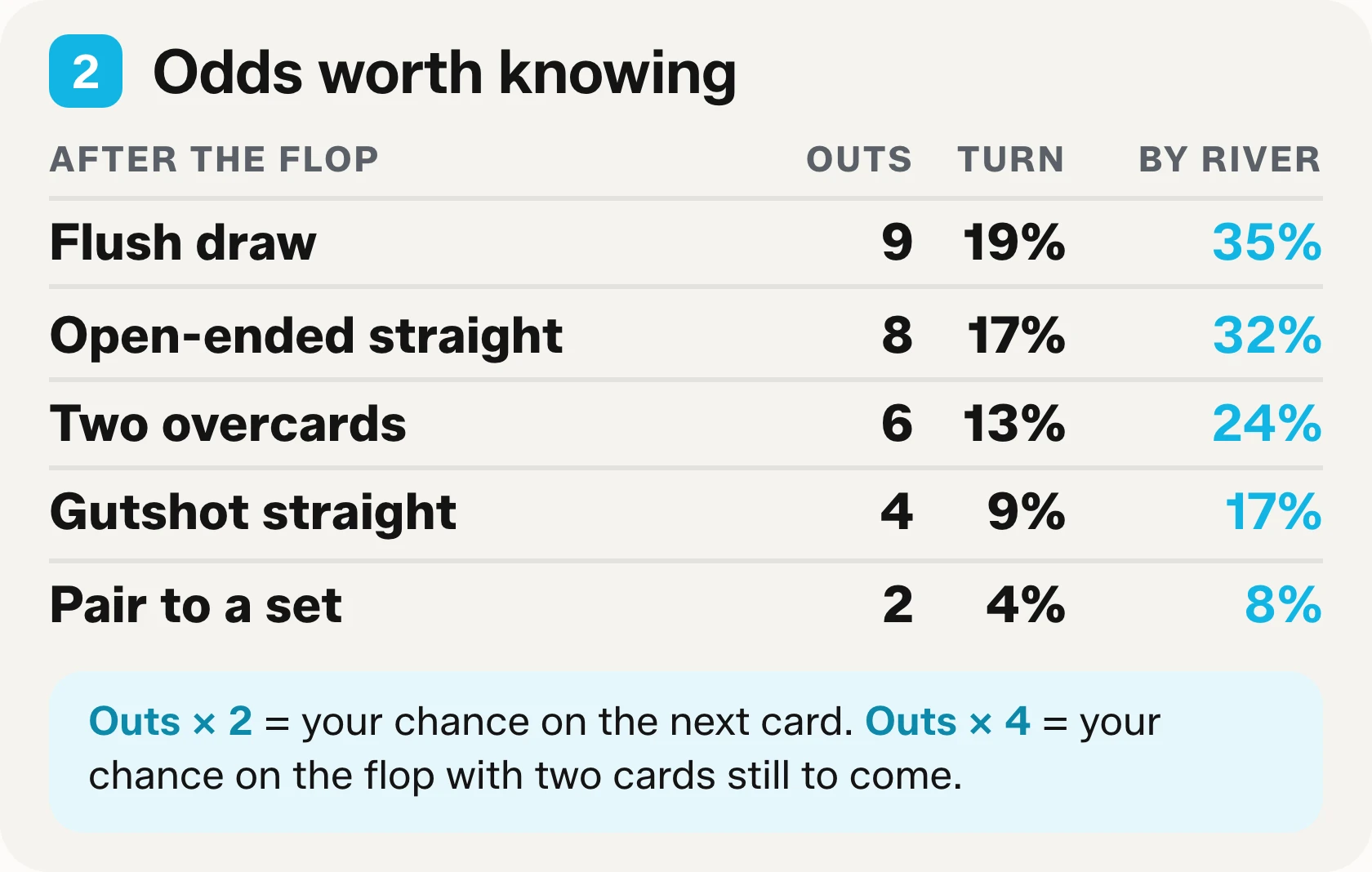
Count the cards that improve your hand. Those are your outs, and the five counts below cover most of the draws you will ever hold.
| After the flop | Outs | Next card | By the river |
|---|---|---|---|
| Flush draw | 9 | 19% | 35% |
| Open-ended straight draw | 8 | 17% | 32% |
| Two overcards | 6 | 13% | 24% |
| Gutshot straight draw | 4 | 9% | 17% |
| Pocket pair to a set | 2 | 4% | 8% |
You do not have to memorize it, because the arithmetic behind it is small enough to run at the table. Multiply your outs by 2 for the chance you improve on the next card, and by 4 for the chance you improve with two cards still to come. Nine outs times four is 36, and the true number is 35. That is the rule of 2 and 4, and it stays honest up to about ten outs before it starts to flatter big draws. If you want the reasoning behind the percentages rather than the shortcut, poker odds explained has it, and the full poker odds chart runs the same table out to twenty outs.
Block 3: position order and what it means
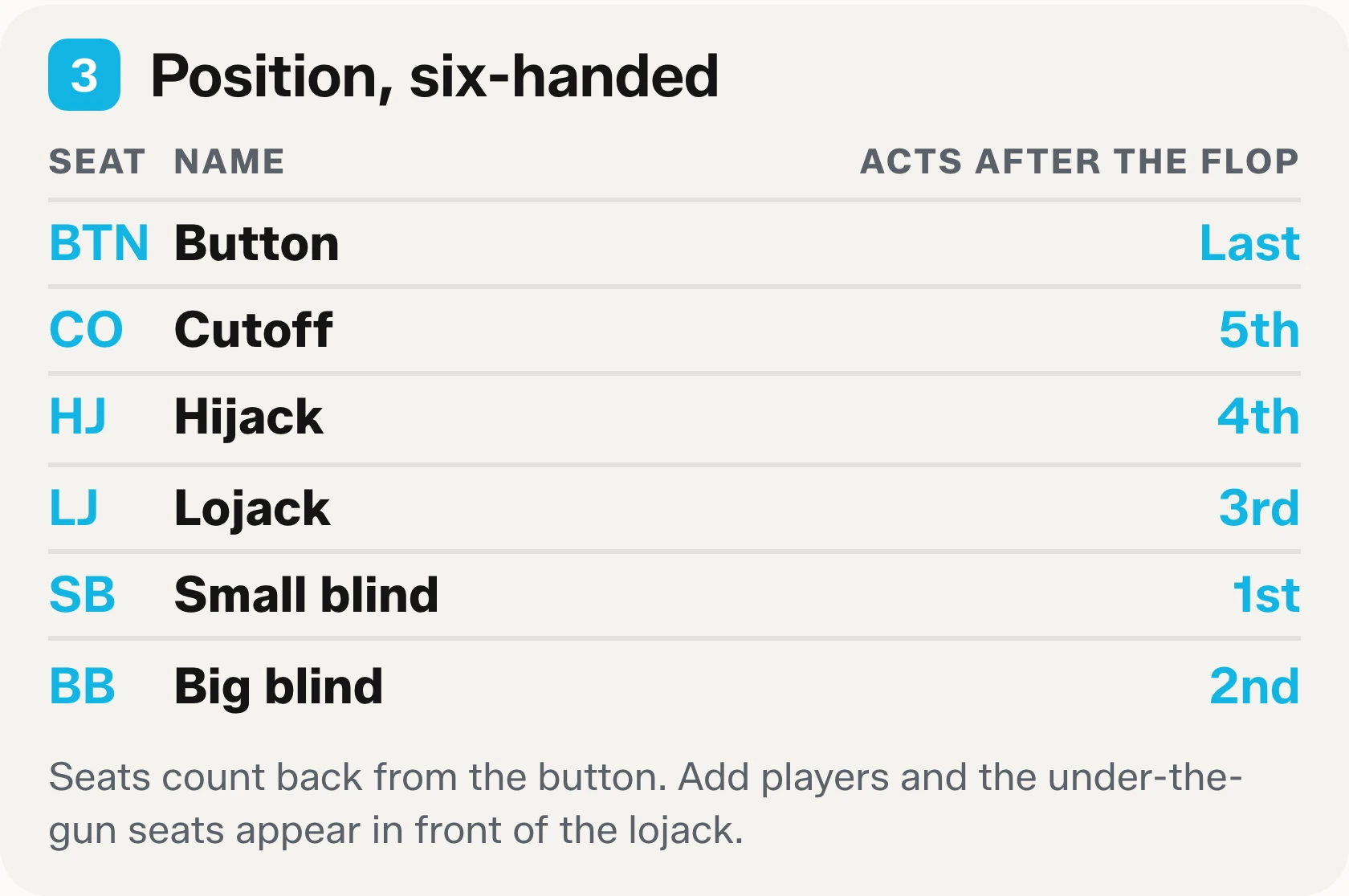
Your seat decides whether you act before your opponents or after them, and that one fact shapes every hand you play. Seats are named by their distance from the dealer button and counted backwards from it, so the same chair changes names as the button moves.
| Seat | Name | Acts after the flop |
|---|---|---|
| BTN | Button | Last |
| CO | Cutoff | 5th |
| HJ | Hijack | 4th |
| LJ | Lojack | 3rd |
| SB | Small blind | 1st |
| BB | Big blind | 2nd |
Those six seats are the whole table in a six-handed game, and the lojack is whoever acts first before the flop. Add players and the under-the-gun seats appear in front of the lojack. The blinds are the exception worth staring at: because they post before the deal, they act last before the flop and first on every street after it, which is the worst trade at the table. Acting last is why the same hand is a raise from the cutoff and a fold from the front, and poker positions walks through what each seat is worth.
Block 4: pot odds in one line

Take what the call costs you and divide it by the size of the pot once your chips are in. That is your pot odds break-even number: how often you have to win the hand for the call to pay for itself. Hold it up against the chance your hand improves from block 2 and the decision answers itself.
| They bet | You need |
|---|---|
| Half the pot | 25% |
| Two-thirds of the pot | 29% |
| The whole pot | 33% |
Example: there is $100 in the pot, your opponent bets $50, and it costs you $50 to call. The pot you are playing for is $100 plus $50 plus $50, so $200. Your $50 into $200 is 25%, which means you need to win this hand one time in four for the call to pay for itself. Hold the open-ended straight draw from block 2 and the next card comes 17% of the time, so the price is asking for more than the draw delivers on its own. Nothing else belongs in the price, and how to calculate pot odds runs it through more spots, including the ones where implied odds change the answer.
Block 5: what to open before the flop

Blocks 1 to 4 are about a hand once it is running. This one is about the moment before it starts: the action folds to you, nobody has put money in and you are deciding whether the two cards in front of you are worth a raise. Read it as a ladder. Every seat raises tier 1; later seats keep it and add the next tier. Anything that never appears is a fold while the pot is unopened.
| Tier | Raise these first in | Hands you play |
|---|---|---|
| 1. From any seat | 22+, ATs+, A5s-A2s, KTs+, QTs+, JTs, T9s, 98s, AJo+, KQo | 14% |
| 2. Add from the hijack and cutoff | A9s-A6s, K9s-K5s, Q9s, Q8s, J9s, J8s, T8s, 97s, 87s, 76s, 65s, 54s, ATo, A9o, A8o, KJo, KTo, QJo | 26% |
| 3. Add on the small blind and button | K4s-K2s, Q7s-Q4s, J7s, J6s, T7s, T6s, 96s, 95s, 86s, 85s, 75s, 64s, A7o-A2o, K9o, K8o, QTo, Q9o, JTo, J9o, T9o, 98o | 43% |
Notation, if it is new to you: s means the two cards share a suit; o means they do not; + means that hand plus every stronger version of it, so ATs+ is ace-ten suited through ace-king suited.
Under the gun you are raising about 14% of your hands. On the button it is about 43%, three times as many, and nothing about the cards changed: three players have already folded and only the two blinds are left to act behind you. That is what the tiers are counting.
These are the same ranges as our free preflop charts, collapsed into three tiers, and that page has them seat by seat as full grids, with a chart for what to do when somebody raises in front of you.
How to use the sheet without slowing the game
The sheet is a study tool rather than a table tool, and where you are decides how much of one.
On the table is normal and nobody minds.
Put it away. The rules bar charts and strategy tools at the table, hand or no hand, and a folded page in your pocket counts the same as a phone. Cash games in a licensed cardroom sit between the two, because house rules vary there, so expect to be asked.
Where the sheet does its best work: read it before you sit down, and read it again afterwards, which is when it actually teaches you anything.
What electronics are actually allowed at a poker table has the exact clause and how rooms enforce it. What keeps the game moving once you sit down is watching the action while it comes to you instead of starting to think when it arrives: know your best five cards before it is your turn and the row you need is already in your head. If the rest of the customs are new to you, poker etiquette covers what regulars assume everyone knows.
Self-check: what does the sheet say here?
Everyone has folded to you in the hijack, and this is what you have.
Show what blocks 3 and 5 say
Raise. Ace-nine offsuit is a tier 2 hand, and block 5 adds tier 2 from the hijack, so it opens. Move the same two cards to an early seat and block 5 leaves them out of tier 1, so the answer flips to a fold. Block 3 is why: the hijack acts fourth after the flop and the seats in front of it act sooner, so the same cards are worth a raise in one chair and nothing in another.
Go deeper than the sheet
Each block is a lookup, and each one has a page underneath it that teaches the thing instead of listing it.
- Hand rankings. The poker hands chart adds the probability of each hand and three showdowns decided card by card. For a single matchup, what beats what in poker answers pair by pair.
- Odds. The rule of 2 and 4 is the mental arithmetic; poker odds explained is where the percentages come from.
- Position. Poker positions explains what each seat is worth and why the button prints.
- Pot odds. How to calculate pot odds covers the prices you meet most and the spots where the price lies.
- Preflop opens. The free preflop charts give every seat its own grid, six-handed and nine-handed, plus the chart for facing a raise.
A sheet answers lookups. It cannot make you faster at the decisions themselves, which is the part that costs beginners real hands. Poker Skill turns these same five topics into short guided drills, so the order, the outs, the seat, the price and the raise-or-fold call stop being things you look up and start being things you know.
Frequently asked questions
Is this a Texas Hold’em cheat sheet?
Yes. The sheet is built for Texas Hold’em and says so at the top: two cards in your hand, five on the board, the best five of those seven at showdown. The outs in block 2, the six seats in block 3 and the opening tiers in block 5 all assume a Hold’em table, so read them as Hold’em advice rather than general poker advice.
Is there a poker cheat sheet PDF?
Yes, and it is the button at the top of this page. One page, US Letter, prints in color or in black and white, with a PNG next to it if you would rather keep it on your phone. Neither file asks for an email address and there is no course behind them.
What should a beginner poker cheat sheet include?
Five things, which is what fits on one page: what beats what, the common draws with the chance they get there, the seat order so you know when you act, the price a bet is asking you to pay and which starting hands are worth a raise. Anything past that is a course wearing a cheat sheet’s title. Bet sizing and stack depth matter, but they are their own study sessions, not something you scan mid-hand.
Which starting hands does the cheat sheet cover?
Block 5 has them as three tiers. Tier 1 is what you raise from any seat. Tier 2 adds the hands the hijack and cutoff can open, and tier 3 adds the ones that only open from the button and the small blind. That is the first decision of every hand, and a table is a good way to answer it. For the full grid seat by seat, use the free preflop charts.
Is there a cheat sheet for poker odds?
Yes, and it is block 2 above. It lists the five draws you will actually hold, their outs and the chance each one gets there on the next card and by the river. The same block is on the printable sheet, along with the rule of 2 and 4 so you can work out any out count the table does not cover.