
Five card draw is a poker game where every player is dealt five private cards and gets one chance to replace the cards they do not want, with a betting round before the draw and another after it, then a showdown. There is no shared board and no face-up card at any point, so the only things you can see are the bets and the number of cards each player took. It is the version most home games mean by five card poker, and it needs nothing but a deck and an agreed ante.
The shortcut, in one line
Play few hands, and when you do play, watch how many cards everyone else took: that number and the betting are all you get.
Five card draw at a glance
| Trait | Five card draw | Texas Hold’em |
|---|---|---|
| Cards per player | 5, all private | 2 private plus 5 shared |
| Community cards | None | Five |
| Betting rounds | 2 | 4 |
| Card exchanges | One draw | None |
| Public information | How many cards each player drew | The whole board |
| Hand rankings | Standard | Standard |
| Forced bets | Usually an ante, sometimes blinds | Blinds |
| Best hand | Royal flush | Royal flush |
| Table size | Best at six or fewer | Up to ten |
The table size is not a style preference. Each player can use up to eight cards, five dealt plus three drawn, so a seven-handed or eight-handed game can run the deck out during the draw.
The rules in one read
One hand of five card draw, start to finish, with the cards you are holding at each step.
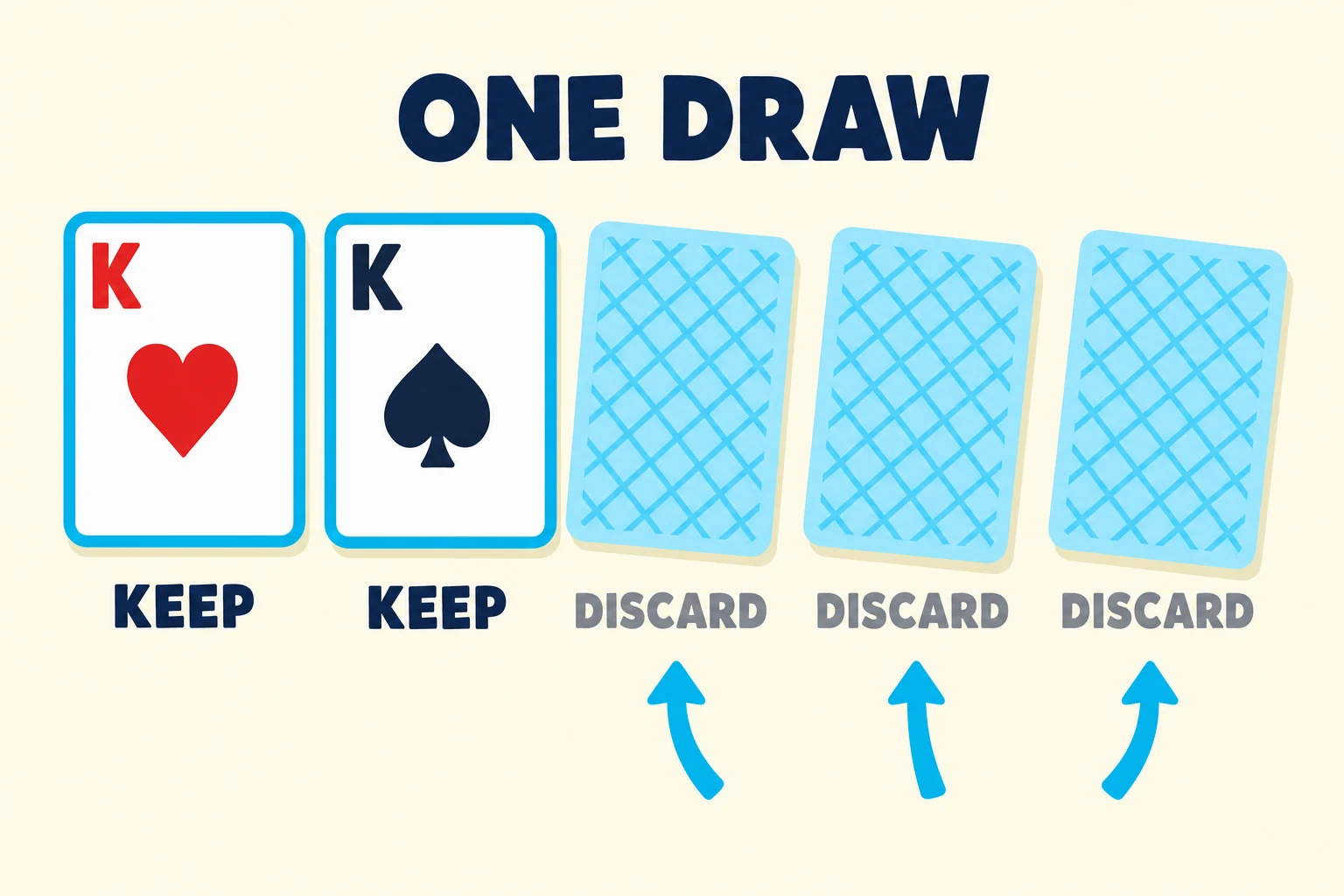
The dealer gives each player five cards face down, one at a time, starting to the left of the button. Nothing is face up, then or later. Every card in this game is private until showdown. You look down at a pair of kings.
Betting starts to the dealer’s left. If nobody has opened, you can check or bet. Once someone opens, the rest can fold, call, or raise. Many home games add an opening requirement, most commonly a pair of jacks or better to open the pot, which is where the name jacks or better comes from.
Each player still in the hand, starting to the dealer’s left, says how many cards they want to draw, discards that many face down, and receives the same number back. You keep the two kings and take three. Keeping all five is called standing pat.
How many you may discard is the one rule that changes from table to table. The traditional home-game limit is three. Many card rooms let you draw any number up to all five. Ask before the first deal, not during your first draw.
One more rule worth knowing: until the second betting round starts, you may ask how many cards another player drew, and you are entitled to an honest answer.
After everyone has drawn, there is one more round of betting, beginning with the player who opened. The three cards brought a third king and a pair of fours, so the pair became a full house. In fixed-limit games the bets in this round are double the size of the first round, so the first round is the cheap one and the decision after the draw is not.
If two or more players are left, the hands are shown and the best five-card hand wins. The standard poker hand rankings apply unchanged, with no low half and no wild cards unless the table agreed to some before the deal. If you want the order in front of you while you deal, there is a printable chart.
What to keep and what to throw
The draw is the whole game, and the arithmetic behind it is short enough to memorize. Three hands, three answers:
- A made hand takes no cards. A straight, a flush, a full house: stand pat, then bet and raise. Slow-playing a pat hand in a two-round game wastes the only two chances you get to build the pot.
- One pair draws three. Keeping the pair and taking three cards gives you roughly a 29 percent chance of finishing with better than one pair. That is the most common hand you will hold, and it is the reason five card draw rewards folding: one pair before the draw is usually one pair after it.
- Four to a flush draws one. Nine cards of your suit sit among the 47 you cannot see, so the flush arrives about 19 percent of the time. An open-ended straight draw is a shade worse at about 17 percent, and an inside straight draw is about half of that. A flush draw on a Hold’em flop is a nine-in-47 shot at the next card as well, about 19% in Poker Skill’s draw lessons, which teach Hold’em and nothing else.
- Three of a kind draws two, or one. Two cards gives you the most chances to fill up, and trips is the hand that most wants to. Keeping a kicker and drawing one card hides the hand a little and costs a little.
Two hands are worth saying out loud because new players get them backwards. Four cards to a flush is nine outs and one card, so it misses about four times out of five. A small pair is a made hand, and it is still fragile against anyone who keeps betting after the draw.
Reading the draw
The number of cards a player takes is the main public information about their cards, alongside how they bet, and everyone at the table gets to see it.
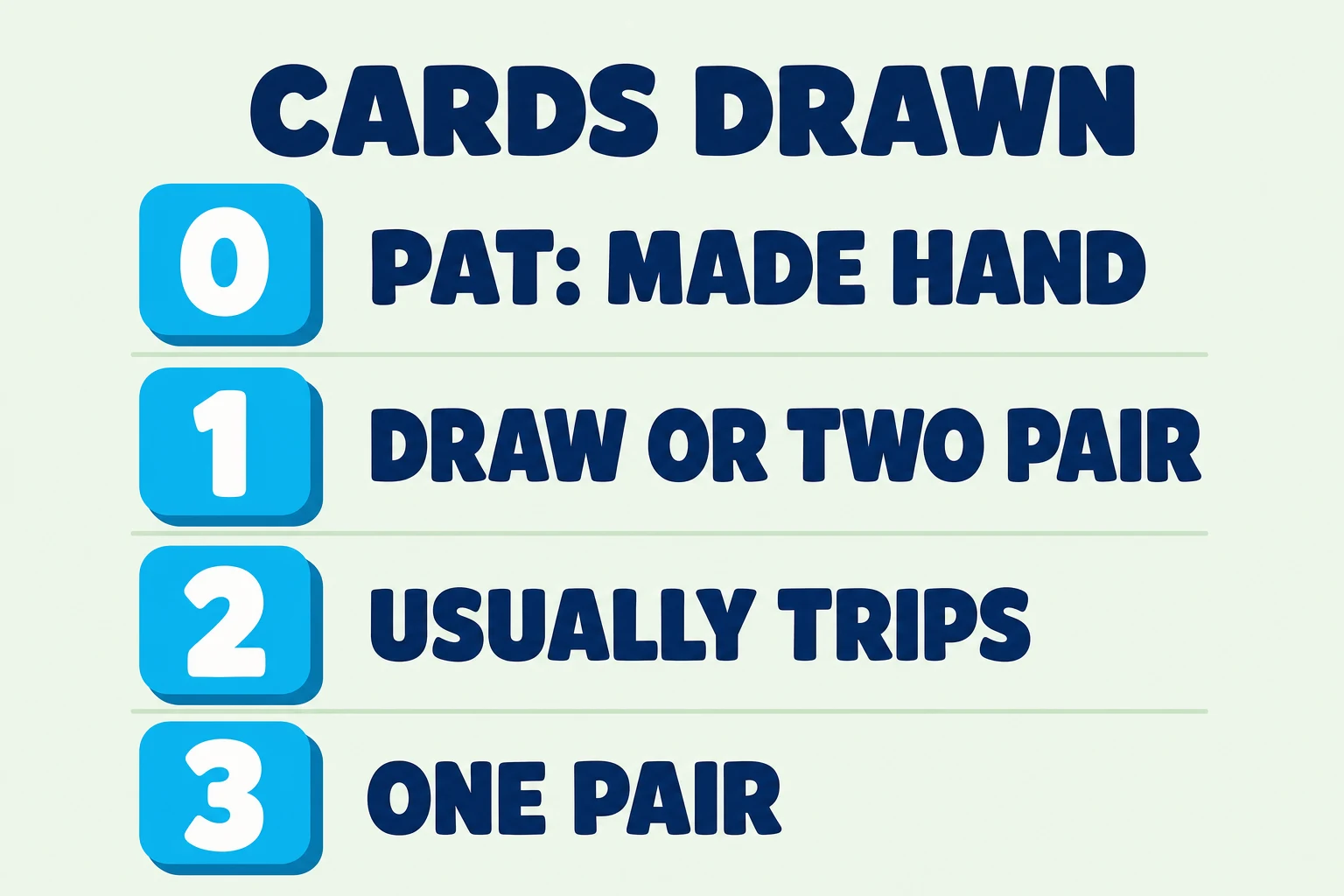
| Cards they take | What it usually means |
|---|---|
| None, standing pat | A made hand: a straight, a flush or better, or a player running a bluff built out of what they did not do. |
| One | The ambiguous one: four to a flush, four to a straight, two pair looking for a full house, or a player representing a made hand. |
| Two | Usually three of a kind, sometimes two pair with a kicker kept, and occasionally three high cards from an optimist. |
| Three | Usually one pair, and sometimes an unpaired hand keeping two high cards. |
| Four or five | If your table allows it, a hand with nothing in it. |
Match the number to what happens next. A player who drew three and then bet the doubled second round is telling a story about hitting trips or two pair. A player who drew one and then checked has often missed, though two pair and better check sometimes too. Neither read is proof, and with only two betting rounds you do not get many chances to be right.
Position without a board
There is no flop to watch, so position does its work in a quieter way: acting last means you see everyone’s draw count and everyone’s second-round action before you decide. Those are real positional advantages, and they are why the early seats should play fewer hands than the late ones.
The mistakes that cost new players
- Playing too many hands. With only two betting rounds and no shared cards, the hand you start with is most of the hand you finish with. A small pair from an early seat is a fold, not an adventure.
- Ignoring the draw counts. The number of cards each opponent took is the game’s only free information, and it is gone as soon as the second round of betting starts.
- Drawing to inside straights. Four outs in a game where you get one card costs chips steadily, and it arrives about half as often as the open-ended version.
- Slow-playing a pat hand. Two betting rounds means two chances to build the pot. Checking one of them away throws half the value out.
- Giving away your own draw. Reaching for your discards before the action gets to you tells the table what you have, for free.
A live-play pattern
Three questions, in order, when the action reaches you.
Is this hand better than one pair, or does it have a real draw with position behind it? If neither, fold, and fold cheaply.
What am I telling the table? Taking one card with two pair says draw. Taking three says pair. Choose which story you want, then bet in a way that matches it.
Who improved? Compare every opponent’s draw count with what they did after it. Bet when the story says they missed, and pass when a pat hand starts raising.
Self-check: what would you draw?
The action is on you and this is your hand. Decide before you open the answer.
Show the answer
Draw one. Keep eight-seven-six-five and throw the deuce: that is an open-ended straight draw, which gets there about 17 percent of the time in this game. Three spades are not four, so there is no flush to chase, and breaking the four-card straight to keep them costs you the only real draw you have. If the deuce had been a spade you would have a genuine choice, and the flush draw at about 19 percent would be the one to take.
Where this fits in your decision
Five card draw is the doorway into the draw family, and it is a draw game rather than a stud game: every card stays private and you get one exchange. Badugi takes the same discard-and-replace mechanic and inverts the goal, so the lowest hand wins and suits decide which cards count. If the mechanics above were the new part rather than the poker, the hand rankings chart covers the hand values this game uses unchanged, and the five card draw glossary entry has the short definition.
Frequently asked questions
How do you play five card draw?
Each player antes, then receives five cards face down. There is a round of betting, then each remaining player in turn discards the cards they do not want and takes the same number of replacements. There is a second round of betting, and if two or more players are left, the best five-card hand wins at showdown.
How many cards can you draw in five card draw?
It depends on the table. The traditional home-game rule lets you discard up to three. Many card rooms let you draw any number up to all five. Keeping your whole hand is called standing pat, and asking about the limit before the first deal is normal.
What are the hand rankings in five card draw?
The standard ones. A royal flush is the best hand, then a straight flush, four of a kind, a full house, a flush, a straight, three of a kind, two pair, one pair, and high card. No low half, no wild cards unless the table agreed to them before the deal.
What does it mean when someone draws one card?
Usually four to a flush or four to a straight, or two pair drawing to a full house, or a made hand that a player is representing. It is the most ambiguous draw count, so the second round of betting is where you get the rest of the evidence.
What does jacks or better mean?
It is a common home-game opening rule: a player needs at least a pair of jacks to open the betting on the first round. Tables that use it are also called jack pots. It exists to stop players opening with nothing, and it is a table agreement rather than part of the base game, so ask before the first deal.