
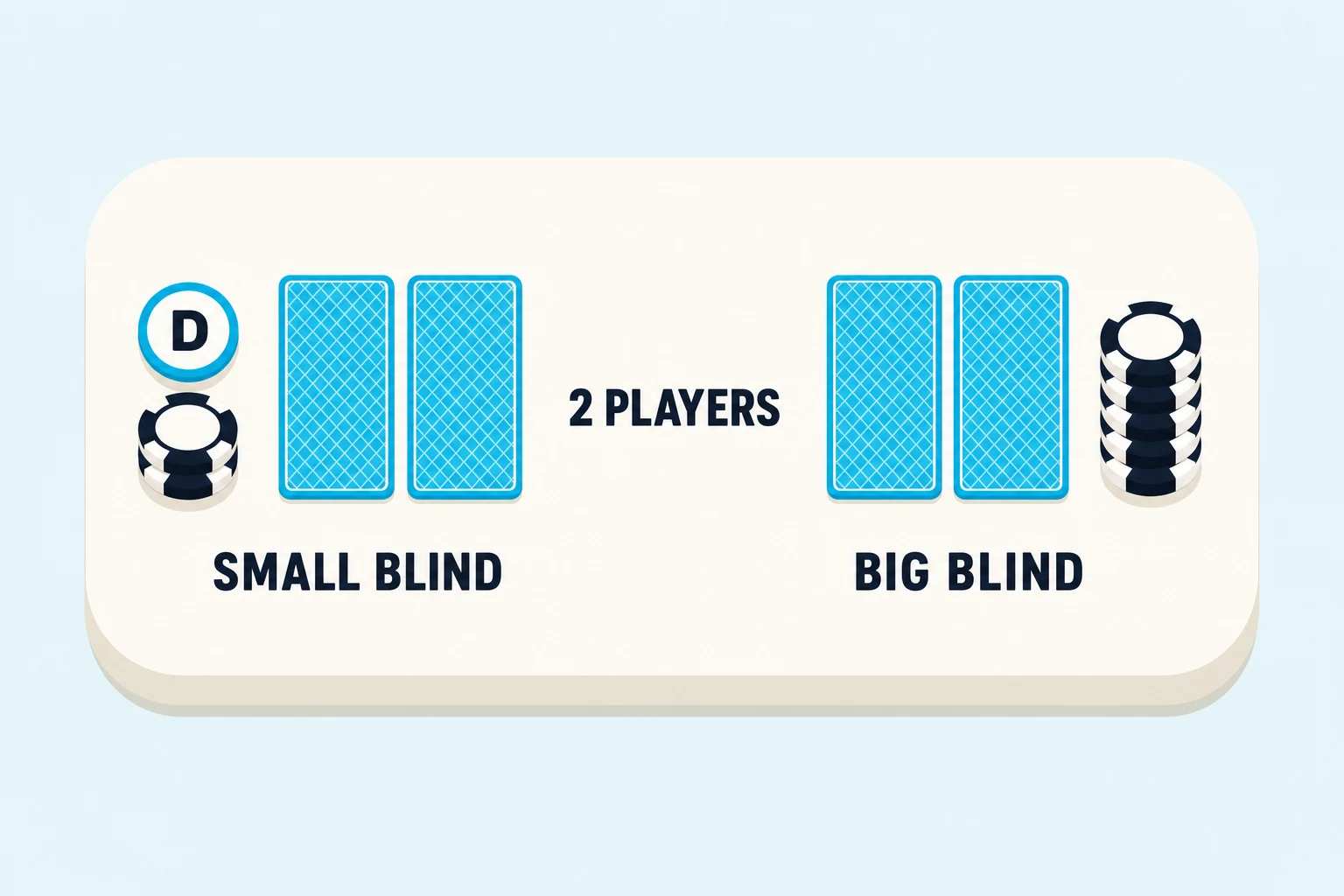
Heads-up poker is poker played between exactly two players. Same cards, same hand rankings, same four betting rounds as any Texas Hold’em game, with two changes that turn it into a different contest: the button posts the small blind and acts first before the flop, and you are dealt into every hand.
Same standard poker hand rankings and the same Texas Hold’em skeleton, with two changes. The button posts the small blind, so the seat order you learned at a full table is inverted. And you are dealt into every hand and post a blind in every hand, which makes folding your way through a session impossible. Heads-up is how most tournaments finish, how sit and go finals end, and it is a format people play on its own. Poker Skill’s Practice vs AI has a heads-up table built on exactly that, where you and one AI opponent swap the blinds every hand.
The shortcut, in one line
You post a blind every hand, so the hands worth playing widen a long way, and the player who bets more often usually takes more of the pots that nobody hit.
Heads-up at a glance
| Trait | Heads-up | 6-max | Full ring |
|---|---|---|---|
| Players | 2 | 6 | 9 or 10 |
| Blinds posted per hand | 2 | 2 | 2 |
| Hands you pay a blind in | Every hand | One in three | One in four or five |
| Who posts the small blind | The button | The seat left of the button | The seat left of the button |
| Acts first before the flop | The button | The seat left of the big blind | The seat left of the big blind |
| Acts first after the flop | The big blind | First active player left of the button | First active player left of the button |
| Typical starting-hand width | Very wide | Wide in late position | Tightest |
| Pots contested by three or more | Never | Common | Common |
Positions when only two play
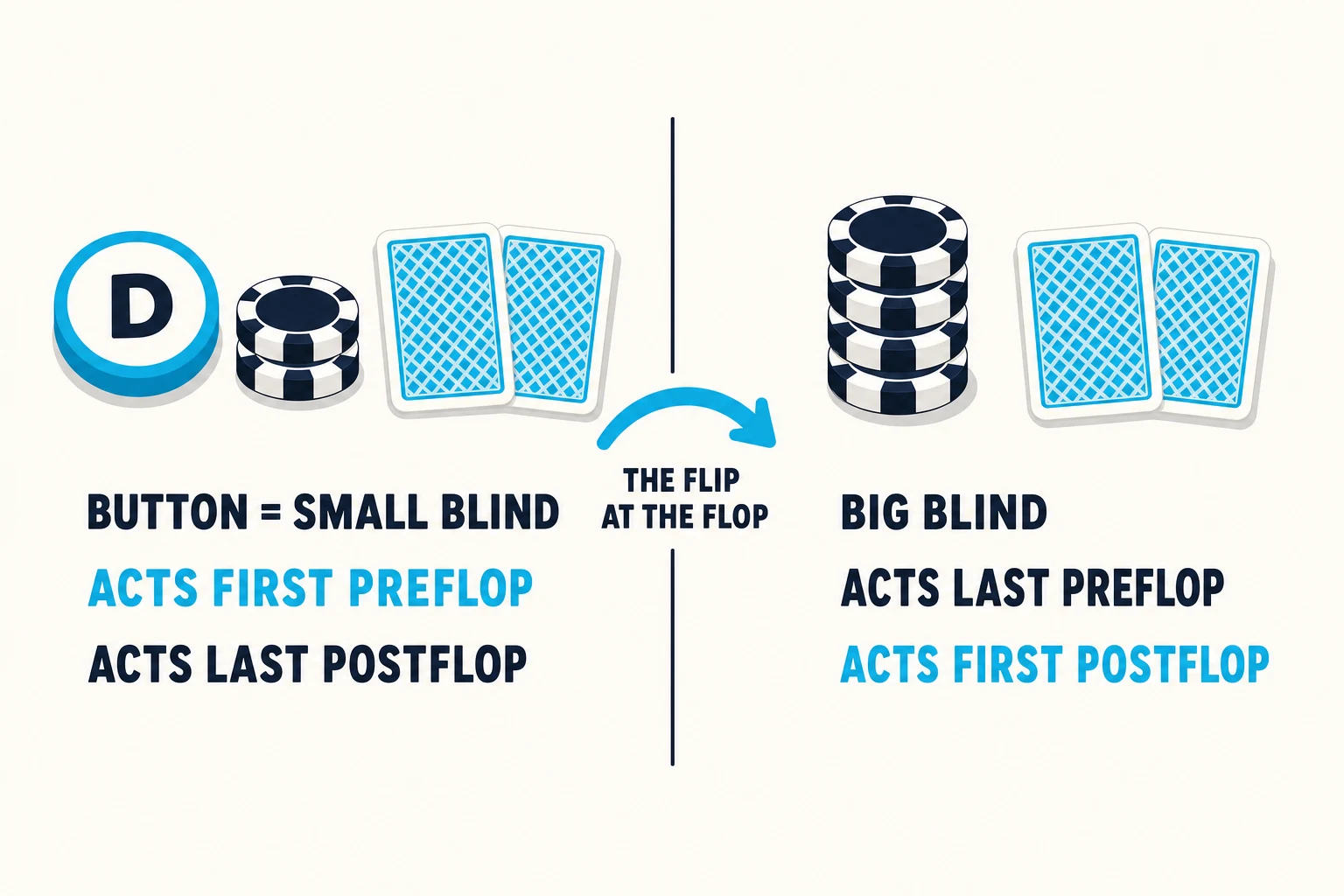
This is the rule people get wrong, so here it is in both directions.
The player on the button posts the small blind. Before the flop, that player acts first. On the flop, the turn and the river, that same player acts last.
The other player posts the big blind. Before the flop, the big blind acts second and last, with the option to check or raise if the button only calls. On the flop, the turn and the river, the big blind acts first.
At a full table the small blind and the button are different seats, and the small blind acts first after the flop. Heads-up they are the same seat, and the order flips at the flop. If you take one thing from this page, take that: the button is the small blind, it acts first before the flop, and it is in position on every street after it.
One hand, in order
The button posts the small blind, the other player posts the big blind, and both get two cards. Nobody else is at the table, so both of you are in every hand whether you like it or not.
Fold, call, or raise. Say the button raises. The big blind acts last and can fold, call, or raise back. Say it calls. This is the order that catches everybody, because at a full table the button never acts first.
The big blind acts first and checks. The button acts last and bets. From here to the end, the seat that was first preflop is last on every street.
Big blind first, button last, until the hand ends or somebody folds.
| Street | Acts first | Acts last |
|---|---|---|
| Preflop | Button (small blind) | Big blind |
| Flop | Big blind | Button |
| Turn | Big blind | Button |
| River | Big blind | Button |
The practical consequence is that the button is the seat you want. Acting last on three of the four betting rounds, which is what position buys you, is worth more than acting last on one, and it is the reason a wider range of hands is playable from the button than from the big blind, even in a game where every hand is played by both people.
Why ranges get so much wider
Do the arithmetic on the blinds. At a nine-handed table you post a blind twice in nine hands. Heads-up you post one every hand, and half of those are the big blind. Folding costs you the blinds you post, and there is no such thing as waiting for a better seat, because there are only two seats and you take turns.
So the standard for playing a hand drops a long way. Hands like A-7 suited or K-9 suited, which are folds or marginal opens from most seats at a nine-handed table, are ordinary raises from the button heads-up.
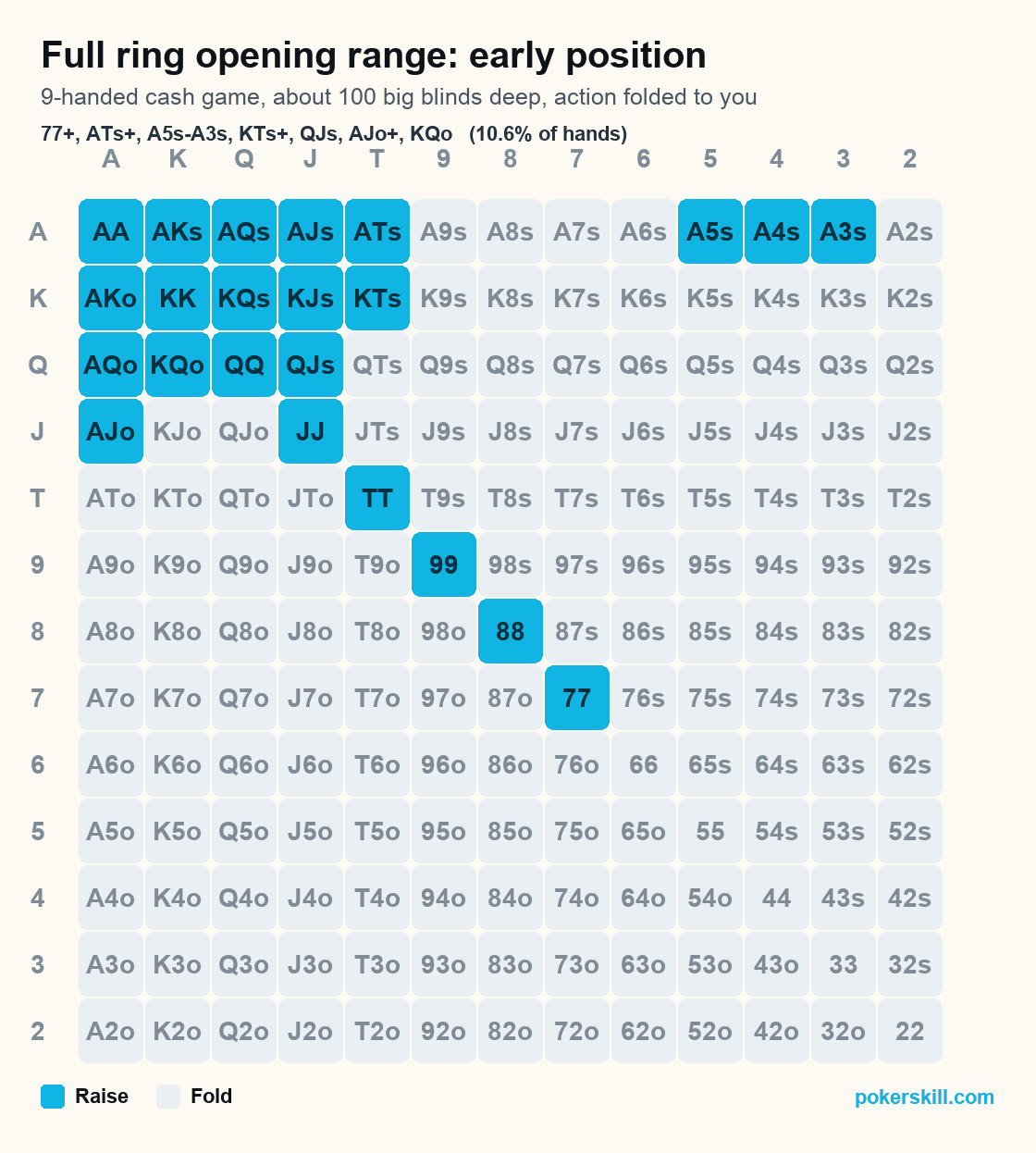
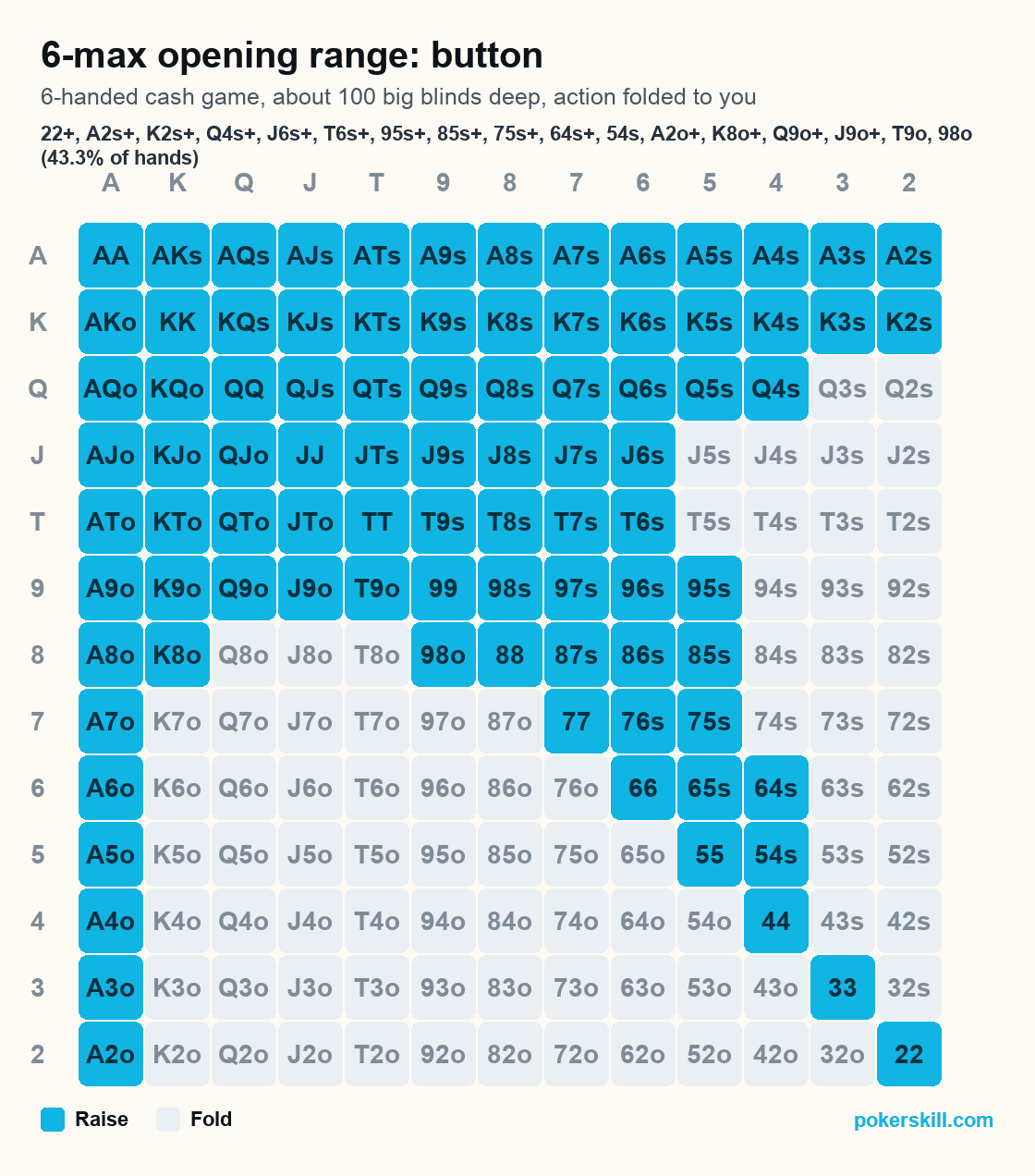
Those two grids are the argument. Nothing about A-7 suited changed between them. The reason is not that the hands got better. It is that you are only ever against one other hand, and one random hand is beaten by a lot of things.
The big blind side of that widens too. The books put big-blind defense at its widest heads-up, for two reasons that hold every hand: you are getting pot odds to call because your blind is already in the pot, and you close the action, so you never call and then face a raise behind you. Against a standard small raise from the button, almost any hand that can make a pair or a draw is a candidate to continue with. Against a large raise, tighten.
A chart can give you a baseline to start from. The habit that decides the session is asking what this one opponent does with their wide range, then widening or tightening against that.
Aggression and the flop bet
Most flops miss most hands. With one opponent, the books put the chance that the other player connects with the flop at about 40 percent, and with more players in the pot that number climbs fast. Heads-up you are always in the first case, which is why the continuation bet from the preflop raiser works more often here than it does at a fuller table.
So bet more flops than you would with a crowd, especially dry ones, and keep the bets small enough that they do not have to work often to be worth making. Poker Skill teaches the small dry-flop c-bet with A♦ K♦ on 9♥ 4♣ 2♦: you missed, but with the initiative on a board that dry, a small bet is a solid default. The mirror image matters just as much: your opponent is doing the same thing, so folding every time you miss hands them the pot on a schedule. Against a small bet, a pair, a draw, or two overcards is often enough to continue once.
Aggression here is about how often you bet, not about how you carry yourself. Betting a lot of dry flops with a plan for the turn is the pattern. Betting every street of every hand is the habit an attentive opponent starts calling with anything.
Playing from the big blind
Out of position for three streets is the hard seat, and it is half of your hands. Three habits make it survivable.
| Habit | Why it works |
|---|---|
| Raise before the flop with the top of your range | Calling every time lets the button open every hand cheaply and see a flop with the wider range. Raising some of them wins pots before the flop and makes the free open cost something |
| Lead or check-raise the flops that suit you | Low, connected boards suit a calling range better than a wide opening range full of big cards that miss them |
| Give up cleanly | Out of position with nothing on a board that helps them, folding early costs you nothing more. Calling twice to find out costs two more bets and usually ends the same way |
Check yourself: who acts first here?
You are on the button heads-up. You raise, the big blind calls, and the flop comes. Who puts in the first action on the flop?
Show the answer
The big blind. You acted first before the flop because the button posts the small blind heads-up, and that is the inversion everyone trips on. From the flop onward the normal order returns and you act last on every remaining street. One seat, first preflop and last on three streets, which is why the button is the seat you want.
The mistakes that cost new players
- Playing a full-table range. Bringing a nine-handed folding standard to a two-handed table means posting a blind every hand while you wait for the same premiums.
- Never defending the big blind. The button opens wide because your folds hand over the blinds uncontested. Defending with hands that can make a pair or a draw takes that away.
- Forgetting the inversion. Planning the flop as though you still act first, when heads-up the button acts last after the flop, is a common error and it costs chips.
- Bluffing every street with nothing. One bet on the flop with a plan is aggression. Three bets with no equity and no fold equity is chips handed to a player who has noticed.
- Treating one wild session as a read. Two players get through hands quickly, so patterns show up sooner than at a full table, but one session of running bad is still a small sample.
A live-play pattern
Three reads, in order, before every decision.
Which seat am I in this hand? The button acts first before the flop and last after it, and the big blind is the other way around.
What is this opponent doing too often? Heads-up you get a decision from the same range every hand, so the pattern arrives fast: folding to flop bets, calling everything, raising the button constantly. Pick the leak and attack that one.
What does this board do for the range that got here? A board of low connected cards is better for the player who called than for the player who opened. A board of big cards is better for the opener.
Where this fits in your decision
Heads-up is how most tournaments finish, so the format arrives whether you seek it out or not: the sit and go article covers the phases that lead into it, and poker positions covers the seat map that heads-up compresses into two. If any of the mechanics above were new, the complete Texas Hold’em rules cover the game itself. The term on its own lives in the heads-up glossary entry.
Frequently asked questions
What is heads-up poker?
Heads-up poker is a game or a hand played between exactly two players. The rules, the cards and the hand rankings are the same as any other Texas Hold'em game. What changes is that the button posts the small blind, and both players are dealt in and post a blind every hand, so the ranges widen and the pace picks up.
Who posts the small blind in heads-up poker?
The player on the button. That is the inversion from a full table, where the small blind sits to the button's left. The other player posts the big blind, and the blinds move between the two players hand by hand.
Who acts first in heads-up poker?
Before the flop, the button acts first, because it is the small blind. On the flop, the turn and the river, the big blind acts first and the button acts last. That flip at the flop is the rule new heads-up players miss most often.
How do you play heads-up poker well?
Play many more hands than you would at a full table, take raising as your default from the button, defend the big blind widely instead of folding it away, bet a lot of dry flops with a plan for the turn, and pick the one thing your opponent does too often. It is a matchup, so the pattern you build against this player is the strategy.
Is heads-up poker all about aggression?
Aggression wins the pots nobody hit, and most flops miss most hands, so it matters more here than at a full table. It is about how often you bet rather than how you behave: bet a lot of dry flops, give up cleanly when the board and the action say the bluff is finished, and make sure the hands you value bet are getting called by worse.