
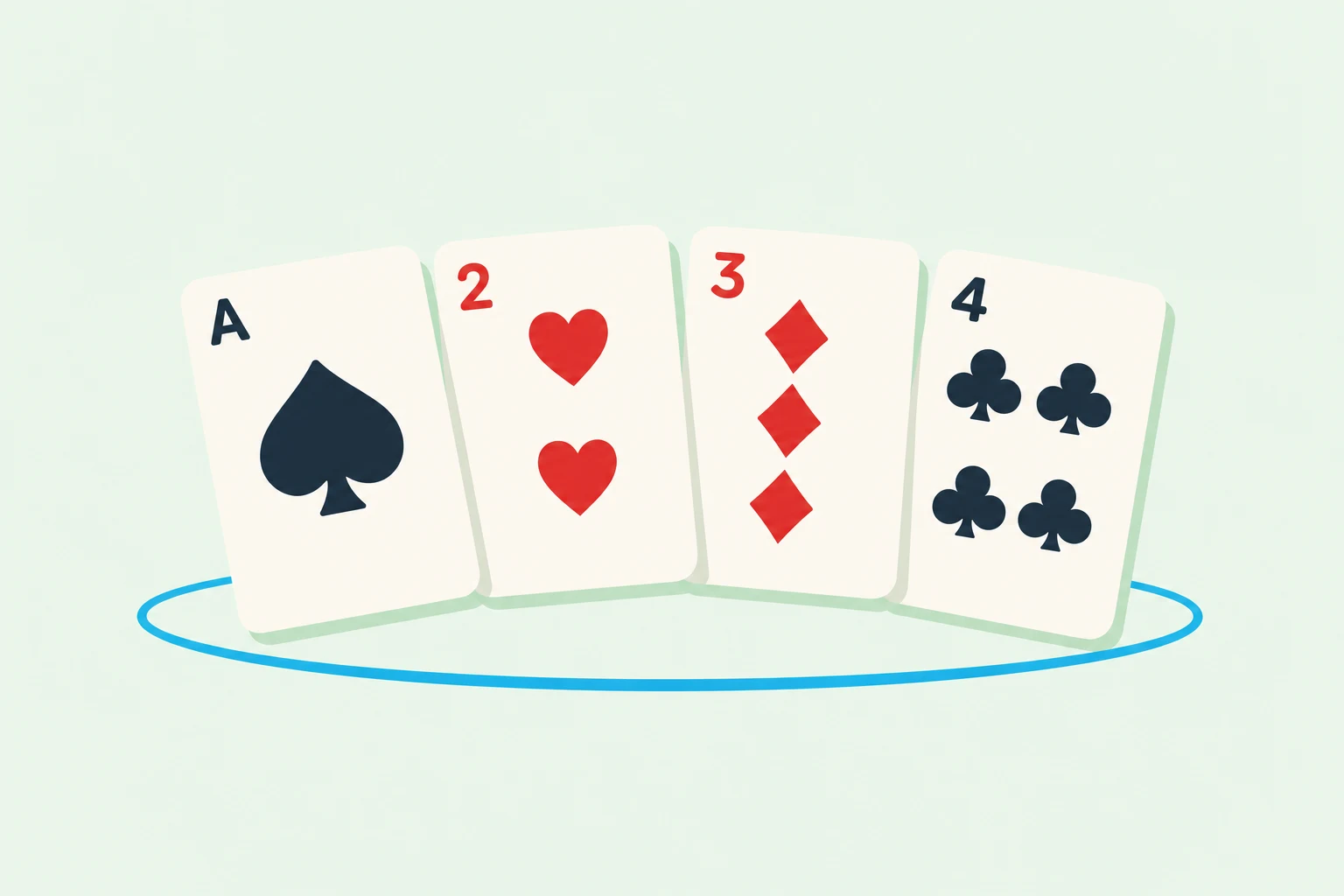
Badugi is a four-card draw poker game where the lowest hand wins and suits decide whether your cards even count. Each player is dealt four cards face down, there are three chances to draw new ones, and at showdown the best hand is four cards of four different ranks in four different suits, as low as possible. That complete four-card hand is what the game calls a badugi.
Aces are low, there are no community cards, and the whole game runs on one unusual rule: a card that repeats a rank or a suit you already hold does not count at all. Three chances to draw and one showdown decide it.
The shortcut, in one line
Start with three low cards of different suits, draw to the fourth, and remember that any complete four-card hand beats every three-card hand no matter how pretty the three cards look.
Badugi at a glance
| Trait | Badugi | Five card draw | Texas Hold’em |
|---|---|---|---|
| Cards per player | 4 | 5 | 2 plus 5 shared |
| Community cards | None | None | Five |
| Draws | Three | One | None |
| Betting rounds | Four | Two | Four |
| Goal | Lowest four-card hand, all different suits and ranks | Highest five-card hand | Highest five-card hand |
| Do suits matter? | Yes, they decide which cards count | Only for flushes | Only for flushes |
| Best hand | A-2-3-4 in four suits | Royal flush | Royal flush |
| Betting structure | Commonly fixed limit | Varies | Usually no limit |
Hand rankings: what a badugi is
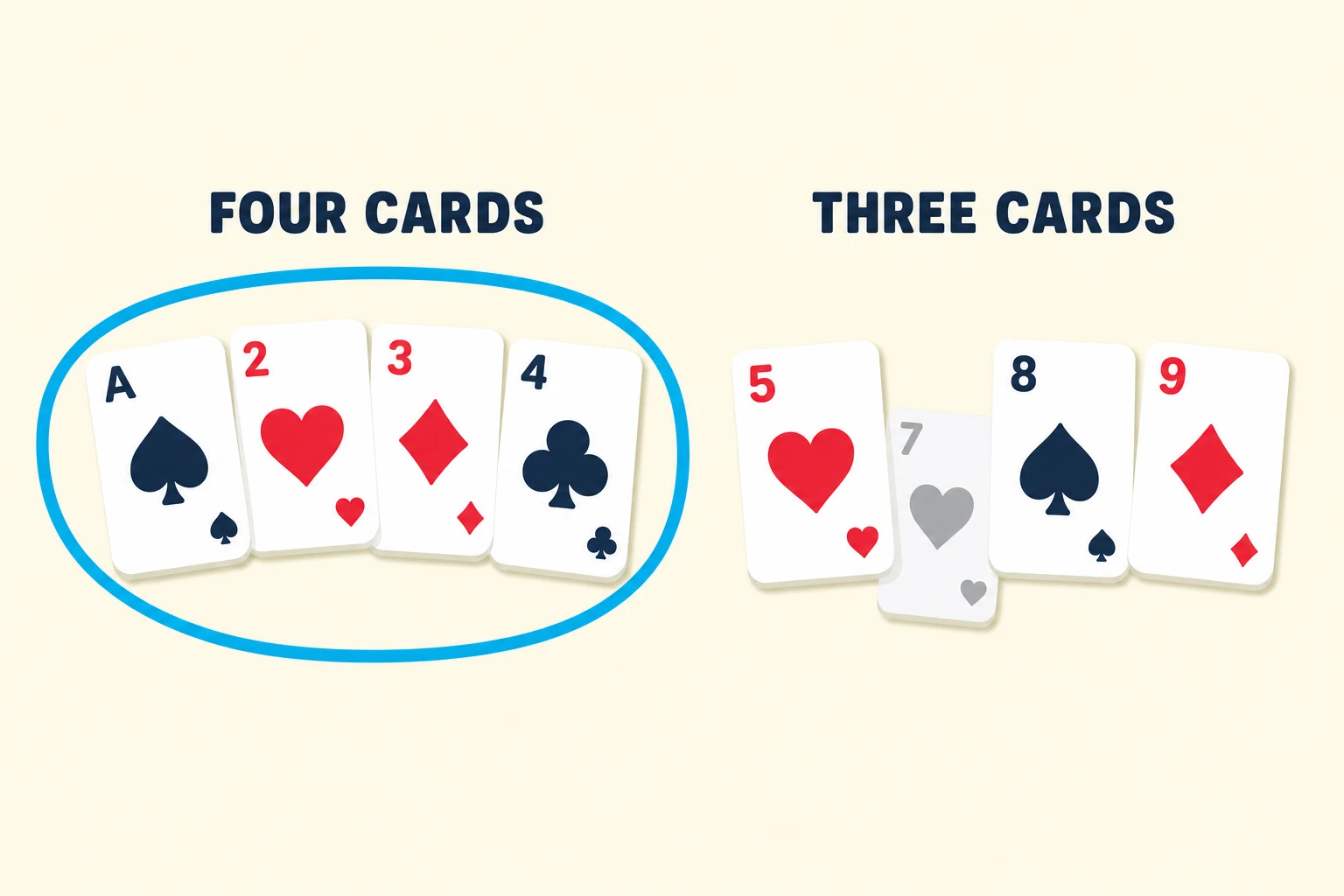
Start with the rule that makes this game different from every other one you know. Inside a single hand, every card that counts must have a different rank and a different suit. Your hand is the best valid set you can build from the four cards you hold, which means dropping cards until no suit and no rank repeats. What survives is your hand, and it can be four cards, three cards, two cards or even one. When you have a choice about which card to drop, keep the lower one.
A hand where all four cards survive is a badugi. Four different ranks, four different suits.
Comparing hands is a two-step job:
- More cards wins. Any four-card badugi beats any three-card hand, which beats any two-card hand, which beats any one-card hand. K-Q-J-8 as a badugi beats 3-2-A as a three-card hand, even though the three-card hand looks lower.
- Then lowest top card wins. Between hands with the same number of cards, compare the highest card first. The hand with the lower high card wins. If those match, compare the next highest, and keep going down. 8-7-5-4 beats 9-4-3-2 because the eight is lower than the nine. 10-7-5-4 beats 10-7-6-A because the five is lower than the six.
The best possible hand is A-2-3-4 with one card of each suit, since aces are low and no four cards are lower.
Players sometimes borrow the wheel nickname for it, the same word lowball games use for their best hand. Suits have no ranking of their own, so two hands that reduce to the same ranks are exactly equal and split the pot.
Three worked reductions. Deal yourself the four cards, then strike out every card that repeats a rank or a suit already counting.
The rules in one read
Badugi is dealt with a button and blinds like Hold’em, and it is commonly spread as a fixed-limit game.
The deal and the first betting round
Every player gets four cards face down, one at a time. The player to the left of the big blind acts first, and the round is ordinary poker: fold, call, or raise.
The three draws
After the first betting round, each player in turn says how many cards they want to exchange, discards them face down, and receives the same number back. You can exchange all four, some of them, or none at all. Taking none is called standing pat, and it announces to the table that you are happy with what you have.
That happens three times, with a betting round after each draw. Four betting rounds in total: one after the deal and one after each of the three draws. After a draw, the betting starts with the first player still in the hand to the left of the button, so the seat that acts first changes once the first draw is done.
Where the bet size changes
In fixed-limit badugi the small bet covers the first two betting rounds, and the bet doubles after the second draw, so the third and fourth rounds are played for the big bet. As in stud, the expensive streets are the ones where drawing hands have to justify themselves.
Showdown
If more than one player is left after the final betting round, the hands are shown. Everybody shows all four cards even when duplicates mean only two or three of them count, and the best hand takes the pot. Ties split it.
What makes a starting hand strong
Four cards, four suits, low ranks. That is the whole target, and starting hands are judged by how close they already are to it.
Four low cards in four suits is the dream and it does not need a draw at all. A three-card badugi with low cards is the standard playable hand: one card to replace. A high three-card badugi is a weak start, because even when you complete it, a nine-high badugi loses to every badugi with a lower top card. Two-card starts are playable in position and expensive out of it.
The habit to unlearn from Hold’em: matching cards do not help here, they hurt. Three low cards of one suit are worth much less than they look, because only one of them can count. A 2-7-9 in three different suits is worth more than three low cards in the same suit.
Check yourself: does this count as a badugi?
You are dealt 8♠ 6♣ 3♦ 3♥ and you stand pat. Your opponent turns over K♦ 9♣ 5♥ 2♠. Who wins?
Show the answer
Your opponent, and it is not close. Your two threes mean only one of them counts, so you hold the three-card hand 8♠ 6♣ 3♦. Theirs has four ranks in four suits, so it is a complete badugi, king-high. Step one of the comparison is “more cards wins”, and it settles the hand before the ranks are even compared. A king-high badugi beating an eight-high three-card hand is the rule this game turns on, and standing pat with three cards is the mistake it punishes.
Snowing, and why it is an advanced move
Standing pat with a hand that is not made, hoping the pat announcement wins the pot on its own, is called snowing. It is a bluff built entirely out of what you did not do. It works because complete badugis are hard to make, so a player who is still drawing will often fold to someone who is not.
Treat it as an advanced move rather than a default. It is a bluff, it costs real bets in a fixed-limit game, and it is at its worst against the player it looks most tempting against: someone who has been standing pat or drawing one card for a couple of rounds probably has the hand you are pretending to have.
The mistakes that cost new players
- Counting a hand before removing duplicates. Two cards of one suit means one of them is not in your hand at all.
- Overvaluing a three-card hand. It loses to every four-card badugi at showdown, however low its three cards are.
- Drawing to matching suits. Low cards in the same suit are the trap of this game. Poker Skill teaches four cards of one suit as a Hold’em flush draw, one card away from a flush, and in badugi the same four cards make a one-card hand.
- Ignoring how many cards opponents drew. In a draw game, the number of cards taken is the main public information you get, and it is the closest thing badugi has to a face-up card in stud.
- Paying big bets with a broken hand. The bet doubles for the last two rounds, and a three-card hand chasing a fourth card is exactly the hand that pays those bets and loses.
A live-play pattern
Three reads, in order, before every draw.
Count the cards that survive after duplicates are removed, not the cards in your hand. Two of a suit means one of them is not in your hand at all.
A player drawing two cards is a long way from a badugi. A player who stood pat is either finished or telling you a story.
The first two rounds are the small bet; after the second draw it doubles. A hand worth one more card early is often not worth one more card late.
Where this fits in your decision
Badugi is a compact introduction to draw poker thinking: no board to read, no shared cards, only your four cards and what the other players’ draws tell you. If you have played for a low hand before, the ace-to-five ideas that drive Razz carry over in spirit, though badugi’s suit rule is its own thing entirely. The hand rankings chart does not apply here at all. Badugi runs on its own ranking system and nothing else.
Frequently asked questions
What is badugi?
Badugi is a four-card draw game where the lowest hand wins and suits matter. A hand only counts a card if it does not repeat a rank or a suit already in the hand, so a complete four-card hand needs four different ranks in four different suits. That complete hand is itself called a badugi.
What is the best hand in badugi?
A-2-3-4 with one card of each suit. Aces are low, straights and flushes do not exist as hands here, so the lowest four different ranks in four different suits is the top of the ranking. Some players call it the wheel.
How do badugi hand rankings work?
Count the cards that survive the duplicate rules first. A four-card hand beats any three-card hand, which beats any two-card hand. When both hands have the same number of cards, compare the highest card and the lower one wins, then the next highest, and so on down.
How many draws are there in badugi?
Three. There is a betting round after the deal, then a draw, then a betting round after each of the three draws, so four betting rounds in total. On each draw you may exchange none, one, two, three or all four of your cards. Taking none is called standing pat.
Is badugi played for high or low?
Low. The lowest qualifying hand wins the pot, and high cards are a liability. The rules also make a shorter hand lose to a longer one, so a smooth-looking three-card hand still loses to any four-card badugi.