


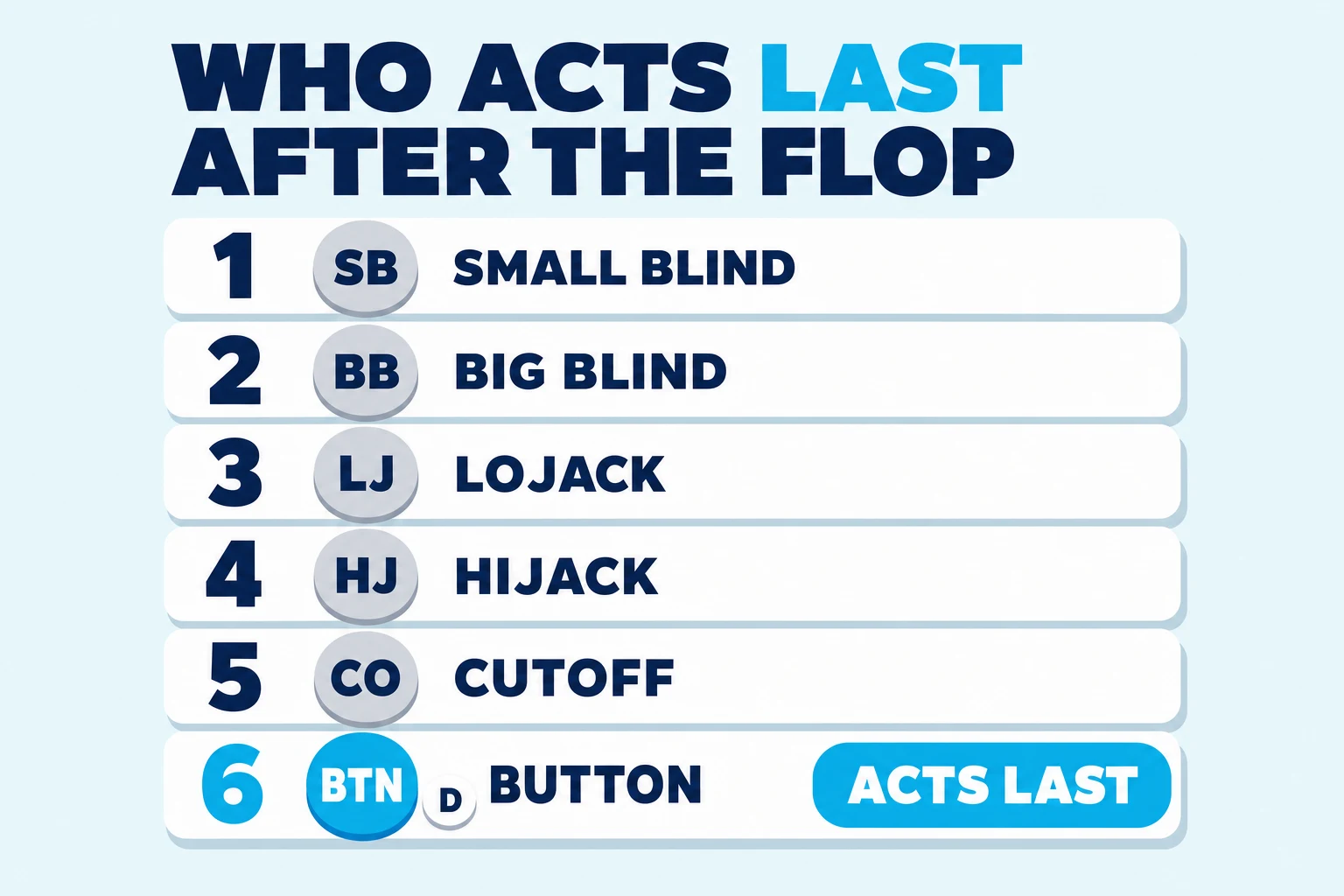
Position is where you sit relative to the dealer button, and it settles the one question that shapes every other question: do you act before your opponent, or after them? Seats are counted back from the button, the button acts last on every street after the flop, and the two blinds act first and second. The closer to the button you are, the more you know when it is your turn, and the more hands you can play at a profit.
The short version
Acting last is worth more than any two cards you can be dealt. The button acts after everyone on the flop, turn and river, so it plays the widest range at the table. The hands each seat plays are charted on opening ranges by position. The blinds pay before they see a card and then act first and second on those same streets, so they lose money over time and the job there is to lose less. Every other seat sits on the slider between the two.
The seats, counted back from the button
Seat names are positions relative to the button, not fixed chairs. Start at the button and walk backwards.
| Seat | Short | Where it sits | Order after the flop |
|---|---|---|---|
| Button | BTN | the seat with the dealer button | last |
| Cutoff | CO | one seat before the button | second to last |
| Hijack | HJ | one seat before the cutoff | third to last |
| Lojack | LJ | one seat before the hijack | fourth to last |
| Small blind | SB | first seat after the button | first |
| Big blind | BB | second seat after the button | second |
Those six are the whole table in a six-handed game. Add players and you add seats in front of the lojack: under the gun, which is whoever acts first before the flop, and then UTG+1 and UTG+2 behind it at a full ring table. Shorten the table and those front seats come off again, highest number first. This is why a hijack exists in a six-handed game and a UTG+2 does not: the seats nearest the button survive every table size, and the seats furthest from it are the ones that come and go.
The blinds break the pattern in a way worth staring at. Because they post before the deal, they are the last two to act before the flop and the first two on every street after it. The small blind is next to last preflop and first postflop; the big blind is last preflop and second postflop. Preflop, the big blind has the best seat in the room. From the flop onwards it has the second worst, and since three of the four betting rounds and nearly all of the big pots happen after the flop, the postflop column is the one that should drive how you play.
Why acting last is the whole point
Position is an information trade. Whoever acts first has to commit to a check, a bet or a raise while learning nothing. Whoever acts last watches that decision and then chooses. Every postflop edge people talk about is downstream of that single asymmetry.
Acting last is what makes pot control possible. With a marginal hand you can check behind and take a cheap card instead of getting raised off it. With a strong hand you can make the bet that your opponent’s check just told you they will pay. Bluffs get more credible, because you are betting into a player who has already shown weakness rather than guessing at it. Protection gets easier, because you can charge a draw after seeing whether the draw is even interested. Continuation bets get simpler too: against average opponents, firing two-thirds to three-quarters of the time after you raised preflop is a workable baseline, and it is easier to follow when the check comes to you first.
The player without position gets none of that. Same cards, same board, but every line they take leaks information before any arrives. That is the whole reason the identical hand is a raise from the cutoff and a fold from the front of the table. The cards did not change. The order did.
The button is the seat that prints
The button acts last on the flop, turn and river, and only two players act after it before the flop. Both of those players are in the blinds, and both will be acting before it for the rest of the hand. Late position opens far wider than early position for exactly that reason: the edge repeats on every street, and it is worth more the more streets and chips are left to play for. Jack-ten offsuit shows the gap in Poker Skill’s raise-or-fold lessons: a fold under the gun, a standard open from the cutoff.
What the button is doing with all those extra hands is stealing the blinds, and in a cash game that matters because the chips are real money rather than tournament equity. It also works less often than tournament players expect. Cash games run looser, players are more willing to gamble, and a steal that gets called leaves you in a pot with a weak hand against someone who is out of position and not folding. The standard adjustment is size: raise larger against loose players who will have to act first after the flop, so the price they are getting is worse.
The blinds are where the money leaks
The small blind and the big blind pay before they see a card, then act first and second on every street that decides the pot. Both lose money across a lifetime of hands. That is the structure of the game rather than a leak to fix, and the goal is to lose less.
Of the two, the big blind loses the most, and it is supposed to. It also has the best price anywhere at the table, because part of your money is already in the pot. The correct response to a wider opener making a smaller raise is to defend more, either by calling or by three-betting; the correct response to a bigger raise is to defend less. The small blind loses less than the big blind and can get close to breaking even if it is played very well, but that is mostly because folding there surrenders only half a big blind. It is a cheaper seat, not a better one, and it never closes the preflop action, so your call can still be attacked by the player behind you.
One small-blind habit is worth deleting on sight: raising a wide range from there against the big blind. Against a competent opponent the goal in the small blind is to put in as little money as possible while out of position, and a wide, cheap raise does the opposite. It hands the big blind a price good enough to continue with almost anything, then leaves you acting first for three streets against a range you did nothing to narrow.
Where position thinking lies to you
The first trap is treating the chart as the reason. Ranges widen toward the button because of how many players still get to act and how often you will hold the information edge, not because the button is magic. A big blind who defends and fights every pot makes the steal worth less than the chart claims.
The second trap is winning a few pots from the front of the table and concluding the seat did not matter. Opening too many hands from early position is the standard small-stakes leak, and it is expensive precisely because it never feels expensive. You win some, you lose the big ones, and the damage turns up across thousands of hands rather than in any single session you can remember.
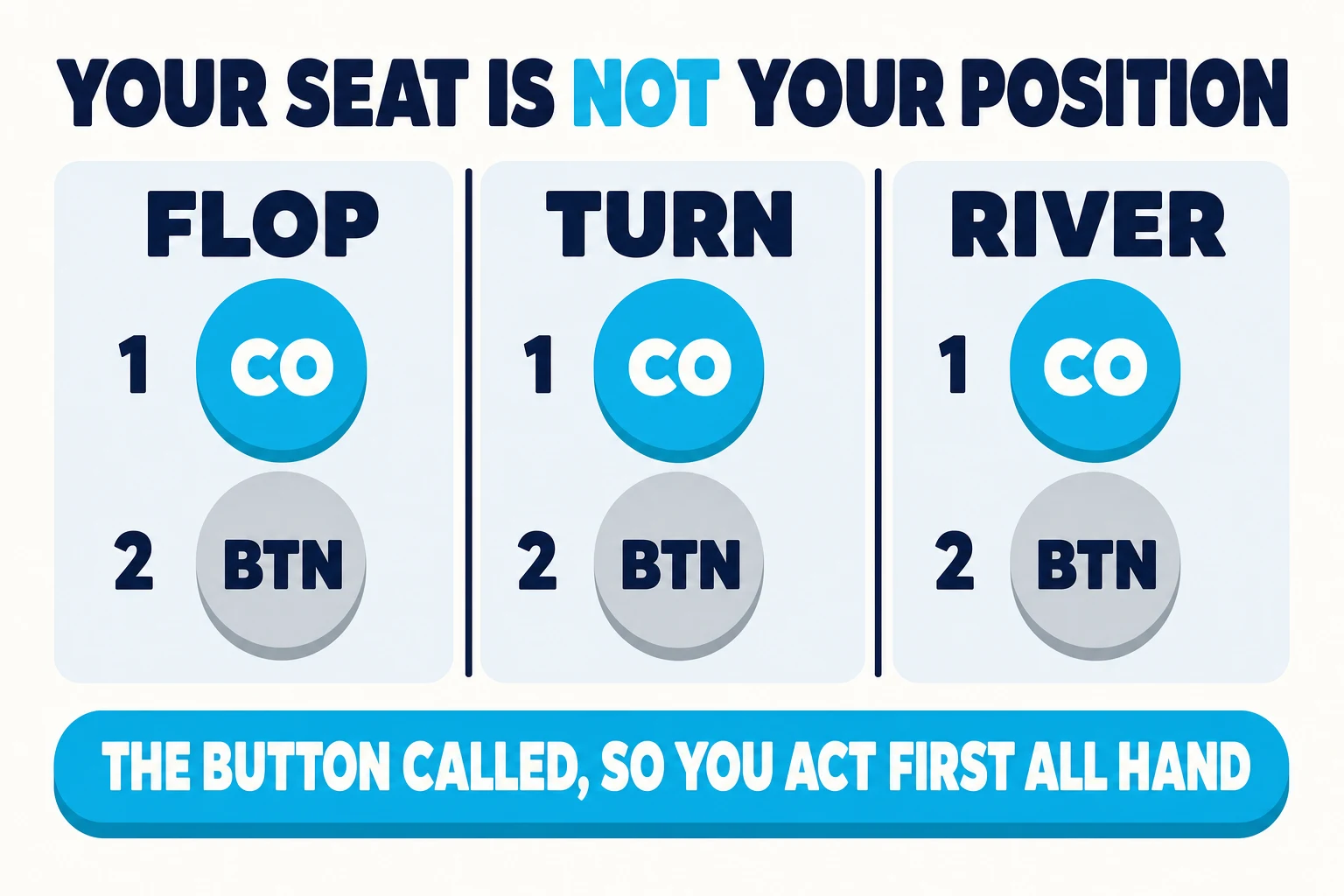
The third is forgetting that position is relative as well as absolute. Your seat relative to the button is fixed when the hand starts. Your position relative to the players still in the pot is not. You can open the cutoff and be out of position for the entire hand because the button called behind you. The seat name sets the preflop order. Who is left in the pot sets the postflop order, and only the second one gets to keep the money.
Three questions before you enter a pot
Ask these in order, before you look at the seat’s name.
How many players still act behind me? That count, not the seat’s name, is what sets how strong your hand has to be.
If I get called, who acts last on the flop? If the answer is not you, tighten up, because you will be paying for information all the way to the river.
Am I entering because the hand is good, or because I am bored and the blinds are coming around? The second reason costs money, and it shows up most often in the seats that can least afford it.
Where this fits in your game
Position is the first filter every other decision passes through. Which hands you open-raise is a positional question before it is a card-strength question, and the preflop charts put a seat-by-seat answer on one page. How wide a range you hand an opponent depends on the seat they opened from. Bet sizing, continuation-bet frequency and whether to bluff at all shift with who acts last. Learn the seats first and everything else has somewhere to attach.
FAQ
What are the positions in poker?
Counting back from the dealer button: the button, the cutoff, the hijack and the lojack, plus the small blind and big blind immediately after the button. Those six are the full list at a six-handed table. Bigger tables add under the gun and the UTG seats in front of the lojack. The button acts last after the flop and is the strongest seat; the blinds act first and second after the flop and are the weakest.
What is the best position in poker?
The button. It acts last on the flop, turn and river, which is where most of the money moves, and only the two blinds act after it before the flop. That is why it can play more hands profitably than any other seat.
Why is the earliest seat the worst one?
Because everyone acts after you before the flop, and the seats nearer the button act after you for the rest of the hand too. Any hand you open has to survive more opponents while you hold less information than any of them, which is why the range you open from the front of the table is the tightest one you will use.
Is the big blind a good position?
No, but it is a cheap one to defend. The big blind loses more money than any other seat over time, because it pays before seeing cards and acts before everyone but the small blind once the flop lands. What it does have is the best price in the pot, which means folding too much from there is its own mistake.