
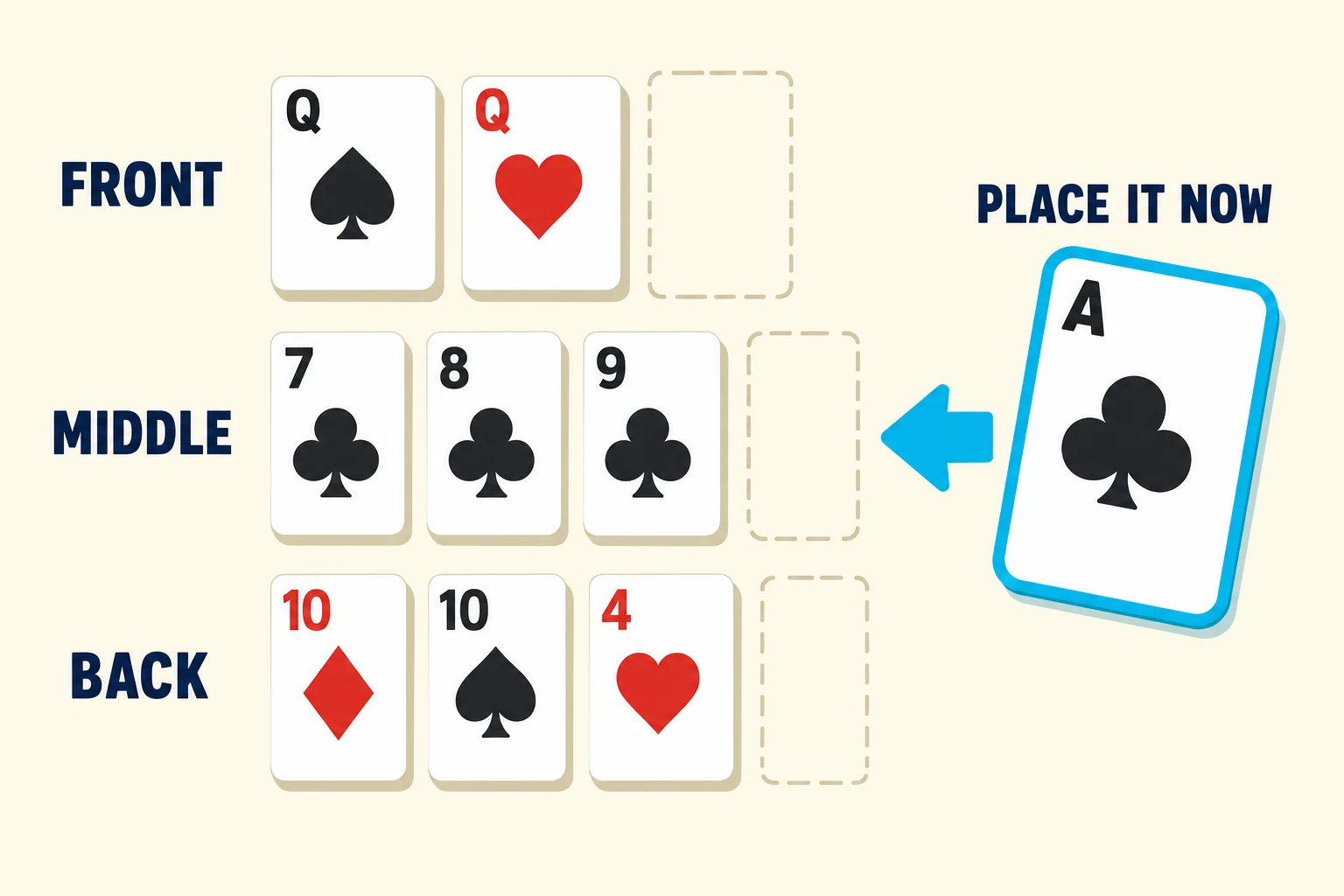
Chinese poker is a card game where each player builds three poker hands out of thirteen cards and scores points against every other player, one hand at a time. There is no betting, no pot, and no folding. You split thirteen cards into a five-card back row, a five-card middle row and a three-card front row, and then everyone compares rows.
You get thirteen cards and you set them into three rows. The order rule is what makes it a puzzle: your back row must be at least as strong as your middle, and your middle at least as strong as your front. Break that and your hand is fouled and scores nothing. The version most new players meet now is open-face Chinese, or OFC, where the thirteen cards arrive a few at a time and you place each one before you know what comes next.
The shortcut, in one line
Set a legal hand first and a strong hand second, because a fouled hand loses six points to every opponent who set a legal one, while a modest legal hand only loses the rows it actually loses.
Chinese poker at a glance
| Trait | Chinese poker | Open-face Chinese (OFC) | Texas Hold’em |
|---|---|---|---|
| Cards per player | 13, all at once | 13, five then one at a time | 2 plus a shared board |
| What you build | Three rows: 5, 5 and 3 | The same three rows | One five-card hand |
| Betting rounds | None | None | Four |
| How you win | Points per row won, with bonus hands by agreement | Points per row won, plus royalties | The pot |
| Can you fold? | No | No | Yes |
| Information | Hands set face down | Every placement is face up | The board and the betting |
| Typical table | Four players | Two to four players | Two to ten |
Setting your three rows
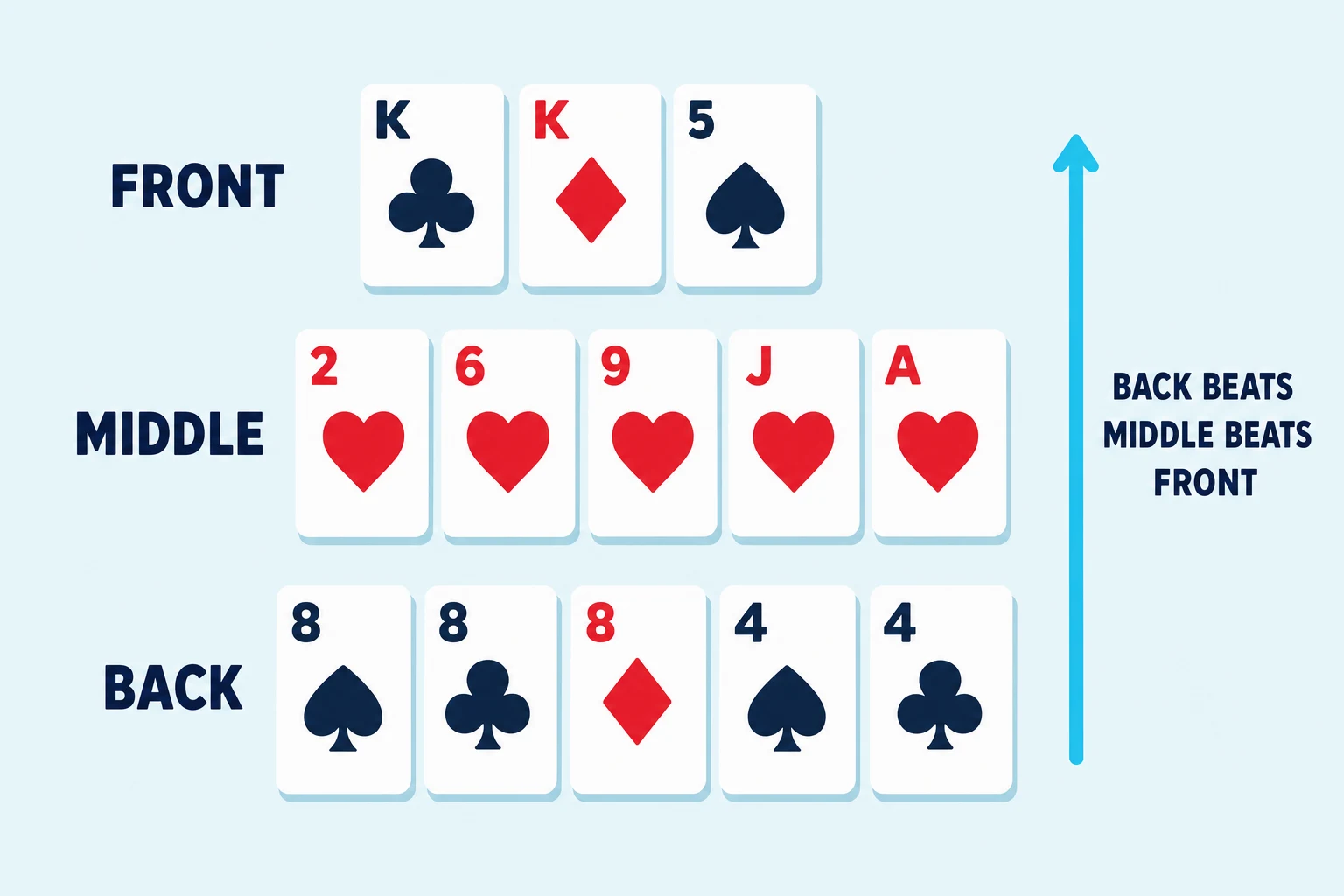
The thirteen cards split into three rows. The back row, sometimes called the bottom, holds five cards. The middle row holds five. The front row, sometimes called the top, holds three. Nothing is dealt to a shared board, so there are no community cards and every card you use is your own.
Standard hand rankings apply, with one adjustment: the front row only has three cards, so the only hands it can make are three of a kind, one pair, and high card. Three cards in sequence or three of one suit count only as high card there.
Now the rule that runs the whole game. Your back row must be at least as strong as your middle row, and your middle row must be at least as strong as your front row. A hand that breaks that order is fouled, also called mis-set, and it scores nothing at all. Worse than nothing: the fouling player pays every opponent who set a legal hand.
Here is the same thirteen cards set two ways.
That is why setting is a puzzle rather than a sort. A full house is a fine back row and a fine middle row, and putting it in the middle only works if the back row can beat it. The strongest thirteen cards at the table lose to a modest legal hand if they are arranged in the wrong order.
How scoring works
You score against each opponent separately, row by row. Win a row, gain a point. Lose a row, lose a point. Tie, and nothing moves at all, the same way a split pot settles nothing between two equal hands.
Win all three rows against the same opponent and you have scooped them, which is worth a bonus. The usual convention is a bonus of three points, so a scoop is worth six in total and a two-out-of-three win is worth one. That convention is common enough to have a name, one-six scoring, and it is not the only one in use: another common arrangement pays a point for winning the majority instead, so two-out-of-three is worth two and a scoop is worth four. Ask which one the table is using before the first deal.
A fouled hand is scored as a loss on all three rows plus the scoop bonus, so it costs six points to each opponent who set a legal hand, and that opponent also collects any royalties they made while the fouling player collects none. When two players have both fouled, nothing moves between them.
Points are the whole result here. In a friendly game they are a running score and nothing else, which is why this game works with a pen and paper and no chips at all.
Royalties
Royalties, sometimes called bonuses, are extra points for making a strong hand in a particular row. They exist because a straight in the front row is impossible and a straight in the back row is ordinary, so the same hand is worth different amounts depending on where you put it.
Royalties are counted for both players being compared, not only for the player who won that row, and the player with fewer total points pays the difference. A fouled hand collects none of its own.
One widely used set of values, and the one this article uses, looks like this.
| Hand | Front row | Middle row | Back row |
|---|---|---|---|
| Pair of sixes through pair of aces | 1 to 9 points, rising with the pair | Not scored | Not scored |
| Three of a kind | 20 points | 2 points | Not scored |
| Straight | Not possible | 4 points | 2 points |
| Flush | Not possible | 8 points | 4 points |
| Full house | Not possible | 12 points | 6 points |
| Four of a kind | Not possible | 20 points | 10 points |
| Straight flush | Not possible | 30 points | 15 points |
| Royal flush | Not possible | 50 points | 25 points |
Two things to notice. From a straight upward, the middle row pays double the back row for the same hand, because putting a big hand in the middle means the back row has to be bigger still. And the front row pays for hands that would be worthless anywhere else: a pair of sixes is worth a point up there, and three of a kind in the front is worth as much as four of a kind in the middle.
Treat these numbers as one common set rather than as the rules of the game. Royalty tables vary from group to group, and some play front-row trips on a rising scale instead of one flat number.
A short scoring example, two players. You win the back row and the middle row, your opponent wins the front. That is one point to you on balance. You made a flush in the back, worth four, and your opponent made a straight in the middle, worth four. The royalties cancel, so you finish plus one. If your opponent had fouled instead, you would collect six points plus your own four.
Open-face Chinese (OFC), turn by turn
Open-face is the version most players meet first now.
You are dealt five cards and you distribute all five among the rows before any more arrive. Once a card is placed it stays there. These five decide the shape of the whole hand.
Eight more cards arrive one at a time, and each one has to go somewhere before you see the next. There is no holding a card back and no rearranging.
Every placement is visible. You can see the rows your opponents are building, they can see yours, and the cards already on the table tell everyone which cards are gone.
When everyone has thirteen cards down, the rows are compared and scored the same way as the original game, with each player’s royalties added to their own total before the difference is paid.
The pressure comes from the order of arrival. In the original game you see all thirteen cards and then decide. In open face you commit to a shape early and then live with what shows up, which is why a hand that looks strong at nine cards can foul at thirteen.
Fantasyland
Fantasyland is the bonus that makes the front row worth fighting for. Under the common rule, set a pair of queens or better in the front row without fouling, and on the next hand you receive all thirteen cards at once and set them in private while everyone else plays out the usual one-card-at-a-time game. Not every table plays it, and the versions differ, so ask.
That is a large advantage, because a major difficulty in open face is committing to placements before you know what is coming. In Fantasyland you know everything before you place anything.
Staying in Fantasyland requires more. A common rule is that you keep it by setting three of a kind in the front, a full house or better in the middle, or four of a kind or better in the back. The exact requirement varies, so ask.
Check yourself: would this foul?
Your back row is A♠ K♠ 9♦ 6♣ 2♥, ace high. Your middle row is 7♥ 7♦ 4♠ 3♣ 2♠, a pair of sevens. Your front row is Q♦ Q♣ 8♥, a pair of queens. Legal or fouled?
Show the answer
Fouled twice over. Ace high does not beat a pair of sevens, so your middle row already beats your back row, which breaks the order rule on its own. Then the queens in front beat the sevens in the middle, which breaks it again. The hand scores nothing and pays six points to every opponent who set a legal one. Both failures point the same way: the back row is the row that has to be strongest, so it gets the first claim on every good card.
The mistakes that cost new players
- Chasing a hand you cannot legally finish. A flush in the middle is worthless if your back row is a pair. Count what the back row can still become before you commit the middle.
- Getting greedy in the front. A pair of queens in the front is worth a lot, and it is also a fast way to foul, because the middle and the back then each have to be at least that strong.
- Placing early cards without a plan. The first five cards shape the whole hand. Spreading them across all three rows with no idea which row is doing the work is how a hand ends up with no legal way to finish.
- Ignoring the cards you can see. Every placement on the table is public. Going for a flush when six of your suit are already showing in other players’ rows is a choice you made, not a card problem.
- Forgetting the order rule under time pressure. Fouling costs six points to every opponent with a legal hand, plus their royalties. Careful placement reduces the risk a long way, though a bad run of cards can still leave no legal finish.
A live-play pattern
Three questions, in order, every time a card arrives.
The back row has to be strongest, since it sets the ceiling for the other two, so an unfinished back row is usually the first claim on a good card.
Play the hand forward. If the middle row would need a hand your back row cannot beat, the placement is wrong even when it looks strong.
Every placement is public. Count the cards of your suit and your rank that are already showing before you commit to a draw that needs them.
One more question sits alongside those three when the hand is going well: is there a royalty on the table worth the risk? A pair of jacks in the front is six points and a step toward Fantasyland. It is worth taking with a solid back row behind it, and it is a trap without one.
Where this fits in your decision
Chinese poker sits outside the betting games entirely: no pot, no bluff, no position, just thirteen cards and an arrangement problem. What it shares with the rest of poker is the hand rankings, unchanged in the two five-card rows, and the habit of counting what is already visible before committing. Poker Skill sticks to Texas Hold’em, but its hand-ranking lessons cover the ladder every Chinese poker row is scored on. There is also a pineapple version of open face, where after the opening five you are dealt three cards at a time and place two of them, discarding the third. That is a different game from the crazy pineapple played with community cards.
Frequently asked questions
What are the hands in Chinese poker?
Standard poker hands, arranged into three rows. The back and middle rows are five-card hands and can make anything from high card up to a royal flush. The front row has three cards, so it can only make three of a kind, one pair, or high card. Three cards in sequence or in one suit count for nothing in the front row.
How does Chinese poker scoring work?
You compare rows with each opponent and score one point per row won. Winning all three rows against the same opponent is a scoop and carries a bonus, three points under the common one-six convention, which is why a scoop is worth six there. Another common convention pays a point for winning the majority instead. A fouled hand loses all three rows plus the bonus.
What is open-face Chinese poker?
It is the version where the cards arrive during play instead of all at once. You start with five cards, place them, then receive one card at a time and place each one before the next arrives. Every placement is face up, so all the rows are visible while they are being built.
What is fouling in Chinese poker?
Fouling, also called mis-setting, is arranging your rows so the order is illegal: the back row must be at least as strong as the middle, and the middle at least as strong as the front. A fouled hand scores nothing, loses six points to each opponent with a legal hand, and collects none of its own royalties.
What is Fantasyland in OFC?
A bonus for setting a pair of queens or better in the front row without fouling. On the next hand you get all thirteen cards at once and set them privately, while everyone else places one card at a time. Staying in Fantasyland takes a stronger hand, commonly three of a kind in the front, a full house or better in the middle, or four of a kind or better in the back.