
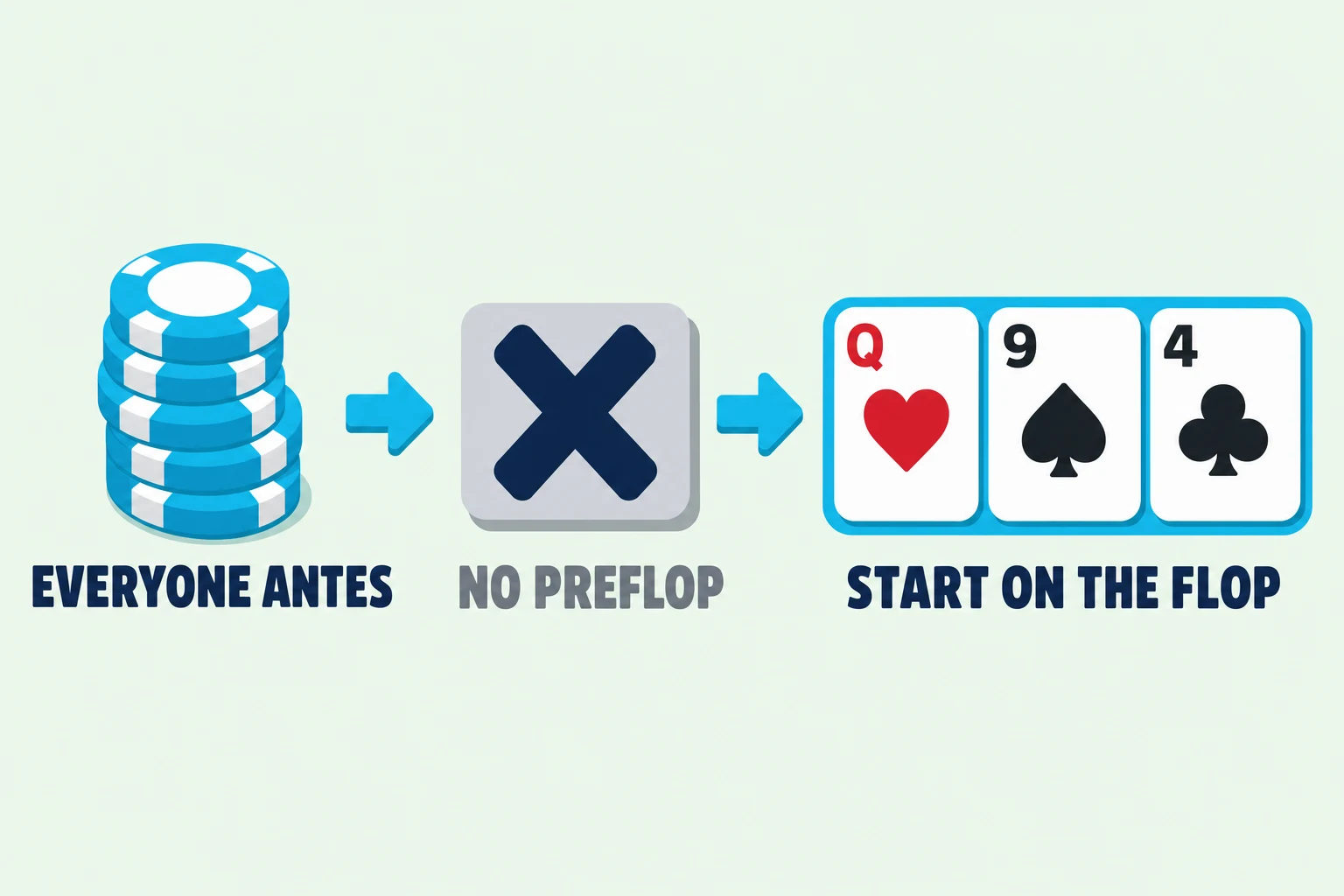
A bomb pot is a hand where every player in it puts in an agreed amount before the cards are dealt, nobody bets before the flop, and the hand starts on the flop with the whole table still in it. It plays as ordinary Hold’em or Omaha, whichever the table deals for that hand, with the first betting round removed.
It is ordinary Texas Hold’em or Omaha, whichever the table deals for that hand, with the first betting round removed and a large pot sitting there from the first card. Because nobody can fold before the flop, a bomb pot is multiway by design: every seat sees the flop, and the pot is already several times the usual size when the betting starts.
Bomb pots at a glance
| Trait | Bomb pot | An ordinary hand |
|---|---|---|
| Forced bets | Every player antes the same fixed amount | Small blind and big blind only |
| Preflop betting | None, the round is skipped | A full round of betting |
| Who sees the flop | Everybody who was dealt in | Usually two or three players |
| Pot size on the flop | Several times the usual | One or two raises |
| Which game is dealt | Table’s choice for that hand | Whatever the table is running |
| Boards | One or two, table’s choice | One |
| Is it a rule of poker? | No, a table convention | Yes |
How a bomb pot works
Every player posts the same fixed ante, commonly a multiple of the big blind. Everybody posts, so nobody buys their way out of the hand cheaply.
Hole cards come out as normal: two in Hold’em, four or more in the Omaha games, depending on which game the table announced for the hand.
There is no opening raise and no folding to a raise, because there is no preflop betting at all. This one missing round is where the whole format comes from.
From that point the flop onward plays exactly like any other hand: bet, call, raise or fold on the flop, the turn and the river, then showdown.
The whole effect of the format comes from that skipped round. Everyone who posted has chips in the pot and a random hand, so the flop arrives with every seat still live instead of the two or three that usually reach it. Poker Skill teaches the players out of position to check to the preflop raiser, and it calls a lead into him a donk bet. A bomb pot has no preflop raiser, so there is nobody to check to and no bet to call a donk.
Double-board bomb pots
The common variation deals two boards instead of one.
Two complete five-card boards go out, and at showdown the pot is split in half. One half goes to the best hand on the first board, the other half goes to the best hand on the second. You read each board separately with the same hole cards, and in Omaha games the usual rule still applies on each board: exactly two hole cards plus three board cards.
Winning both halves is called scooping, and it is what the format is played for. You can scoop using different hole cards on each board. Winning one board and losing the other returns half the pot, which may be more or less than you put in depending on how the betting went. Losing both loses everything you put in, not only the ante, and a tie on a board splits that half again.
The betting runs on one pot, not two. The usual sequence deals both flops, then a betting round, then both turns, then a round, then both rivers and a last round, with the single pot split at showdown. Some tables deal both boards out first and have one round of betting instead. Ask which one your table is running before the dealer starts, because it changes how much a marginal hand costs to play.
When bomb pots happen
Bomb pots are a table convention, not a rule of poker. They show up in home games and in live games where the table has agreed to run them, and nothing in the rules of Hold’em or Omaha requires one.
The common trigger is a schedule: once an orbit, or every time the button reaches a particular seat, or whenever the table agrees to one. The amount and the trigger are both table decisions, and both get set before the first one runs rather than argued about after.
Because the format needs everyone in, it works best where everybody has agreed in advance. Whether a player can sit one out is itself a table decision, so it is worth settling with the amount and the trigger.
Confirm these four before the first one runs
How to adjust when one hits your table
A bomb pot is a multiway pot with a big starting pot and no preflop information.
Hands that can make the nuts go up in value. The more players see a flop, the more likely it is that somebody connected with it. The hands worth committing chips to are the ones that can still be best against several opponents, which usually means the nut version of a hand or a draw to it. A second-best flush or the low end of a straight is a much worse holding here than it is heads-up, and worse again on two boards.
One-pair hands go down in value. Top pair is a fine hand against one opponent and a modest one against seven. In a bomb pot it is usually a hand to control the pot with rather than build it, because the number of hands that beat it grows with every extra player still in. With only two callers, K♠ 7♠ checks its pair of sevens on A♦ 7♥ 3♠ in Poker Skill’s lesson on multiway c-bets, since too many of their hands hold an ace.
Read the board before you read the players. With no preflop betting, everyone starts with a random hand, so there is no raiser to put on a range. The first question on the flop is which hands this board helps, and ranges only start to narrow once the betting begins. Watch what the postflop action says, because it is the only information the hand has produced.
Check yourself: who wins each half?
Two boards. Board one: A♣ 8♥ 5♦ 2♠ 7♣. Board two: K♠ Q♠ 9♥ 4♣ 4♦. You hold A♦ K♦ 9♣ 5♣ in a double-board Omaha bomb pot. What are your two hands?
Show the answer
Aces and fives on board one, kings and nines on board two, and the pairs come from different hole cards. On board one your ace and your five play with the ace, the eight and the five for two pair, aces and fives. On board two your king and your nine play with the king, the nine and the queen for kings and nines. Neither is close to the nuts, which is the honest lesson: two boards double the chances that somebody at a full table has something better than a modest two pair, and this hand is a candidate to control the pot rather than build it.
The pot is already big, which changes the price rather than the principle. A draw is still worth continuing with only when your share of the whole pot justifies what the bet costs, and a big pot on its own is not a reason to call.
Frequently asked questions
What is a bomb pot in poker?
A bomb pot is a hand where every player in it posts the same agreed amount before the deal, there is no preflop betting, and the hand starts on the flop with the whole table still in it. The rest of the hand plays like a normal hand of the game you are in, with betting on the flop, the turn and the river.
What are the rules of a bomb pot?
Everyone antes the same fixed amount, everyone is dealt in, the preflop betting round is skipped, and the flop comes out. Betting starts on the flop and runs as usual to showdown. Four things are set by the table rather than by the rules: the amount, which game is dealt for that hand, whether there are one or two boards, and when the betting rounds fall.
What is a double-board bomb pot?
The same format with two boards. Two complete boards are dealt, the betting still runs on one pot, and at showdown the pot is split: half to the best hand on one board, half to the best hand on the other. Winning both halves is a scoop, and you can use different hole cards on each board to do it. Tables differ on whether the betting runs street by street across both boards or once at the end, so ask before the hand starts.