
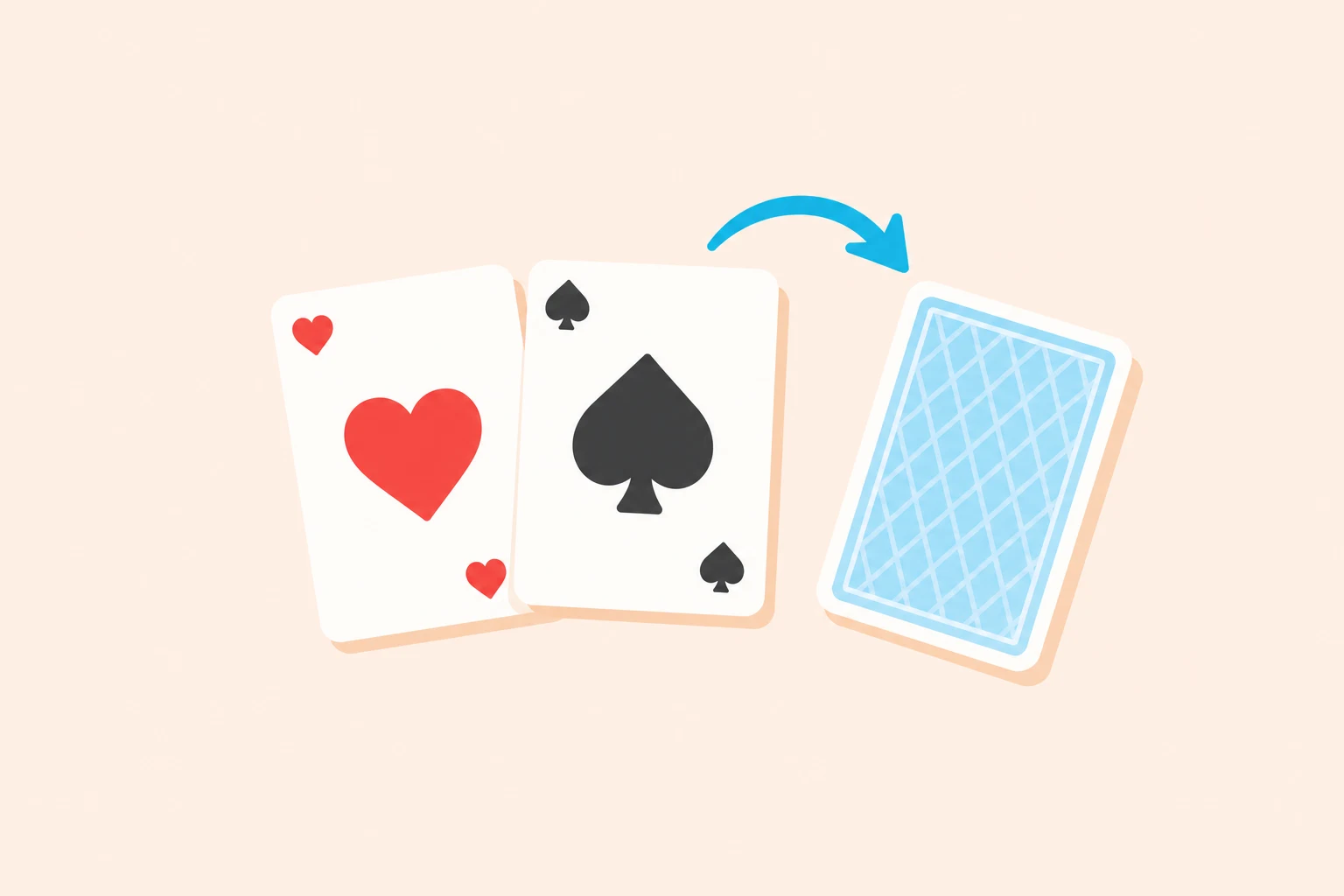
Crazy pineapple is Texas Hold’em with one extra card and one extra decision: every player is dealt three hole cards instead of two, keeps all three through the preflop and flop betting rounds, then throws one away before the turn is dealt. From that point the hand is ordinary Hold’em, two cards in your hand and five community cards on the table, best five wins.
You start with three hole cards and finish with two, against the usual five community cards. The extra card does not change the hand rankings, the betting, or the showdown. It changes what you know, what everyone else has, and how strong a hand needs to be to win.
The shortcut, in one line
Choose your two cards against the flop, not against the three you were dealt. The discard is the decision this game is built on, and hands run stronger here than they do in Hold’em.
Crazy pineapple at a glance
| Trait | Crazy pineapple | Pineapple | Texas Hold’em |
|---|---|---|---|
| Hole cards dealt | 3 | 3 | 2 |
| Cards at showdown | 2 | 2 | 2 |
| When you discard | After the flop betting round | Before the first betting round | Never |
| Hand construction | Best five from 2 hole plus 5 board | Best five from 2 hole plus 5 board | Best five from 2 hole plus 5 board |
| Betting structure | Limit, pot-limit, or no-limit | Same | Same |
| Pot award | High hand only, unless the game is hi-lo | High hand only | High hand only |
| Players | 2 to 10 | 2 to 10 | 2 to 10 |
| Typical dynamic | More players see flops, stronger showdown hands | Tighter than crazy, looser than Hold’em | The baseline |
The three pineapple games
All three deal three hole cards and all three use Hold’em betting. The only thing that changes is when the third card leaves your hand, and that one difference changes how the game plays.
Pineapple. You look at three cards and throw one away before the first betting round. Every decision after that is a Hold’em decision, made with a slightly better starting hand than Hold’em usually gives you.
Crazy pineapple. You keep all three cards through the preflop betting and through the flop betting. Once that round is settled, every player still in the hand discards one card face down, and then the turn is dealt. This is the version this page is about.
Lazy pineapple, also called Tahoe. Nothing gets thrown away until the hand is over. You keep three cards through every betting round, and at showdown you may use at most two of them with the board. You never have to guess which card matters, because you get to see the whole board first.
One name that is not part of this family: pineapple open-face Chinese is a different game entirely, a card-placement game rather than a betting game with a flop.
| Version | The discard | What it rewards |
|---|---|---|
| Pineapple | Before the first betting round | Reading three cards cold, before any board |
| Crazy pineapple | After the flop betting round | Playing the flop with an extra out in hand |
| Lazy pineapple (Tahoe) | Nothing until showdown | Patience; the third card never has to be guessed |
The rules in one read
A crazy pineapple hand runs on the Hold’em skeleton. The button marks the dealer, the two seats to its left post the blinds, and the action moves clockwise.
- Every player is dealt three cards face down.
- Preflop betting, starting with the player to the left of the big blind.
- The dealer burns a card and deals the flop, three community cards face up.
- Flop betting, starting with the first live player to the left of the button.
- The discard. Every player still in the hand throws one hole card away, face down. You are down to two cards. Rooms differ on the exact moment: the common version discards after the flop betting round, and some published rule sets discard as soon as the flop is spread, before that round of betting.
- The turn is dealt, then a betting round.
- The river is dealt, then the last betting round.
- Showdown. Best five cards from your two plus the five on the board.
The discard, and when it happens
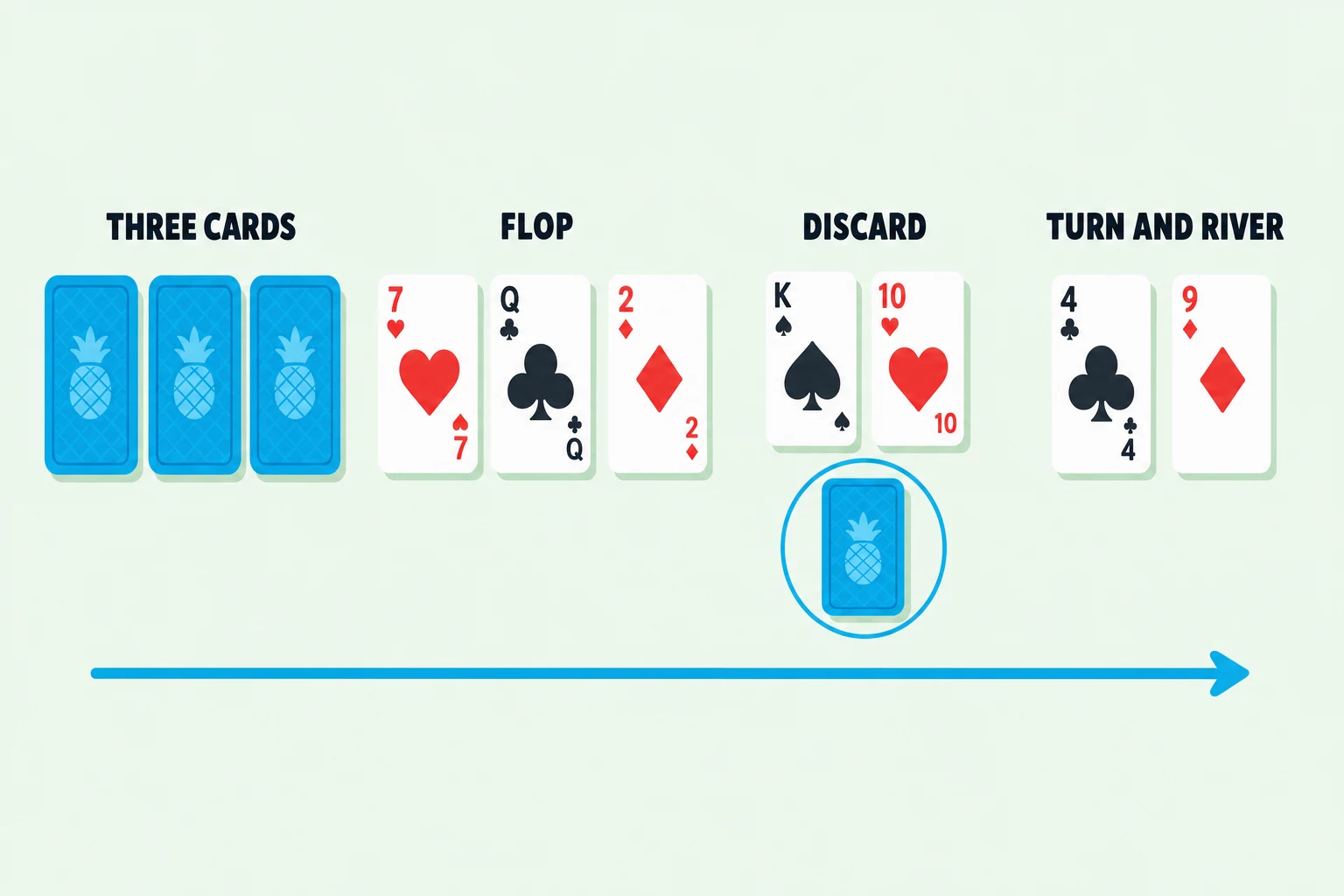
The discard is not optional and you do not get to defer it. Once the flop betting round is settled, every player still in the pot picks a card, puts it face down in the muck, and plays the rest of the hand with two. You do not show it, and you should not: that card can never appear on the board and can never sit in anyone else’s hand, so it is information only you hold.
The timing is the point. You see three board cards before you choose, which makes the decision easy on most flops and brutal on a few.
Ask which timing the table uses. Both versions are written down in serious rule sets. Discarding after the betting round means you choose your last two cards knowing who liked the flop; discarding as the flop lands means choosing without that read.
What makes a starting hand strong
Standard Hold’em hand values still apply, with one asterisk: everyone picks their best two cards out of three, so showdown hands run stronger than in Hold’em. That is the same reason top pair gets more caution in four-card games like Omaha, and it is the first Hold’em instinct to check here.
Three shapes are worth playing:
- A big pair with a live third card. Aces, kings, queens, and jacks often win without improving, and the third card gives you a spare part: a set look, a flush look, or a straight look you can keep if the flop points that way.
- Two big cards plus a connected or suited third. Suited cards add flush potential and connected cards add straight potential, so a third card that extends either gives you two flops you are happy to see.
- Three cards that make two different hands. A hand that leaves you a sensible pair to keep on most flops beats one that needs a specific card.
Two shapes that look better than they are:
- Three cards of the same suit. Only two can survive the discard, and the one you throw away is a card of that suit that can no longer come on the board. Three suited cards leave you with the same two-card flush draw a two-suited hand would give you, minus one of the cards that completes it.
- Three of a kind in the hole, sometimes called rolled up. Only two of them can play, so at showdown you hold a pair, and the one card of that rank you did not keep is dead in the muck. The fourth card of the rank is the only card left that can make you three of a kind.
Worked examples
Top pair and the nut flush look, so the odd card goes
You have top pair with the best kicker, and the ace and king of spades give you the nut flush look with two spades already out. The discard is the four of diamonds and it is not close: both spades work with this exact board and the four does nothing on it. Most discards are not this clean.
Three suited cards, and why one of them is dead
Five hearts are already visible to you: two on the board and three in your hand. You keep two, so you go to the turn with four hearts toward a flush and one heart of your own in the muck. Keep the ace of hearts, because it makes the best possible flush of that suit if another heart arrives. Between the six and the five, you are choosing which low straight cards to carry. The lesson is in the arithmetic: the heart you throw away is a card that can no longer complete your own flush, so three suited cards is worth less than it looks. That suit count comes early in Poker Skill’s lessons: A♣ Q♠ on 10♥ 6♣ 2♥ is no flush draw at all, because a flush draw needs four cards of one suit.
The trap hand: three of a kind in the hole
Three eights is the trap hand of this game. You carry all three through the flop betting, and then two of them have to play and one goes in the muck. You end up with a pair of eights on a board that missed you, holding two of the four eights yourself and one more sitting dead in the discard. The only card that can turn this into three of a kind is the last eight. A hand that felt enormous when you looked at it is a small pair with one card left to help.
Check yourself: which card goes?
The flop is J♦ 9♦ 4♣. You hold A♦ J♣ 9♥. The betting is done and the dealer is waiting. Which card do you throw away?
Show the answer
The ace of diamonds, and it feels wrong. With one diamond in your hand and two on the board, the ace only gives you a runner-runner shot at the nut flush, about one time in 23, while the jack and the nine are already two pair on this board, and a jack or a nine on the turn or river fills them into a full house. Holding the ace already told you nobody else can make the ace-high flush, and mucking it does not change that.
The mistakes that cost new players
- Paying off top pair. Every opponent chose two cards out of three, so top pair with a weak kicker wins less often here than the same hand wins in Hold’em.
- Treating three suited cards as a flush hand. One of them is going to be thrown away. Two suited cards is the most you can ever take past the flop.
- Discarding on autopilot. The card you keep should be chosen against the exact flop in front of you, not against the hand you hoped for preflop.
- Showing the discard. It costs you the one piece of private information the game hands out for free.
- Assuming the table plays the version you know. Pineapple, crazy pineapple, and lazy pineapple all get called “pineapple” at a home game. Ask when the discard happens before the first hand.
- Playing every three-card hand. Three cards make almost anything look playable, and more players seeing flops is exactly why the pots get big and the winning hands get strong.
A live-play pattern
Three reads, in order, at the moment the flop betting closes.
Not which two were prettiest preflop. Which two make a hand or a draw right now. Poker Skill asks you to name those draws card by card: with 8♣ 9♣ on 4♥ 10♦ J♠, any seven or queen makes the straight.
It is a card no opponent can hold and a card the board can never show. If you are throwing away the ace of hearts on a two-heart board, you already know nobody else can make the ace-high flush.
The table discards after that round, so you are choosing your last two cards already knowing who liked the flop. Hold’em never lets you pick your hole cards with that read in hand.
Where this fits in your decision
Crazy pineapple gives you repeated practice at one skill that carries everywhere: choosing which part of your hand to keep. If the rest of the table’s game is Hold’em, the complete Texas Hold’em rules cover the skeleton this game is built on, and the poker hand rankings chart still decides every showdown. If the discard is the part you like, Omaha is the next game to look at, since it hands you four cards and makes you use exactly two.
Frequently asked questions
When do you discard in crazy pineapple?
In the common version, after the flop betting round is finished and before the turn card is dealt: you keep all three hole cards through the preflop betting and the flop betting, then every player still in the hand throws one away face down. Some published rule sets have the discard happen as soon as the flop is spread, before that betting round. Both are real, so ask which one the table is using.
Is crazy pineapple the same as pineapple?
No. The games use the same three-card deal and the same Hold'em betting, but the discard happens at different times. In pineapple you throw a card away before the first betting round, so you never see a flop with three cards. In crazy pineapple you keep all three until the flop betting is done.
Can you use all three hole cards in crazy pineapple?
No. One card is discarded before the turn, so you reach showdown with two hole cards and five community cards, exactly like Hold'em. Your best five-card hand comes from those seven cards, and you may use both hole cards, one, or neither.
What is lazy pineapple?
Lazy pineapple, also called Tahoe, keeps all three hole cards through every betting round. Nothing is thrown away until the last bet is settled, and at showdown you may use at most two of your three cards with the board. The extra card rides along the whole hand instead of leaving before the turn.
Can crazy pineapple be played as a split-pot game?
Yes. Crazy pineapple hi-lo eight-or-better is a common home-game version: the deal and the betting are unchanged, and at showdown the pot splits between the best high hand and the best qualifying low of five unpaired cards eight or lower. With no qualifying low, the high hand takes the whole pot.