


Blinds
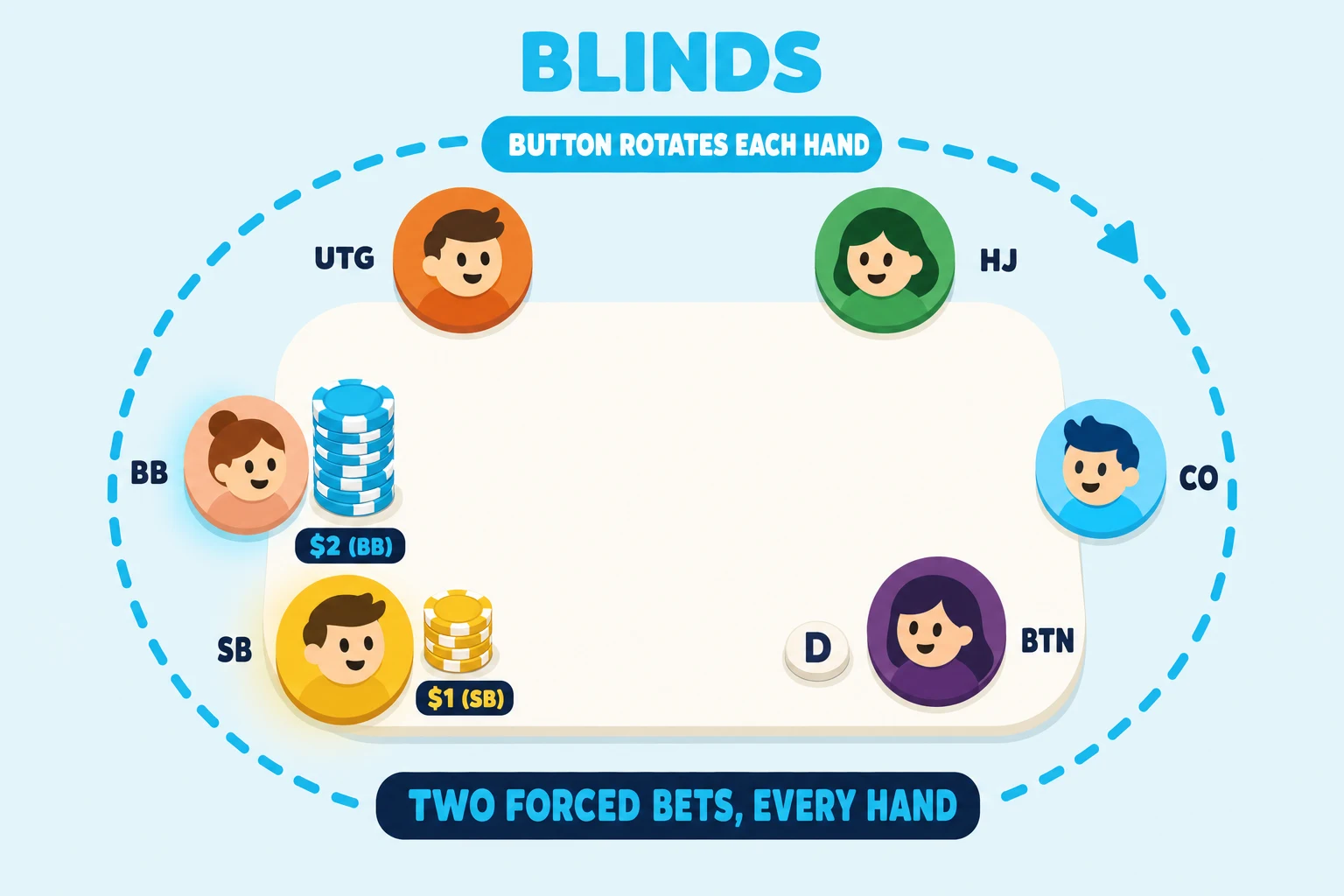
In No-Limit Texas Hold'em two forced bets, the small blind and big blind, seed the pot. They are posted by the two players immediately left of the dealer button (the marker showing who deals). The small blind typically equals half the big blind; the big blind usually equals double the small blind. For example, in a $1/$2 game the small blind posts $1 and the big blind posts $2.
Practice this in Poker Skill. The lesson on checking and calling covers how a posted blind counts: with no raise in front of the big blind you check for free, and when someone raises you add only what your blind is missing.
Get the free appBlinds in No-Limit Texas Hold’em
What the small blind and big blind are
In No-Limit Texas Hold’em two forced bets, the small blind and big blind, seed the pot. They are posted by the two players immediately left of the dealer button (the marker showing who deals). The small blind typically equals half the big blind; the big blind usually equals double the small blind. For example, in a $1/$2 game the small blind posts $1 and the big blind posts $2.
Players post blinds before cards are dealt and before they see their hole cards (the two private cards). That initial money creates an incentive to play and prevents everyone folding without cost.
Poker blinds exist so a hand always has money worth fighting over. The small blind posts the smaller half and the big blind posts the full amount. The ante is the other kind of forced bet you will meet, paid by every player at the table instead of by two seats. When someone says a stack is 100bb or an open is 3bb they are counting in big blinds as a bet size, not in dollars.
How and when blinds are posted and rotate
Blinds are posted immediately before cards are dealt for each hand. The sequence is:
- Dealer button is placed or passed to its player.
- Player to the left of the button posts the small blind.
- Next player to the left posts the big blind.
- Cards are dealt and the hand begins.
After each completed hand the blinds move one seat to the left, so every player posts both blinds over time. Players place money into the pot before seeing hole cards; this feature forces action.
Example: If you’re on the button and the players to your left are Amy and Ben, Amy posts the small blind and Ben posts the big blind. After the hand ends, the button moves left, making Amy the button and shifting the blinds accordingly.
How blinds affect betting and hand play
The big blind sets the minimum amount other players must call to continue. If the big blind is $2, a player must call $2 or raise more to play. If no raises occur before action returns to the big blind, the big blind can check instead of posting more money, since they already posted $2.
Concrete example: In a $1/$2 game, Player A raises to $6 from early position. Players fold to the big blind, who already posted $2. The big blind must call $4 more to match the raise or raise further, unless they fold.
Blinds create pot odds and pressure. Pot odds equal the ratio of the current pot to the cost of a contemplated call, so existing blinds can improve drawing odds. Conversely, players on the blinds often defend their posted money, widening their calling or raising ranges.
Blinds within the No-Limit betting structure
No-Limit means no upper cap on how much a player can bet or raise after blinds are posted. Blinds serve as the minimum opening stake but do not limit later bet sizes. That creates strategic depth: forced stakes start action, and any player can bet any amount up to their full stack.
Example: In a $1/$2 cash game a player could open-raise to $10 or shove (go all-in) for $200 - both actions are permitted under No-Limit rules.
How blind size and timing shape tournaments and cash games
Blinds strongly affect dynamics in both formats. In tournaments blinds increase at set intervals (commonly every 15-60 minutes), pressuring players to accumulate chips as effective stack sizes shrink. In cash games blinds remain constant, so chip values stay stable and players can use longer-term strategies without time-driven escalation.
Quick checklist
- Small and big blinds are forced bets posted before cards are dealt.
- Small blind ≈ half the big blind; big blind ≈ double the small blind.
- Blinds rotate one seat left after each hand.
- The big blind can check if no raise is made; others must at least call the big blind to stay in.
FAQ
What are blinds in poker?
Blinds are two forced bets posted before any cards are dealt. The player immediately left of the dealer button posts the small blind and the player left of them posts the big blind. They seed the pot so every hand has something to play for, then move one seat left after the hand ends.
What is the small blind?
The small blind is the forced bet posted by the player immediately left of the dealer button, usually half the size of the big blind. In a $1/$2 game it is $1. After the flop the small blind is first to act on every street, which is the hidden cost of the seat.
Big blind vs small blind: who acts first?
The small blind acts first of the two on every street. Before the flop the big blind is last to act in the whole round, which is why it can check when nobody raises. After the flop the small blind leads off and the big blind follows it.
Why do poker games use blinds?
A hand with no money in it gives nobody a reason to play. The blinds seed the pot before the cards come out and force action. They rotate one seat after every hand, so the cost lands on every player equally over a full orbit.