
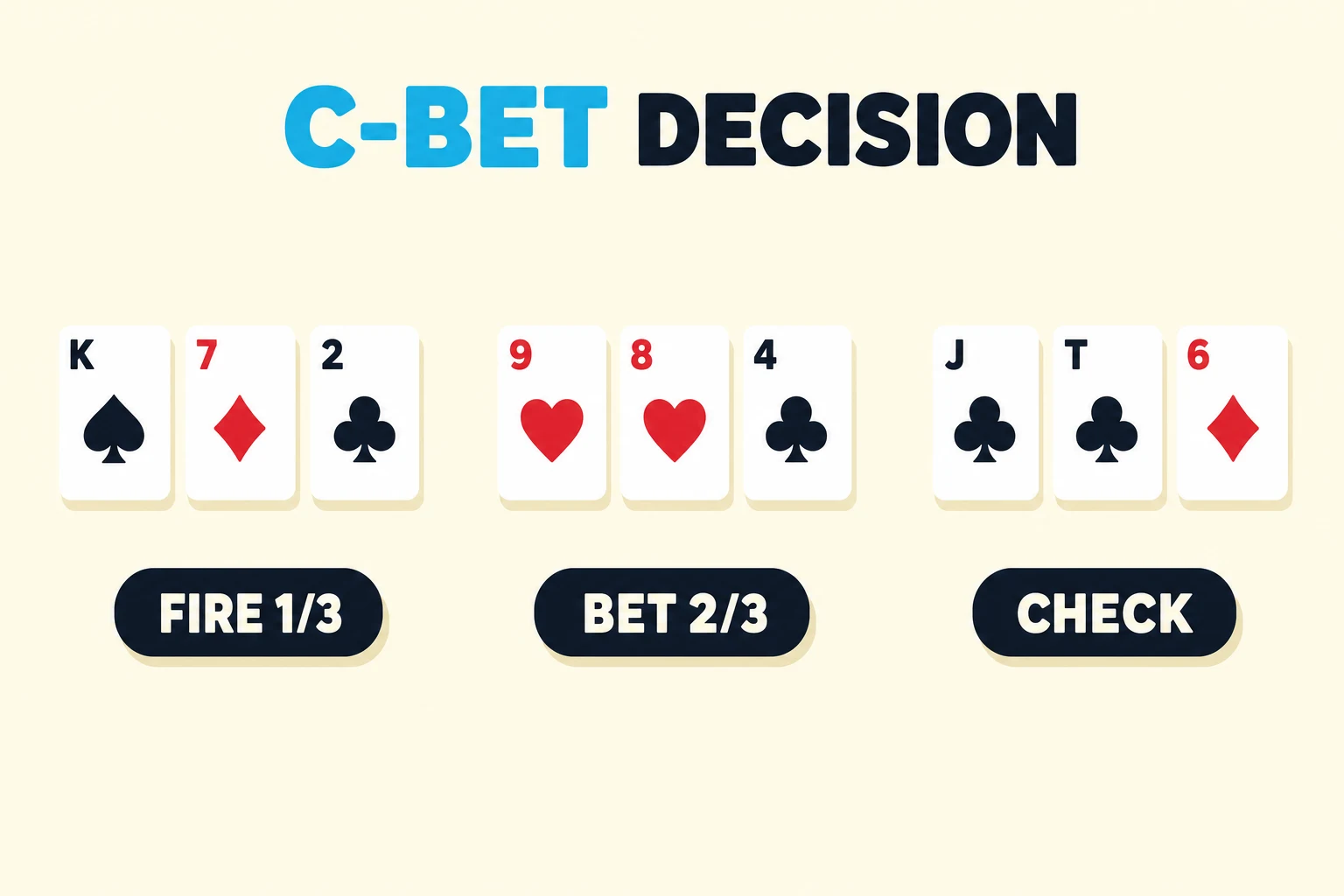
A good c-bet decision starts with the board: when the flop favors your range you fire often and small, when it favors the caller you check more than feels comfortable, and when the board is wet enough to charge draws you size up and bet polarized. Your preflop raise gives you the betting lead, but it does not give you a duty to fire the flop every time. The default is not “always c-bet.” It is “look at the flop first, then pick a frequency and a size that match what you see.”
The shortcut, in one line
Fire when the flop hits your range harder than the caller’s. Check when it hits theirs. Let the wetness of the board pick your size: small and depolarized on dry, bigger and polarized on wet.
A quick-reference table
| Flop | Who it favors | C-bet frequency | Default size |
|---|---|---|---|
| A♣9♣2♦ (Ace-high dry) | Preflop raiser | High | 1/3 pot |
| K♠7♦2♣ (King-high dry) | Preflop raiser | High | 1/3 pot |
| J♥J♦5♠ (paired high) | Preflop raiser | High | Min-bet to 1/3 pot |
| 9♥8♥4♣ (middling wet) | Mixed | Medium, polarized | 2/3 pot |
| K♠Q♠9♦ (high connected two-tone) | Caller | Low | Often check |
| 7♣6♣5♦ (low connected) | Caller | Lowest | Mostly check |
This table is the cheat sheet. The rest of this article is why the rows look like that.
Why range advantage decides it
Your preflop raise narrows you to a stronger band of hands than the caller’s flat. The flop either favors that narrower band or it does not. On A♣9♣2♦ you have more aces, more big pocket pairs, and more nut combos than the caller; the board belongs to you. On 7♣6♣5♦ the caller can show up with low connectors and small pairs that hit hard, while your AKo has nothing. That edge is what the c-bet decision is reading: sometimes the broad equity of range advantage, sometimes the narrower edge in nutted hands. When the answer is “you,” you bet often. When the answer is “them,” you bet seldom and usually with backup equity.
Three flops, three c-bet decisions
The dry king-high flop: fire small, fire wide
This is the driest, most range-advantage-favoring flop in poker. Your button opening range hits the king harder than any flat the caller can have, and the unconnected low cards give the caller almost no draws to lean on. The right move is a small range bet, about a third of the pot, with most of your range, including hands that whiffed completely. You are not betting because your hand is strong. You are betting because the board belongs to your range and a small bet is enough to fold out the trash. If you get raised, fold the air and continue with the king or better. The bet only needs to work 25% of the time to break even, and dry king-high boards work more often than that against most calling ranges.
The wet middling flop: bet polarized or check
This is a wet board, and every middling open-ender in the caller’s range loves it. Your cutoff range still has slight range advantage, but the caller hits the middle of this flop more often than they do dry textures. The fix is to bet polarized: fire 2/3 pot with your overpairs (KK is the easy bet here), sets, two pair, and the bluffs with backdoor equity (A♥K♥, A♥Q♥). Check most of your middling stuff. AK with no heart wants to check this flop and play a smaller pot. Do not bet middle pair into a board that has six different draws against it; you are not betting for value, you are bet-folding while the caller raises.
The caller’s flop: check more than you think
The board hits the caller’s flat. They have all the JT and J9 and T9 and pocket sevens through tens that you do not open, plus open-enders with QT, Q9 of clubs, and a pile of flush-draw combos. Your AKo has two overcards and a gutshot to broadway, which is well behind the parts of the caller’s range that hit this flop hard. The right move is to check back most of your range. Save the bet for bricks on the turn. If the turn is a 2♥, you can fire a delayed c-bet and represent the strength your check on the flop denied. Bluffing into a flop that hits the caller harder than yours is the leak this article is mostly trying to prevent.
When NOT to c-bet
You c-bet because you raised before the flop, so you hold more of the strong hands on most boards and your opponent has to keep folding or keep calling with worse. That is the whole reason, and it tells you when to stop: when the flop hands those strong hands to them instead, or when there are too many opponents for a single bet to move anyone. On sizing, you need two: a small bet, about a third of the pot, and a bigger one around two thirds. The page’s pegs above are those two, and a third size is almost always a hand that did not want to bet.
So here are the four spots where checking is usually the better half of that plan. Each one ends with what you do next, because the check is a plan rather than a surrender.
Flops that hit the caller’s range harder than yours
Some boards belong to the player who called. Books describe it directly: on coordinated boards the caller is far more likely to have connected than on a dry one, so you play your range more honestly there, while the wide bluffing bets make more sense on the dry boards.
Three flops where that applies:
Each is full of the middling suited and connected hands a caller flats with, and empty of the ace-high and king-high hands your raise is made of.
After you check: on the turn, take a stab when a card arrives that misses most of what they would have continued with, and give up when it completes the draws you were avoiding. Checking one street does not end the hand, it moves the fight to a cheaper one.
Multiway pots
More opponents means more of the board is spoken for. Books quoting the rough version of that arithmetic put it this way:
| Opponents in the pot | Chance at least one connected |
|---|---|
| 1 | about 40% |
| 2 | about 64% |
| 3 | about 78% |
| 4 | about 87% |
After you check: with a marginal hand, a checked flop often buys you a cheap showdown. If everyone checks behind, a turn bet from you should usually mean something, because the players who would have called a flop bet are still there.
Out of position on a dynamic board
On a board where they can continue with pairs, gutshots and flush draws, a bet out of position buys less than it costs: the hands that beat you rarely fold, the draws come along, and you act first on two more streets with nothing new to go on.
After you check: call a bet with the hands that have real showdown value or a real draw, and let the rest go. Deciding which of those you are holding before the turn arrives is most of the skill in the spot.
When your hand has showdown value and nowhere to grow
Middle pair with a weak kicker, ace-high on a low board, second pair on a board that missed you. These hands win a fair share of pots by simply being shown down. They can still improve, a middle pair has a few outs to two pair or trips, but improving is not where their value lives. Betting them tends to fold out the hands they already beat and get called by better, and books make the same point about checking a hand with showdown value, including that the check can induce a bluff you are happy to call.
After you check: call one bet, then decide on the turn card whether you are calling a second. Pot control is the name for that plan, and it is a plan rather than passivity.
The board-texture checklist
Six questions, in order. The first yes you reach is your answer.
| Question | If yes |
|---|---|
| Is the pot multiway? | Bet only hands you would show down happily, and check the rest |
| Is the flop ace-high or king-high and disconnected? | Fire small, with most of your range |
| Is the flop paired with a high card? | Fire small, and keep betting on later streets when they call |
| Is the flop monotone or heavily connected? | Check most hands, and fire big with your strongest hands and best draws |
| Are you out of position on a board full of draws? | Check, and plan which hands call a bet |
| Does your hand have showdown value and no real way to improve? | Check, and plan to call one street |
If none of them is a yes, you are on a board that favours you against one opponent, which is the small bet with most of your range: the first fire-small row above.
Two sizes are enough
The continuation bet sizes on this page are a third of the pot and two thirds, and that pair covers nearly everything. Small when the board belongs to your range and you are betting most of your hands, big when the board is contested and you want folds from hands that have equity against you. Wanting a third size usually means the hand did not want to bet. The dry-board rows in the table above take the small size, and wet vs dry boards has the texture reading behind the split.
When this lies to you
Three failure modes are worth naming. The first is multi-way pots. A second caller in the pot doubles the chance someone hit, and the boards where range advantage looked clear heads-up start to smear. Default to checking in three- and four-way pots unless you have a real value hand or a powerful semi-bluff.
The second is sticky callers. A reg might fold king-high to a small range bet on K♠7♦2♣; a recreational player who likes to “see the turn” with any pair will call with second pair and call the turn too. The textures where you can c-bet wide assume the caller will fold the trash. If they will not, your bluffs are losing.
The third is bet-folding mid-equity hands. If you are holding a hand with too much equity to fold to a raise but not enough to call one, betting puts you in the worst spot. Middle pair on a coordinated flop, or fold equity hands that are also drawing, often play better as a check than as a thin bet you cannot defend.
The other thing the rule cannot see is stack depth. Deeper stacks reward more selective c-betting because the cost of getting check-raised goes up. Shallower stacks reward more aggression because you can size to commit. If you are 50 big blinds deep facing a check-raise on the turn, you need a plan; if you are 200 deep, the same hand starts to look a lot more like a check-fold.
Check yourself: fire or check?
You open from the button with A♥ 4♥ and the big blind calls. The flop is Q♦ 6♠ 2♣, rainbow. Fire or check?
Show the answer
Fire, small. This is the first row of the quick-reference table: a high-card, disconnected, rainbow board, which is the shape your button opening range owns and the caller’s flatting range does not. You have nothing yet, and that is the point of a range bet: about a third of the pot, with most of your hands, because the board belongs to your range rather than to this particular holding. The backdoor nut flush draw is a bonus that gives the turn somewhere to go. Fold to a raise.
A live-play pattern in three questions
Run this sequence every flop, in order.
Look at the highest card and the connectivity. High-card unconnected is yours. Middling, connected, two-tone is mixed or theirs.
Even when raw equity is close, the side with more sets and two-pair combos can size up and put pressure on. If you have the nuts more often than they do, lean toward the bigger size.
If your hand cannot continue against a check-raise and you cannot credibly bluff a turn, the bet is a leak. Check those hands and use the turn or river to make decisions with more information.
Three questions, ten seconds. Not perfect, but enough to keep the auto-fire instinct in check.
Where this fits in your decision
The c-bet is the first decision in a multi-street plan, not a one-time choice. If you fire small and dry on K♠7♦2♣, you should already have a double-barrel idea for the turn cards that extend your range advantage and the cards that give it back to the caller. If you check the flop on J♣T♣6♦, you should know which turns turn into a delayed c-bet and which turn into a clean fold. The full bet-types map (c-bet, range bet, probe, double-barrel, check-back) lives in the glossary; this article is the framework for picking among them.
Frequently asked questions
Is checking the flop as the preflop raiser weak?
No. Checking is the right play any time the board favors the caller's range or your hand wants to play a smaller pot. Auto-c-betting every flop is a bigger leak than checking your bluffs on the wrong textures. The strong default is "fire when the math says fire, check when it does not."
When should I delay the c-bet to the turn?
When the flop hits the caller harder than you, and the turn brings a brick that does not change that picture. The check on the flop denies your strength and lets you represent more on the turn at a smaller cost than firing a flop you cannot credibly back up.
How often should I c-bet against the big blind?
On dry, range-advantage flops (Ace-high dry, King-high dry, paired high), c-bet at high frequency, often 70 to 80 percent of your range with a small size. On wet middling boards, c-bet more like 40 to 50 percent with a bigger size and more polarization. On low connected boards that hit the BB's flat, c-bet 30 percent or less and lean on check-back lines.
Does the rule change in multi-way pots?
Yes. With two or more callers, your range advantage shrinks because someone else's range overlaps yours. C-bet less, and lean on hands with real equity rather than pure bluffs. The cheat-sheet table assumes heads-up.