
To calculate pot odds, divide the amount you have to call by the pot you would be playing for after that call. The percentage you get is the share of the time you need to win for calling to break even. Compare it to the equity your hand actually has, and the decision is made. That is the entire calculation, and once you stop dividing and start recognizing bet sizes, it takes about five seconds. Outs, equity and expected value live together in poker odds explained; this page is the calculation. The printable pot odds chart is the same prices as a sheet you can keep beside you.
Key takeaways
- Your call divided by the final pot is the equity you need. Nothing else in the calculation matters.
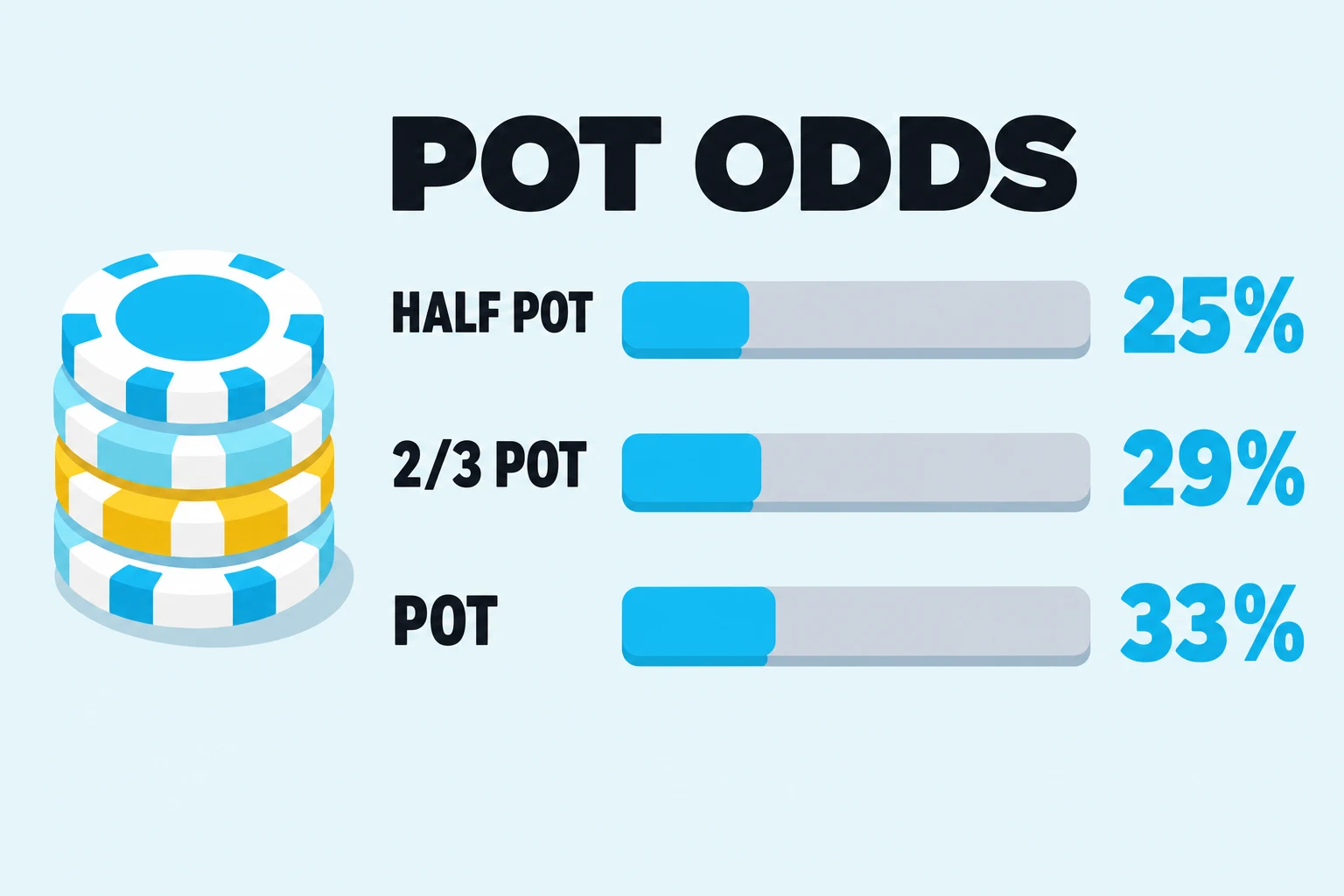
- Three prices cover most of poker: a half-pot bet needs 25%, two-thirds needs 29%, a pot-sized bet needs 33%.
- Compare it to the equity for the cards you are guaranteed to see, then let implied odds settle the close ones.
On this page
- The five-second method
- The pot odds chart: price by bet size
- Do you have enough equity? The rule of 2 and 4
- Worked examples
- When the price lies
- Practice pot odds until they are instant
- Pot odds FAQ
The five-second method
- Take the bet you are facing. That is your call.
- Add it to what is already out there: the pot before the bet, plus the bet, plus your call. That total is the pot you are playing for.
- Divide your call by that total.
- Compare the result to your equity. More equity than the number means the call pays for itself. Less means the call needs a reason beyond the price.
One adjustment to step 1: if you already have chips in on this street, your call is only what’s missing.
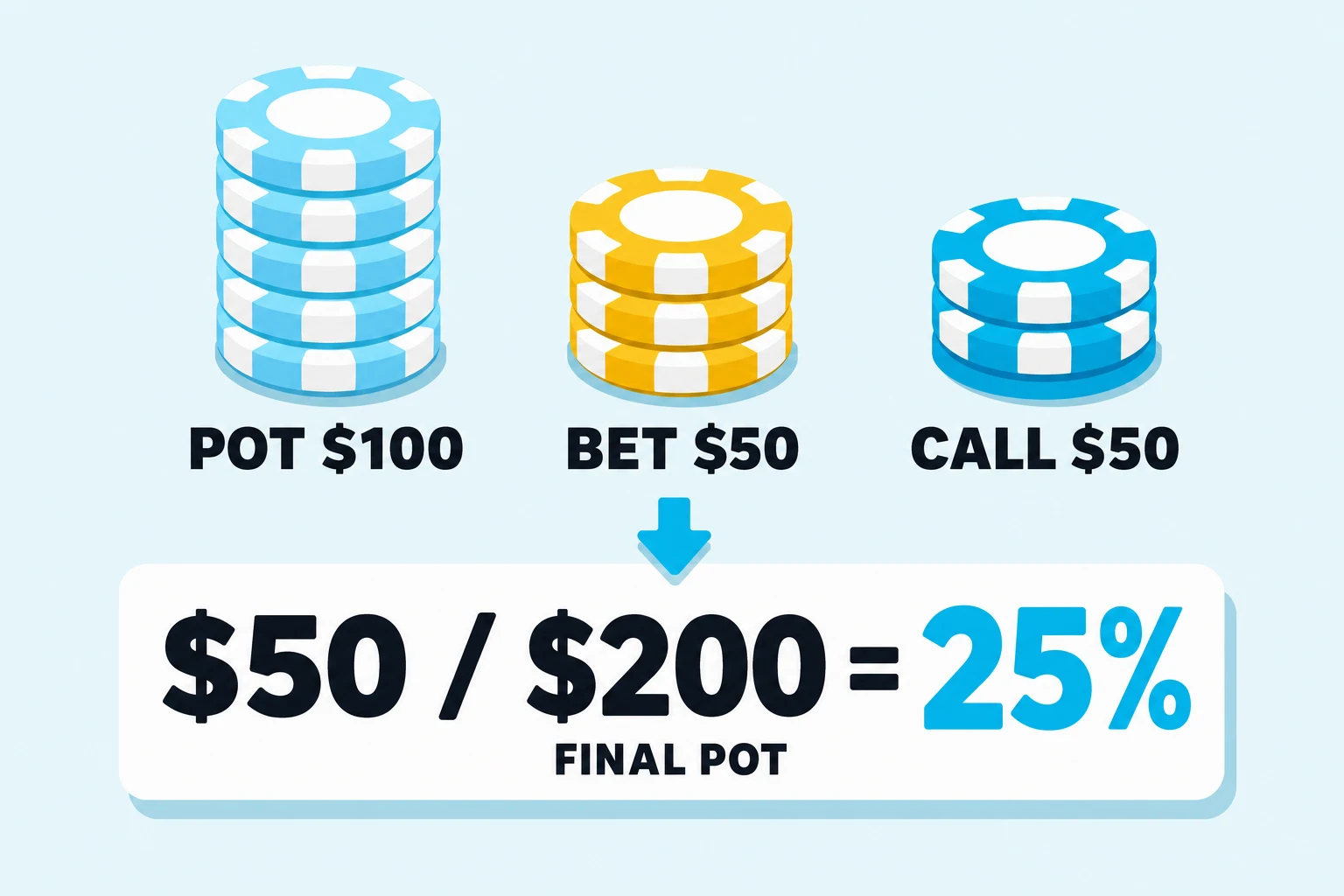
Run it once with real chips. There is $100 in the pot, your opponent bets $50, and you have to call $50. The pot you are playing for is $100 plus $50 plus $50, so $200. Your $50 into $200 is 25%. You need to win this hand one time in four to break even on the call.
Notice that the method never asked what you are holding: pot odds are a price, not a hand read.
Some players learned this as a ratio: $150 to win for $50, so 3 to 1. That works too, it just costs a step. Three to one means three losses for every win, which is four outcomes, so divide 1 by 4 and you are back at 25%.
The pot odds chart: price by bet size
At the table you rarely need the division, because bet sizes repeat. Opponents bet half pot, two-thirds, pot. Learn what those prices ask for and the calculation collapses into recognition.
| Bet you face | You call, into a $100 pot | Final pot | Equity you need | Odds you are getting |
|---|---|---|---|---|
| Quarter pot | $25 | $150 | 17% | 5 to 1 |
| Third pot | $33 | $166 | 20% | 4 to 1 |
| Half pot | $50 | $200 | 25% | 3 to 1 |
| Two-thirds pot | $67 | $234 | 29% | 2.5 to 1 |
| Three-quarters pot | $75 | $250 | 30% | 2.3 to 1 |
| Pot | $100 | $300 | 33% | 2 to 1 |
| Overbet, 1.5x pot | $150 | $400 | 38% | 1.7 to 1 |
| Double pot | $200 | $500 | 40% | 1.5 to 1 |
The dollar column is only there to make the arithmetic checkable. The percentages travel: they are identical in a $20 home game and a $2,000 pot, which is why good players size bets in fractions of the pot rather than in chips.
If you memorize three rows, make them half pot at 25%, two-thirds at 29%, and pot at 33%. Those sizes cover most of the bets you will face, and anything between them can be eyeballed. Notice how slowly the requirement climbs at the top: doubling the bet from pot to double pot moves it only from 33% to 40%. Big bets are expensive, but not as expensive as they feel, which is what makes them work.
Do you have enough equity? The rule of 2 and 4
The price is half the decision. The other half is what your hand is worth right now, and for a drawing hand you can estimate that in your head. Count your outs, multiply by 2 for one card to come, or by 4 when both the turn and river are still coming. The exact turn and river chance for every count from 1 to 20 outs sits beside the rule’s estimate on Poker Skill’s outs to odds chart, and in its lessons the rule is how you pick a draw’s chance by the river. The rule of 2 and 4 has the full treatment, including where it drifts past ten outs, and the hand probability tables have the exact numbers. This is the part that touches the price.
| Outs | Typical draw | One card to come | Both cards to come | Biggest bet this can call on price alone |
|---|---|---|---|---|
| 4 | Gutshot | 8% | 16% | About a tenth of the pot |
| 8 | Open-ended straight draw | 16% | 32% | About a quarter pot |
| 9 | Flush draw | 18% | 36% | Just under a third of the pot |
| 12 | Flush draw plus a gutshot | 24% | 48% | About half pot |
| 15 | Flush draw plus an open-ender | 30% | 60% | Just under a pot-sized bet |
The last column is where the two halves meet: the price at which each draw stops paying for itself, worked from the exact one-card odds rather than the rounded shortcut. Read it once and a lot of hands answer themselves. A gutshot cannot call any real bet. A flush draw calls small bets and folds to big ones, on price alone.
Which equity column you compare against matters more than most players realize. The price you are being offered is a one-street price: it buys you the next card, not both of them. Use the four-times number only when no more betting can happen, which in practice means someone is all in. Any other time, the honest comparison is the two-times number, and the gap between the two is what implied odds have to cover.
One thing the multiplication cannot see is whether your outs are real. A card that makes your straight and hands someone a flush is a dirty out, not an out. Counting outs cleanly is the input to all of this, and a bad count makes precise pot odds useless.
Worked examples
Example 1: a flush draw facing a half-pot bet
You defend your big blind with 7♠ 6♠ and the flop comes K♠ 9♠ 2♥. There is $60 in the pot. Your opponent bets $30, and you have a flush draw and nothing else: nine spades, no pair, no straight draw.
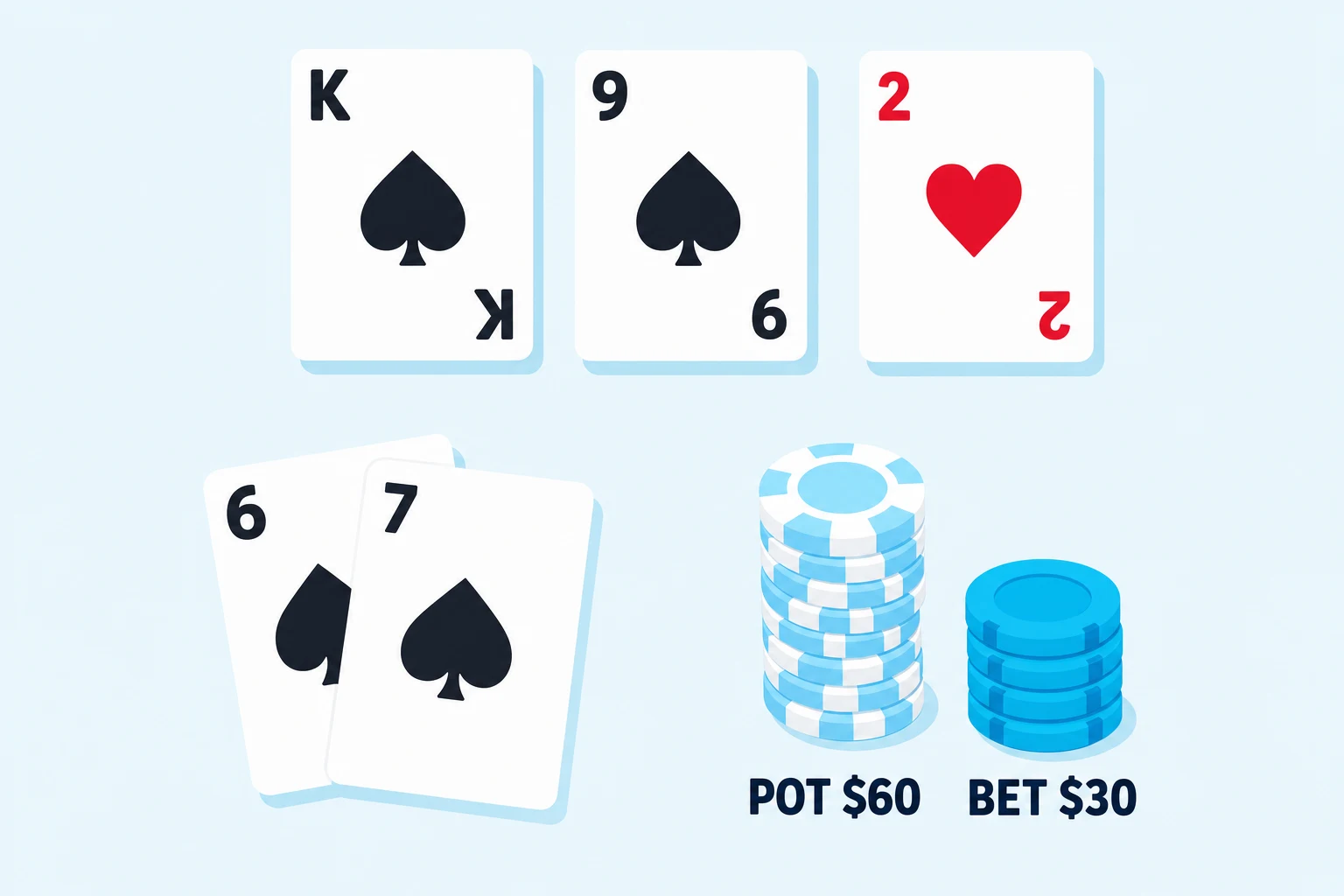
Price first. You call $30 into a pot that becomes $120, so you need 25%. Equity second. Nine outs times two is 18%, and the exact number is 19%. You are short.
That surprises people, because the same nine outs are worth about 35% by the river, which beats 25% comfortably. Nobody is offering you the river, though. Your $30 buys the turn card only, and if the turn bricks your opponent gets to bet again with money that was never in the price you calculated. Comparing a two-card equity to a one-street price is the most common way this math goes wrong.
So the raw price says fold, by six points. Had your opponent moved all in for that $30, both cards would come with no more betting, and 35% against 25% is an instant call. Short of that, the gap has to come from the money you win on the streets where you do hit, which is implied odds.
Example 2: a gutshot facing a big turn bet
You call a raise in position with 6♥ 5♥. The flop is 9♠ 8♣ 2♦, the turn is the K♦, and now there is $120 in the pot. Your opponent bets $90, three-quarters of the pot. You have a gutshot: any 7 makes 5-6-7-8-9.
Call $90 and the pot becomes $300, so the price asks for 30%. Four outs with one card to come is 8%. This is not a close decision, and no read makes it close.
Worth seeing how far away it is: breaking even on implied odds would take roughly $730 more on the river the times you hit, on top of the pot you are playing for. Stacks are $400. The money does not exist, so nothing rescues this call. Fold, and notice you got there without a calculator.
Example 3: a river bluff-catch price
The board finished A♣ 9♦ 4♥ 8♥ 2♠ and you hold J♦ 9♣ for second pair. There is $180 in the pot on the river, and your opponent bets $120.
Same arithmetic: $120 into a final pot of $420 is 29%. What changes is the meaning of equity. No cards are left, so your hand is not a chance to improve, it is a chance to already be best. You are a bluff-catcher: every ace, every set and every two pair beats you, and almost nothing bet this size for value is worse than a pair of nines. The hands you beat are the ones that missed, which on this runout means the heart draws and straight draws that never got there.
So the question the price asks is precise. Is this bet a bluff at least 29% of the time? Put it in combinations if that helps: if your opponent would bet eight value hands here, he needs at least four bluffs in the same line before calling breaks even. Count the missed draws his line allows, compare, and act.
One consequence worth carrying: your folding threshold is also his bluffing license. He is risking $120 to win $180, so folding more than about 40% of your range here makes every bluff he tries profitable on its own, whatever he holds.
When the price lies
The chart tells you what the pot is offering right now. Two forces move the real price, one in each direction, and both live in the money nobody has bet yet.
Implied odds: calling bad prices with big paydays
Implied odds count the chips you expect to win after you hit, not just the ones already in the middle. They are why the flush draw in the first example is a routine call at most tables despite being six points short on the raw price.
Put a number on it: closing that six-point gap takes about $38 of extra money on a later street. With $270 behind, collecting $38 when your flush comes in is normal, not optimistic. The gutshot needed $730 out of a $400 stack, so the difference between a thin call and a fantasy is arithmetic rather than opinion. Name the number you need to win later, look at the stacks, decide whether it exists. Implied odds pay best when the money is deep, when you are in position, and when you are drawing to the nut draw, because second-best hands collect far less than players expect.
Reverse implied odds: when hitting still loses
The mirror image is the money you lose on the hands where you hit and still lose. Look back at the gutshot. Any 7 makes your straight, and the same 7 makes a bigger straight for anyone holding J-T. Chasing a flush draw without an ace has the same shape: the card you want brings your flush and someone else’s better one. Reverse implied odds are the reason non-nut draws are worth less than their out count says.
Handle them by subtracting. Take the outs that make you second best out of the count and price what is left, which sometimes turns nine outs into six and a call into a fold.
Practice pot odds until they are instant
Nothing on this page is hard. It is slow, and slow is what makes players skip the calculation and guess. The fix is repetition on real spots: see a board, see a bet, name the price and the equity before you look at the answer. Twenty reps in and a half-pot bet stops being arithmetic and becomes a number you already know.
That is what the drills in Poker Skill are for. You get a spot, you commit to a decision, and the coaching explains the price you were offered and whether your hand could pay it. Commit before you read: an explanation you did not test yourself against teaches almost nothing. For a quick self-check right now, two questions in our free poker quiz are pot-odds spots scored the same way.
Pot odds FAQ
What is the pot odds formula?
Break-even equity equals your call divided by the total pot after your call, or call / (pot + bet + call). Multiply by 100 for a percentage. If you prefer ratios, pot odds are the pot after the bet divided by your call, stated as x to 1, and you convert with 1 / (ratio + 1).
What pot odds do you need for a flush draw?
A nine-out flush draw is about 19% to come in on the next card, so on price alone it can call a bet of up to just under a third of the pot. When both cards are guaranteed, which really only happens when someone is all in, it is about 35%, and that covers everything up to a pot-sized bet.
Is there a pot odds calculator?
Plenty exist, and they help when you review hands afterward. You cannot use one during a live hand, and online you rarely have time. The method above plus the price chart gets you the same answer inside your decision clock, which is the version worth owning.
What is the 15-25-35 rule?
It is not a standard poker rule, and no serious source defines one. If you have seen those numbers together, they are most likely rounded required-equity figures for common bet sizes: about 17% against a quarter-pot bet, 25% against half pot, 33% against a pot-sized bet. The chart above gives you the same idea with the right numbers. Some books do describe separate 25% and 35% rules about stack commitment: treat a raise of a quarter of your stack as effectively all in, and at a third or more, moving in usually beats calling.