
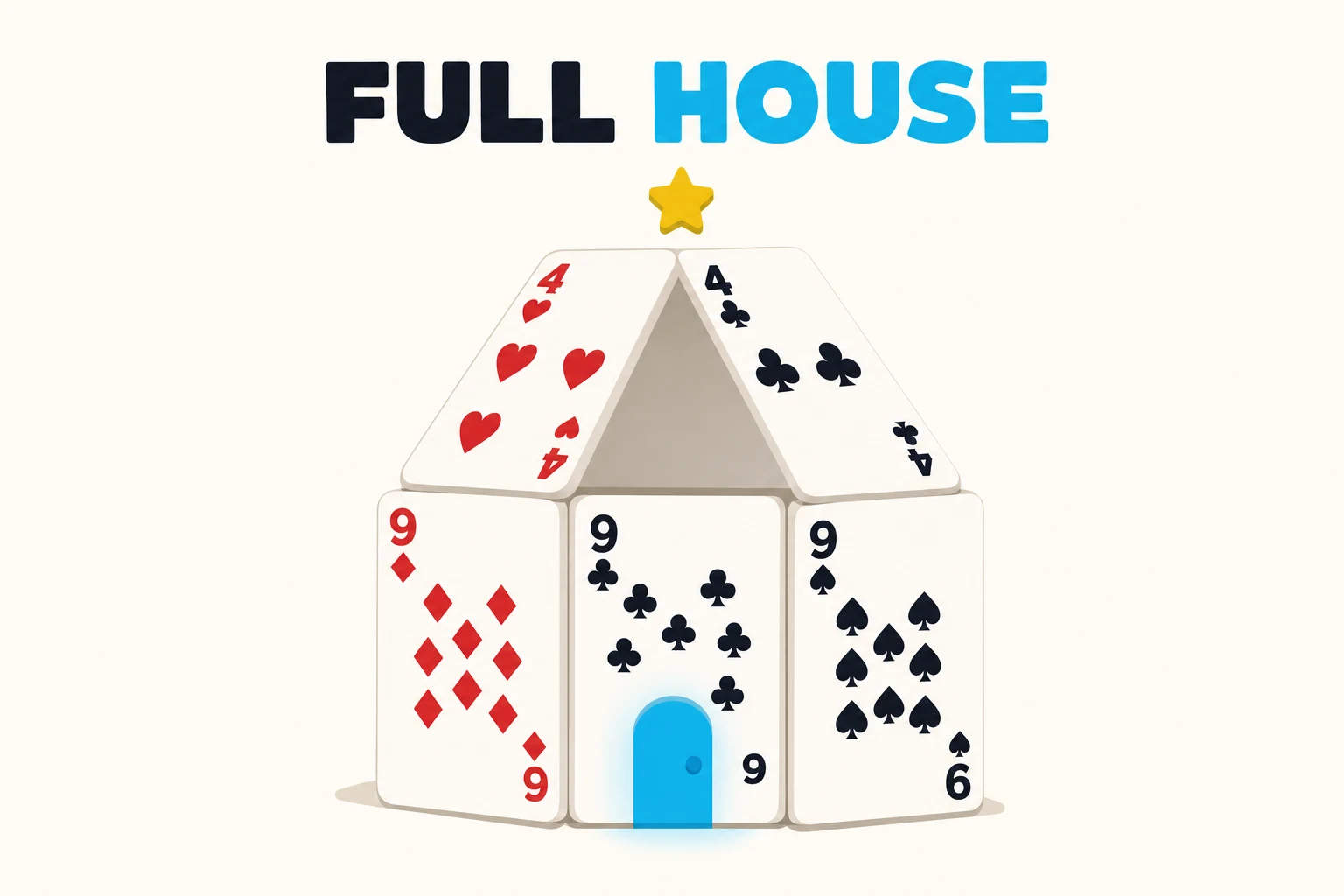
A full house is three cards of one rank plus two of another: 9♦9♣9♠4♥4♣ is “nines full of fours.” It beats a flush, a straight, and everything below them, and loses only to four of a kind, a straight flush, and a bigger full house. When two boats collide, the three-card rank decides the winner. That last rule settles more arguments than the rest of this article combined.
What a full house is
Take three cards of one rank, add a pair of another rank, and you have a full house. Players read the hand out loud as “X full of Y,” where X is always the trips: A♠A♥A♦K♣K♠ is aces full of kings. The nickname is boat, and the story behind that name is its own article. What matters at the table is that the trips half of the hand does the heavy lifting and the pair half comes along for the ride.
What it beats and what beats it
| Matchup | Result |
|---|---|
| Full house vs flush | Full house wins |
| Full house vs straight | Full house wins |
| Full house vs three of a kind, two pair, below | Full house wins |
| Full house vs four of a kind | Four of a kind wins |
| Full house vs straight flush or royal | Straight flush wins |
| Full house vs bigger full house | Trips rank decides |
Three example boats, ranked: aces full of twos (A♠A♥A♦2♣2♠) beats nines full of aces (9♦9♣9♠A♥A♣), which beats twos full of aces (2♦2♣2♠A♠A♥). Read the trips first and the order is never in doubt. For the pairing on its own, what beats a full house takes every matchup one at a time.
Which full house wins
The rule: compare the three-card ranks first. Only if those match do the pairs decide. The pair never outvotes the trips, no matter how pretty it is. Poker Skill’s winners capstone tests the rule on a Q♦Q♥9♣9♠2♦ board, where queens full beats nines full because the trips are compared first.
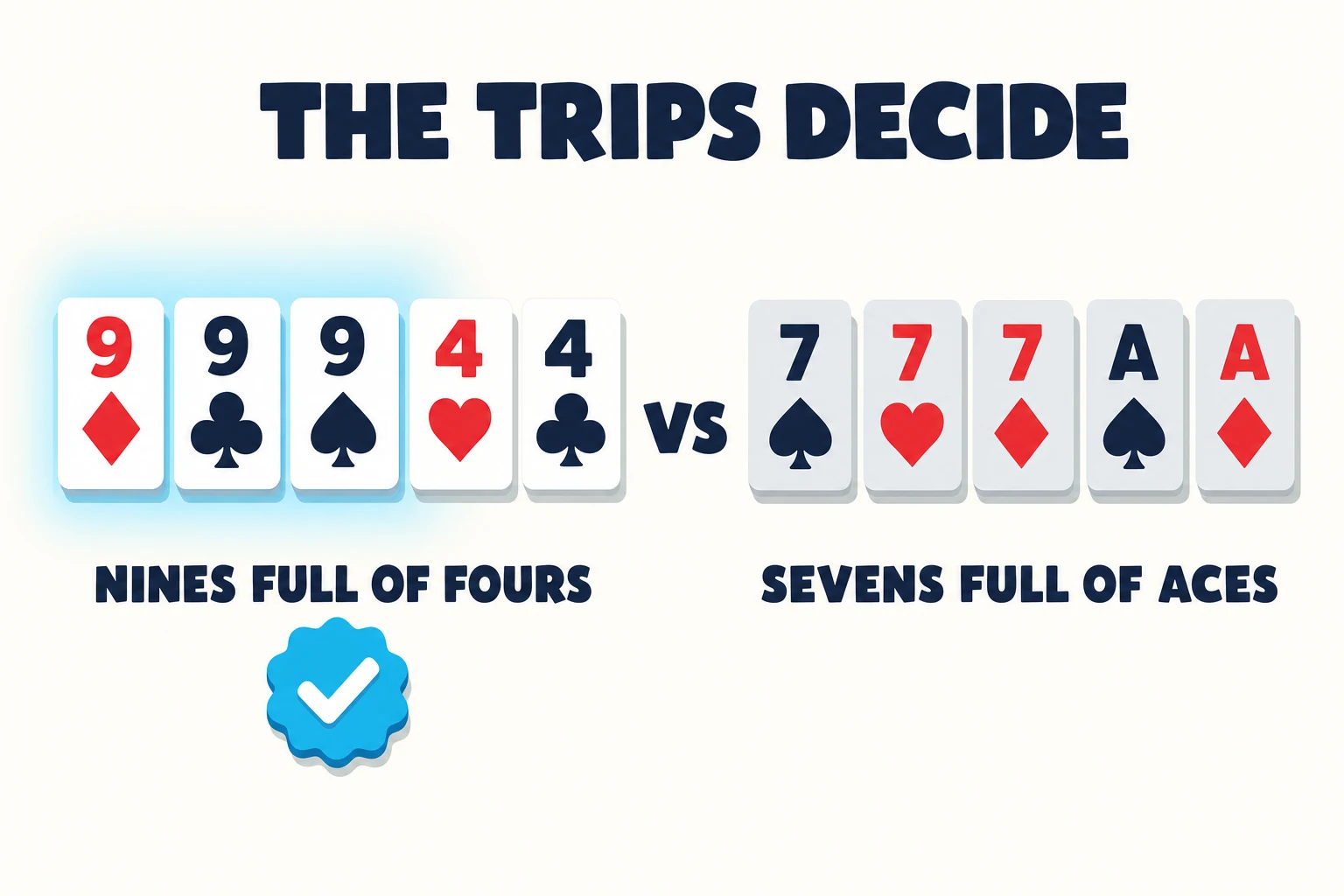
Watch it work. You hold 9♦9♣, your opponent holds 7♠7♥, and the board runs out 9♠7♦4♥4♦2♣. You have nines full of fours; they have sevens full of fours. Your trips are nines, theirs are sevens, so nines full wins, and it would keep winning even if their pair half were aces. Swap their hand to A♠7♣ on a 7♥7♦A♥9♠2♣ board and they hold sevens full of aces, which still loses to a player sitting on 9♦9♣, because nines full of sevens outranks sevens full of anything. “Full of aces” sounds rich and decides nothing unless the trips tie first.
Ties happen when the board itself is the full house. On K♠K♥K♦7♣7♥, a player holding A♠Q♦ and a player holding 8♣7♠ both play the board’s kings full of sevens, because the best five rule picks kings full either way, and the pot splits. The 7 in the second player’s hand looks like it should matter and does not: three sevens make sevens full of kings, which loses to the board’s kings full of sevens, so the board stands.
The traps on paired boards
Two boats in the same pot is where the money moves, and the smaller boat pays the bigger one almost every time, because nobody folds a full house once they have it. That tendency is reliable enough to have a name, Zeebo’s theorem, and it cuts both ways: bet your big boats for full value, and respect the possibility that your small one is the customer.
The other trap is the counterfeit. Say you hold 5♥4♥ and the flop comes 5♠4♦Q♣: two pair, nice. The turn Q♦ pairs the board, and your best five is now queens and fives with a four kicker instead of fives and fours. The board’s queens replaced your fours, and the demotion is expensive: any queen makes trips, any pocket pair above fives now makes a better two pair, and even A♠5♦ beats you with the same queens and fives on a bigger kicker. Your hand did not improve when the board paired; it got demoted. The trap doubles on double-paired boards like 9♠9♥4♣4♦2♠, where the smaller full house pays off the bigger one. Whenever the board pairs, re-read what your best five actually is before putting in another chip.
The three ways a boat gets built
In Texas hold’em, your full house arrives by one of three routes, and knowing which route built yours tells you how hidden it is. Route one: you hold a pocket pair, the flop brings a third, and the board pairs later, the set-to-boat line. This one is invisible, because nothing in your betting had to announce the pocket pair. Route two: you flop two pair with both hole cards and the turn or river pairs one of them. Also well hidden, and also the route most likely to be second-best, since your two pair started vulnerable. Route three: the board pairs itself and your single big pair or trips fills up, the route everyone at the table can see. The visible routes get paid less and run into bigger boats more, which is a compact argument for playing the hidden routes faster and the obvious ones with more patience.
The odds of making one
Four numbers cover most situations, all for Texas hold’em. Holding a pocket pair, you flop a full house about 1 percent of the time. Flop a set and you improve to a full house or four of a kind by the river about 33 percent of the time. Flop two pair using both hole cards and you fill up by the river about 16.5 percent of the time, four outs, twice. Playing any two cards all the way to the river, a full house arrives roughly 2.6 percent of the time, which is why the hand stays memorable enough to overplay.
When this lies to you
The hand’s strength invites autopilot, and autopilot loses in three places. On a board with quads possible, like the K♠K♥K♦7♣7♥ example, your board-boat can at best split the pot: a lone king in someone’s hand beats it, and so does any pocket pair from sevens up. On double-paired boards, “I have a full house” is only half a sentence; the question is which one, because the underfull loses stacks to the overfull. And on coordinated suited boards, remember that your boat blocks nothing about a straight flush: hold 7♣7♦ on a 5♥6♥7♥ flop and the 5♦ turn makes you sevens full, while an opponent with 8♥9♥ has held the straight flush since the flop. Rare, but the rare ones are the expensive ones.
A live-play pattern
Every time the board pairs, run two questions before betting. What is the biggest full house this board allows, and how close is mine to it? If yours is at or near the top, bet for stacks; if it is near the bottom, keep the pot medium and let them do the pushing. Second, does any single card beat my boat? On boards showing trips, one card in the right hand changes everything, and the players who check that first are the ones who lose the minimum on the bad nights.
Where this fits
The full house sits fourth on the ladder, above the flush and below four of a kind. The full ladder, with an example for every rung and how each tie breaks, lives on the poker hand rankings page. If the boat itself is the part you want more of, the naming story and five showdown examples are in the boat article.
Frequently asked questions
Does a flush beat a full house? No. A full house beats a flush, a straight, and everything below them. The flush’s five suited cards look impressive, but the ladder puts the boat one rung higher, and the gap matters: flush-versus-boat is one of the most common stack-losing collisions in hold’em.
What beats a full house? Four of a kind, a straight flush, a royal flush, and a bigger full house. Nothing else does. On most boards that makes the boat the effective nuts, which is exactly why the bigger-boat exception deserves respect.
Aces full of kings vs kings full of aces: which wins? Aces full of kings. Compare the three-card ranks first: three aces beat three kings, and the comparison ends there. The pairs only break the tie when both players hold the same trips.
How rare is a full house? About 2.6 percent of river runouts with any two cards, roughly 1 percent on the flop with a pocket pair, and about a third of the time by the river once you have flopped a set, four of a kind included. Rare enough to feel special, common enough that the bigger-boat question comes up every session.