
Nut flush in No-Limit Texas Hold’em
What a nut flush is
A nut flush is the best flush the current board allows. Usually that is the ace-high flush, because no other card of the suit outranks an ace. The word “nut” is doing narrow work here: it puts you first among flushes on this board, and it says nothing about the hands that outrank flushes. Check the board before you decide the ace settles it.
Key takeaways
- The nut flush is the best flush this board allows, which is not always the ace-high flush.
- When the ace of your suit is on the board, everyone with a flush plays it, so the best flush belongs to whoever holds the king of that suit.
- The board tells you what else is live: a pair on the board puts full houses in play, and three cards of your suit close enough to fit inside one five-card run put a straight flush in play.
Nut flush vs a regular flush
A flush is any five cards of the same suit. Two of them get compared card by card: highest card first, then the next, until one hand is higher. So “flush” describes a hand category, and “nut flush” describes your place inside it on this specific board.
That place is worth naming because flushes get expensive. Money goes in on the river when a flush completes, and the second-best flush is usually the hand paying it. With the nut flush you can raise and know you are not the one paying. With a king-high flush on a board where the ace of the suit is unaccounted for, the same raise is a coin toss you chose to take.
Two related pages pick up where this one stops. The unfinished version, four to a flush with the ace in your hand, is the nut flush draw, and that entry covers outs and the odds of getting there. For betting, sizing, and getting paid once the hand is made, read how to play the nut flush.
When the ace-high flush is not the nuts
Three board patterns break the shortcut, and each one takes about a second to check.
The board is paired
A flush ranks below a full house and below four of a kind, so a paired board puts hands above you in play. On J♠ 8♠ 4♠ 4♦ 2♣, your A♠K♠ is still the best flush anyone can have. It also loses to J4 and 84 for a full house, to pocket jacks or pocket eights for a bigger one, and to 4♣4♥ for quads. Best flush, not best hand.
Three cards of your suit sit close together in rank
A straight flush needs five cards of one suit in a row, which means three of them have to be sitting on the board. On 9♠ 8♠ 7♠, your A♠Q♠ makes the ace-high flush and still loses to J♠T♠ or T♠6♠, both straight flushes. They do not have to be consecutive on the board either: on Q♠ J♠ 9♠, both K♠T♠ and T♠8♠ get there. The test is whether three suited board cards fit inside one five-card run, not whether they look connected.
The ace of your suit is on the board
At showdown you play the best five cards out of your seven, so a board ace of the flush suit belongs to everyone who has the flush. On A♠ J♠ 6♠ 3♦ 2♣, no player can hold the ace of spades, and the best possible spade flush goes to whoever holds the king with a second spade. K♠7♠ reads A♠ K♠ J♠ 7♠ 6♠ and is the nut flush; Q♠T♠ reads A♠ Q♠ J♠ T♠ 6♠ and is not. A fourth board card of your suit works the same way, which is what makes four-flush boards awkward: each player is adding a single card, and the highest one wins.
Poker Skill’s Winners & Splits lesson includes this showdown: both players make an ace-high flush, and the next heart down decides the pot.
Example: two flushes on the same board
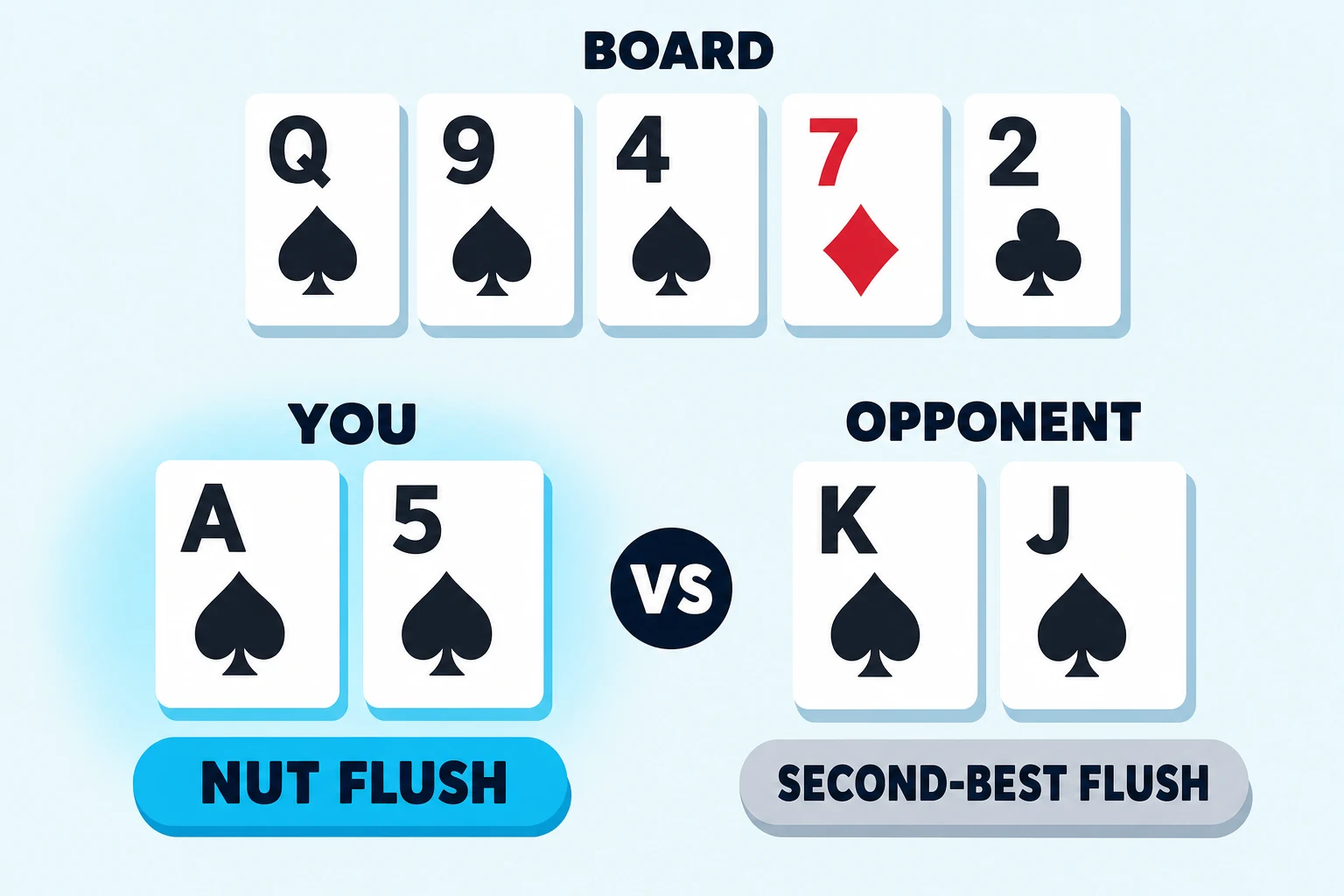
Board: Q♠ 9♠ 4♠ 7♦ 2♣. You hold A♠ 5♠. One opponent holds K♠ J♠.
- Your hand is A♠ Q♠ 9♠ 5♠ 4♠, an ace-high flush.
- Theirs is K♠ Q♠ J♠ 9♠ 4♠, a king-high flush.
- Compare from the top card down. Your ace beats their king, and nothing further needs checking.
Now the board check that makes it the nuts rather than just the best flush. The five ranks are Q, 9, 4, 7 and 2, all different, so no full house or four of a kind is available to anyone. The three spades are Q, 9 and 4, spread too far apart to sit inside any run of five, so no straight flush exists either. Your ace-high flush is the nut flush and the best hand available.
Your opponent has a strong hand and an expensive one. Whether they can be expected to hold it after the betting so far is a separate read, and the term for the best hand still realistically out there is the effective nuts.
Common mistakes with the nut flush
1. Treating the ace of the suit as a guarantee
The ace locks out higher flushes. It does not lock out full houses, quads, or straight flushes. On a paired or connected board, an ace-high flush is a strong hand you are allowed to fold.
2. Paying off with the second-best flush
King-high and queen-high flushes are the hands that pay off the nut flush, and the error is putting in too much action with a flush that is not the best one. When a passive opponent raises the river on a flush board, the question is not whether you have a flush. It is whether you have the flush that can call a raise.
3. Not looking at whether the ace is on the board
Players read their own two cards and skip the board. If the ace of the suit is a community card, your king is the top card that matters, and the ranking of every flush in the pot shifts down one rung.
4. Mixing up the made hand with the draw
Holding the ace of the suit with two more of that suit showing is a draw, not a made hand. It is worth what a draw is worth, and the ace only sets the ceiling for the times it gets there.
FAQ
What is a nut flush in poker?
The nut flush is the best flush possible on the current board. On most boards that is the ace-high flush, because the ace cannot be outranked inside the suit. If the ace of the suit is on the board, the nut flush is held by the player with the king of that suit.
What is the difference between a nut flush and a regular flush?
A regular flush is any five cards of one suit. A nut flush is the highest of them on this board. Every other flush in the pot is second best or worse, and flushes are compared from the top card down, so the difference is usually the whole pot.
Is the nut flush always the ace-high flush?
No. When the ace of the suit is a community card, everyone plays that ace and the king takes over as the top card that separates hands. The ace-high flush is also not automatically the best hand: a paired board can produce a full house, and three cards of your suit that fit inside one five-card run can produce a straight flush.
What beats a nut flush?
Only three hands: a full house, four of a kind, and a straight flush. A higher flush cannot exist, because the nut flush is by definition the highest one the board allows. Our guide to what beats what shows the order in full.
Final takeaway
Nut flush means best flush this board allows, not ace-high flush. Most of the time those are the same sentence, and the times they are not are exactly the spots where money changes hands: the paired board, the three suited cards that fit inside one five-card run, the ace of the suit sitting in the middle of the table. Read the board first, then decide what your flush is worth.