
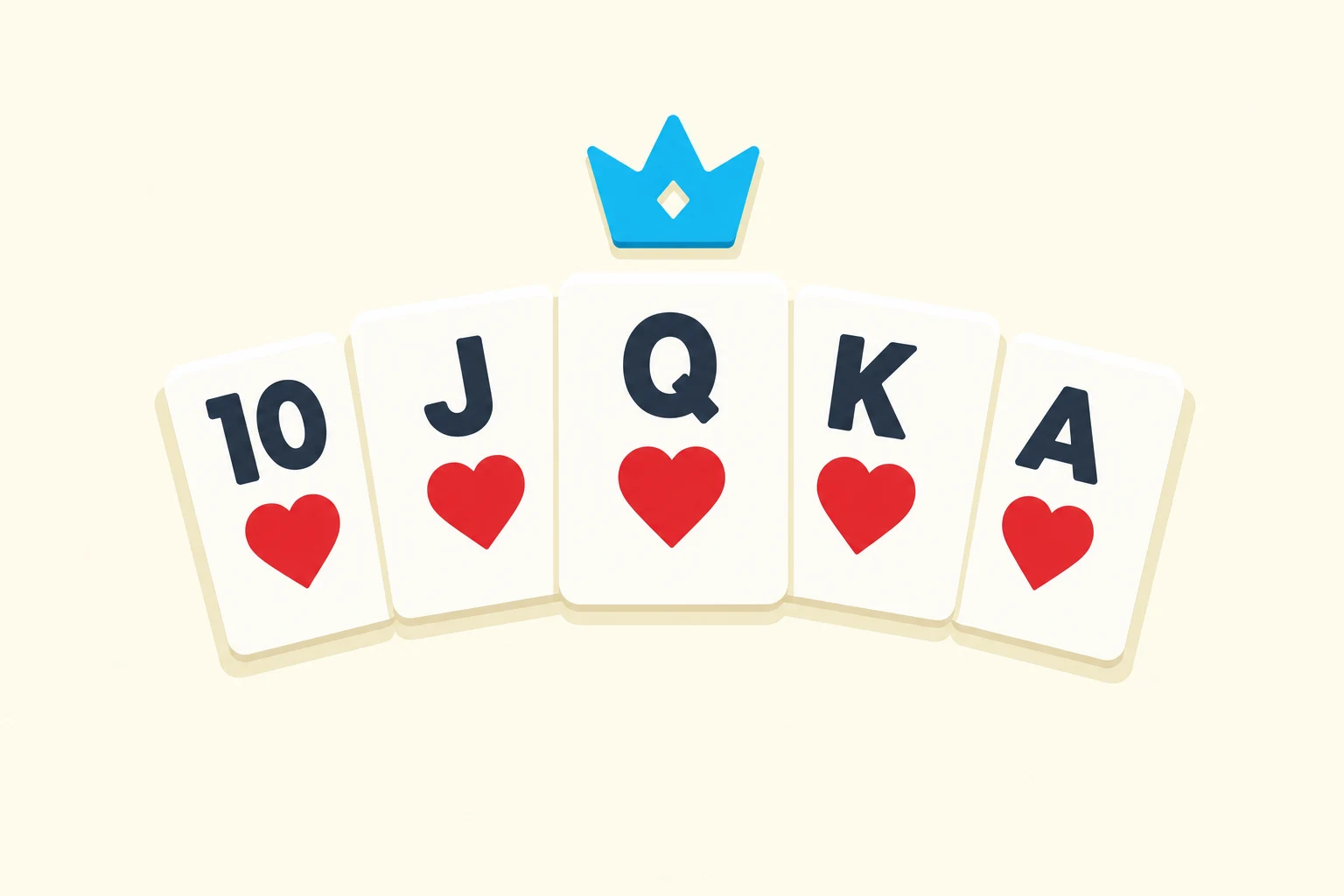
Dealt exactly five cards, your chance of a royal flush is 1 in 649,740. In Texas hold’em, where seven cards build your hand by the river, it improves to roughly 1 in 31,000 per dealt hand. Nothing beats it, and the only way to not win with one is the freak case where the board itself is the royal and everyone chops.
Those are the numbers. What they mean at a table you actually sit at, and why the hand still shows up on livestreams every month, is the more interesting part.
The two odds numbers, and why they differ
The famous 1 in 649,740 is a five-card figure: four possible royals out of 2,598,960 possible five-card hands. It is the chance of being dealt one in five-card draw and the trivia answer, and the wrong number for hold’em.
Hold’em deals you seven cards’ worth of chances: your two plus five on the board, and your hand is the best five of those seven under the best five rule. Seven cards can combine into many five-card hands at once, so the royal arrives more often: 4,324 of the 133,784,560 possible seven-card combinations contain one, which is about 0.0032 percent, or once in roughly 31,000 dealt hands.
Once per 31,000 hands is rare, but it is not lottery rare. A live player seeing 30 hands an hour meets those odds about once per thousand hours, a few years of regular home games. An online grinder playing multiple fast tables can realistically expect one every few months. That is exactly the rarity sweet spot that makes the hand mythical at your kitchen table and routine on a stream that films thousands of hands a week.
Nothing beats it, with one strange footnote
A royal flush is the top of the hand rankings: ten through ace, one suit. It is not its own category so much as the best possible straight flush, the ace-high one. No hand outranks it, and unlike every other hand in poker, no kicker, no bigger version, no board texture can take it away.
The footnote: two players can never hold separate royals in the same hold’em hand, because each would need at least three of its cards from the board, and five board cards cannot give three to two different suits. The only shared-royal scenario is the board playing all five cards, ten-to-ace of one suit sitting face up, in which case every player still in the hand splits the pot. It has happened on television precisely because it is absurd: everyone at the table briefly holds the nuts.
How royals actually arrive
Nobody draws to a royal on purpose, or nobody sane. You arrive at one holding two big suited cards, usually for ordinary reasons, and the board cooperates outrageously. You call a flop with the nut flush draw plus an inside straight draw, which is already a strong hand you would play identically without any royal in sight, and the one card in the deck that completes both arrives. The royal is almost always a bonus on top of a draw that justified itself.
That is worth internalizing because it vaccinates you against a real leak: chasing “royal draws” that are actually weak. Four cards to a royal is often just a flush draw plus a gutshot, and it should be priced like one. The rule of thumb from the four-flush article applies unchanged; the royal possibility adds only a sliver of extra equity, because only one card in the deck delivers it.
Pricing the royal draw, so you never overpay for magic
Say you hold Q♥ J♥ and the flop lands A♥ K♥ 4♣. This is the classic royal fantasy: one card, the 10♥, completes the royal. Price it like an adult. You have nine hearts for the nut flush plus three non-heart tens for the Broadway straight, twelve clean outs: the rule of 2 and 4 calls that 48 percent by the river, and the exact number sits a shade lower around 45. That is a monster draw worth serious aggression, and it would be exactly as much of a monster if royals did not exist.
The royal itself? One card in the remaining forty-seven, about 2 percent on the turn, maybe 4 percent by the river. It adds a rounding error of equity to a hand already worth stacks. Chase this flop hard because twelve outs justify it; the crown, if it comes, is a photograph, not a strategy. The draws to fear are the ones people talk themselves into with two royal cards and nothing else: Q♥ J♥ on a 10♥ 6♦ 2♣ board holds no one-card draw at all, just backdoor straight and flush hopes, priced like a lottery ticket and usually played like a mortgage.
Rarity in context
Numbers this small mean more next to their neighbors. Any straight flush, royal included, arrives about once in 3,200 hands by the river in hold’em. Take the royals out and the straight flush is 1 in 3,591, the row just under the royal on Poker Skill’s printable hands chart. Four of a kind, the hand that usually wins the pots royals are imagined winning, shows up about once in 600 hands. A full house arrives about once in 40. So a royal is almost nine times rarer than the other straight flushes combined, fifty times rarer than quads, and about eight hundred times rarer than the boat your opponent is celebrating.
One more comparison worth having ready: you will flop a set with a pocket pair about once every 8.5 tries. Entire sessions are decided by that number. The royal’s number decides bragging rights, once every few years, which is precisely its charm.
”Royals keep showing up online, is it rigged?”
Every poker forum hosts this thread weekly, and the odds above explain it without conspiracy. An online site dealing millions of hands a day should produce royal flushes by the dozen daily; seeing one at your table is a sampling event, not a signal. Speed multiplies exposure: an online player sees three to five times more hands per hour than a live player, across multiple tables, so a “once in 31,000 hands” event becomes a monthly sighting for a regular. The feeling that rare hands cluster online is the arithmetic of volume wearing a costume.
The honest version of the concern, whether the shuffle itself is fair, is a real and answerable question about certified random number generators and audits, and it deserves better than vibes: the poker RNG and shuffle audits piece covers how that verification actually works. The short version: regulated sites’ shuffles are audited against exactly the frequencies this article describes, and a site producing too many royals would fail its audit as surely as one producing too few.
What to do when it happens
Slow down and get paid; the hand plays itself, your only job is the bet sizing that keeps a worse flush or a boat interested. Then take the picture. Many card rooms pay a bonus or a jackpot for a royal, some requiring both hole cards to play, so know the house rules before you muck anything. And if it comes at a home game, accept that nobody will believe you without evidence. Once in 31,000 hands earns the skepticism.
Is a royal flush just a straight flush?
Yes: it is the ace-high straight flush, the best possible one. Some charts list it as its own category for ceremony, but the math and the rules treat it as the top of the straight-flush family, which is why nothing ties it except the board itself.
What beats a royal flush?
Nothing. It is the highest possible hand in standard poker. The only outcome besides winning is chopping, when the royal is entirely on the board and every remaining player shares it.
Can two players have a royal flush in the same hand?
Not separately: the shared board cannot supply two. The only way multiple players “have” one is when the board itself is the royal, and then the pot splits among everyone still in.
What are the odds of a royal flush in Texas hold’em?
About 1 in 31,000 per dealt hand by the river (4,324 qualifying combinations out of 133,784,560 seven-card deals). On exactly five cards, the odds are 1 in 649,740.