
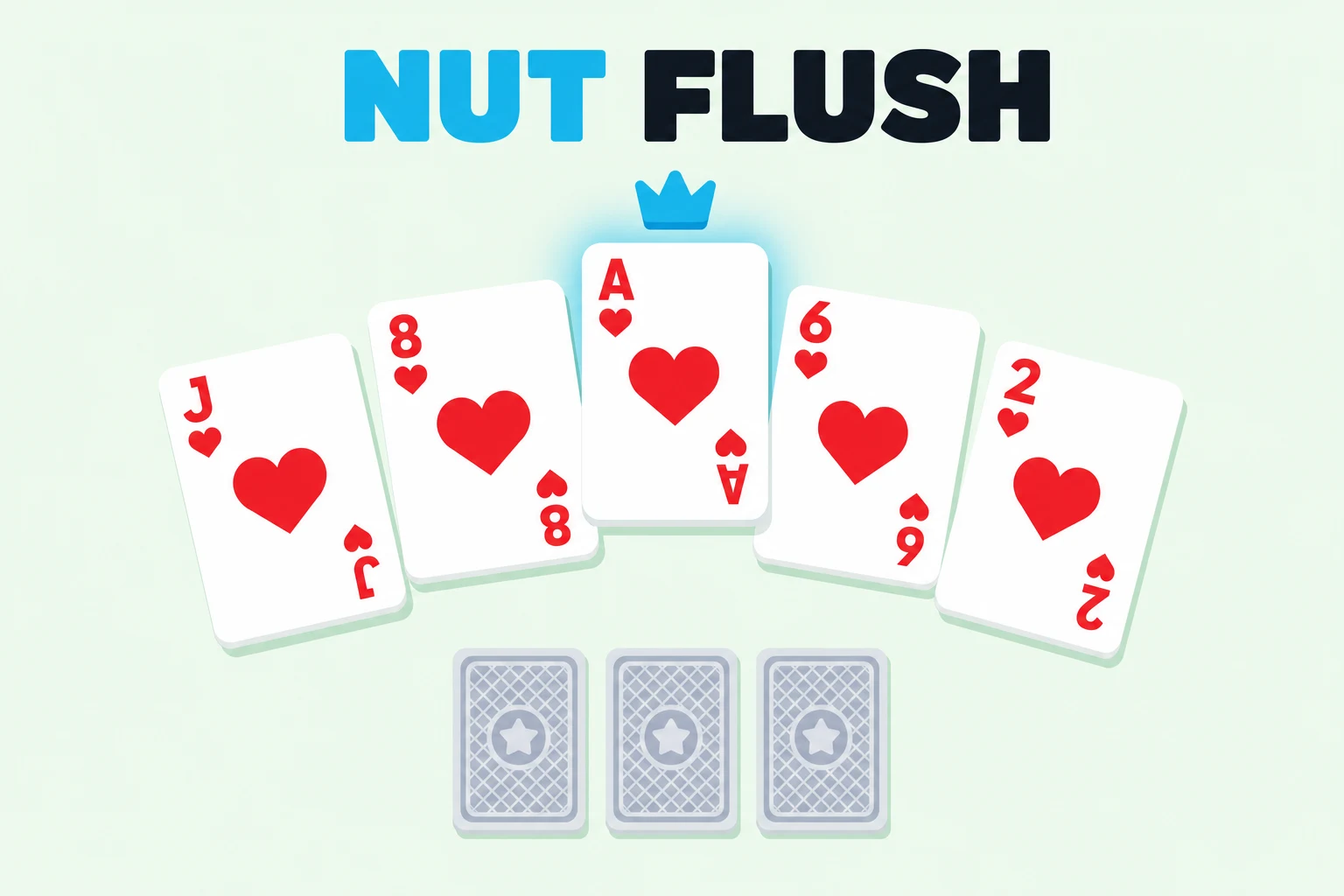
The nut flush is the best possible flush on a given board, and on most boards that means the ace-high flush of the suit. Hold the ace of the board’s flush suit plus one more of it, and no other flush can beat you. The two skills this article builds: finding the nut card in two seconds, and playing the draw to it with the right mix of patience and pressure.
What makes a flush the nuts
Flushes are ranked by their highest card, so the best flush is the one containing the highest card of the suit that is still unaccounted for. Board Q♥9♥2♥: the ace of hearts is out there somewhere, so whoever holds A♥ with any second heart has the nut flush. Now put the ace on the board instead, A♥9♥2♥: the nut card becomes the K♥, and the player holding it with any second heart makes the best flush the board allows. That is the whole trick. Find the highest card of the suit not on the board; whoever holds it holds the nuts of the flush world. Poker Skill’s lesson on nut flushes runs that check from both sides: A♣9♣ on Q♣7♣2♦ is the nut flush draw, and with the ace on the board, K♦9♣ on A♦7♦2♦ holds it instead.
Is the nut flush the actual nuts?
Best flush and best hand are different claims. The quick audit:
| Board | Nut flush holding | Is it the true nuts? |
|---|---|---|
| Q♥9♥2♥ (unpaired, no straight flush open) | A♥ + any heart | Yes |
| Q♥9♥2♥ with a 9♣ turn (paired) | A♥ + any heart | No, full houses and quads possible |
| 8♥7♥6♥ (connected suited) | A♥ + any heart | No, straight flushes possible |
| A♥Q♥9♥4♥ (four-flush board) | K♥ alone | Yes, if the board stays unpaired |
The paired-board row is the expensive one. A flush never beats a full house, and from an unpaired flop the board pairs by the river about 40 percent of the time.
Playing the made nut flush: fast beats fancy
You hold A♥6♥ and the flop comes Q♥9♥2♥. The temptation is to check and let someone catch up. Resist it. Wet boards are exactly where strong hands bet: worse flushes, sets, two pair, and big draws can all pay you right now, and every safe turn card cools the action while every dangerous one, a fourth heart or a board pair, kills it. Bet the flop, bet most turns, and size up as the pot grows. The one checkpoint that matters is the board pairing. When the 9♣ hits the turn, your flush stops being the nuts, and the players who keep piling in on paired rivers against heavy resistance are donating to boats. Fast by default, brakes when the board pairs.
Playing the nut flush draw
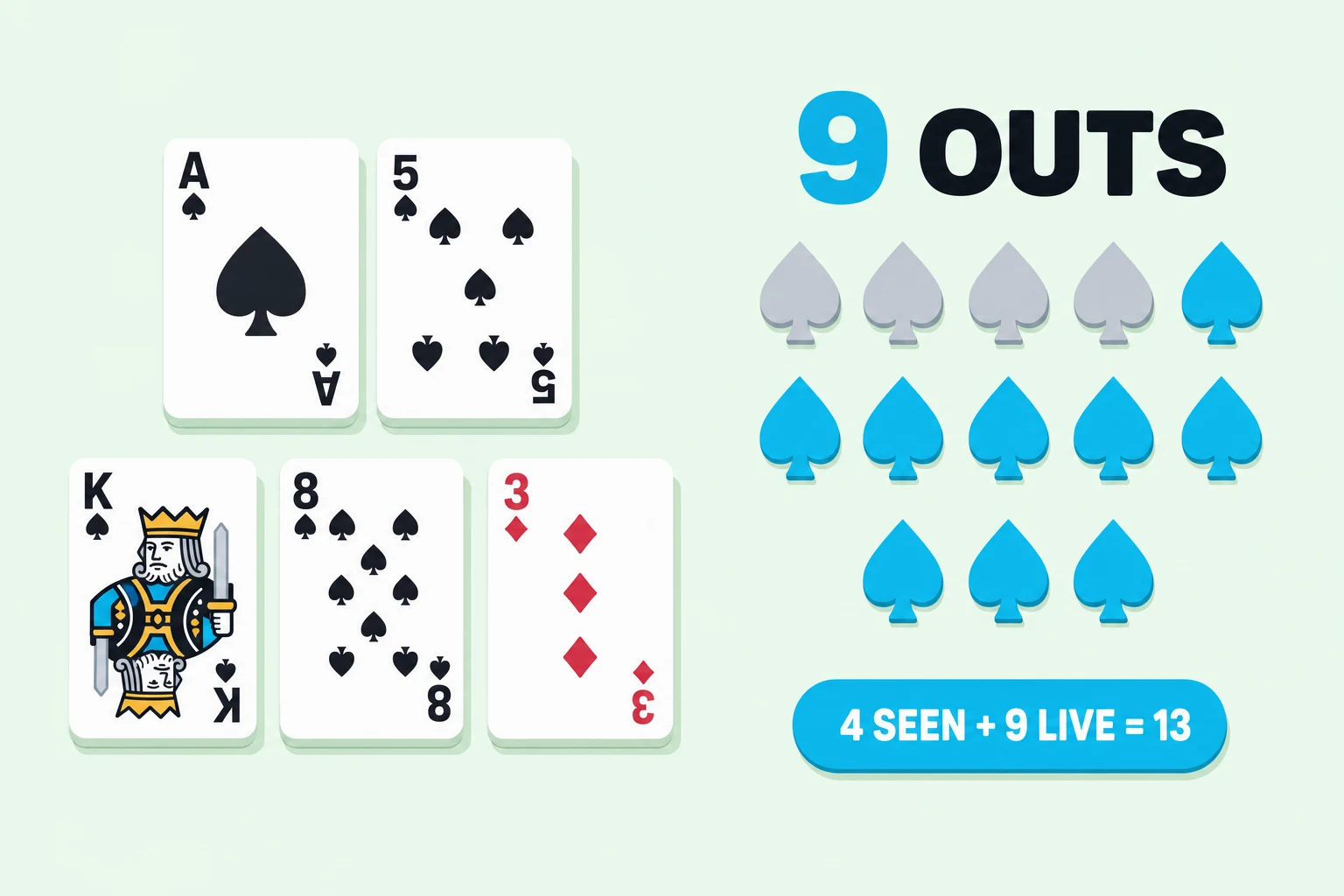
Flop the draw, A♠5♠ on K♠8♠3♦, and you hold nine outs: the nine remaining spades. Those nine cards arrive by the river about 35 percent of the time, about 19 percent on the turn alone, numbers the rule of 2 and 4 reproduces within a point. Add the hidden equity: your ace is an overcard, so three more aces can win you the pot even when the flush misses, though those outs are cloudier since an ace can also make someone two pair.
Heads-up with real stacks behind, the default is aggression. Facing a c-bet here, raising as a semi-bluff gives you two ways to win: they fold now, or you arrive with the nuts a third of the time when they call. A hand that wins the pot outright sometimes and holds 35 percent equity when it does not is a raising hand, not a calling hand. The honest caveats: in multiway pots, calling gains value because your fold equity drops while your pot share of a made nut flush grows, and at shallow stacks the raise commits you, so pick call or shove deliberately instead of raise-folding away your equity.
When your nine outs are not nine
The 35 percent figure assumes every spade that lands wins you the pot, and paired boards break that assumption. Take the same A♠5♠ on K♠8♠3♦, but now the turn pairs the board with the 8♥. Your nine flush outs still complete the flush, but against an opponent whose line says trips, some of those rivers no longer win. The 3♠ completes your flush while double-pairing the board, which hands any 8 a full house and hands you the second-best hand of your life. And if your opponent already holds K♦8♦, they filled up on the turn, while 8♣8♦ made quads outright; either way, all nine of your outs were dead before you counted them. Outs that make your hand and a better one at the same time are dirty outs, and honest accounting discounts them instead of counting them: nine clean outs on an unpaired board might be eight, or far fewer, once the board pairs against the wrong range. The adjustment is not to abandon the draw; it is to stop treating 35 percent as a constant and shade your calling price down when the board’s pairing makes even your best card negotiable.
Nut versus second-nut: the cooler that funds careful players
When two flushes collide, the second-best one writes the check. You hold K♦Q♦, the board runs out J♦7♦2♦8♣3♠, and you have the king-high flush, a monster by feel. Against A♦4♦ you are the customer, and nothing about the hand warned you.
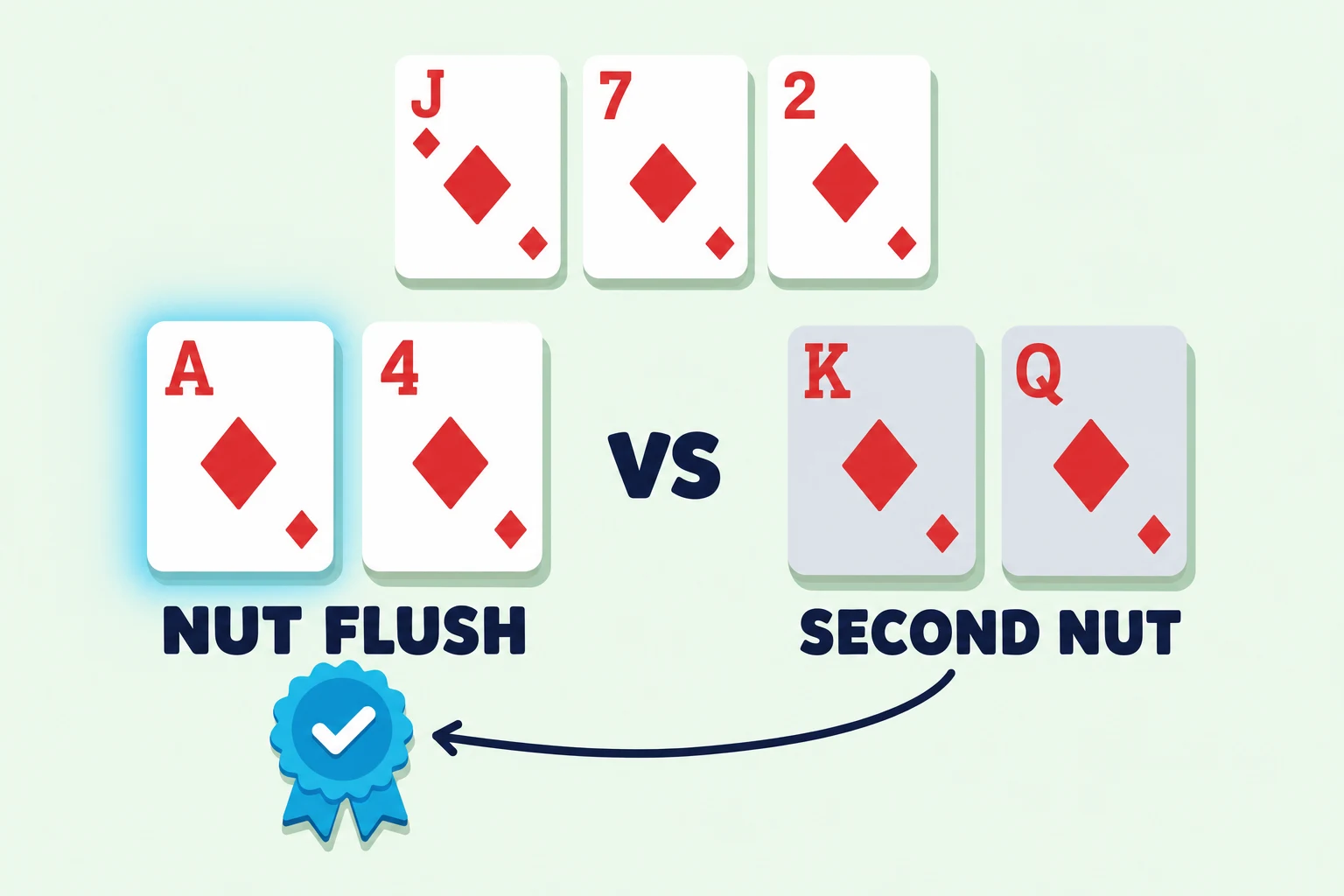
This is why the second nut flush draw and everything below it carry reverse implied odds: the hands that call your big bets when you get there include the one hand that beats you, and when the ace-high flush is out there it never folds. The playbook adjustment is sizing-shaped, not fold-everything: with the king-high flush, bet for value but keep the pot medium against heavy resistance, and treat a river raise as exactly what it usually is. Chasing non-nut draws cheap and making nut draws expensive is a one-line summary of profitable flush play.
When this lies to you
Three failure modes. First, the four-flush board, where holding one high card of the suit plays a flush: with four hearts on board, your bare K♥ is strong, but a bare A♥ in someone’s hand beats it, and this is the one board type where “I have a flush” means the least; the four cards of the same suit article covers that whole mess. Second, brick-blindness: the draw misses 65 percent of the time, and a missed nut flush draw is ace-high, which sometimes wins at showdown and rarely earns another bet; know before the river whether your plan is bluff or give up. Third, freezing the label: the flush that was the nuts on the turn can be second-best on a paired river, and the players who re-read the board every street lose the minimum when it happens.
A live-play pattern
Every time a third suited card lands, run the two-second nut check before any chips move: name the highest card of that suit not on the board, then check your hand for it. Have it, and your job is building the biggest pot the table will tolerate. Missing it, and your next thought should be who might have it and how much a wrong guess costs. Two seconds, every flush board, forever; it is the cheapest habit in poker relative to what it saves.
Frequently asked questions
What is the nut flush? The best possible flush on a given board, ranked by the highest card of the suit. When the ace of the flush suit is not on the board, the ace-high flush is the nut flush; when it is, the player holding the king of the suit makes the best flush available, and so on down.
Is the nut flush always the best hand? No. On paired boards, full houses and four of a kind beat every flush, and on connected suited boards a straight flush can. On unpaired boards with no straight flush possible, the nut flush is the true nuts.
How often does a flush draw come in? From the flop, about 35 percent by the river; from the turn, about 20 percent on the river card. Nine outs drive both numbers, and the rule of 2 and 4 reproduces them fast enough to use mid-hand.
Should you always raise the nut flush draw? Heads-up with meaningful stacks, raising is the strong default because fold equity plus 35 percent pot equity adds up to a profitable bet. Multiway or very shallow, calling or shoving cleanly beats a raise you cannot back up. For draws that are not the nuts, playing flush draws street by street covers the same decisions with the extra caution a lower draw needs.