
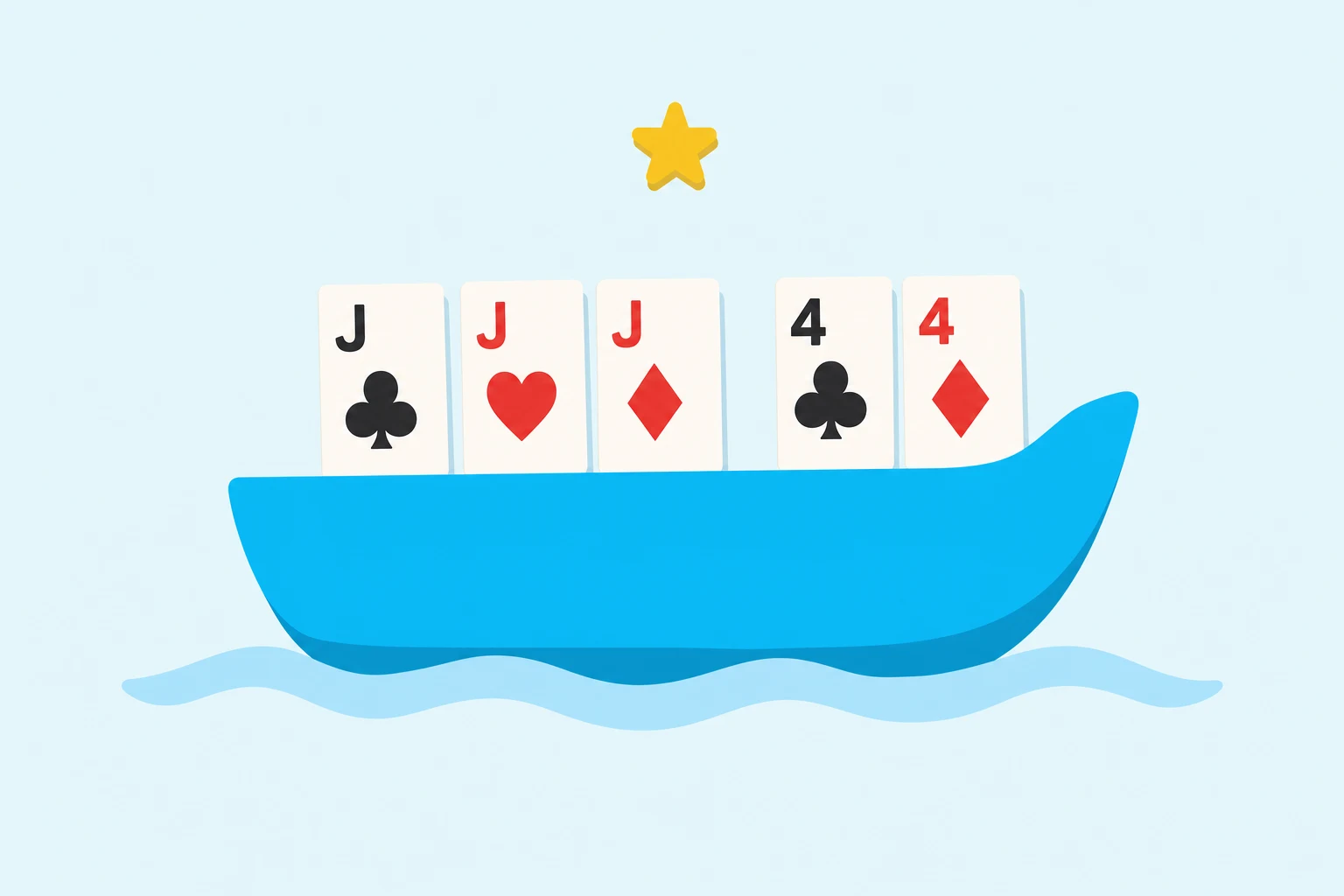
A boat is a full house: three cards of one rank plus a pair of another, like J-J-J-4-4. The two words mean exactly the same hand. “Boat” is just the slang that stuck, and if you play live poker for one evening you will hear it more often than the official name.
Knowing the nickname is the easy part. The part that wins money is knowing how boats rank against each other, because when two players both make a full house, someone usually loses a big pot. This article covers the name, then the part worth drilling.
Where the name comes from
Nobody wrote down the origin, so treat every explanation as a good story rather than settled history. The most repeated one traces back to “full boat,” a phrase from riverboat-era card games, where poker spread through Mississippi steamboat traffic in the 1800s. A hand stuffed with three of a kind plus a pair was full, no room for improvement, a full boat. Over time the “full” fell off in table talk and the boat stayed.
Whatever the true history, the usage today is universal and unambiguous. Say “boat” at any table in the world and every player knows you mean a full house. You will also hear “full boat” from older players, and specific boats get called out as “jacks full” or “jacks full of fours.” Same hand, three names.
What a boat beats, and what beats it
A full house sits near the top of the hand rankings. It beats a flush, a straight, and everything below them. Only three hands beat it: four of a kind (quads), a straight flush, and a royal flush. Those three are rare enough that when you hold a boat, you are usually holding the best hand at the table.
Usually is the word that matters. The pots where boats lose tend to be enormous, because the losing player almost never believes it. More on that trap below.
How to name a boat, and which one wins
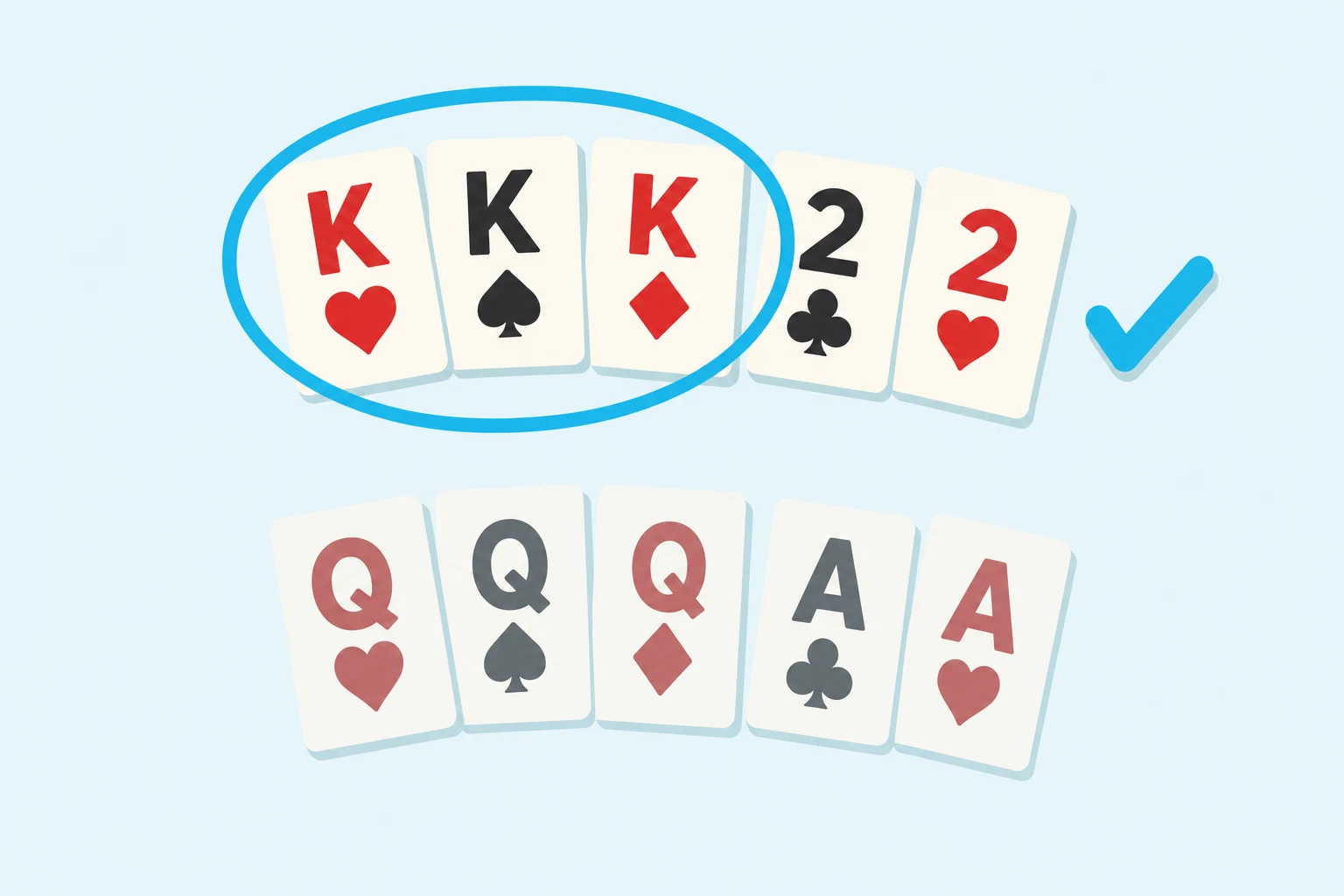
A full house is named by its three-card rank first: J-J-J-4-4 is “jacks full of fours,” never “fours full of jacks.” That naming rule is also the showdown rule. When two players both have a boat, the higher three-card rank wins, and the pair only matters if the trips match. The naming rule is a question in Poker Skill’s full house lesson, where K♣ K♥ K♠ 2♦ 2♥ comes with “twos full of kings” among the wrong answers.
Kings full of twos beats queens full of aces. It looks wrong the first time you see it, because the queens hand contains aces, but the three-of-a-kind part is the hand’s engine and the pair is just the caboose. Drill the phrase “trips first” and you will never misread a boat at showdown again.
How boats get made
Two paths produce most full houses. The first: you hold a set, your pocket pair has matched one board card, and the board pairs. The second: you hold two pair and the board delivers a third copy of one of your ranks. The set path is the happier one, both because a set is already a strong hand while it waits and because set-made boats are better disguised.
That is also why boats feel rare when you chase them and common when you flop a set. A set fills up by the river more often than most new players expect, roughly a third of the time, which is exactly why sets quietly win the biggest pots in hold’em.
The math in plain numbers
You do not need a solver to carry the useful boat numbers in your head, just outs and the rule of thumb you already use for draws.
Flop a set and you have seven outs to fill up on the turn: the case card of your rank, plus three copies of each of the two other board ranks. Miss the turn and the river adds more, because the turn card brought three new pairing outs with it. Add it up across both streets and a flopped set becomes a full house or quads by the river roughly a third of the time. That is why set-holders play big pots so comfortably: the hand is strong now and carries a real chance of becoming nearly unbeatable.
Flop two pair instead and you have exactly four outs to boat up, the two remaining cards of each of your ranks. Four outs is about 8 percent on the next card and about 16 percent across both streets. Worth seeing, rarely worth chasing at a bad price. The difference between seven outs and four is the honest reason sets out-earn two pair over a lifetime of hands.
A worked hand
You hold 8♠ 8♦ and the flop comes Q♠ 8♥ 3♦. That is a flopped set with the boat draw attached. The turn is the Q♦, and now the board is paired: you hold eights full of queens. Your opponent bets big.
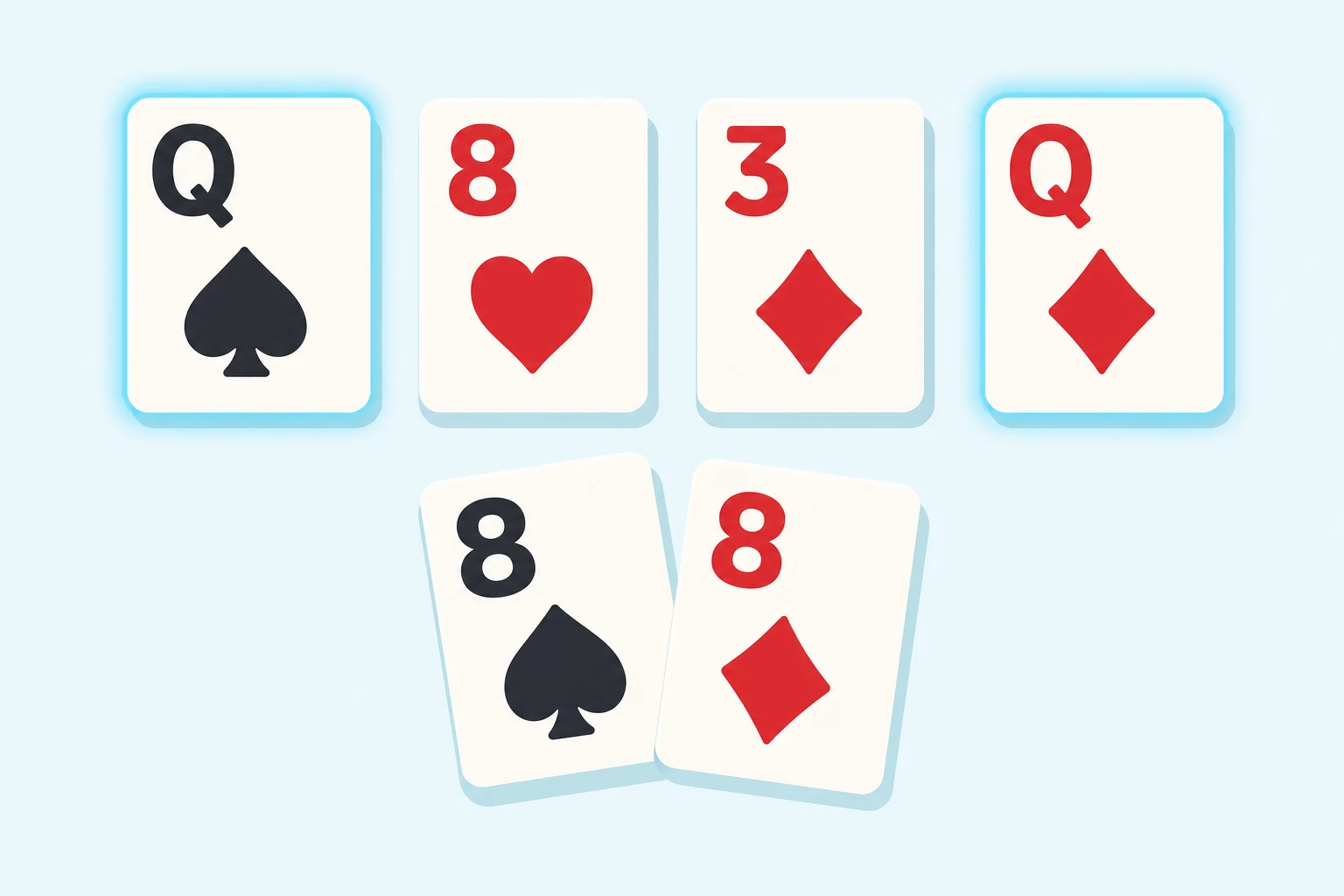
Run the checklist before celebrating. Which hands beat you? Queens full, made by exactly Q-8 or Q-3, and pocket queens, which is quads here. Pocket threes boated too, but threes full loses to your eights full. A lone queen, hands like K-Q or Q-J, only has trip queens on this board, and your boat beats trips. So you are ahead of almost everything that can bet, and the few hands that beat you are narrow enough that folding would be a disaster.
Now flip the hand: you hold Q♥ 8♣ on that same run-out. Queens full of eights, and with the third queen in your own hand, nothing on this board can beat you: quads are impossible and no bigger boat exists. This is the hand that stacks the eights. The lesson from both seats is identical: the moment the board pairs, stop reading your own hand and start ranking the possible boats.
The boat-over-boat trap
Here is the expensive lesson, and it always happens on a paired board. When the board shows something like Q-Q-8, every player holding a queen has trips and almost every pocket pair is drawing at a boat. If the river makes two players full, the smaller boat almost always pays off the bigger one, because “I have a full house” feels unfoldable, a tendency so dependable it earned its own name: Zeebo’s theorem.
Two habits protect you. First, on paired boards, ask which boats are possible and where yours sits in that order before the money goes in. Eights full is a mile from queens full. Second, respect the board’s top rank: when your boat uses the board’s pair as its trips, anyone playing the case card has you beat, and heavy resistance means exactly that more often than new players want to believe. A boat is not a license to stop thinking; it is a hand strong enough that your only real job left is reading whether a bigger one is out there.
Where this fits in your game
Vocabulary first: “boat” will show up in table talk, hand histories, and every training video you ever watch, so file it next to the boat glossary entry and move on. The durable skill underneath is paired-board reading. Every time a board pairs, run the same three questions without touching your chips: what boats are possible, where does mine rank among them, and does my opponent’s story only make sense as one of the boats above me? Those three questions are a rep you can practice deliberately, and they transfer to every big-hand situation in hold’em, not just full houses. Players who never build the habit pay for it in exactly one way: slowly at first, then all at once, stacks going in with the second-best boat and a shocked face.
The one-line summary worth keeping
Boat means full house, trips rank decides between boats, and paired boards are where boats go to get out-boated. Everything else about the hand is celebration.
What is a boat in poker?
A boat is poker slang for a full house: three cards of one rank plus a pair of another rank, like jacks full of fours. At showdown it beats a flush and a straight, and only quads and straight flushes beat it.
Is a full house the same as a boat?
Yes, identical. Boat, full boat, and full house all name the same hand: three cards of one rank plus a pair of another. There is no rules difference, only table talk.
What beats a boat?
Only three hands: four of a kind, a straight flush, and a royal flush. A boat beats a flush, a straight, three of a kind, and everything weaker.
Which full house wins at showdown?
The one with the higher three-of-a-kind rank. Kings full of twos beats queens full of aces. If both players have the same trips, the pair breaks the tie, and if the whole five-card hand matches, the pot splits.