


Three of a Kind
Three of a Kind (called "Trips" or a "Set") is a five-card hand: three cards of the same rank plus two unrelated side cards. It beats one pair and two pair in Hold'em standard hand rankings. Only straights, flushes, full houses, four of a kind, straight flushes, and royal flushes beat it. Because Three of a Kind appears often and can be concealed, it wins many pots at multiple stages.
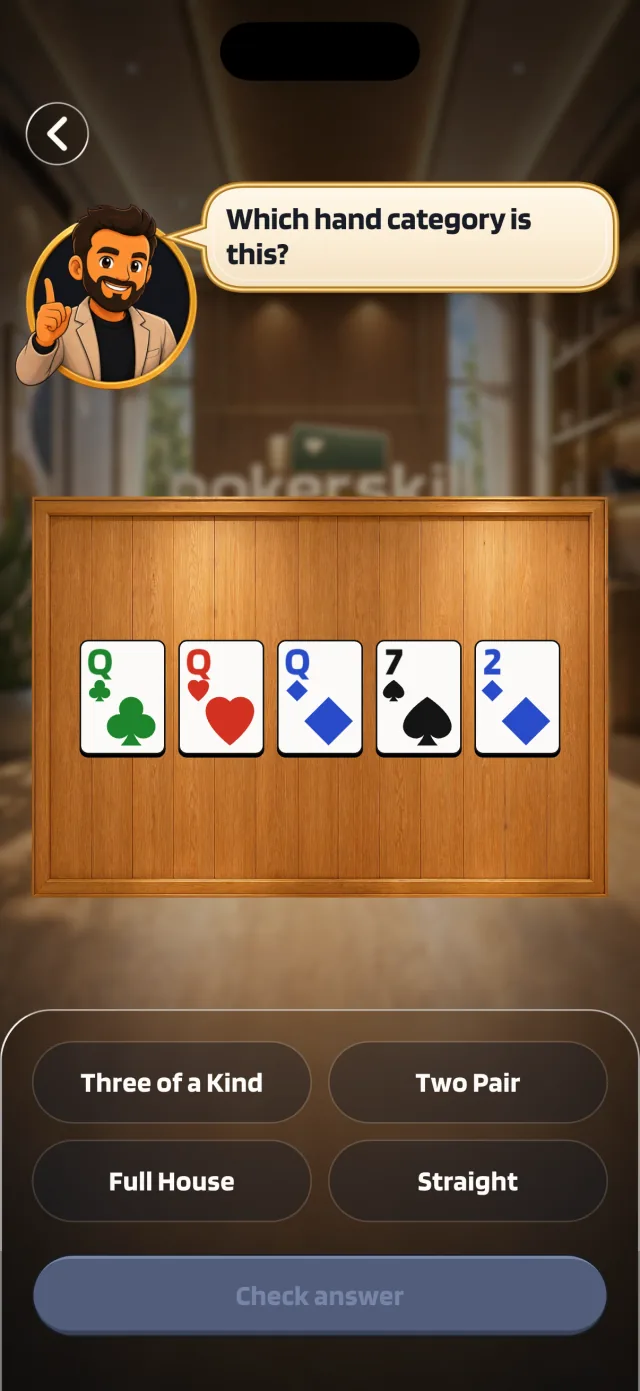
Practice this in Poker Skill. The Winner Blitz drill puts the trips on the board, where every player shares them and ace-king beats ace-nine because the second kicker decides.
Get the free appThree of a Kind (No-Limit Texas Hold’em)
What Three of a Kind Means
Three of a Kind (called “Trips” or a “Set”) is a five-card hand: three cards of the same rank plus two unrelated side cards. It beats one pair and two pair in Hold’em standard hand rankings. Only straights, flushes, full houses, four of a kind, straight flushes, and royal flushes beat it. Because Three of a Kind appears often and can be concealed, it wins many pots at multiple stages.
For the full order of hands, odds, and tie-break examples, see the poker hand rankings chart.
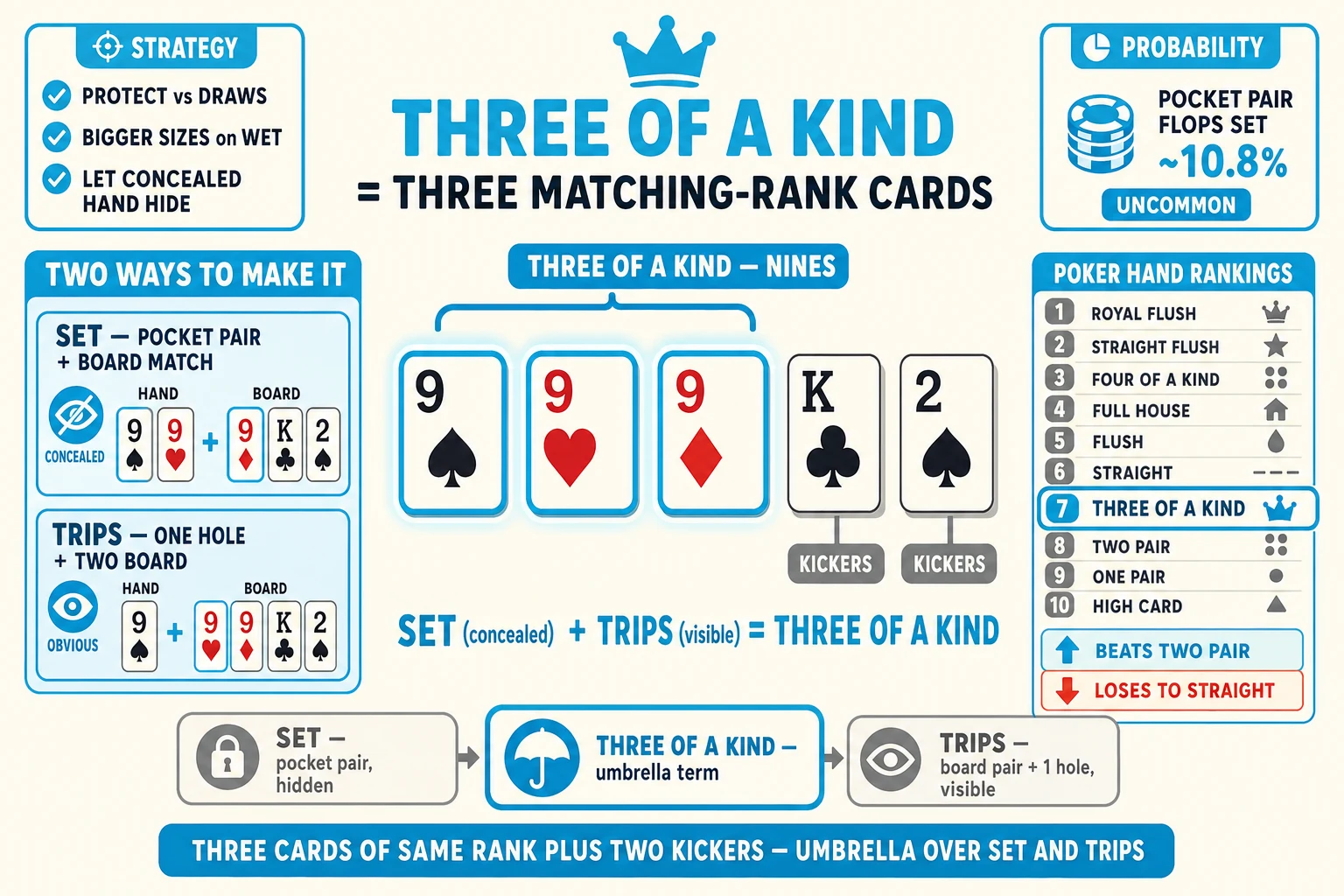
Set vs Trips: formation and practical difference
A set forms when you start with a pocket pair and one matching card hits the board (for example, you hold 7♠7♥ and the flop shows 7♦ 3♣ 2♠). Trips occur when two of a rank already sit on the board and you hold the third (for example, board 8♦8♣ K♠ and you have 8♠). The practical difference is visibility: sets hide more of your strength than trips. When you hold a set, opponents seldom put you on three of a kind. Trips are more visible because two matching cards sit on the board, which often reduces how much extra value you can extract.
Hand strength rules and five-card evaluation
Three of a Kind beats one pair and two pair, but loses to higher hands. Only your best five cards determine the final hand; kickers often decide ties. If the board makes three of a kind - for example 9♠9♥9♦ K♣ 2♣ - every player uses the board’s three nines. Each player’s two highest hole or board cards fill the final slots.
Odds and when you can expect it
If you start with a pocket pair, you will flop a set about 10.8% of the time. That 10.8% rate and the concealment of sets make Three of a Kind profitable, especially in multi-way pots. Chances to make trips in other ways depend on the board texture and your hole cards.
How to play Three of a Kind: betting, protection, and value
- Protect aggressively: When you flop a set, bet or raise enough to charge straight and flush draws. For example, with Q♣Q♦ on A♠ Q♥ 7♦, bet to deny cheap cards to draws.
- Use concealment: Mix check-raises and variable bet sizing to hide a set’s strength and extract more value.
- Size for texture: On dry boards, size bets for value; on wet or coordinated boards, size larger to deny free cards.
- Use position: Being last to act lets you extract more value and control the pot with a set or trips.
Common mistakes and when to temper aggression
- Overplaying trips on coordinated (wet) boards where straights or flushes are likely; opponents can outdraw you.
- Slowplaying a set against multiple opponents; giving free cards with several players is dangerous.
- Misjudging concealment: treating visible trips like a concealed set often leaves value on the table.
Compare all ten poker hand rankings, best to worst to see where three of a kind sits.
For how three of a kind holds up against each stronger hand, see what beats what in poker.
Quick checklist
- Confirm whether you have a set (pocket pair plus board card) or trips (board pair plus hole card).
- Bet to protect against straight and flush draws; size bets larger on wet boards.
- Prioritize extracting value in multi-way pots where concealed strength pays best.
- Always evaluate the final five-card hand and watch for stronger possible holdings on the board.