
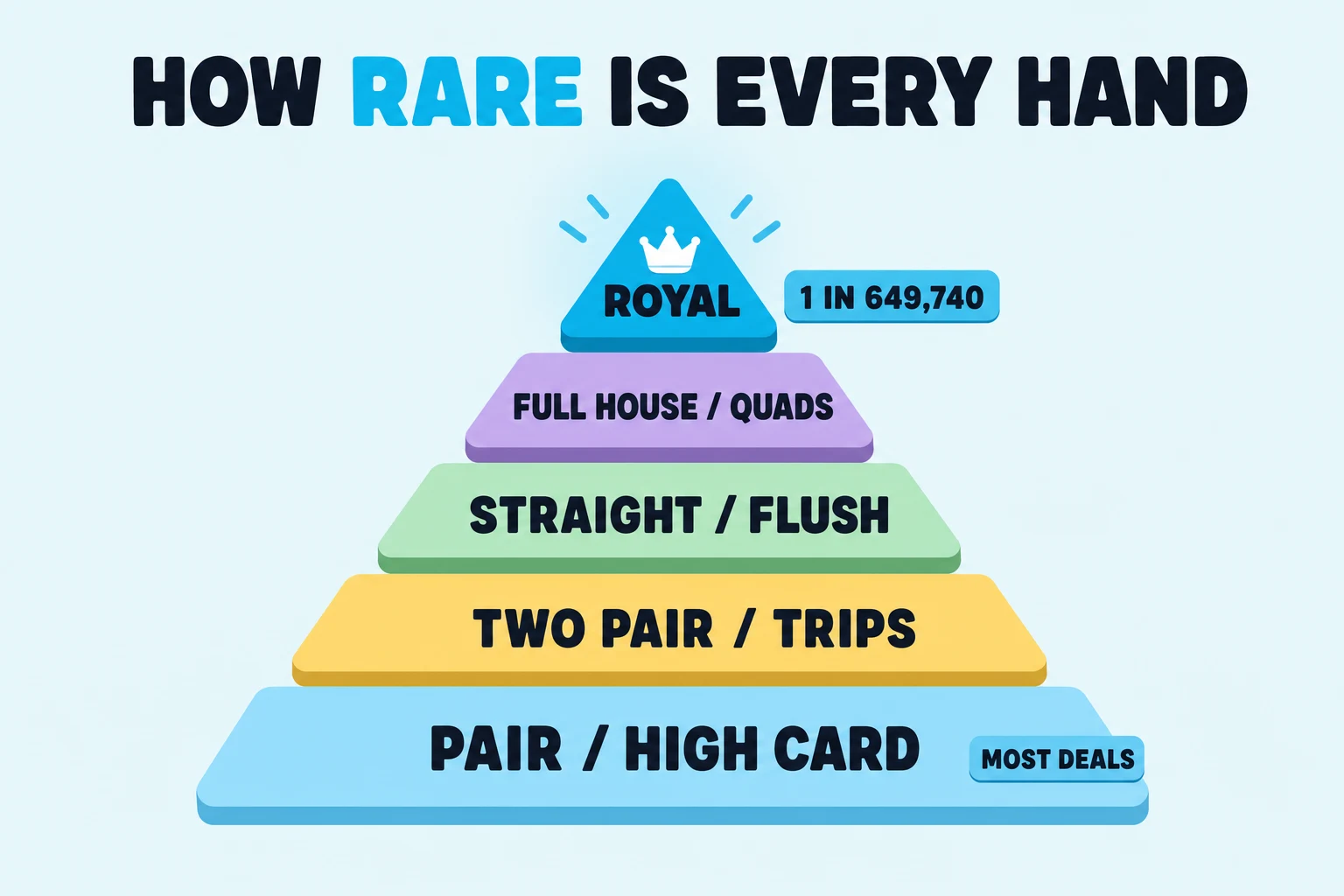
Dealt five random cards, you get no pair at all just over half the time and a royal flush once in 649,740 deals. Play a hold’em hand to the river, where you choose the best five of seven cards, and you make a pair or better about 83 percent of the time.
The full probability table
| Hand | Dealt 5 cards | Odds against (5-card) | By the river (7 cards) |
|---|---|---|---|
| Royal flush | 0.0002% | 649,739-to-1 | 0.003% |
| Straight flush | 0.0014% | 72,192-to-1 | 0.028% |
| Four of a kind | 0.024% | 4,164-to-1 | 0.17% |
| Full house | 0.14% | 693-to-1 | 2.6% |
| Flush | 0.20% | 508-to-1 | 3.0% |
| Straight | 0.39% | 254-to-1 | 4.6% |
| Three of a kind | 2.1% | 46-to-1 | 4.8% |
| Two pair | 4.8% | 20-to-1 | 23.5% |
| One pair | 42.3% | 1.4-to-1 | 43.8% |
| High card | 50.1% | 1-to-1 | 17.4% |
The 5-card column describes a raw deal: five cards, no choices. The 7-card column describes hold’em reality: your best five from two hole cards plus five board cards. Both columns are counts. The first sorts all 2,598,960 five-card hands into categories and the second sorts all 133,784,560 seven-card hands. Every figure is counted from every deal and shown rounded: percentages to one decimal place at one percent and above and to their first two digits below it, with the royal flush cut to one digit. The odds column is rounded to the nearest whole number, apart from one pair at 1.4-to-1. That second count is the one on Poker Skill’s printable poker hands chart, written as one-in odds from 1 in 30,940 for a royal flush to 1 in 5.7 for high card.
Why the two columns differ
Seven cards give you twenty-one ways to choose five, and you always keep the best one, so every hand above high card gets more common while high card collapses from half of all deals to about a sixth. Two pair rises furthest, from 4.8 percent of raw deals to 23.5 percent by the river, because seven cards offer so many ways to pair twice. The order of the rungs does not move: the hand rankings are built on five-card rarity, so a flush stays above a straight even though hold’em reaches both far more often.
Six-card hands
There are 20,358,520 six-card deals, and two different ways to count what they make.
Score the best five of the six, the way a six-card game scores hands under the standard rankings, and the categories hold their usual order while the frequencies change. One pair turns up 9,730,740 times, close to 48 percent, and high card, meaning no pair, no straight and no flush, only 6,612,900 times, about a third. With six cards a pair is more likely than a high-card hand, which reverses the five-card column above, where high card leads at 50.1 percent.
The second count sorts every six-card deal by how rare its whole six-card pattern is. Six cards hold shapes that five cannot, such as two separate three-of-a-kinds, 1,248 of them, and four of a kind sitting beside a pair, another 936. All six cards suited happens 6,864 times, and 36 of those are six-card straight flushes, so flushes that are not straight flushes come to 6,828. Because those same 36 also run in sequence, the 36,864 six-card runs leave 36,828 straights. The flush is rarer than the 13,728 hands holding four of a kind and two unpaired kickers, and the straight is rarer than the 164,736 holding three of a rank, two of another and a sixth card. Sorted by frequency, that model puts the flush above four of a kind and the straight above the full house.
Six-card games award the pot to the best five cards under the standard hand rankings.
The rarity ladder, walked
Unpaired high card leads the five-card column, which is why ace-high wins real pots. Above it the gaps are uneven: two pair at one deal in 21, trips at one in 47, a straight at one in 255, a flush at one in 509, a full house at one in 694. The step from trips to a straight is 5.4 times, while a flush to a full house is only 1.4. The last three rungs are steeper: four of a kind at one in 4,165, a straight flush at one in 72,193 and the royal at one deal in 649,740, steps of six, seventeen and nine times. At thirty hands an hour and two thousand hours a year, 649,740 deals is about eleven years of full-time play. By the river in hold’em, where seven cards give twenty-one five-card combinations, a royal arrives about once in 31,000 hands.
Before the flop: what you get dealt
The same counting decides what you are dealt before the flop. A pocket pair arrives once in 17 hands, 5.9 percent. Narrow that to a specific pair like aces and it is once in 221 hands, while two suited cards turn up 24 percent of the time. Aces are rarer for you than for the table: at a nine-handed table somebody is dealt them about once in every 25 hands. The odds for the collisions themselves, aces against kings and the other famous races, are in AA vs KK and famous matchup odds.
Three numbers worth memorizing
By the river you hold a pair or better 83 percent of the time, and more than half of those hands are a single pair. Of the draws you can price, a pocket pair becomes a set or better on 12 percent of flops, about one in 8.5, and two suited cards finish the flush 6.4 percent of the time, one in 16.
When these numbers lie to you
These probabilities describe deals. A river with a big bet in front of you is a filtered set, so “flush by the river” and “flush, given that someone just check-raised the river” are different numbers, and this page only answers the first. Equity is a different measurement, because how often a hand arrives says nothing about how often it wins on that board against that range. The by-the-river column counts all 133,784,560 seven-card combinations, including every hand you would have folded before the flop.
A live-play pattern
Mid-hand, translate the table into outs and a price. When you catch yourself thinking “a flush is unlikely,” count the outs instead. Nine clean outs is roughly 35 percent from the flop to the river by the rule of 2 and 4, and 35 percent needs about 1.9-to-1 to break even if you see both cards without paying again.
Where this fits
The rankings chart shows the order itself, with an example hand on every rung. What beats what in poker settles single pairings one at a time. The royal flush odds article works through the rarest hand in detail. The full house article does the same for the boat.
Frequently asked questions
What is the most common poker hand? In a raw five-card deal, high card, at just over 50 percent. By the river in hold’em, one pair, at about 44 percent of hands.
What are the odds of a royal flush? One in 649,740 for a five-card deal; about one in 31,000 by the river in hold’em when you count all seven cards. Either way it is the rarest hand in the game.
How rare is four of a kind? One five-card deal in 4,165, and about one river in 595 in hold’em.
Do more players at the table change these odds? Your own hand keeps the same odds however many seats are filled. The chance that someone at the table holds a big hand rises with every player dealt in. That rising chance is why every pocket pair is an open on Poker Skill’s six-handed preflop charts, and why its six-seat lessons say “Pocket pairs are opens first in,” while a full ring’s early seats start at sevens.