
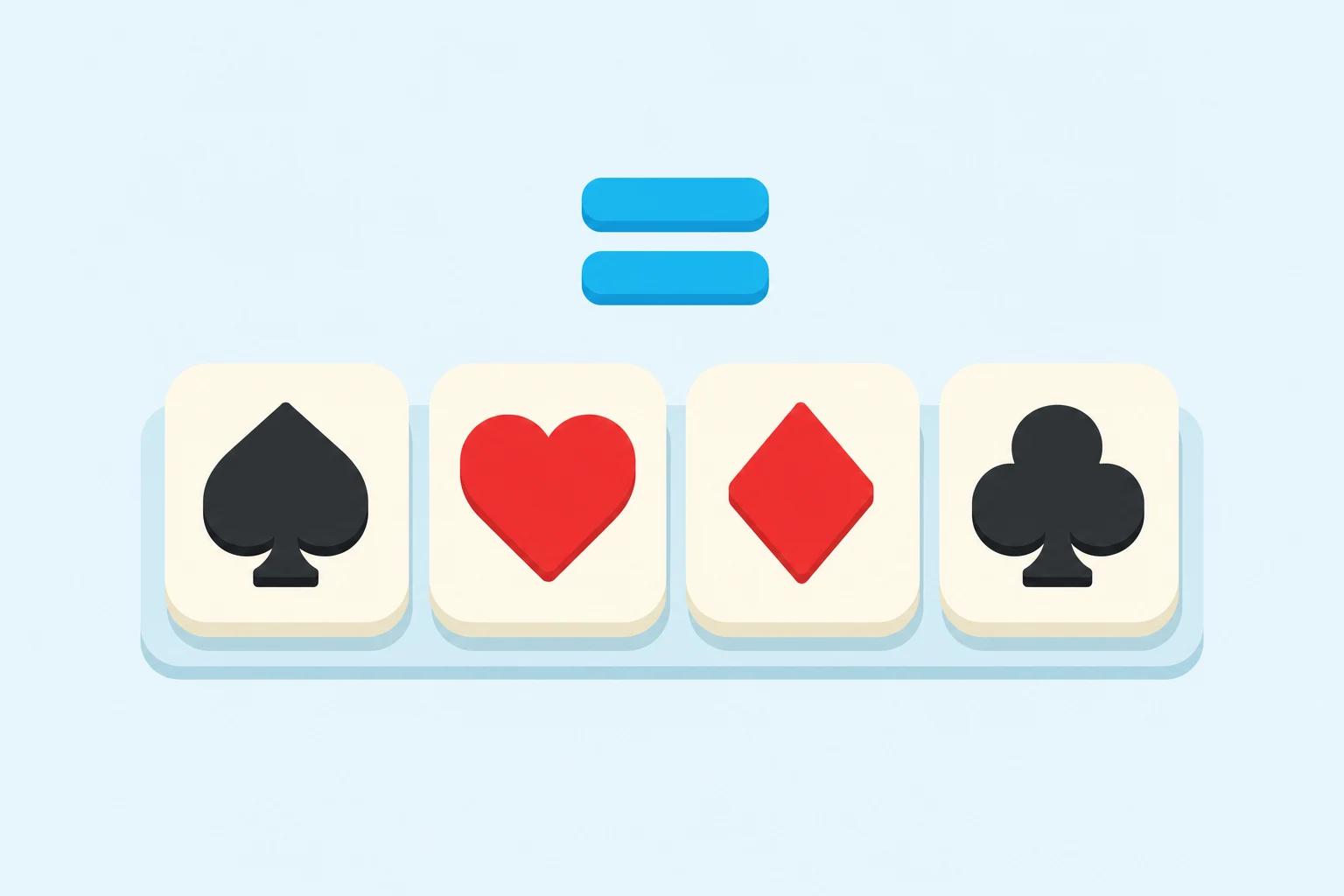
In Texas hold’em, no suit is higher than any other. A flush in clubs is exactly as strong as the same flush in spades, suits never break a tie at showdown, and two otherwise-identical hands split the pot. Every card game rumor you have heard about spades beating hearts is imported from somewhere else.
That is the whole ruling, and it settles more home-game arguments than almost any other fact in poker. What makes it worth an article is the rest of the story: where the myth comes from, the two narrow situations where poker really does use a suit order, and the one way suits genuinely make you money.
Where the suit-ranking myth comes from
The myth is not stupid; it is borrowed. Plenty of card games do rank suits. Bridge ranks them for bidding, with spades on top and clubs on the bottom. Big two, popular across much of the world, ranks them in play. Some casino stud variants use suit order for specific procedures. If you learned cards at a kitchen table before you learned poker, there is a decent chance suit order was real in the first game you ever played.
Poker deliberately is not one of those games. Hand strength comes from card ranks and hand categories on the hand rankings ladder, and the suit symbols exist to define flushes, nothing more. When a poker room does need an arbitrary tiebreaker for a procedure, it borrows the bridge order, which is exactly where the confusion sneaks back in.
The two real exceptions, and neither touches your pot
First: dealing for position. When a new game starts and someone has to get the button, many rooms deal one card to each player and the highest card wins, with the bridge suit order (spades, hearts, diamonds, clubs) breaking ties between equal ranks. That decides who deals first. It never decides who wins money.
Second: the bring-in in stud games. Seven-card stud forces the lowest exposed card to start the betting, and when two players show the same rank, suit order breaks the tie to pick who posts. Again, procedure: it chooses who acts, not who collects.
Those are the exceptions people half-remember when they insist “spades count for more.” Both are real, both use suit order, and neither has anything to do with a showdown in hold’em.
What actually happens at showdown
Flushes compare by card rank, top card first. An ace-high flush beats a king-high flush whatever the suits involved; if the top cards match, the second cards compare, and so on down all five. When two players hold literally equal five-card hands, the pot splits, and if the best five cards sit entirely on the board, everyone still in the hand chops. The kicker resolves ties between matching made hands; suits resolve nothing. The full chop mechanics live in side pots explained, including the odd-chip rule that home games argue about most. Two ace-high heart flushes meet on 7♣ A♥ 2♥ K♦ 9♥ in Poker Skill’s lesson on winners and splits, and the second card settles it, a queen over a jack.
One consequence of the shared board surprises new players: two flushes at the same showdown always share a suit. Each needs at least three board cards of its suit, and five board cards cannot give three to two suits.
The way suits really make you money
Suits matter before showdown, not at it. Two starting cards of the same suit can make a flush together, and that possibility is worth real equity: a suited hand carries a few extra percentage points against the same hand offsuit, plus something subtler, the ability to make nut flushes and win big pots when the draw completes.
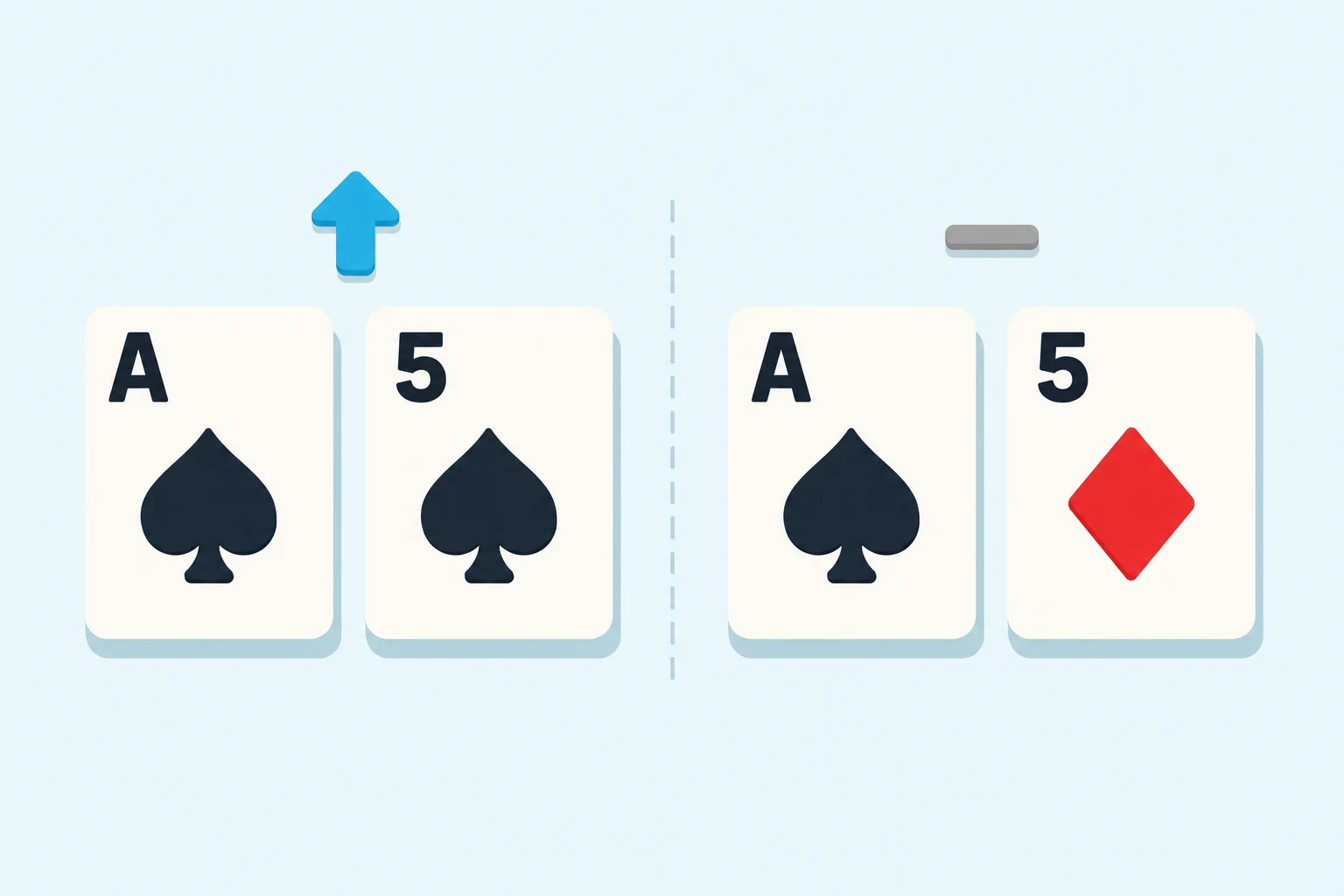
That is why hand charts treat A♠5♠ and A♠5♦ as different hands. Not because spades beat diamonds, but because matching suits open a path to a hand category that mixed suits close. Suitedness is a drawing asset priced into preflop decisions, and it is the only respect in which the pips on your cards should ever change what you do.
The trap is overrating it. Suited hands make a flush by the river only about six percent of the time when both cards are suited, so “but they were suited” justifies far fewer loose calls than it gets blamed for. Suits add value at the margin; they do not turn junk into a hand, as any 7-2 suited owner eventually learns.
A worked showdown, suit myth included
Two players reach the river on a board of K♦ 9♦ 4♦ 7♣ 2♠. One holds A♦ 3♦, the other Q♦ J♦. Both have diamond flushes, and at a home game this is exactly where someone declares that their “higher diamonds” or someone’s spade kicker matters. Walk it properly instead.
Compare the five-card flushes rank by rank. The first player’s best five diamonds: A, K, 9, 4, 3. The second player’s: K, Q, J, 9, 4. Ace beats king at the first card, and the hand is over: ace-high flush wins, no suit consulted at any point. Now change one card and make it interesting: give the second player A♥ instead of Q♦. Their diamond flush is gone entirely: K-J-9-4 of diamonds is four cards, and four is nothing, because the A♥ cannot join a diamond flush. Hearts do not help a diamond hand no matter how red they both look at midnight. Same board, one suit-blind mistake, and a stack changes hands.
Run every flush comparison exactly like that, top card down, suits invisible, and you will adjudicate showdowns faster than most dealers.
The poker suit order, when one exists: spades, hearts, diamonds, clubs
When a room does need the arbitrary order, it is reverse alphabetical in English: Spades, Hearts, Diamonds, Clubs. If you can alphabetize, you can referee a button draw. Just remember what the order is for, seating and bring-ins, and what it is never for, money.
Four-color decks: the practical fix for suit misreads
The costliest suit mistake at real tables is not believing spades outrank hearts; it is misreading a club as a spade, or a diamond as a heart, in a two-color deck where half the suits share a color. The A♥-in-a-diamond-flush error from the worked hand above happens constantly online at speed, and it is why most poker sites offer a four-color deck option: black spades, red hearts, blue diamonds, green clubs.
Turn it on. There is no strategic downside, misread flushes all but disappear from your game, and nobody can see your settings to judge you. Live, where the deck stays two-colored, build the habit of counting your suit twice before acting on a flush: five diamonds means five cards wearing exactly the same pip, not five red cards. Dealers misread too, which is why the cards speak for themselves at showdown: lay your hand face up and let the table verify. The rule that suits never rank each other also means nobody has to trust anyone’s color vision.
Settling the argument at the table
When the debate erupts mid-hand, and it will, the resolution takes one sentence: suits never decide a pot in hold’em; equal hands chop. If someone appeals to that time a spade flush “won” over a heart flush, invite them to reconstruct the hand, because a hold’em board cannot give one player a spade flush and another a heart flush. Nobody has ever produced the counterexample, for the same reason nobody has produced a square circle.
House games are free to invent their own rules, and a few do rank suits for fun. If you are in one, get the rule stated before the money goes in, and know that you have left standard poker the moment it applies.
Which suit is highest in poker?
None, in standard poker. When a suit order is needed for a procedure, like dealing for the button or a stud bring-in, rooms use the bridge order: spades, hearts, diamonds, clubs. That order never determines the winner of a pot.
Do suits matter in Texas hold’em?
Only before showdown. Suited starting cards can make a flush together, which adds a few points of equity and real big-pot potential. At showdown itself, suits carry zero weight: flushes compare by card rank and equal hands split.
Can two flushes tie?
Yes. If both players’ best five flush cards have identical ranks, the pot splits. And when the board itself holds the best five-card flush, every remaining player chops it.