
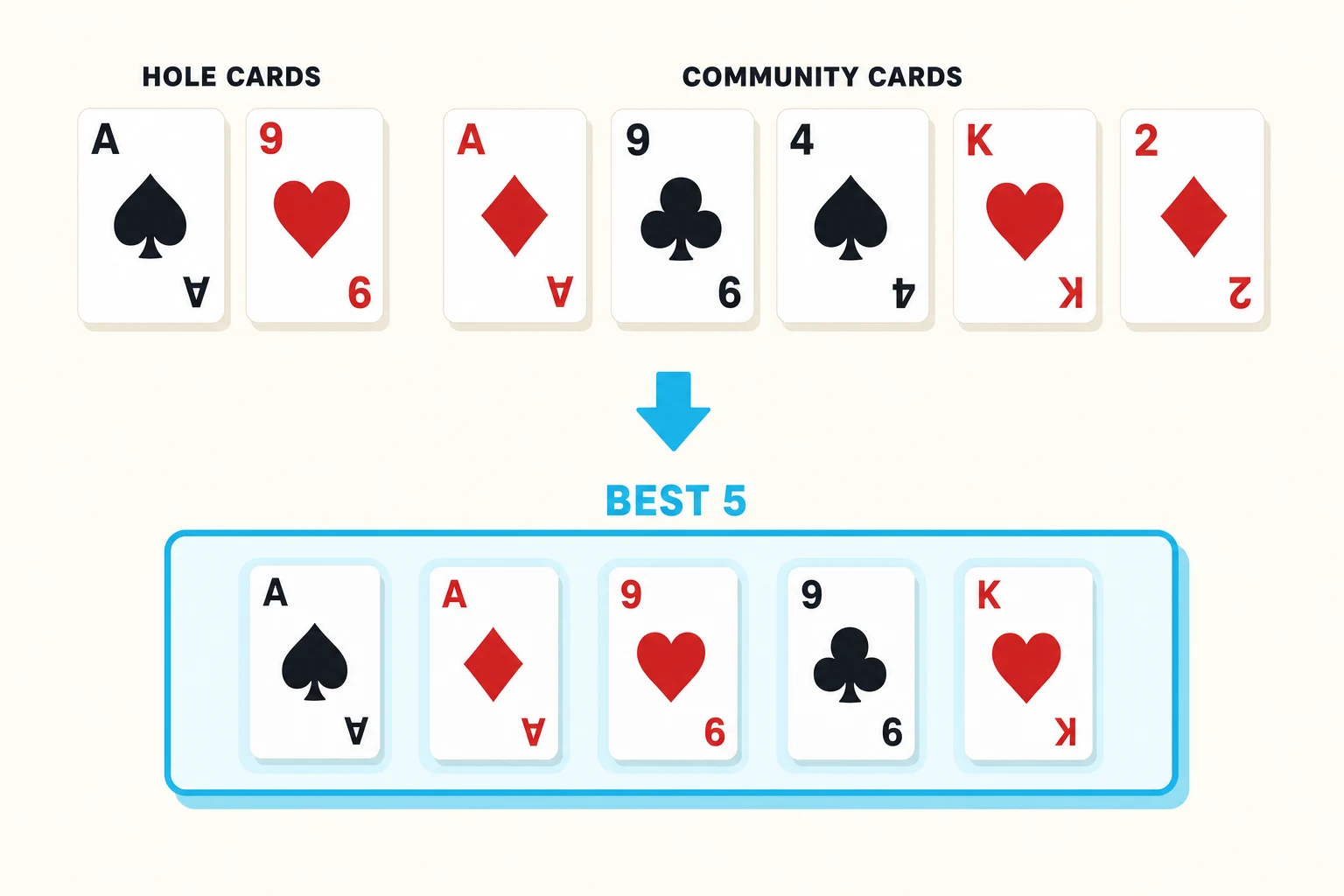
Your Texas Hold’em hand is the best five-card hand you can build from the seven cards you can see: your two hole cards and the five community cards. You may use both of your cards, one of them or neither. At showdown you compare those five cards with everybody else’s five.
The ten hand names rank in one fixed order, nine categories once the royal flush is counted as the highest straight flush. The full ladder with example cards lives on poker hand rankings. Before that ladder is any use, you have to know which five of your seven cards you are ranking. When two players land in the same category, their five cards are compared in order and the first card that differs takes the pot. If none of the five differ, the players split it.
What plays, at a glance
Your two hole cards and the five community cards combine in three ways.
| Hole cards used | Board cards used | What it means |
|---|---|---|
| Two | Three | Both your cards make the hand better |
| One | Four | One card joins a pattern already on the table |
| None | Five | The board is stronger than anything you can add |
Both hole cards play
Both of your cards pair the board, so both play. The fifth slot goes to the king because it is bigger than the 4♠ and the 2♦, which stay on the table unused.
One hole card plays
Four hearts are on the table and your K♥ is the fifth, so the flush is four board cards and one of yours. The 3♣ stays out of it.
Neither hole card plays
This is playing the board. The five community cards already make Broadway, the highest straight there is, and your 7♣ and 2♦ cannot improve on it. Your hand is the board itself, and so is every other hand that reaches showdown without a card that beats it, which is why the pot is split between all of them.
One board, two players, ten cards chosen
Both players below hold an ace on the same board, and only one of them wins the pot.
Five community cards, available to everyone still in the pot. Read these before you read your own hand.
The ace pairs the board’s ace. The king is a candidate for one of the three remaining slots.
A pair of aces, then the three biggest cards left: king, nine, six. The 4♥ and the 2♠ are cut.
B pairs the same ace and brings a queen where A has a king.
A pair of aces, then queen, nine, six. The two hands differ by one card.
Compare from the top down. The pairs are equal, so the third card decides: A’s king against B’s queen, and A takes the pot. The nine and the six are the same in both hands and cannot separate them.
When the board pairs
A paired board opens more than one way to build the same hand, so the choice of five matters before any comparison starts. The kicker is the unmatched card that fills the last slots, and it decides nothing until the made part of both hands is equal.
A wins: the ace decides
Full houses compare the three of a kind first, and A’s aces beat B’s eights there, so the pairs are never reached. A holds the third ace and the third four, and any two of the three fours can fill the last two slots. Built the other way round the same cards make fours full of aces, which is weaker.
Split pot: all five match
Here the kicker comes from the board, so both players have the same one. A’s seven is bigger than B’s five and it changes nothing, because neither card is in the best five: two pair plus the board’s nine already fills all five slots.
Flushes and straights
Same-category flushes and straights are settled by height, one card at a time, starting at the top.
A wins: the queen decides
Four hearts on the board means both players have a flush, and both flushes start A-K. The third card is where they separate: A’s queen against B’s jack.
A wins: the jack decides
Both players used both of their cards, and both built a run through the same three board cards. A straight is compared by its highest card, so jack-high wins and how each player got there does not matter.
The ace can also sit at the bottom of a straight, and when it does the hand is five-high rather than ace-high.
Show which five cards play
B wins: the six decides
A’s straight is the wheel, A-2-3-4-5, the lowest straight in the game. The ace plays low there, which is why it is written last and why the hand is read as five-high. B’s six-high straight uses the same three board cards and one better card at the top, so B wins the pot. An ace plays at the top of a straight or at the bottom, never both, so no straight wraps from king through ace to two.
The sixth card never plays
Split pot: all five match
Four nines and an ace fill all five slots, so B’s king sits outside the hand. Both players play four nines with an ace, and the pot is split.
Where the rule gets misread
Reading your hand before the board. Pocket eights feel strong right up to the moment the board runs 9-10-J-Q-K. After that the eights play no part: you hold the board’s king-high straight, and so does every other player without an ace. Name the best five the board makes on its own, then ask whether your two cards improve on them.
Assuming both hole cards have to play. Neither example above needed both of yours: the flush took one heart and the Broadway board took nothing.
Counting a card the hand has already cut. The four nines split because each player’s fifth card was an ace, and B’s king was outside the hand before the comparison began. However big it is, a sixth card cannot break a tie.
Omaha runs the strict version
Hold’em lets you reach for any of the seven cards. In Pot-Limit Omaha you are dealt four cards and must use exactly two of them with exactly three from the board. Playing the board is impossible there. You can hold three hearts, watch two more land on the table and still have no flush, because only two of your four cards are allowed to play.
Where this fits in your decision
Once you can name the best five from any seven cards without stopping to work it out, you can start reading the board for what an opponent’s range can make on it. The short version of the rule lives in the glossary as the best-five rule. When the question is which category wins rather than which five cards play, what beats what in poker answers the matchups one by one.
Frequently asked questions
Do you have to use both your hole cards in Texas Hold'em?
No. You may use both, one or neither. Pick the five strongest cards from the seven you can see. If your second card does not make those five better, it takes no part in the hand.
What does playing the board mean?
It means your best five cards are the five community cards. Your hole cards add nothing to them, so every player left in the pot who cannot beat the board holds the same hand and the pot is split.
How does a kicker decide a tie?
When two players make the same category, compare the cards in order from the top of each hand down. The first card that differs wins the pot. If all five match, the players split it, and suits never separate them.
Can a sixth card break a tie?
No. Only five cards play. If both players hold four of a kind and an ace on a board of four nines, the sixth card in either hand is dead and the pot is split.
Does the wheel beat a six-high straight?
No. A-2-3-4-5 is the lowest straight in Hold'em, and the ace plays low in it, so it is a five-high hand. The six-high straight, 6-5-4-3-2, beats it.