
Low hand: the five cards that win the low side
What a low hand is, and which ranking decides it
A low hand is the five-card hand that wins the low half of a split pot in a game like Omaha 8-or-better, or the whole pot in a game played for low only, such as Razz. It is read by its own rules, separate from the standard poker hand rankings that decide a high hand.
Two ranking methods decide which five cards are lowest: ace-to-five and deuce-to-seven. Ace-to-five reads the ace as the smallest card in the deck and ignores straights and flushes, so 5-4-3-2-A is the best hand it can make. Deuce-to-seven flips both of those rules: the ace is the highest card in the deck, and a straight or a flush counts against you the way it would in a high game, which leaves 7-5-4-3-2 in mixed suits as the best hand there. A third method, ace-to-six, keeps the ace low but counts straights and flushes, which makes 6-4-3-2-A its best hand. It is used in some lowball games.
Split-pot games add a qualifier called eight-or-better on top of ace-to-five ranking. Your five cards have to be unpaired and all ranked eight or lower to take the low half at all.
How the low rankings compare
| Ranking | The ace | Straights and flushes | Best hand |
|---|---|---|---|
| Ace-to-five | Lowest card | Ignored | 5-4-3-2-A |
| Deuce-to-seven | Highest card | Count against you | 7-5-4-3-2, not all one suit |
| Ace-to-six | Lowest card | Count against you | 6-4-3-2-A, not all one suit |
| Ace-to-five plus the eight-or-better qualifier | Lowest card | Ignored | 5-4-3-2-A, and nothing above an eight qualifies |
Ace-to-five: Razz and ace-to-five lowball
Ace-to-five is the ranking Razz uses. Any five unpaired cards beat any hand holding a pair, and you compare two lows by their highest card, so a nine-low beats a ten-low.
Razz has no eight-or-better bar, so nothing disqualifies a hand. The best five cards at the table take the pot even when every low at showdown is ugly, which is how 9-8-7-6-4 wins whenever nobody holds better.
Deuce-to-seven: the mirror image
Deuce-to-seven is also called Kansas City lowball. Because the ace plays high it can never be your smallest card, and a hand of five running cards is a straight, which in this game loses to a pair. A flush is worse still, which is why the best hand here, 7-5-4-3-2, has to come in mixed suits.
7-5-4-3-2 is the best hand because the only five ranks that would beat it, 6-5-4-3-2, make a straight, and the five cards have to miss a flush as well. With the ace playing high, the wheel is only an ace-high hand here, and ace-high loses to every unpaired king-high hand at the table.
Eight-or-better: the qualifier used in split games
Inside the qualifier, lows rank exactly as they do in ace-to-five. The worst hand that still qualifies is 8-7-6-5-4 and the best is the wheel.
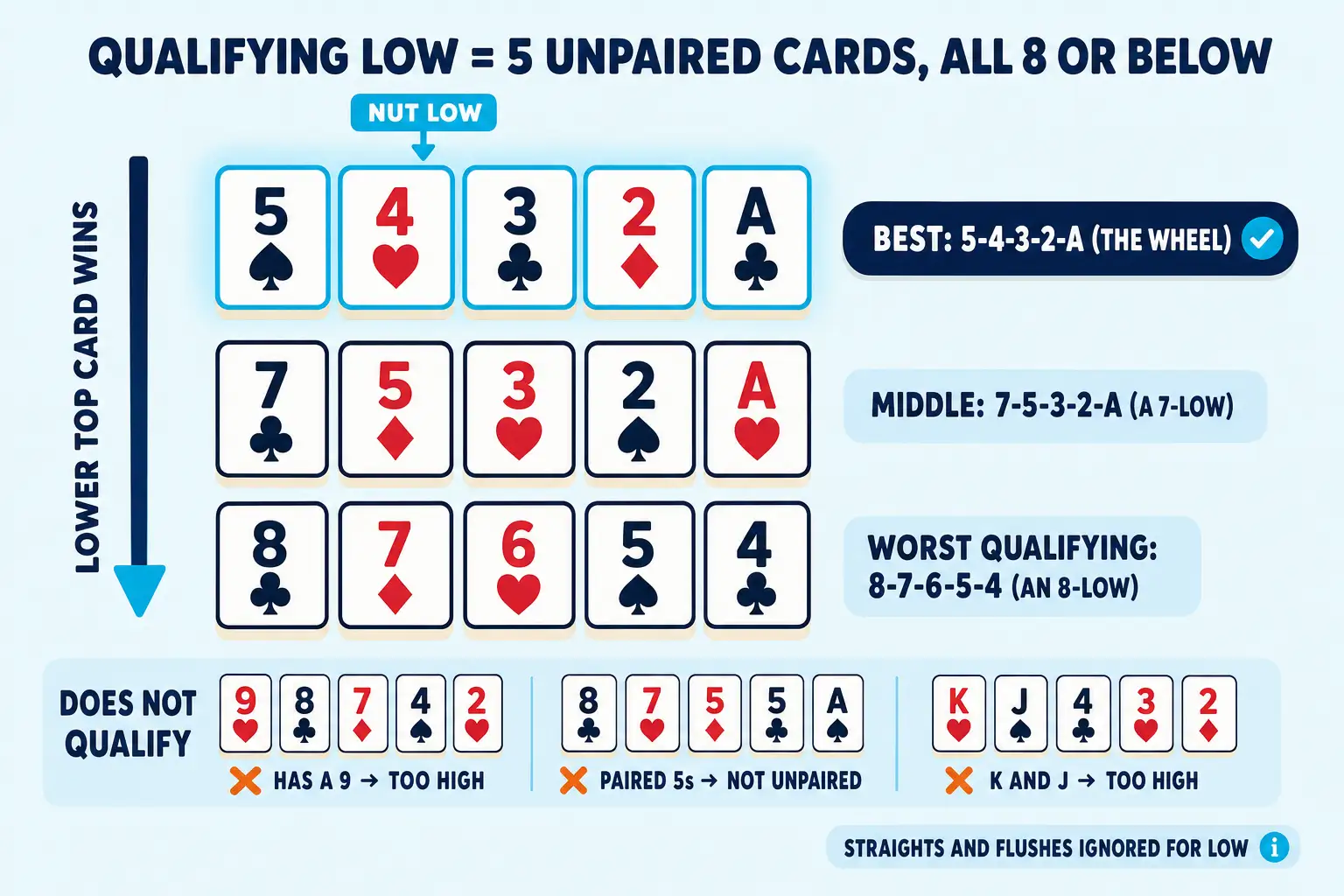
When nobody at the showdown builds a qualifying low, there is no low half to award and the best high hand takes the entire pot. A board only offers a low when three of its five cards are eight or lower and those three are different ranks.
Reading a low hand: lowest top card wins
You read a low from the top down, sorting both hands from highest to lowest so the top cards can be compared. The lower top card wins. If they tie, the next card down settles it, and so on to the fifth, which is why the ace at the bottom of two 7-lows decides nothing.
A “7-low” is any low whose highest card is a seven, for example 7-5-3-2-A. It beats any 8-low, and inside the 7-lows the second card breaks the tie. When players say “seven-five low” they are naming the top two cards, which is usually enough to compare against an opponent calling out “seven-six low”. The rest only matters when the top two match.
Low hand vs nut low vs qualifying low
| Term | What it names | Example |
|---|---|---|
| Low hand | The five cards that play for the low under whatever ranking the game uses | 8-6-5-3-A, read as an eight-low |
| Qualifying low | A low that clears the eight-or-better bar, in the games that have one | 7-5-3-2-A |
| Nut low | The best low available on the current board | 5-4-3-2-A on a 5-3-2-J-Q board |
In an 8-or-better game, “low hand” and “qualifying low” usually mean the same thing, and the word “qualifying” gets stressed when somebody is checking whether the hand even makes the low half. Razz and deuce-to-seven have no qualifier at all, so the phrase does not apply there.
The nut low is the strongest low the board allows. On a 5-3-2 flop in Omaha, A-4 already makes it: your A-4 plus the board’s 5-3-2 is 5-4-3-2-A. A second player holding the same two cards splits the low half with you, so each of you collects a quarter of the pot (see chop pot).
When low hands matter
Low hands come up in these games:
- Omaha 8-or-better (also written O8 or PLO8). Four hole cards, community board, split pot between the best high and the best qualifying low.
- Big O. The five-card cousin of Omaha 8-or-better. Same low rules, more two-card combinations per hand.
- Stud 8-or-better. Seven-card stud where the pot splits between the best high and the best qualifying low.
- Razz. Seven-card stud for the low only, with no qualifier. The lowest hand under ace-to-five ranking takes the pot.
- Ace-to-five lowball. A low-only draw game on the same ranking: pairs hurt, straights and flushes are ignored, the ace plays low.
- Deuce-to-seven lowball. The draw game where aces are high and a made straight or flush ruins the hand.
No-Limit Texas Hold’em and Pot-Limit Omaha have no low half. The whole pot goes to the best high hand, and a phrase like “low pocket pair” or “the lowest hand to play in poker” is about starting-hand selection rather than the low side of a split pot.
Example: building a low in Omaha 8-or-better
You hold A♠ 3♥ J♣ J♦ in Omaha 8-or-better. The board comes 2♣ 4♦ 7♣ K♠ Q♥.
On both sides of the pot the construction rule is the same: exactly two cards from your hand and exactly three from the board.
Low side. The only board cards eight or lower are the 2, the 4 and the 7, so every qualifying low at this table contains all three of them. From your hand the ace and the 3 are the two lowest cards that are not already on the board. That gives you A-3 plus 2-4-7, or A-2-3-4-7, read from the top as a 7-4 low.
That is the nut low on this board, and A-3 is the only pair of hole-card ranks that makes it. With the 7 forced into every qualifying low, nobody can reach a wheel or a 6-low, and nothing beats a 7-4.
High side. The most you can do for the high is play J♣ J♦ with K♠ Q♥ 7♣, a pair of jacks, which loses to any set, any two pair and any pair above jacks.
Result. You take half the pot with the nut low and lose the high. Another player with A-3 shares the low half with you, and your half becomes a quarter.
Common mistakes when reading low hands
Straights and flushes change meaning between systems
In ace-to-five and eight-or-better games, straights and flushes are invisible to the low. In a split-pot game like Omaha 8-or-better, a 6-4-3-2-A of hearts is a 6-4 low on the low side and a flush on the high side at the same time, so folding it because the flush “spoiled” the low gives up both halves of the pot. In deuce-to-seven the same five cards are a flush, and a flush loses there to any hand that is merely unpaired.
Any pair kills a qualifying low
A pair inside your five breaks the qualifier. A board of 4-4-7-K-Q makes a qualifying low impossible no matter what you hold, because the only board cards eight or lower are the two fours and the seven, and three cards carrying a pair cannot build one. Any board that fails to show three different ranks of eight or lower does the same thing, and the best high hand takes the whole pot.
A bare A-2 has no backup
Say you hold A-2 in Omaha 8-or-better and the flop comes 3-4-8, giving you 8-4-3-2-A, the nut low. An ace on the turn leaves your own five cards where they were, because you still play A-2 with the board’s 3-4-8. The board now holds an ace of its own, so a player with 2-5 builds 5-4-3-2-A out of the board’s A-3-4 and beats you. That is counterfeiting. The board pairs a card you are using for the low, and that card stops separating your hand from the holdings that can now reach it.
A third low card gives you a second combination to switch to. Hold A-2-3 on a 5-6-8 board and you start with the same 8-6-5-2-A a bare A-2 has, but when a deuce lands you can play A-3 with the board’s 2-5-6 for a 6-5-3-2-A, while the bare A-2 is still stuck on its eight-low.
The nut low can still cost you chips
When two players turn over the same nut low, they split the low half and each collects a quarter of the pot. That is quartering.
FAQ
What does it mean for a low hand to “qualify”?
Only games with an eight-or-better rule ask the question. There, the low half is awarded only to a hand of five unpaired cards all ranked eight or below. A hand with a pair, or with any card above an eight, is not eligible. If nobody at the showdown holds a qualifying low, the whole pot goes to the best high hand. Razz and deuce-to-seven lowball have no qualifier: the best low at the table wins whatever it looks like.
Does a flush or straight hurt my low hand?
It depends on the ranking. Ace-to-five, which covers Razz, ace-to-five lowball and every eight-or-better split game, ignores them for the low. Deuce-to-seven and ace-to-six both count them against you, which is why the best deuce-to-seven hand is 7-5-4-3-2 in more than one suit.
Does Texas Hold’em have low hands?
No. No-Limit Texas Hold’em is high-only: the entire pot goes to the best five-card high hand at showdown. The phrase comes from split games like Omaha 8-or-better and Stud 8-or-better and from low-only games like Razz. In Hold’em the phrase usually points at high card, the weakest class on the high-hand ladder, or at a small pocket pair. Neither is a low hand in the split-pot sense.