
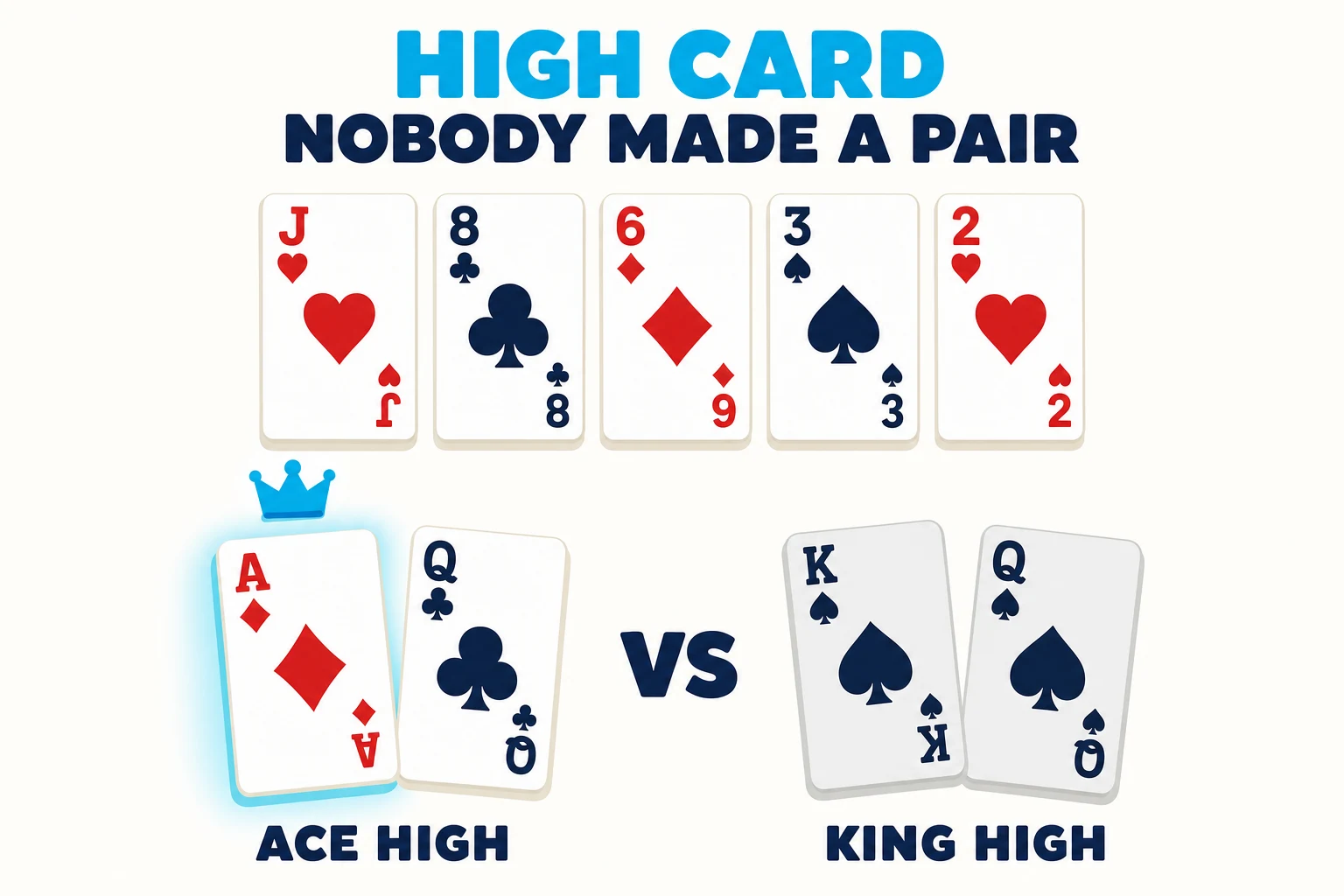
When nobody makes a pair, the hand with the highest card wins. If the top cards match, compare the next ones, and keep walking down until one hand wins or all five cards match and the pot splits. Suits never break ties in standard hold’em. That comparison walk settles every “who wins here” argument this hand rank produces, and it produces a lot of them.
What a high-card hand is
A high card hand is what remains when your best five cards contain no pair, no straight, no flush: five unmatched ranks. Players name it by its top card: hold A♠Q♦ on a board of J♥8♣6♦3♠2♥ and you have “ace high,” specifically A-Q-J-8-6 once the best five rule picks your strongest five from the seven available. It is the bottom rung of the ladder, beating nothing but a lower high card, and it still decides real pots every session, because two players missing everything is not rare.
The comparison walk
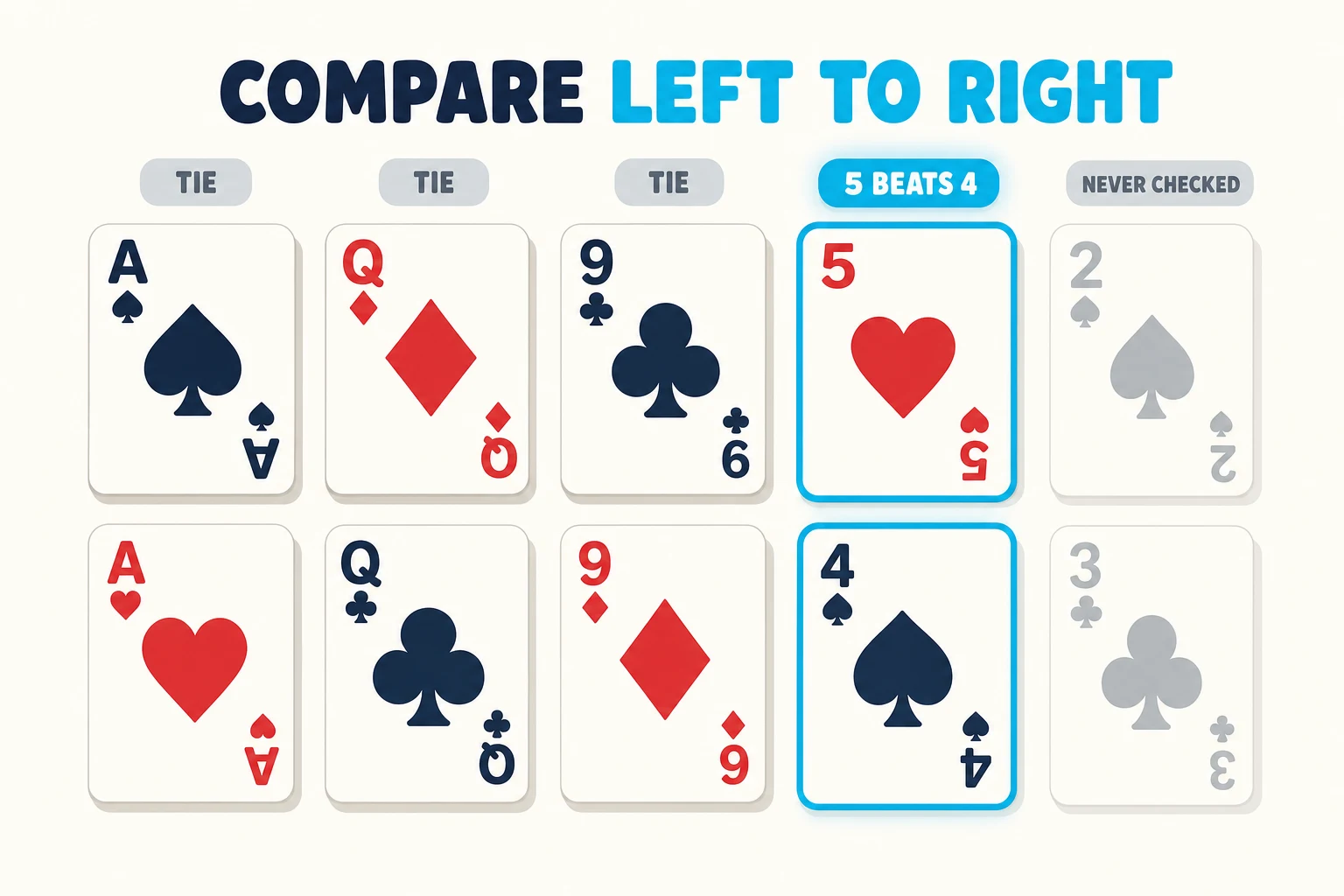
Two unpaired hands compare like words alphabetize: first letter, then the next, until they differ. Take A♠Q♦9♣5♥2♠ against A♥Q♣9♦4♠3♣. Aces match. Queens match. Nines match. Then a 5 beats a 4, and the walk is over: the first hand wins, and the fifth card never gets a vote. The walk stops at the first difference, always, which means a hand’s strength lives in order, top down. A-K-7-3-2 beats A-Q-J-T-9, because the walk never gets past the second card, however much prettier the queen hand looks as a group.
Every card in the walk after the first is doing kicker work: same job kickers do for pairs, applied five cards deep. That walk also settles made hands in Poker Skill’s kicker lesson: on 7♠7♦7♣4♥3♦ both players hold an ace beside the trips, and the king beats the queen at the next step.
Who wins: worked comparisons
| Hand A | Hand B | Winner | Decided by |
|---|---|---|---|
| A-Q-9-5-2 | A-Q-9-4-3 | A | Fourth card, 5 over 4 |
| A-K-7-3-2 | A-Q-J-T-9 | A | Second card, K over Q |
| K-Q-J-9-7 | A-7-5-4-2 | B | First card, A over K |
| Q-J-9-8-3 | Q-J-9-8-3 (other suits) | Chop | All five match; suits irrelevant |
Ties and chops
When all five cards match in rank, the pot splits, full stop; there is no suit tiebreak in standard hold’em showdowns. The chop that surprises people is the board-plays case: on a board of A♥K♦Q♠J♥8♣, a player holding 7♦6♣ and a player holding 9♠2♦ both play the board’s A-K-Q-J-8… almost. Check the second player again: their 9 replaces the board’s 8, making A-K-Q-J-9, and they win outright. That double-take is the whole skill. Before declaring any chop, walk each player’s best five, because a single live kicker in the 8-to-9 zone quietly un-splits pots that looked identical.
How often nobody makes anything
Deal five random cards and high card is the single most common result: just over 50 percent of all five-card hands. Hold’em softens that with seven cards to choose from; by the river, your best hand is still only high card about 17 percent of the time, and you make at least one pair or better around 83 percent. Heads-up, both players whiffing completely happens often enough that ace-high wins are a normal part of the game, not a novelty. The full odds ladder for every hand lives in the hand probabilities table.
Ace-high as a real hand
Since roughly one river hand in six ends up as no pair at all, ace-high has real showdown value: it beats every busted draw and every worse unpaired hand, which is a bigger slice of real ranges than beginners expect. The practical rules follow from that. Ace-high wants to check when checking gets it to showdown, because it beats the hands that would fold anyway and loses to the hands that call. It can call small river bets against players whose busted draws bluff too often; that is the everyday version of the hero call. What it almost never wants is to bet, because betting folds out the worse hands it beats and gets called by everything better. King-high and worse follow the same logic with a steeper discount.
A real pot, won with nothing
Here is the hand rank earning money. You raise A♦Q♣ from the button, the big blind calls, and the board runs out J♥8♣6♦3♠2♥ with checks all the way after your flop bet gets called. The river checks through, your opponent turns over K♠Q♠, and the pot slides to you: ace high beats king high, decided on the first column of the walk. Nothing connected for anyone, and the hand still had a winner, a loser, and real chips changing hands. Notice what both players did right. Neither bluffed the river: the caller’s king-high had just enough showdown value to check, and your ace-high beat everything that would have folded to a bet anyway. High-card pots reward the player who correctly values “nothing,” and that valuation starts with knowing the walk cold.
When this lies to you
Three traps. First, paired boards end the high-card conversation: if the board itself has a pair, nobody at showdown has a “high card” hand anymore, and the walk runs on different rails. Second, some home games and casino side games invent suit tiebreaks or declare “high card by suit” for choosing dealers; fine for assigning seats, irrelevant at showdown, and worth clarifying before a house-rules argument eats the pot. Third, lowball games invert everything: in razz or 2-7, the unpaired hand you are learning to rank here is the goal, ranked backwards. Know which game you are in before applying any of this.
A live-play pattern
At every showdown where the pot might chop, resist reading hands as wholes. Build each player’s best five explicitly, board plus hole cards, and run the walk column by column: top card, next, next. Say the ranks in order under your breath if you have to. The players who narrate the walk catch the live kicker that un-chops the pot; the players who eyeball it push their winning half across the table without ever knowing.
Where this fits
High card is the tenth rung of ten, and everything above it is built from the same comparison logic: pairs use kickers, two pairs compare top pair first, and the whole ladder lives on the poker hand rankings page with an example for every rung. Learn the walk here and every tie above resolves the same way.
Frequently asked questions
Does a high card ever beat a pair? No. Any pair beats any high-card hand, including a pair of twos over ace-king. High card only wins against other unpaired hands.
What happens when two players have the same high card? The comparison moves to the second card, then the third, through all five. Only if every rank matches does the pot split.
Does suit matter for high card? Not at showdown in standard hold’em; a spade ace and a heart ace are identical. Suit-based tiebreaks exist only in side procedures like drawing for the button.
Is ace always the highest card? For high-card purposes, yes. The ace plays low only inside the wheel straight (A-2-3-4-5), and that hand is a straight, not a high card.