


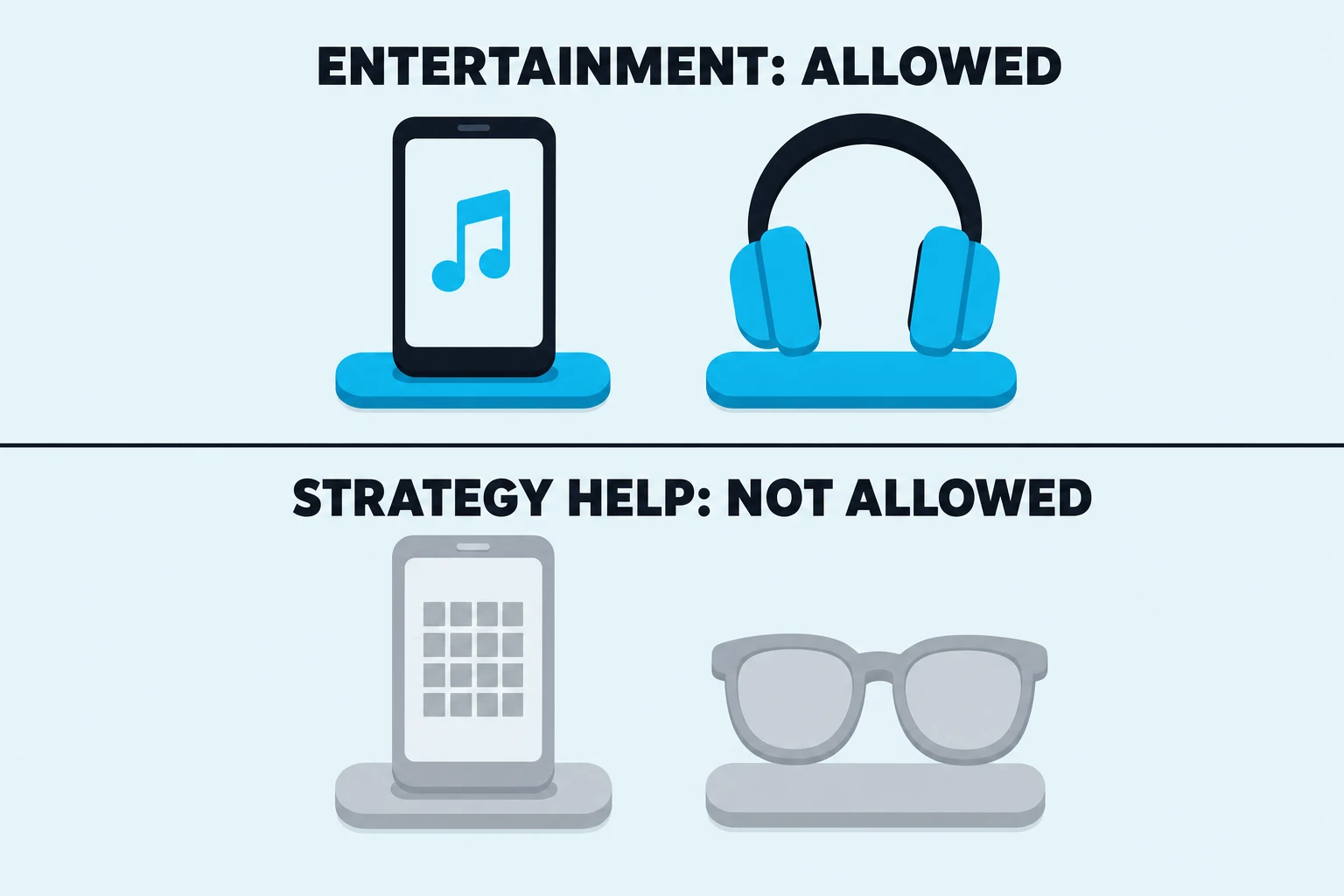
Every time a new consumer device ships with an assistant in it, poker has the same argument, and it always starts with the hardware. Can you tell whether the glasses across the table are the ones with a microphone and a model behind it? Is there a way to check? Should the room ban all glasses to be safe?
The rule that answers this is older than the product that prompted the question, and it does not care about the hardware at all.
The clause that decides every case
For rules and procedures, live tournaments point at the rulebook published by the Poker Tournament Directors Association. Its 2024 rules put electronics in Rule 5, and two clauses do almost all of the work.
Rule 5C says players with live hands may not interact with or operate an electronic or communication device, and then adds a line that is doing more than it looks like: the definition of such devices may include new technologies and shall be as updated by the tournament director. That sentence was written precisely so the rulebook does not have to be reissued every time a category of gadget appears.
Rule 5D is the one that settles the smart-glasses argument. Betting apps, charts, and other poker strategy tools may not be used at the table, and players may not receive or use poker strategy data from another person or source.
Read that again with the hardware taken out. The rule bans the help. A pair of glasses that can answer a strategy question is a poker strategy tool being used at the table, which is prohibited under a clause written years before anyone could buy one. So is a phone. So is a folded chart in your pocket. So is a friend on the rail who knows the answer and finds a way to tell you.
That framing is why “how would you even detect it?” is a real operational problem but not a rules problem. Detection is hard. The rule is not ambiguous.
What you can actually have at the table
Here is how the common cases fall out under Rule 5 and the etiquette that surrounds it. Individual rooms add their own house rules on top, usually posted or available on request, so ask when something is unclear.
| Item | At the table | The reasoning |
|---|---|---|
| Phone, hand folded | Allowed, silenced, not resting on the table | Rule 5B keeps phones and other devices off the playing surface; Rule 5A says ringtones, music, images and video should be inaudible and non-disturbing |
| Phone, hand live | Not allowed | Rule 5C bars interacting with a device while you hold live cards |
| Phone call | Not at the table | Rule 5A: players may not talk on a phone at the table |
| Music, headphones | Generally allowed, house policy applies | Sound must be inaudible to others and must not delay the game |
| Preflop chart on your phone | Not allowed | Rule 5D names charts and strategy tools directly |
| Preflop chart in your head | Allowed | Knowing your ranges is the entire point of studying |
| Solver window, second screen | Not allowed | This is the textbook case of real-time assistance |
| Advice from a friend or railbird | Not allowed | Rule 5D covers strategy data from another person or source |
| Smart glasses with an assistant | Not allowed under 5D, and hardware policy is the room’s call | The assistant is the strategy tool; whether the frames come off is a house decision |
| Filming your own table | Room policy | Recording is a house decision, so ask before you point a camera at a table |
The single test that resolves almost every case: does this give me strategy help on a hand I am currently in? If yes, it is real-time assistance and it is banned, whatever shape the object is.
Why the line sits at “while the hand is live”
Rule 5D does not ban solvers. It bans using one at the table, and the distinction is not a technicality.
A solver takes ranges, stack depths, and bet sizes and returns a strategy that cannot be exploited. Working through its output away from the table, arguing with it, figuring out why it splits a hand between calling and folding, is how modern players study. None of that is the cheating question, and the comparison between a trainer and a solver is about study method, not ethics. Poker Skill is study of that kind: lessons, and full hands against AI opponents in Practice vs AI, all played away from any live table with no real money in play.
What the game is actually selling, to players and to spectators, is that the person in the seat is making the decisions. Consult the tool mid-hand and the answer on the felt stopped being yours. That is the whole offense, and it is why the rule reads the way it does: the ban attaches to the moment, not to the object.
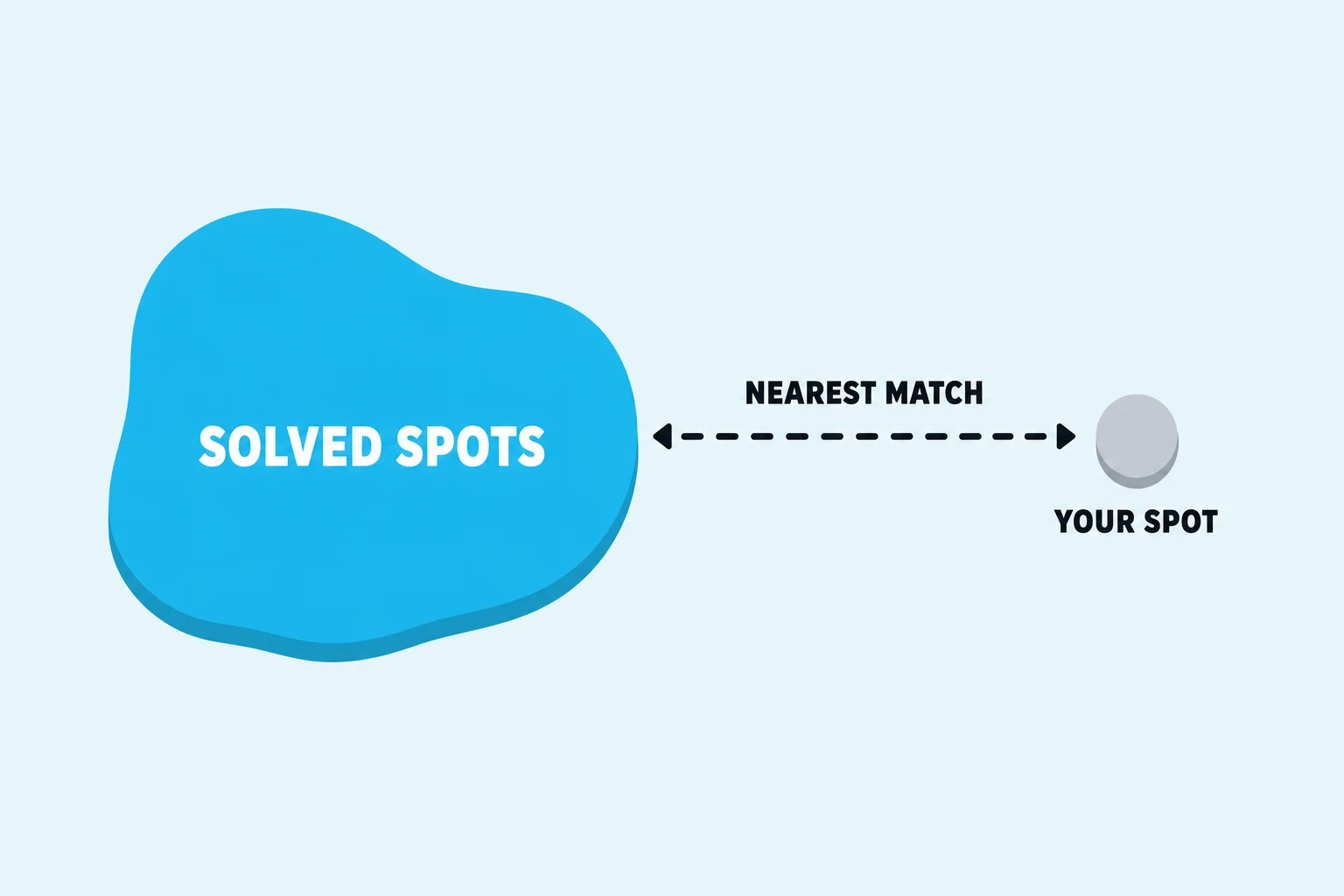
There is a practical footnote worth knowing, because the tools are frequently described as more capable than they are. Real-time assistance software does not solve your hand while you sit there. No solver computes a full game tree in the seconds you have to act. What the software does is search a database of previously solved hands and hand back the nearest match. When your spot is ordinary, that match is close. When your spot is unusual, which is exactly when a player is most tempted to reach for help, the nearest match can be a long way from your actual situation, and the tool has no way to tell you so.
What the World Series adds on top
Large festivals publish their own rules alongside the association’s, and the 2025 World Series of Poker rules are more explicit about artificial intelligence than the general rulebook needs to be.
Its Rule 64 permits approved devices, including music players and noise-reduction headsets, through most of an event, but only so long as they do not contain or use artificial intelligence or any other type of electronic assistance that could give a player an advantage over another. Once a tournament reaches its final three tables, those approved devices come off entirely, and players at a table designated as a feature table for production lose them earlier.
Rule 64 also extends past the players. Charts, apps and artificial intelligence are barred anywhere in the tournament room, and spectators are specifically prohibited from providing live real-time assistance or coaching to an active player, whether by speaking, texting, or any other route. Break that one and the player takes a penalty and the spectator leaves the room.
The pattern across both rulebooks is the same. Devices are tolerated as long as they are entertainment. The moment a device can supply strategy, it stops being a pair of headphones and becomes a prohibited tool.
The etiquette that keeps you out of it
Most players never get near a deliberate violation and still manage to draw a warning, usually for the same three things.
Phones on the table. Rule 5B is blunt about this. Pocket or rail, not felt.
Acting on a device with live cards. Even checking the time on a watch face that also shows notifications gets awkward once you have a hand. Fold first, then look. This sits next to the rest of table etiquette that keeps a game moving.
Talking strategy about a live hand. Telling anyone how to play a hand that is still in progress, or taking that steer from a player who has already folded, is the strategy data from another person that 5D names. Save it for the break.
None of these are moral failures. They are the small mechanics of not slowing the game down or looking like you are getting help, and they are worth the same attention you would give to protecting your cards or not shooting an angle you did not intend.
The honest version of the worry
The public argument about camera glasses is really an argument about trust, and the rules can only carry part of that. A rulebook can define the offense cleanly, which Rule 5D does. Detecting it in a crowded ballroom is a different job, and it belongs to floor staff, room policy, and eventually to whatever equipment standards operators decide to adopt.
What a player can control is narrower and more useful. Learn the ranges well enough that you do not want a chart. Do the solver work at home so the answer is already in your head when the money goes in. Then, at the table, judge your decision by whether it was right with the information you had, not by whether the river was kind. That is the version of the game worth protecting, and it is the only version where the electronics question stops mattering at all.