
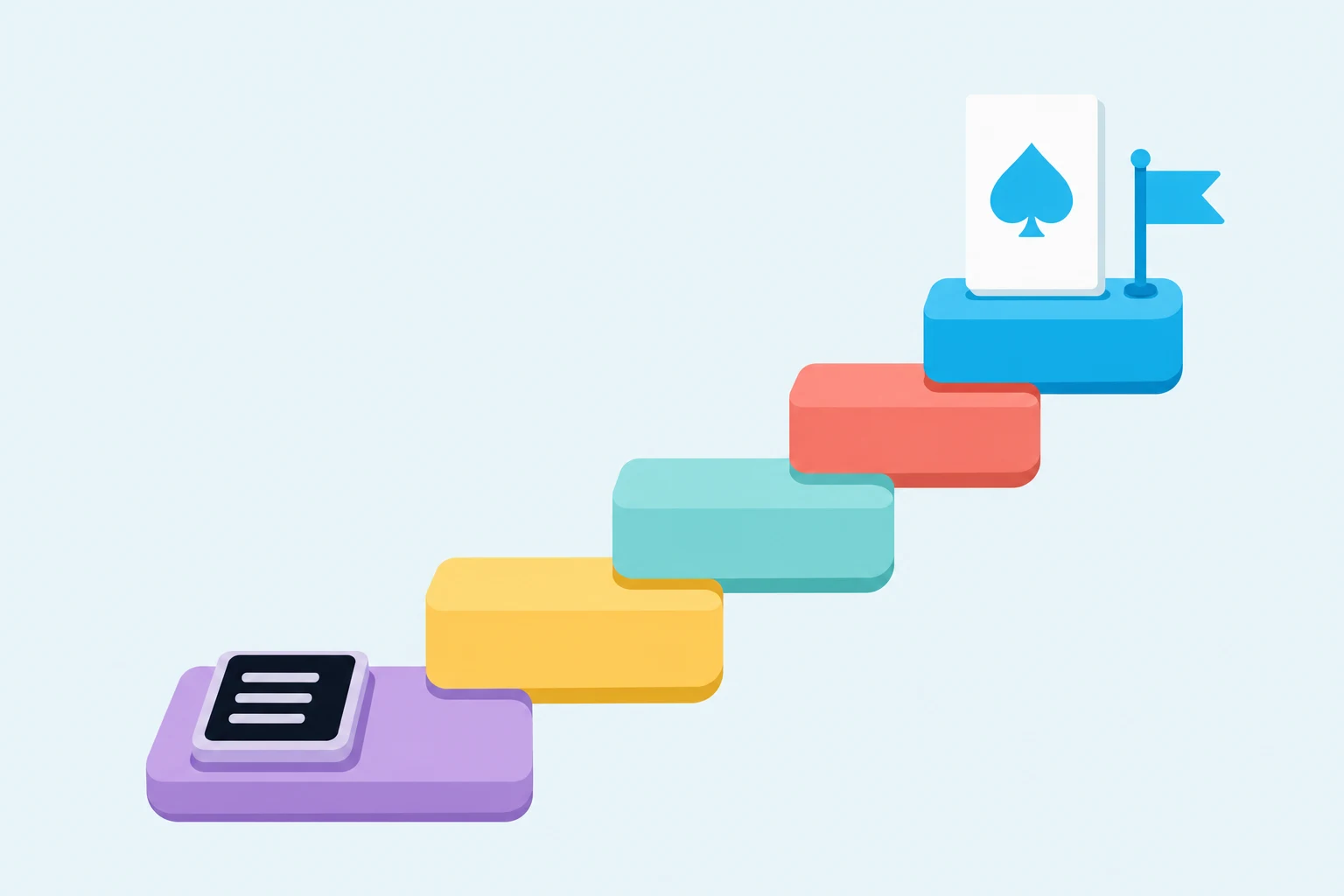
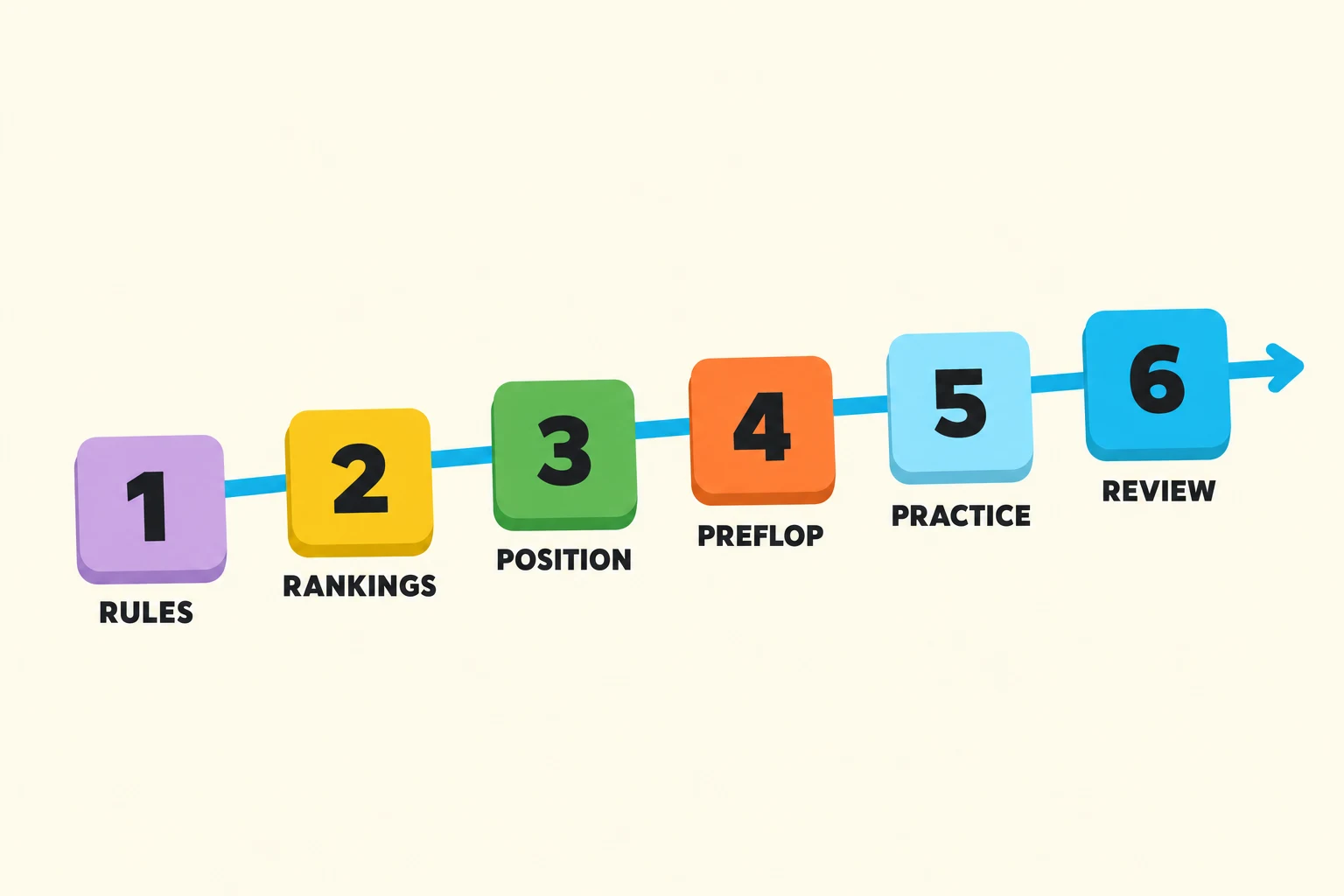
Learn poker online free in six steps, in this order: how a hand runs, what beats what, position, your first preflop decisions, free practice that answers you back, and a one-sentence review habit. Two or three weeks of short daily sessions carries you through the first four.
Every step below names one free place to do it and one check that says when you are finished. No deposit, no subscription, no book order.
If you came here to play a free hand right now rather than study anything, go straight to step 5. Playing first is a fine way in; coming back for steps 1 through 4 is what turns the playing into learning.
The six-step path
Blinds, four betting rounds, five legal actions, showdown. Free surface: a written rules walkthrough.
The ladder plus the tie-break rules that decide the close ones. Free surface: the rankings hub and its printable chart.
Who acts last, and why the same two cards are a fold from one seat and a raise from another. Free surface: a positions guide.
Raise or fold, tight from early seats, wider from late ones. Free surface: a starting-range guide and the printable charts.
Reps where something tells you why an answer was wrong. Free surface: free drills and practice hands.
Turning a session into a single lesson. Free surface: a notes app and five minutes.
The order is the part most free advice skips. Rules and rankings come first, because strategy content read before them slides straight off. Free games teach mechanics honestly and opponents dishonestly: with nothing at stake, players call far too much and fold almost nothing.
If you already know how a hand runs and the same mistake keeps costing you money, that is the other job: how to get better at poker is the improvement loop, and this page is the learning path. Learning is about order. Improving is about aim.
Step 1: Learn the flow of a hand
Every hand of Texas hold’em runs the same shape, and knowing that shape is the difference between following the action and guessing at it.
Two players post the blinds, everyone gets two private cards, and the first betting round runs on those two cards alone.
Three community cards land face up and the second betting round runs.
A fourth community card, then the third betting round.
The fifth and last community card, then the final betting round.
If two or more players are still in, the hands go face up and the best five-card hand made from your two cards and the five on the table wins the pot.
Poker has five actions: check, bet, call, raise and fold, though no turn offers all five. With no bet to face, you check or bet; facing a bet, you fold, call or raise. Read that once, in one place, instead of in fragments from clips. The how to play poker walkthrough covers the sequence end to end, and Texas hold’em rules adds the table procedure. One sitting is usually enough, and it stays learned.
You are done when you can say the sequence out loud with nothing in front of you: blinds, hole cards, preflop, flop, turn, river, showdown. Then name the five actions and say which of them you have when you face a bet. Strategy advice sitting on top of a shaky sequence is what makes the game feel unlearnable.
Step 2: Learn what beats what, cold
The ladder is ten rungs, and learning the list takes an afternoon. The part that actually costs beginners pots is everything underneath it.
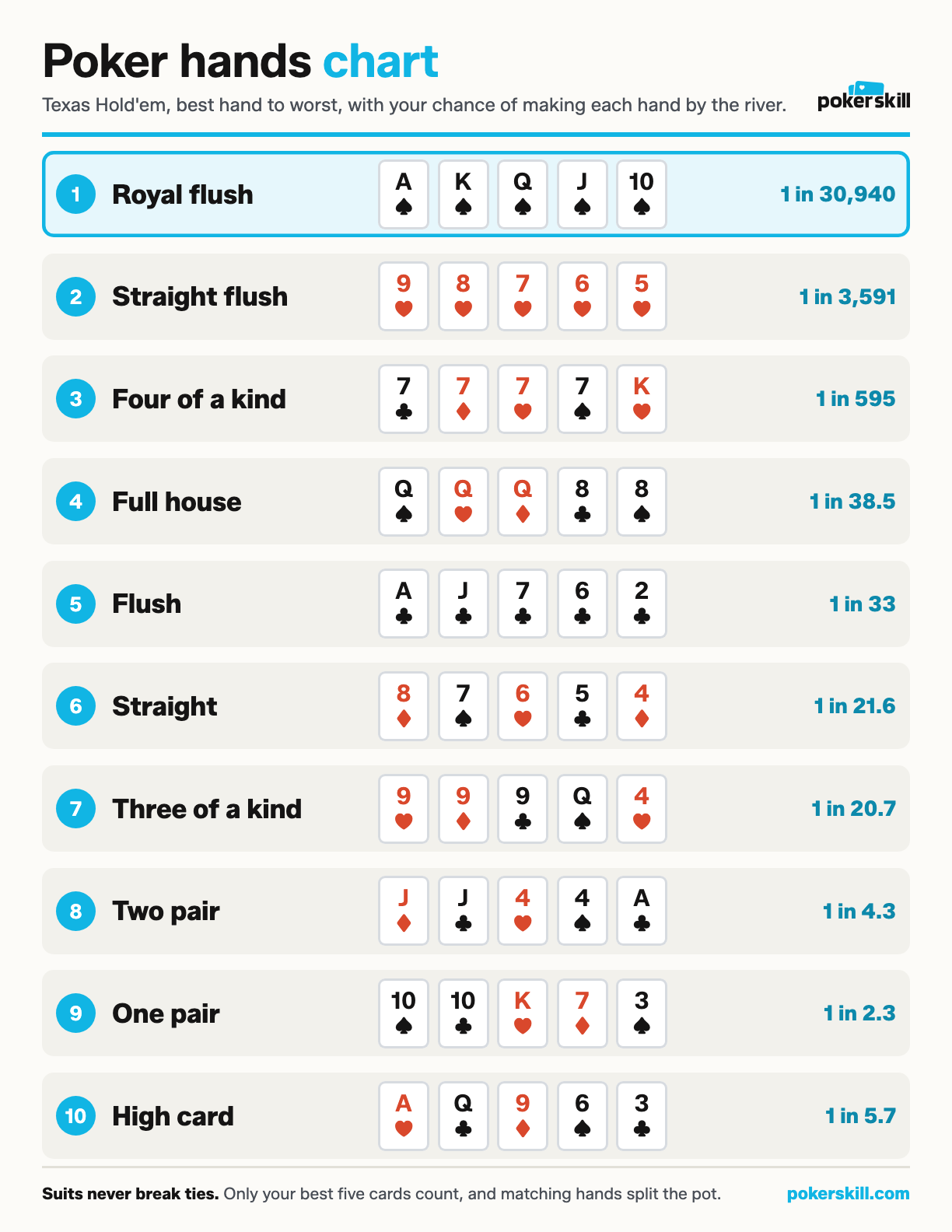
Same pair on both sides means the kicker decides it. Two straights or two flushes go to the higher one. Two full houses compare the three-of-a-kind part first, not the pair. An ace plays high or low inside a straight but never wraps the corner, so Q-K-A-2-3 is nothing at all. Identical hands split the pot. Those five rules are where the money hides, and the poker hand rankings hub holds them with examples.
You are done when you can deal two hands and a five-card board from a shuffled deck, call the winner in under five seconds with the kicker accounted for, and do it ten times in a row without looking anything up. Not “I know the order.” Know it the way you know which way a light switch flips.
Self-check: who wins this one?
Deal yourself the test before you trust the step.
Show answer
Hand A. Both players have a pair of aces, so the pair decides nothing and the kickers play: king beats seven. This is the single most common showdown in Texas hold’em, and it is decided by a card most beginners do not look at.
Step 3: Learn position before you pick hands
Position is who acts last, and acting last is information nobody can take back. At a six-handed table, preflop action runs under the gun, hijack, cutoff, the button, small blind, big blind. After the flop, the button acts last in every round. That single fact is why the same two cards are a fold from the first seat and a raise from the last one.
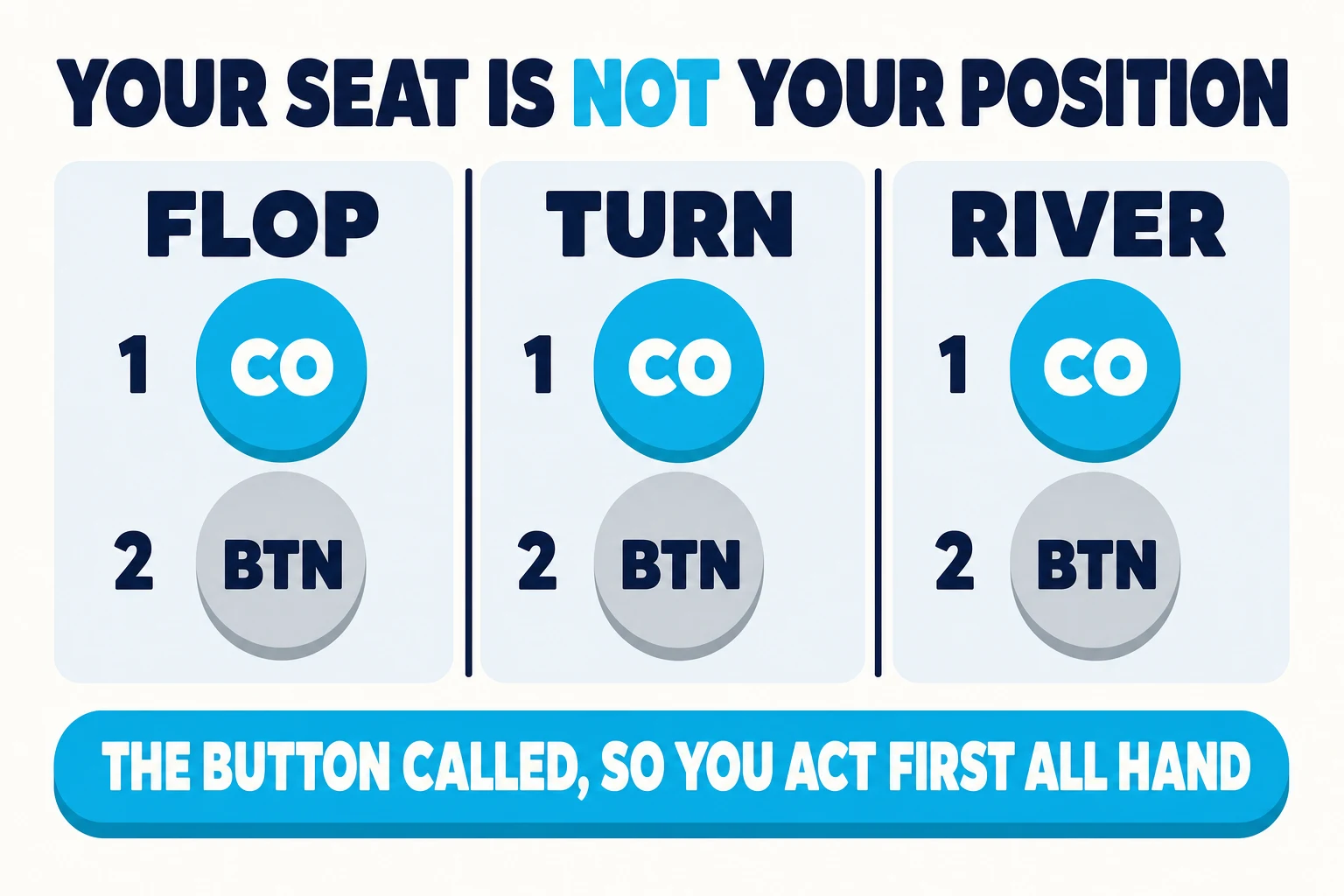
Beginners learn hands first and position later, then wonder why their hand list keeps failing them. It fails because it was never a hand list, it was a hand-and-seat list. Early seats act into the whole table with no idea what anyone behind them holds, so they need stronger cards to enter. The positions guide walks each seat and what changes as you move around the table.
You are done when you can name all six seats in order, say who acts first after the flop and who acts last, and point at the two seats where you will play the fewest hands.
Step 4: Make your first preflop decisions
Your first strategy, the one that carries every free game you are about to play, has two rules. Raise or fold. Play fewer hands than you want to.
The habit to skip entirely is the limp, calling the big blind and hoping the flop is kind. It puts money in with a weak holding, invites everyone else in behind you and gives up the chance a raise gives you to win the pot before the flop. Entering with a raise takes the initiative, and it lets you win some pots without seeing a single community card.
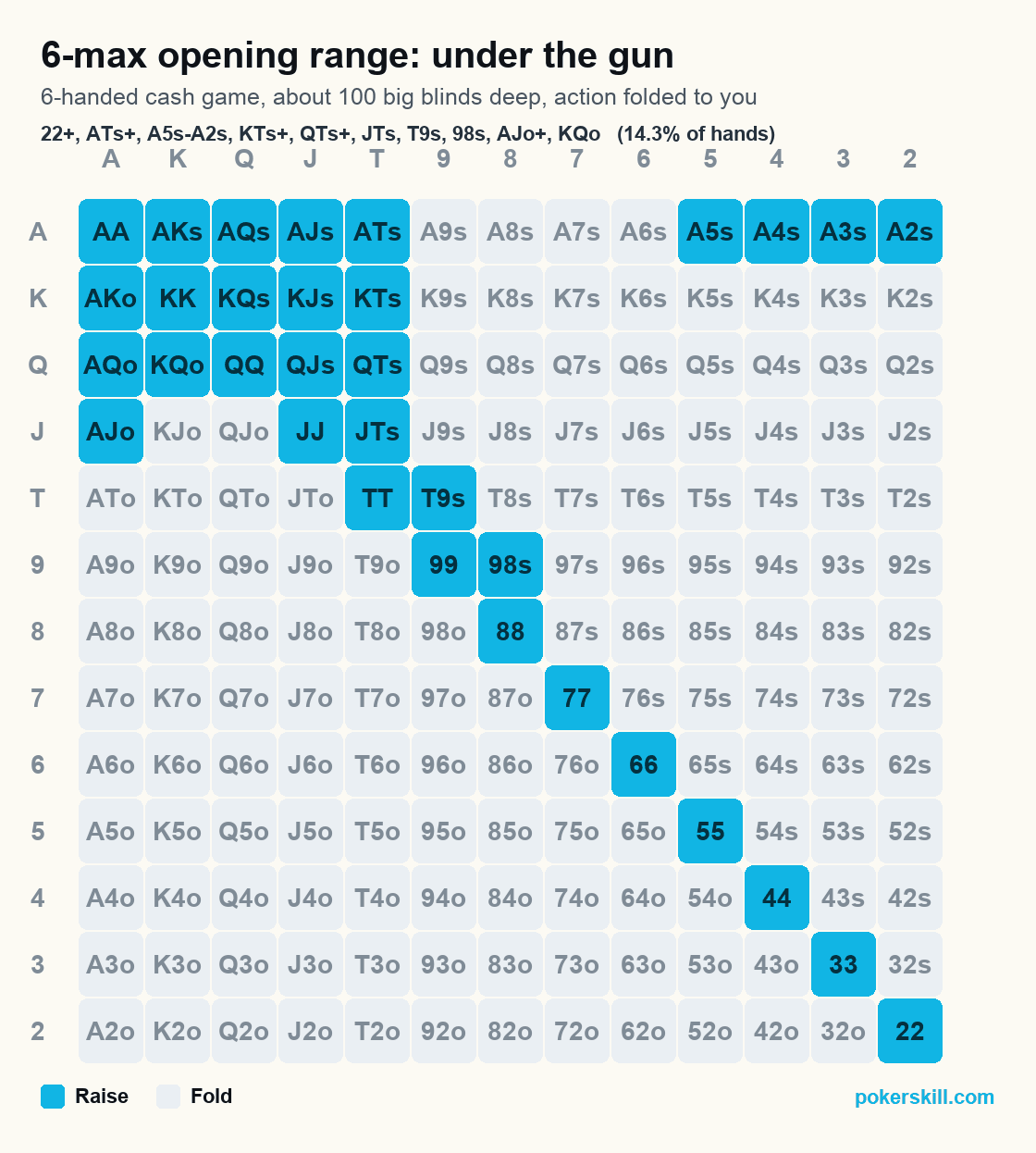
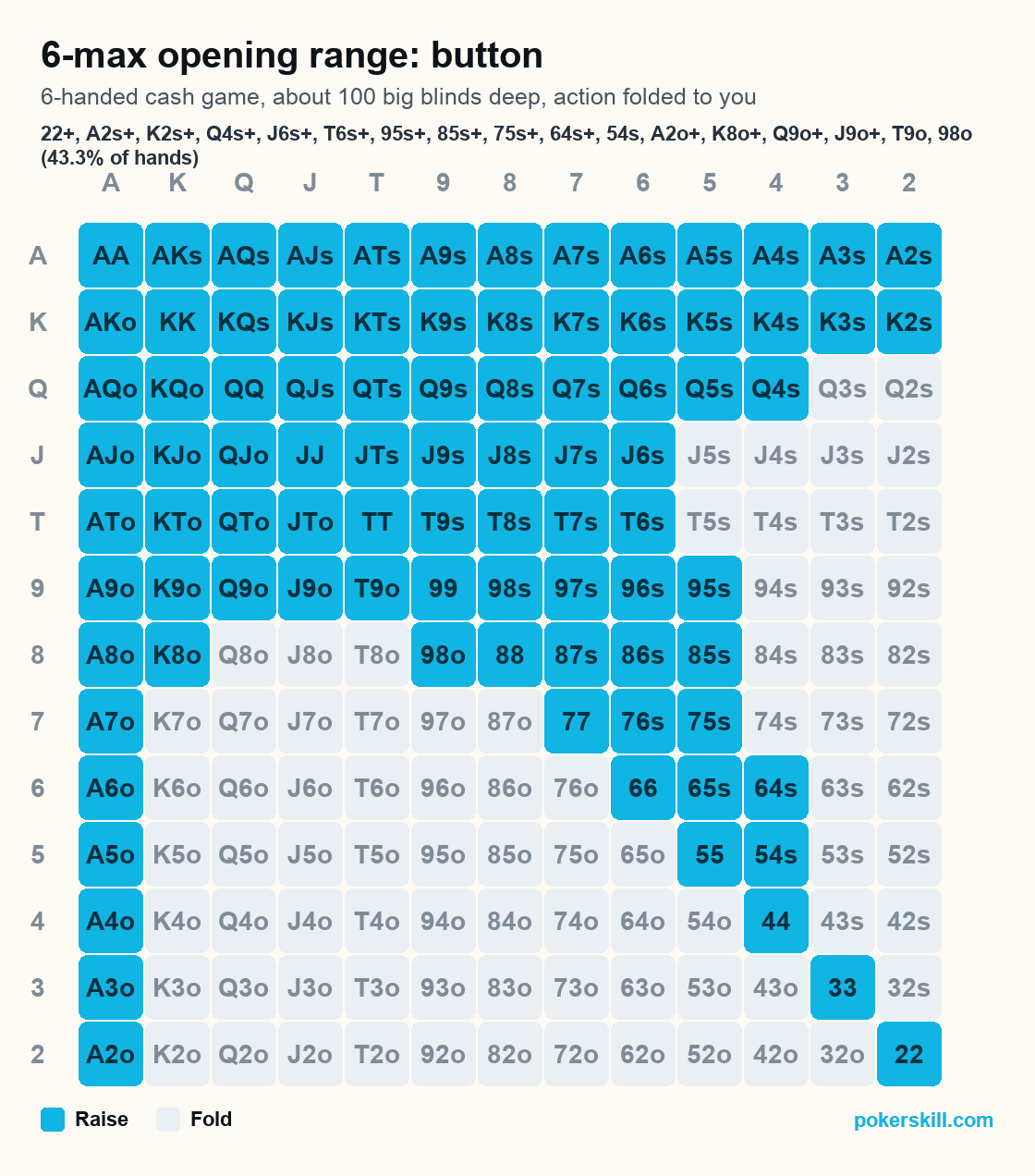
From the first seats, all pocket pairs plus ace-king and ace-queen is a defensible starting core. From the cutoff and the button, widen a step: your other strong aces, king-queen, and the better suited broadways and connectors. Where exactly to stop is a judgment call; the direction matters more than the edges. The starting ranges guide explains what a range is, and the free preflop charts put a printable version in your hand.
You are done when you have written your own one-page opening list, seat by seat, and you can play a full session without opening a single hand that is not on it. An imperfect list you actually follow beats a perfect chart you ignore.
Step 5: Practice free, with feedback
This is the step where most free learning stalls, because the three free routes are not interchangeable.
| Free route | Decisions per hour | Tells you why | What it teaches badly |
|---|---|---|---|
| Play-money tables | Low, most of it waiting | No | Opponents, who call everything |
| Quizzes and drill pages | High | Sometimes, and often only right or wrong | Table flow and reading a live opponent |
| Practice apps with explanations | High | Yes, on every answer | A full table adjusting to you over hours |
Play-money tables give you volume and the real mechanics of a hand, and no feedback at all. Use them to make the sequence automatic, not to learn how people behave. Quizzes and drill pages flip that trade, and the weaker ones stop at right or wrong.
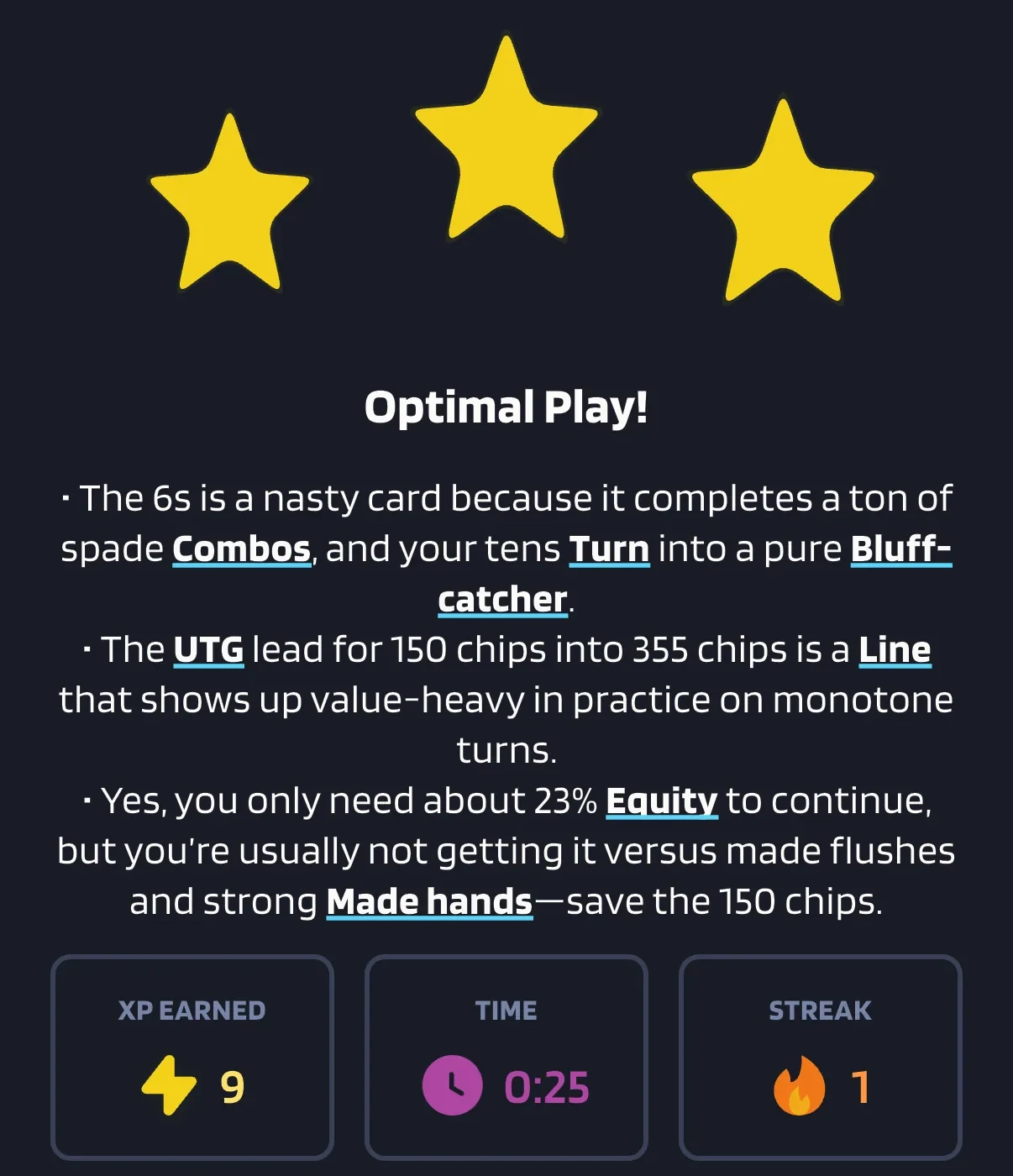
Practice apps that hand you a decision and then explain the answer sit closest to a coach at your shoulder. Poker Skill is our version: guided hands and short drills with the reason attached to every answer, free practice with no real money anywhere in it, and the app-shaped version is the Poker Skill learning app. Its Practice vs AI mode deals whole hands against AI opponents, heads-up or three-handed, with Coach Max, Poker Skill’s AI poker coach, advising you during the hand and grading your decisions in the review after each game. Its real limit is that no app gives you a full table of live opponents adjusting to you over hours, and that part of the game waits until the fundamentals are in place.
The feature that matters across all three is not volume. It is whether something tells you why.
A free play-money app can still sell chip packs for real money, and a trial that takes your card up front renews as a paid subscription unless you cancel it at least a day before it ends. Before you install any other poker app, read the In-App Purchases list on its App Store page, where chip and coin packs show up by name.
You are done when you can name your single most common mistake using your own results instead of a guess. Calling too wide out of the blinds, folding to every raise, paying for draws that were never priced right: the specific answer matters less than the fact that your practice produced it.
Step 6: Review one hand per session
The last step is the smallest and the one that compounds. At the end of a session, pick the single hand that still bothers you, walk it street by street, and write one sentence about it: what you knew at each decision, and what the price asked for. That rehearsal is what shows up next time the spot appears.
Twenty sessions later you have twenty sentences, and the repeats in that list are your leak, named by you, with evidence. The 15-minute practice routine is the daily shape of this, and how to study poker is the weekly structure that comes after this path.
You are done when every session ends with one written sentence naming the decision you would take back and why. The sentence is about a decision, never about how much you won or lost.
How long does it take to learn poker online?
The question hides two questions. The rules can be learned in an evening; competence arrives gradually, and nobody honest puts a date on that part.
| Step | Realistic time to “done when” |
|---|---|
| 1. Flow of a hand | One sitting |
| 2. Hand rankings | A few short sessions across a week |
| 3. Position | An hour to understand, a couple of weeks of hands to feel |
| 4. Opening list | One evening to write, a few sessions to obey |
| 5. Practice with feedback | Never finishes; it is the loop |
| 6. Review | Five minutes at the end of every session |
Two or three weeks of short daily sessions gets you through steps 1 to 4. Past that, progress tracks decisions made with feedback, not the calendar.
Run the path yourself
The six steps, as a list you can tick
Nothing is saved and nothing is scored. The list is here so the path fits on one screen when you come back to it.
Where this fits in your decision
Which software you learn on is a different question from this one, and it has its own page. If you are choosing an app, the checklist for picking an app to learn poker on walks the features that actually matter and the ones that only look good in a screenshot. The one requirement worth insisting on: it has to tell you why an answer was wrong, not just that it was.
Frequently asked questions
How do I learn poker from scratch?
Start with the order of play, not with strategy. Read how a hand runs once, drill the rankings until you can call a winner instantly, learn which seat acts last, then write a one-page list of the hands you will open with and follow it. Practice pays after those four, and only when something tells you why an answer was wrong. The opening list is the part beginners skip, and playing too many hands is the leak that costs them the most.
Can I learn poker online for free?
Yes, all the way to a competent beginner. Rules, rankings, position, a starting hand list, practice with feedback, and a review habit are all available free online, and that is the whole path above. Paying starts to make sense later, for a specific leak you have already identified, in the form of structured courses, coaching, or hand-history tools. Buying any of that before step 4 is buying answers to questions you have not asked yet.
What is the best free way to learn poker online?
The best free route is an order, not a website. Read the rules once, drill the rankings until they are automatic, learn position, write your own opening list, then spend most of your time on free practice that tells you why an answer was wrong. Free learning fails when it is volume with no feedback, which is exactly what a play-money table alone gives you.
Should you learn with play money or real money?
Play money for everything in steps 1 through 4. Free games teach the mechanics, hand strength, and the shape of a hand at zero cost, which is the whole job at that stage. What they teach badly is opponents: with nothing at stake, players call far too much and fold almost nothing, so reads you build there transfer poorly. The fix is not rushing to put money at risk. It is getting feedback on your own decisions, which is what step 5 exists for.
How long does it take to learn poker?
The rules take an evening. Playing them well is open-ended, and nobody honest hands you a date for that half. Two or three weeks of short daily sessions is a realistic window for steps 1 through 4, after which progress tracks the number of decisions you have had corrected rather than the calendar.