

Getting better at poker is a loop, not a syllabus. Find the one mistake you keep repeating, drill that exact spot until the right play comes automatically, judge yourself on decisions rather than on how the night finished, then go again with what the next review turns up.
Most stuck players are not lazy. They are playing plenty and watching plenty, and neither activity is aimed at anything in particular. A leak you have never named is a leak you cannot practice, so the same call keeps costing the same money.
One check before you start. This page assumes you already know how a hand runs and what beats what, and that your problem is repetition rather than ignorance. If you are still learning the game itself, order matters more than effort at that stage, so take the six-step path at learn poker online free instead, starting from how to play poker. Come back here when the rules are automatic and the question turns into why the same decision keeps costing you.
| The loop, in three lines | |
|---|---|
| Name one leak | Your last few sessions already contain it, and you do not need tracking software to see it |
| Spend the hour on the lever that repairs that kind of leak | Reviewing, studying, drilling and playing fix four different things, and they are not interchangeable |
| Watch the leak leave your decisions | Money is too noisy to read over a few weeks. Decision quality is readable immediately |
Why playing more does not make you better
Playing more hands is the default plan for anyone trying to improve at poker. It is also the weakest one: volume gives you repetitions with almost no feedback attached. At the end of a hand you learn who won the pot, which is close to useless as a teaching signal, because bad plays win pots all evening and good ones lose them. What you need, whether the decision was right given what you knew, never arrives on its own.
Worse, unexamined repetition is not neutral. Repeat a mistake for six months and you get better at the mistake: faster at it, more comfortable with it, more certain it is normal. That is the real cost of grinding without review, and why two players with the same hours can be a year apart.
This is where the standard advice stops being useful. “Focus on one thing at a time” is correct and almost impossible to act on, because nobody tells you which thing. Pick wrong and you spend a month drilling river bluffs while your preflop calling range quietly does the damage. Diagnosis has to come before effort, which is why it gets its own step below.
Playing still matters. It is the only thing that generates real questions, and a study plan with no fresh hands in it starves. What has to change is where those hands go afterwards.
The improvement loop
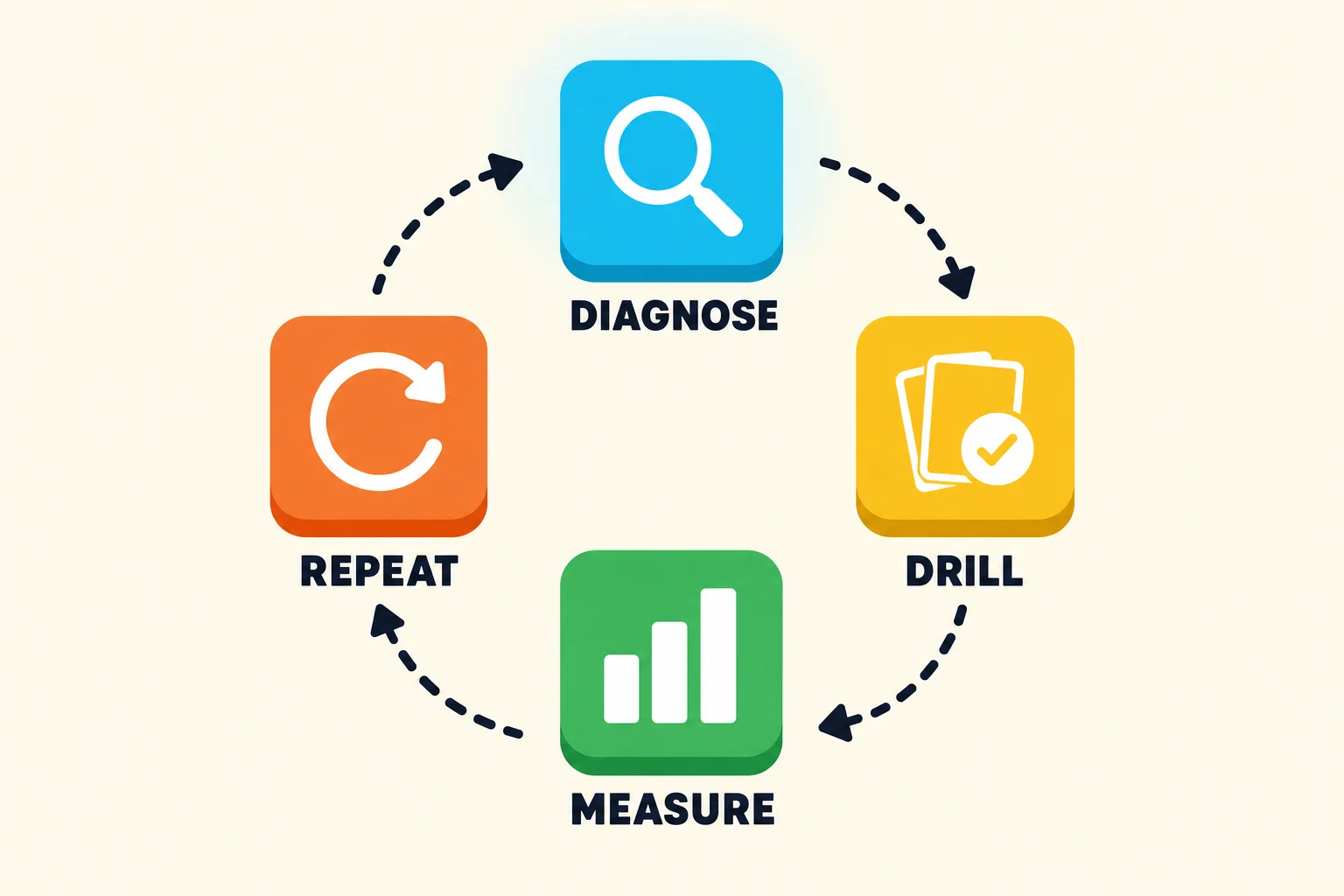
Four moves, in this order, repeating for as long as you want to improve.
Find the mistake in your own recent hands that shows up more than once. One named leak, in a sentence you could hand to somebody else.
Do that exact decision many times, with an explanation after each answer, until the right play stops requiring thought.
Track whether the leak is leaving your decisions. Not whether you won.
The next review names the next leak, usually smaller and further along the same line of play.
The order is what makes it work. Reviewing finds the problem, studying explains the correction, drilling makes it automatic under time pressure, and playing tests it and hands you the next question. Skip the diagnosis and every later step is aimed at a guess.
Step 1: Find your biggest leak
You do not need a database, a coach, or a solver to name your worst leak. A leak is a mistake you make repeatedly, so it is already sitting in the hands you played this week. The trick is knowing which evidence to trust, because the hands that hurt most are rarely the hands that cost most.
The three leak signals you already have
| Signal | Where to look | What it usually means |
|---|---|---|
| The showdowns you lost | Hands where you paid to see the end and lost | Second pair, ace-high or a missed draw as the pattern means you are calling too much, which is among the most expensive habits at low stakes |
| The spots you did not understand | Any decision you cannot reason through in ten seconds | An unstudied spot, and if it recurs it already has a name: turn raises, three-bet pots out of position, big rivers on paired boards |
| The hand you replay hours later | The one that still itches, walked street by street | The mistake usually happened a street earlier than the moment you regret, and that earlier street is the real leak |
Calling is the weakest of your three options and the one players reach for when unsure, which is why signal one is the most common finding. Uncertainty is data, which is why signal two counts at all. And your memory has already done the selection work for signal three.
Run this on your last three sessions
Run all three and you will have candidates. Pick the one that repeats most often rather than the one that lost the biggest pot: a cooler costs a buy-in once, a calling habit costs a fraction of a buy-in a hundred times, and only the second is fixable. Write it as one plain sentence, something like “I call river bets with one pair against players who never bluff.” That is your training target for the next couple of weeks, and every step below points at it.
The five most common leaks, by level
Beginners lose money in a predictable order, and so do improving players. Most expensive first, both ladders side by side.
| # | Beginner leaks | Improving-player leaks |
|---|---|---|
| 1 | Unnecessary risk out of position. Calling flops and floating from the seat that acts first every street, which compounds every mistake after it | No plan for the flop when out of position. Reducing exposure and thinking a street ahead, one level up |
| 2 | Not folding. To a three-bet, with a big pair on a dangerous board, or out of the big blind because the money is already in | One bet size for everything. Overbetting big hands and folding out the calls you wanted, undersizing when the board begs for pressure |
| 3 | Calling too much everywhere else. Preflop calls that become flop folds, river calls made to end the story | Autopilot lines. Betting every flop, barrelling because the story sounded good, one line against a station and a nit alike |
| 4 | Playing too many starting hands. Any ace, any two suited, any face cards, routinely dominated by the hands that pay you off | Turn decisions with no river plan. One loose call becoming two |
| 5 | Chasing draws without pricing them. Drawing at a price that never justified the call is a slow, invisible drain | Missing thin value. Checking back rivers you win often enough to bet, the last leak most players fix |
The two ladders share a shape: position first, discipline second, and the quiet leaks last. Two honest notes on those orderings. Exposure, folding discipline and hand selection sit at the top because their cost is measurable; tilt and bluffing frequency are real leaks with no reliable place in a ranking, which is why neither is in one. And your list is yours. If your reviews keep producing a leak on neither list, trust your reviews.
Step 2: Pick the right lever
With a leak named, the question is where the next hour goes. Four activities are on the menu, and each repairs a different kind of weakness.
| Lever | What it fixes | What it costs | When it is the right spend |
|---|---|---|---|
| Reps with feedback | Execution. You know the rule but do not apply it under pressure | 10 to 15 minutes, most days | Your leak is specific and mechanical: pricing draws, folding to three-bets, defending the blind |
| Hand review | Diagnosis. What you actually did, and where it first went wrong | 5 to 10 minutes per hand | You cannot name your leak yet, or your named leak stopped showing up |
| Targeted study | Understanding. A missing piece of the framework itself | 30 to 60 minutes a week | You do not know what the correct play looks like, so drilling would just rehearse a guess |
| Volume | Reinforcement, and fresh questions for the next review | Hours | You know what you are working on and the loop is starving for material |
That table is an order of operations, and both common ways of breaking it cost months. Jumping straight to volume buys exposure with nothing repairing anything. Jumping straight to study buys theory aimed at an unconfirmed leak, which feels productive until the same hand costs you again.
Drills are the highest-value block for most improving players, because they are the only lever that hands you a decision, your answer, and the reason behind it, over and over. The daily version sits in our 15-minute practice routine, and if you are still choosing where to get those reps, the training app comparison covers the field, including where we fit and where we do not.
Review needs one rule to stay useful: one hand, one sentence, chosen by feeling rather than by pot size. Study should be aimed by that sentence and nothing else, which is what keeps it from turning into a subscription you scroll. The weekly structure holding both together is in our guide to how to study poker. Volume, the honest fourth, is worth aiming at the format you actually want to beat, whether that is cash games or tournaments, because they punish different leaks.
Step 3: Measure decisions, not results
Here is where good work usually gets undone. You fix something real, play for two weeks, lose, and conclude the fix was wrong. Then you change it back.
Results cannot carry that weight. Published examples of genuinely winning players include stretches of forty thousand hands going nowhere and downswings around twenty buy-ins deep, on graphs that still climb by the end. If a real winner can sit break-even for months, two losing weeks say nothing about your correction. Our breakdown of what a normal downswing looks like has the arithmetic.
Measure the fix directly instead. Three things move faster than money:
| What to measure | What progress looks like |
|---|---|
| Accuracy in the leak’s category | If your leak is draw pricing, track how often you get the price right when a drill hands you one. Six in ten becoming nine in ten is visible progress inside a losing week |
| How often the leak appears in your review sentences | The same mistake four weeks running means the drills are aimed slightly wrong. Narrow them until the sentence changes |
| Whether you can state the price before you act | When pot odds arrive as a reflex rather than a calculation, something in your game changed permanently |
The rule that follows: strategy changes come from your reviews, never from a session. A night is not a sample. A month of review sentences is.
Step 4: Repeat on a schedule
The loop compounds only when it runs on a calendar instead of on motivation, which means deciding in advance which days carry drills and which carry a review. That schedule is its own job and we have already written it: the weekly architecture in how to study poker, the daily fifteen-minute version in the practice routine. Run one for a month, then let your review sentences name the next leak.
How long does it take to get better at poker?
Not thirty days, and anyone selling a fixed calendar is selling packaging. Different skills move on different clocks.
| Clock | What moves on it | Why |
|---|---|---|
| Days to a couple of weeks | Discipline leaks: folding hands you used to talk yourself into, giving up on a flop you missed, checking the price before calling a draw | These are rules you can hold in your head and apply at once, and drilling makes them automatic quickly |
| Weeks to months | Judgment skills: hand reading, bet sizing, range thinking | All three depend on texture, opponent and how the hand played out, so they need volume and variety before they settle. You cannot shortcut the number of distinct situations required |
| Longer than you want | Results | Variance owns short samples, and improving players keep raising their own difficulty by moving up, so the graph reflects a harder game as well as a better player |
Expect early progress in your decisions and late progress in your money, and distrust any promise that inverts that order.
Check yourself: which lever is this?
You have named your leak in one sentence: “I call river bets with one pair against players who never bluff.” You know the fold is right. You keep calling anyway, in the moment, with the clock running. Reps, review, study, or volume?
Show the answer
Reps with feedback. Read the lever table again: this is an execution problem, not a diagnosis problem and not a knowledge problem. You have already found the leak, so review has done its job, and you already know the correct play, so study would rehearse something you can recite. What is missing is the decision arriving fast enough under pressure, and reps are the only lever on the table that repairs that. Volume would hand you more of the same leak at full price.
Can you get good at poker without playing for money?
Partly, and further than most players assume. Mechanics, hand values, folding discipline, pricing, and the habit of reviewing all transfer from free play, and being wrong for free is the cheapest way to learn anything. What free tables do not teach is how people behave when losing costs them something. Play-money opponents call everything because there is no penalty for it, so treat those games as a training environment rather than a preview of a real one, and expect an adjustment when the stakes turn real.
Drill your leak
Everything above runs on free surfaces. A notebook handles the review, reading covers the concept, and any source of prepared decisions with explanations covers the reps.
What the Poker Skill app adds is a graded answer on every rep, in the same categories your diagnosis produces, so the drill block and the leak sentence stay pointed at one thing and step three’s accuracy number exists without you building it. The reps are educational, with no wagering in them. To try that shape of practice with no money involved, start with free decision practice.
Frequently asked questions
How do you get better at poker fast?
Fast comes from aim, not from hours. Name one leak out of your own recent hands, drill that exact decision until the right play arrives without thinking, and judge the week on decisions rather than on what the graph did. That loop moves a game in weeks. Adding volume with nothing correcting you mostly makes the mistake faster, which is the slowest way to spend a year.
How to learn poker as a beginner?
Learn it in order rather than by topic. How a hand runs, then what beats what, then position, then a short list of hands you will open with. The free six-step path walks that order with a check at the end of each step, and it is the page to use before this one. The improvement loop here starts paying once those four are automatic, because a loop needs a decision worth correcting.
How many hours does it take?
There is no honest hour count, and the section above says why: discipline leaks move in days, judgment skills in weeks or months, results last of all. What decides the pace is not hours logged but how many of those hours contained a decision somebody corrected. Fifteen focused minutes a day with feedback beats a weekend of unreviewed volume, which is the whole argument for the practice routine.
How do I know what I am doing wrong in poker?
Look for what repeats. Go through the hands you lost at showdown, the spots where you were unsure, and the one hand you keep replaying, then find the mistake that appears in more than one of them. Write it as a single sentence. A leak you can say out loud is a leak you can drill, and it beats any checklist because it came from your own hands.
Is poker skill or luck?
Both, on different timescales. Luck decides individual hands and can decide whole months; skill decides where you land over tens of thousands of them. That gap is why decision quality is the only short-term feedback worth trusting. The evidence is in is poker a game of skill.