
Studying poker works when it is scheduled, aimed at one topic, and closed with reps that tell you whether you were right. Here is the week you can start tonight. Pick one topic and spend twenty minutes learning it from a single source. Drill that topic twice, fifteen minutes each time, somewhere that tells you why an answer was wrong. Review one of your own hands twice, ten minutes and one hand, each review ending in a written sentence. Play your normal sessions with that topic as the only thing you are watching for. Eighty minutes of study, one topic, no shelf of unwatched videos.
This is the weekly architecture. If you want the daily version instead, the 15-minute daily routine runs the same reps on a daily clock, and the two fit together: this page decides what the week is about, that page keeps the habit alive between the blocks.
Quick checklist
- One topic per week, chosen by your own hands rather than by whatever got uploaded.
- Three blocks: twenty minutes to learn it, fifteen to drill it, ten to review one hand you played.
- Every drill block has to answer you back. Reps with no feedback are just more playing.
- Every review block ends in one written sentence, and that sentence picks next week’s drills.
Why most poker study fails
Most players who say they are studying poker are consuming poker. Videos while eating, a forum thread on the bus, a course bought in January and opened twice. It feels like work because it costs time, and it changes almost nothing, because watching someone else make a decision is not the same act as making one.
The distinction that matters is between passive intake and active work. Reading and watching help, but they sit below the methods that force you to produce an answer: working through decisions and finding out why you were wrong, going back through your own hands, asking a coach or a study partner a real question. Being tested is what makes material stick, which is why the drill block below is the one to protect when the week gets busy.
Three specific ways study goes wrong, all common at low stakes:
Hoarding content. Buying material as a substitute for reps. An unwatched library teaches nothing, and a watched one changes little without practice attached to it.
Starting at the hard end. River bluff frequencies while your opening ranges are still a mood. Advanced ideas are not wrong, they are premature, and premature study gets you fluent in theory you cannot yet use.
Studying whatever the last bad night suggested. Session results are noisy enough to send you rewriting strategy every week. The plan below exists so your syllabus comes from a pattern in your own hands rather than from a cooler.
A fourth failure hides inside the other three: spreading a week’s attention across five topics at once. You get better at what you repeat, so what you repeat has to be the correction rather than the mistake. One topic per week is what makes the repetition land somewhere.
The weekly plan at a glance
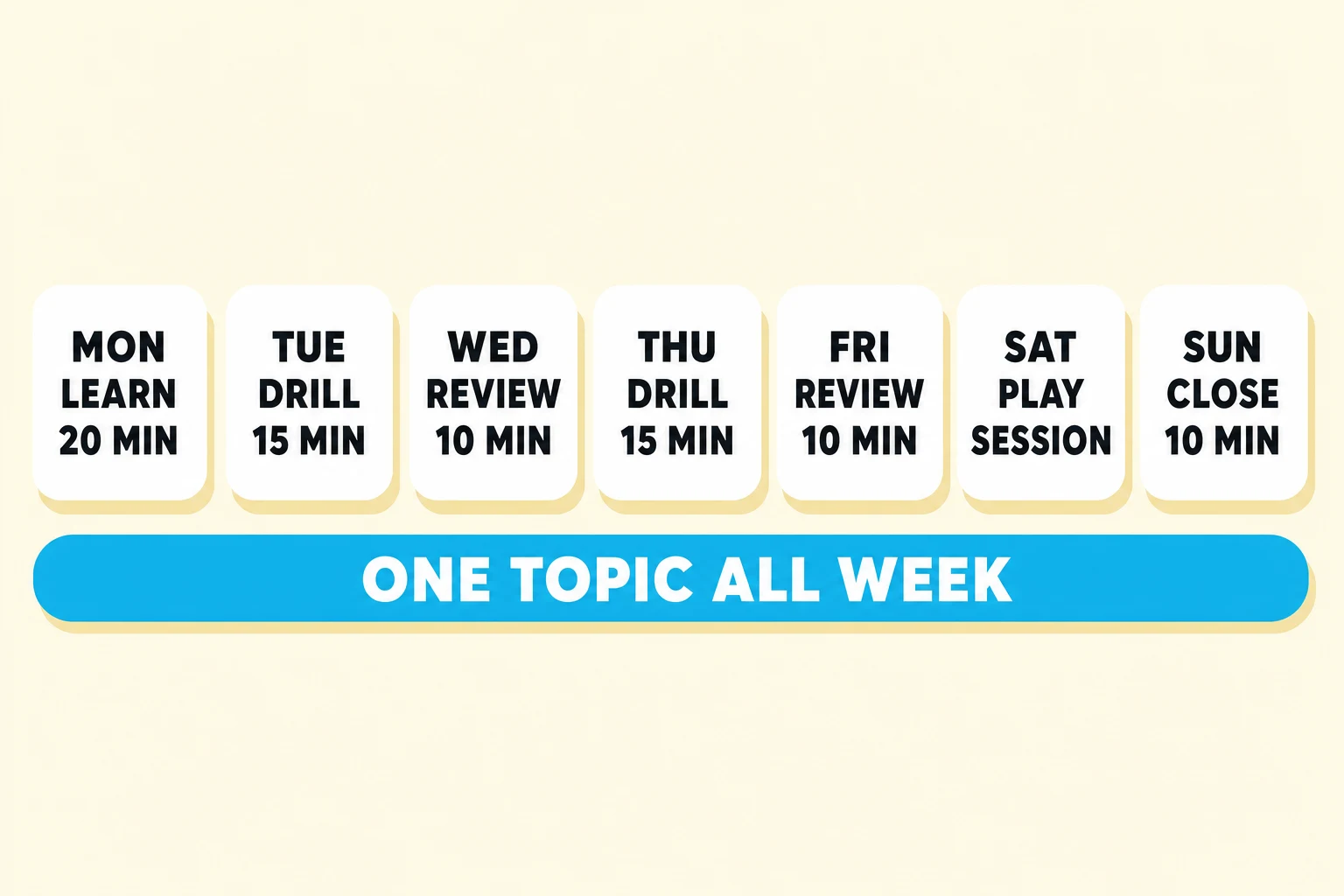
Eighty minutes of study across the week, plus the poker you were going to play anyway. The days are movable. The order is not: learn it, drill it, review it, then play it.
| Day | Block | Minutes | What you actually do |
|---|---|---|---|
| Monday | Pick and learn the topic | 20 | One topic, one source, notes written as questions |
| Tuesday | Drill it | 15 | Reps on that topic only, with feedback on every answer |
| Wednesday | Review one hand | 10 | The hand that still itches, one written sentence |
| Thursday | Drill it again | 15 | Same topic, harder spots, watch the accuracy |
| Friday | Review one hand | 10 | Pick a hand where this week’s topic showed up |
| Saturday | Play | your session | Play normally, watching for this week’s topic only |
| Sunday | Close the week | 10 | Reread your two sentences, choose next week’s topic |
Also on this page: which topic to pick first, a worked session run start to finish, how long results take to move, the study tools ranked by what they teach, and the questions players ask most.
Scale it honestly. Half of this week still improves you, and it beats a four-hour Sunday that never happens twice. If you play more than a few hours a week, treat eighty minutes as the floor and add a third drill block before anything else, because the reps move fastest.
Pick one topic per week
If you have no idea which topic to start with, use this order. It is the order the money leaks in, from the cheapest mistakes to fix to the ones that only make sense once the earlier layers are solid.
- Which hands you play, from which seat. Starting hand selection is the most systematic part of poker and the one place a written list beats instinct. A week here is a week spent making the rest of the game affordable.
- Position. Acting last is worth more than most beginners believe, and it changes which hands from step one are playable at all. The positions guide is a single-session read.
- Price: pot odds and outs. This is where poker turns from vibes into arithmetic. Learn to count outs cleanly and to convert them with the rule of 2 and 4, including the part where the rule of 4 stops being true.
- The continuation bet. Your most frequent postflop decision as the preflop raiser, and the first postflop habit worth drilling. When to fire and when to check is a week of its own.
- Hand reading and ranges. Last, because it stands on all of the above. Reading an opponent means little while your own play is disorderly.
After those five weeks, drop the default order. Your review sentences will be naming the same leak by then, and that leak beats anything a list can suggest.
The mix inside the blocks shifts as you improve: mostly drills and guided lessons at the start, an even split once your fundamentals settle, then reviews as the centerpiece later, with drills there to keep the basics from rusting.
Whatever you pick has to be small enough to drill. “Postflop play” is not a topic. “Betting the flop after raising preflop on a dry board” is a topic, because you can find thirty reps of it and know by Thursday whether you got better at it.
The three study blocks
Three blocks, in this order, on one topic. The loop closes when a review names something next week’s drills can attack.
Block 1: Learn it in 20 minutes
One topic, one source, twenty minutes. An article, a chapter, a lesson, one video. Not five tabs. The limit exists because you are here for a working rule you can apply on Tuesday, not to feel informed.
Take notes as questions rather than summaries. “Do I raise or call with suited connectors in the cutoff against a loose opener?” is a note you can drill. “Suited connectors play well in position” is a sentence you will nod at and forget. If the source raises a question it does not answer, write it down and let it wait for next week.
Block 2: Drill it for 15 minutes
Fifteen minutes of decisions on this week’s topic, where something tells you why each answer was right or wrong. Commit before you see the explanation, every time. The commitment is the mechanism: an answer you guessed and had corrected sticks, an explanation you nodded along to does not.
This is the block to protect, because it is the only one where you produce decisions under a little pressure and get them graded on the spot.
If you want reps more often than twice a week, that is what the 15-minute daily routine is for. Daily reps and a weekly topic fit together: the daily habit keeps your hands warm, the weekly topic decides what they are warming up on.
Block 3: Review one hand in 10 minutes
One hand. Not ten. Walk it street by street asking two questions and only two: what did I know at that moment, and what was the price? Then write one sentence naming the mistake or confirming the read. That sentence is the deliverable, and a season of them is a leak ledger nobody can sell you.
Choose the hand by feel, not by pot size. The right hand is the one that still itches: where you did not know what to do, where you knew and did something else, or where you won and cannot explain why. A pot you lost to a two-outer teaches nothing, because being unlucky is not a leak. If you can already name the mistake in one sentence before you start, the hand is done teaching, so pick the second itchiest one instead.
Early on, lean your reviews toward preflop and flop spots, where the money actually leaks and the hand is simple to reconstruct. River reviews pay off later, once you have the range thinking to make sense of them.
A worked study session
Here is one full review block, the pricing week, ten minutes end to end.
The hand, from a $0.25/$0.50 online game, six-handed, everyone about a hundred big blinds deep. The button opens to $1.25. The small blind folds. You call in the big blind with the ace and five of spades. The pot is $2.75. The flop comes nine of spades, six of spades, two of hearts, giving you the nut flush draw. The button bets $1.35. You called, the turn and river bricked, and you gave up.
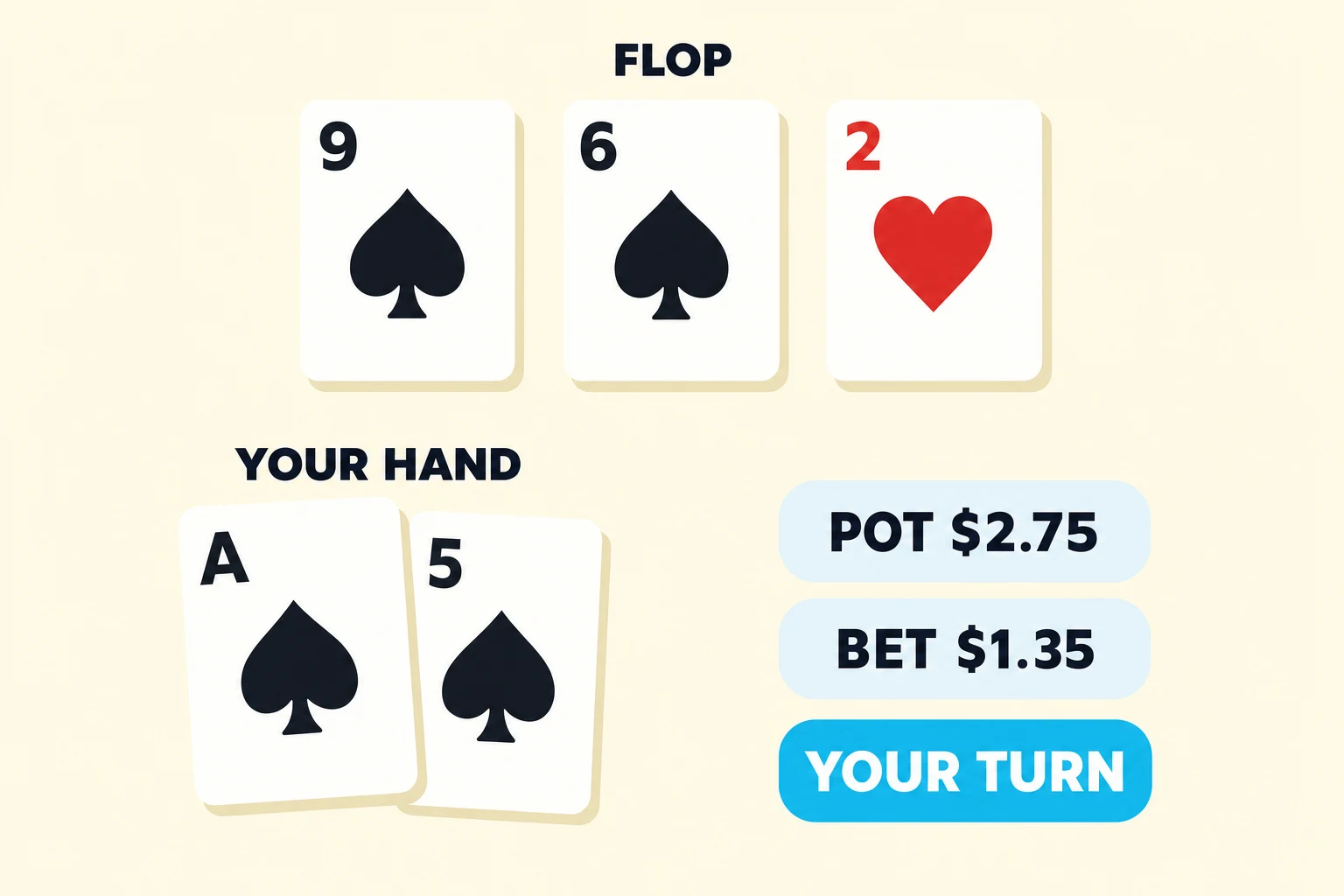
Now the two review questions, in order. Start with what you knew. Nine spades finish your flush, and it is the best possible one when it gets there. You are out of position for the rest of the hand. The button raised first in and bet a flop that misses most big blind calling hands, so the bet says very little about his cards.
Then the price. You are calling $1.35 into a pot that will hold $5.45, so you need to win about one time in four. That is the number to compare against, and the comparison is where this hand went wrong. Nine outs come in about 19 percent of the time with one card to come, and about 35 percent when both cards are coming. Facing a flop bet with money still behind, only the first number is yours. The 35 percent belongs to the case where the rest of the chips are already in the middle and there is no more betting to survive.
So the call is short on immediate price by about six points, and it lives or dies on what happens when the flush arrives: roughly $47 behind, out of position, against someone who may not pay you. Your ace adds a little value the nine outs do not count, but not enough to cover the gap.
The sentence for the ledger: I priced a flop draw with the rule of 4 while there was still betting to come. It names the reasoning rather than the result. The call itself is defensible; the reasoning repeats in every draw you face from now on, which is why it is the thing to fix.
That sentence wrote Thursday’s drill block: fifteen minutes of draw pricing with one card to come, nothing else.
How long until studying shows up in results?
Slower than you want, and the delay is not evidence the study is failing. Results are noisy enough that a genuinely winning player can sit near break-even for tens of thousands of hands before the edge shows in the graph. A weekend is a very small sample.
So judge the study by things that move before the money does:
- Drill accuracy on this week’s topic, week over week. If it is climbing, something is working.
- Your review sentences. The same leak should stop appearing after a few weeks of aimed drills. When it stops, that is progress you can see on a Sunday rather than in a graph.
- Speed on the easy decisions. Prices and expected value calls you used to grind out in a minute should start arriving in seconds, which frees attention for the hard spots.
Results follow those three eventually. They are just rude about the schedule.
When the week stops working
Every improving player hits a stretch where the loop keeps spinning and nothing moves. Before buying anything, run three checks.
Check the reviews: if the same sentence repeats for a month, your drills are not aimed at it, so narrow them until they are. Check the difficulty: accuracy above 90 percent means the reps got comfortable, so move up a topic rather than farm green checkmarks. Check the volume: study with too few hands behind it is a syllabus with no student, and the fix is playing more so the reviews have material.
If all three check out and the wall stays, that is the moment to change tools rather than effort. And studying is only one lever on improvement. Which leak to attack first, how much to play, table selection, bankroll, and tilt belong to the wider improvement plan; this page owns the study system that plan sends you to.
Study tools, honestly ranked
Ranked by learning per minute, not by price. Every category has a job in the week above.
- Drills that answer you back. Highest yield, because you commit and then find out why. This is Block 2, and it is the only category that manufactures graded decisions on demand.
- Your own hand histories. The only material that knows your leaks. Free, slow, and irreplaceable. This is Block 3.
- A human: a coach or a study partner. Feedback with judgment attached. Worth the hourly rate once your reviews can pose a sharp question.
- Charts and reference pages. Cheap correctness on solved questions such as opening ranges and prices. Our free preflop charts are that shape: read once, keep nearby, stop relitigating.
- Video and books. Ideal for Block 1, weak as a main course. One chosen to answer this week’s question beats six on autoplay.
- Forums and hand-discussion threads. Good for a second opinion and for hearing how other players describe a spot. Uneven, and slower than a drill.
- Solvers. Research instruments for questions that survive your first year of fundamentals. Pointed at a beginner’s problems, they mostly produce expensive confusion.
Choosing between actual products is a different question from choosing a study method, and it has its own pages: trainers compared with solvers covers the split at the top of that list, the training app comparison is the honest roundup, the training site comparison does the same for the video-course platforms, and the evaluation checklist is what to look for before you pay for any of them.
Make the reps automatic
The block most likely to get skipped is the one with the most friction: finding fifteen minutes of good decisions on this week’s exact topic. That is the job Poker Skill is built for, with short drills that explain every answer and a daily puzzle for the first rep of the day. Pick the topic, open the app twice a week, and Block 2 stops being a planning problem.
The week does not depend on it. Any source of real decisions that tells you why works the same way. What the week depends on is that something grades the reps.
Poker study FAQ
How many hours should you study poker?
Eighty focused minutes, spent the way the plan above spends them, is enough to improve on, and two or three focused hours beats ten scattered ones. The aggressive version, for a beginner in a hurry, is studying close to as many hours as you play, which is far more study than almost anyone actually does. There is no magic weekly number. Add hours only when the blocks you already run are landing.
Should you study or play more?
If you cannot name your most common mistake, play more, because you have no material to study yet. If you can name it and it keeps happening, study more, because the hands are no longer telling you anything new. Playing asks the questions and study answers them, so feed whichever side is starving the other.
What should a beginner study first?
Which hands to play from which seat, then position. They are the cheapest leaks to fix and everything postflop stands on them. If the rules themselves are still new, start with how to play poker and come back to this week when you can follow a hand without thinking about it.
Is watching training videos studying?
Only inside the loop. A video chosen to answer this week’s question, followed by drills on that exact idea, is studying. Autoplaying strategy content is watching television with extra steps.