


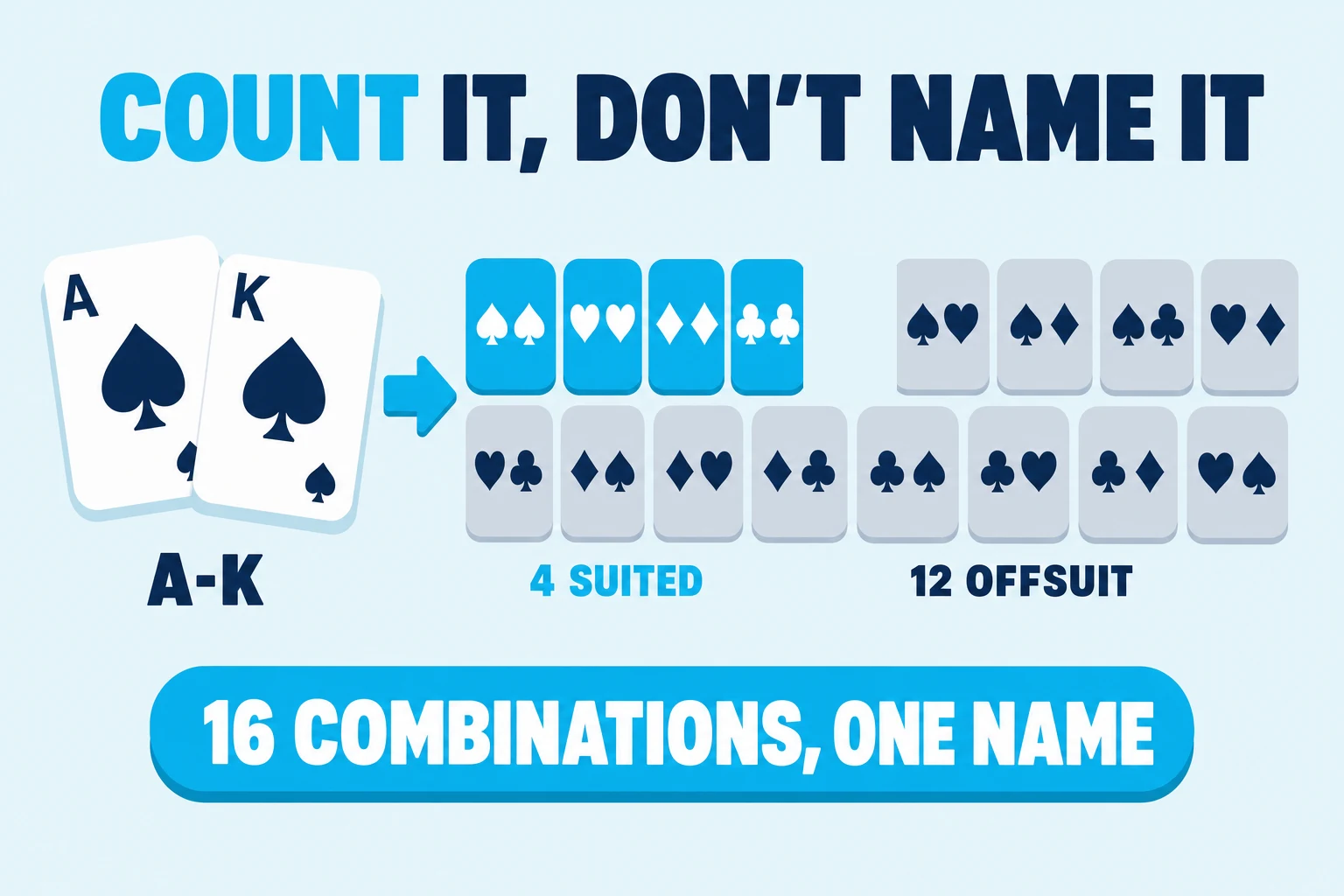
A poker range is the full set of hands a player can hold at this exact moment, given their position, their actions so far, and how deep the stacks are. Instead of naming their two cards, you name the group those two cards came from and delete parts of the group as the hand goes on. It is the difference between “I put you on ace-king” and “his range here is about 92 combinations and only a third of them like this flop.”
This page is about the concept: what a range is, how to count one, how to cut it as the hand goes on. If you came for the charts themselves, the poker opening ranges by position page has one grid per seat with a printable download.
The short version
Write down every hand your opponent plays this way, convert the list into card combinations, then cross out the combinations each new card and each new bet rules out. What survives to the river is what you are actually betting into.
How many hands are in a range
Ignore suits and there are 169 different starting hands in Texas Hold’em. Count the suits and there are 1,326. That second number is the one that matters, because ranges get compared by combinations, not by names. A hand like ace-king sounds like one hand and is really sixteen of them.
| Hand type | Example | Combinations |
|---|---|---|
| Pocket pair | A♠ A♥ | 6 |
| Suited | A♠ K♠ | 4 |
| Offsuit | A♠ K♥ | 12 |
| Any unpaired hand, both forms | A-K | 16 |
Offsuit hands are three times as common as their suited twins, so “he could have ace-queen” is a much bigger statement than it sounds: twelve of those sixteen combinations are the offsuit version. Cards on the board and in your own hand remove combinations too. Aces are six combinations until you are holding one yourself, at which point there are three.
Ranges are usually written in shorthand. AA is the pair, s marks the suited version so AKs is ace-king suited, o marks the offsuit version so AKo is ace-king offsuit, and range charts use plus notation like ATs+ to compress a run of hands into one entry. Percentages get used the same way, though a “20% range” is rarely the literal top 20% of hands by rank. It is more often the top 15% plus a slice of suited connectors and one-gappers that got included because they play well after the flop, not because they are strong before it.
Assigning a range: an under-the-gun example
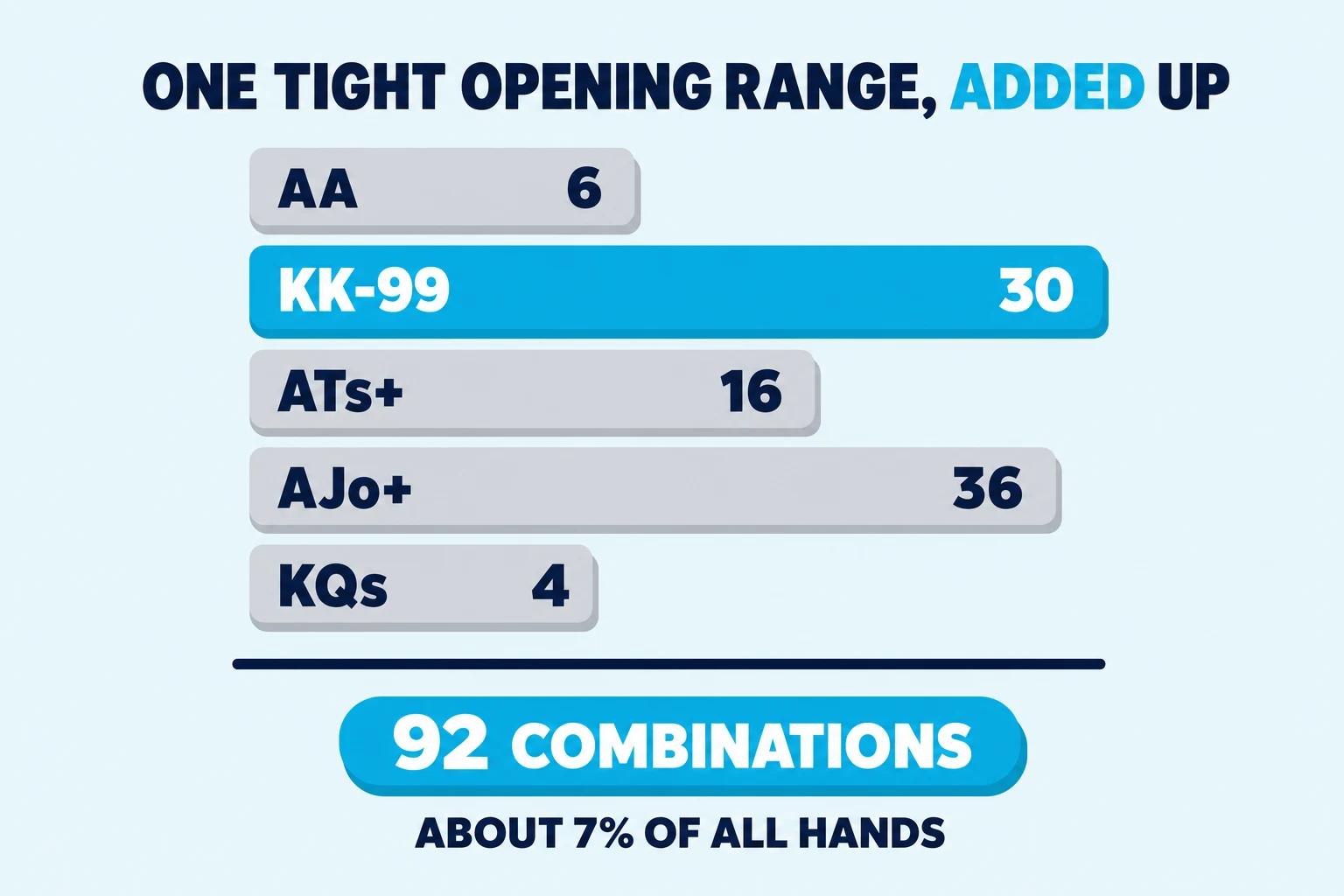
You are in a 6-max cash game, 100 big blinds deep. A tight player opens from under the gun, the seat that acts first and has five opponents left behind it. You have watched them for an hour and they open premiums only. A reasonable range to hand them is AA, KK through 99, ATs+, AJo+, and KQs.
Now count it instead of eyeballing it. AA is 6 combinations. KK through 99 is five pairs at 6 each, so 30. ATs+ is four suited hands at 4 each, so 16. AJo+ is three offsuit hands at 12 each, so 36. KQs is 4. Add them up and you get 92 combinations out of 1,326, which is a hair under 7% of all hands.
Ninety-two is the number to carry forward. Every question about the rest of the hand is now a subtraction from it rather than a fresh guess. Poker Skill’s big blind lesson against an under-the-gun open is built on a tight range like this one: A♠ Q♠ 3-bets, K♥ Q♦ calls and A♣ 8♦ folds because a tight opener’s range dominates it.
Narrowing it on the flop
The flop comes Q♦ 6♥ 2♥. Nothing in the range contains a six or a deuce, so only the queen matters, and it deletes eight combinations straight away: three from QQ, three from AQo, one from AQs, one from KQs. Eighty-four combinations are left.
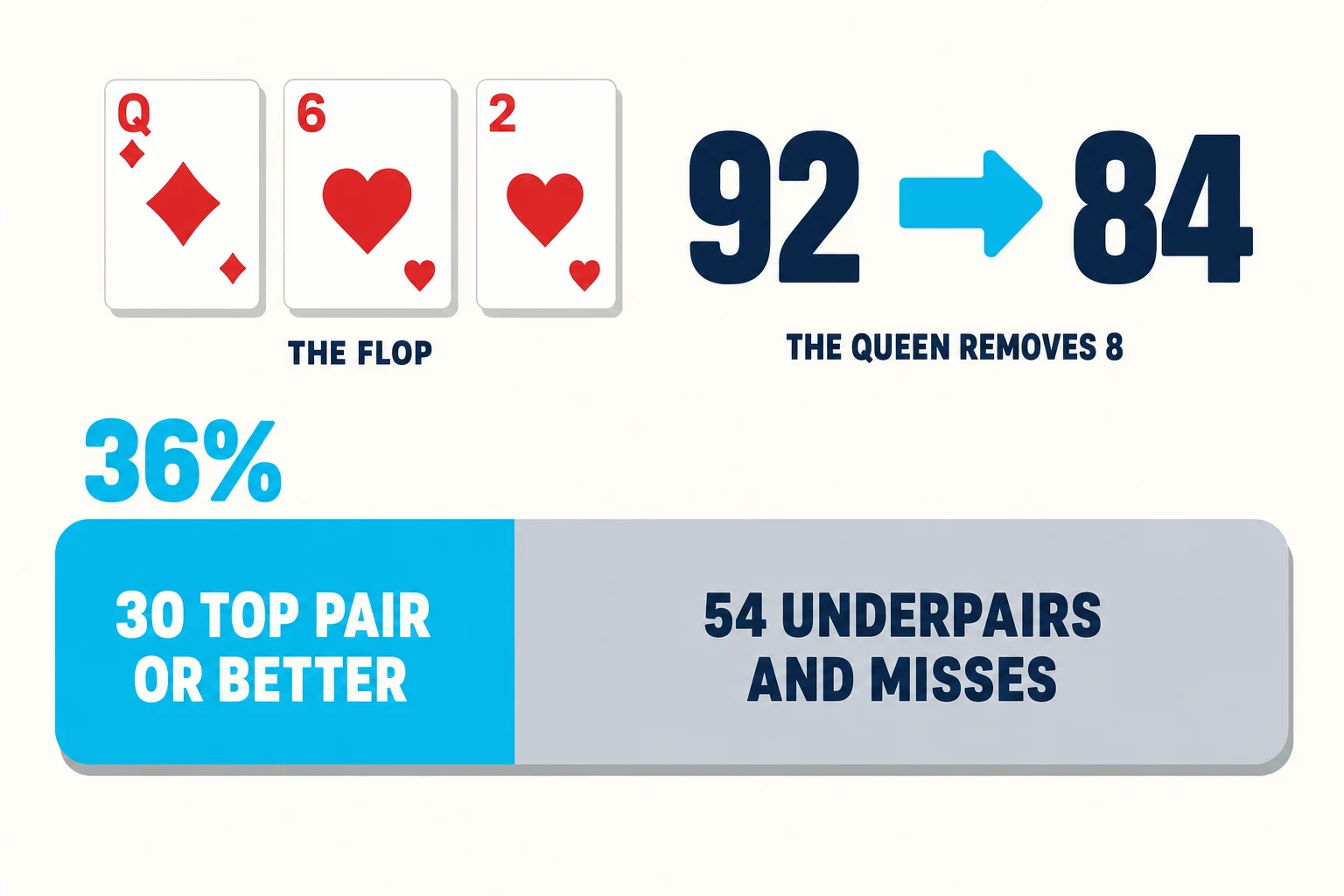
Of those 84, count the hands that flopped top pair or better. AA is 6, KK is 6, QQ is now 3 and they are sets, AQs is 3, AQo is 9, KQs is 3. That is 30 combinations, a little over a third of what they have. The other 54 are JJ down to 99 sitting under the queen, or two big cards that missed, and only three of those 54 picked up a heart draw off the 6♥ 2♥.
So when this player fires the flop, you are not facing “a queen.” You are facing a range that is top pair or better about 36% of the time and is an underpair or ace high the rest of the time. That is a different hand to play, and you got there by subtracting rather than guessing. Turn and river do the same work: each action they take and each card that lands removes another slice, and by the river what is left is usually polarized into strong hands and busted draws with very little in between.
Range advantage is not nut advantage
These are two different questions and they get run together constantly. Range advantage asks whose overall range is stronger on this board. Nut advantage asks who holds more of the very best hands. They do not have to belong to the same player, and which one you hold changes what you should do with it.
The clean example is a 6♣ 5♦ 4♥ flop after an under-the-gun raise and a big blind call. The big blind is the one who defends 8-7 and 3-2 and flopped a straight with them, plus every set, plus two pair, plus a pile of combo draws. The raiser holds almost none of that. It is a nut advantage, and it flips the usual script: the big blind leads out into the raiser about 81% of the time, with a small bet. The raiser, holding more overpairs and fewer monsters, is the one calling and folding.
The reverse case is a dry, high flop like the Q-6-2 above. There the raiser holds the range advantage and can bet at a high frequency with a small size. Same principle, opposite owner, and the only way to know which case you are in is to look at both ranges instead of at your own two cards.
Where range thinking lies to you
The expensive failure is assigning a range once and then treating it as settled. If you decided preflop that this player has premiums only, and they then bet three streets on a board thick with draws, the estimate has to move. Either the range was wider than you wrote down or the read was wrong, and refusing to pick between those two is how a tidy number turns into a bad call.
Ranges also do not travel between formats. Opening ranges widen as position improves, from tight under the gun to very wide on the button, but the exact hands depend on the game you are in. Cash ranges run tighter than tournament ranges at the same stack depth, because rake takes a cut of every pot and there are no antes building it for you. A chart learned for one game is quietly wrong in the other.
Then there is your own range, which is the one most players never look at. Raise your good hands and limp your medium ones and you have announced that your raising range contains no medium hands. A decent opponent responds by folding weak hands to your raises and attacking your limps, and none of that requires them to read you at all. They are just reading the split.
A four-step routine at the table
Before you act, run the same four steps every time. Name the range their preflop action implies, in shorthand rather than in feelings. Count it roughly, in combinations, so you know whether you are arguing about 20 hands or 200. Cross out what this board and this bet size rule out. Then ask what fraction of the survivors beats you, and hold that fraction against the price you are being offered.
The steps get faster with reps, and they leave a trail. When the hand is over you can redo the arithmetic away from the table and find the exact step where the estimate went wrong. A gut read gives you nothing to check.
Where this fits in your decision
Range thinking sits underneath most of the postflop vocabulary. Range construction is the work of deciding your own splits before you sit down, so that your bet sizes do not sort your hand for the table. If you want a ready-made starting point for the preflop half of that work, the preflop chart library has opening ranges seat by seat, free to read or print. A capped range is a range whose top has been cut off by an earlier action, and you can only attack one if you were tracking the range in the first place.
FAQ
What is a poker range?
A range is the set of all hands a player can hold right now, based on their position, everything they have done in the hand, and how deep the stacks are. It replaces the older habit of naming one specific holding, which is wrong far more often than it is right.
How do you put someone on a range?
Start with the hands their first action makes sense with, write them in shorthand, then remove hands as the board and their later actions rule them out. The removing is the part that matters. A range you assign preflop and never touch again is a guess wearing a costume.
How many hand combinations are there in poker?
There are 1,326 possible starting hands when you count suits, and 169 when you do not. Any pair is 6 of those combinations, any suited hand is 4, and any offsuit hand is 12.
Do I need a solver to think in ranges?
No. The arithmetic in this article is addition and division, and it runs on a napkin. Solvers are useful for checking frequencies once you already think in ranges, but they cannot install the habit for you. Reps against real spots do that.