
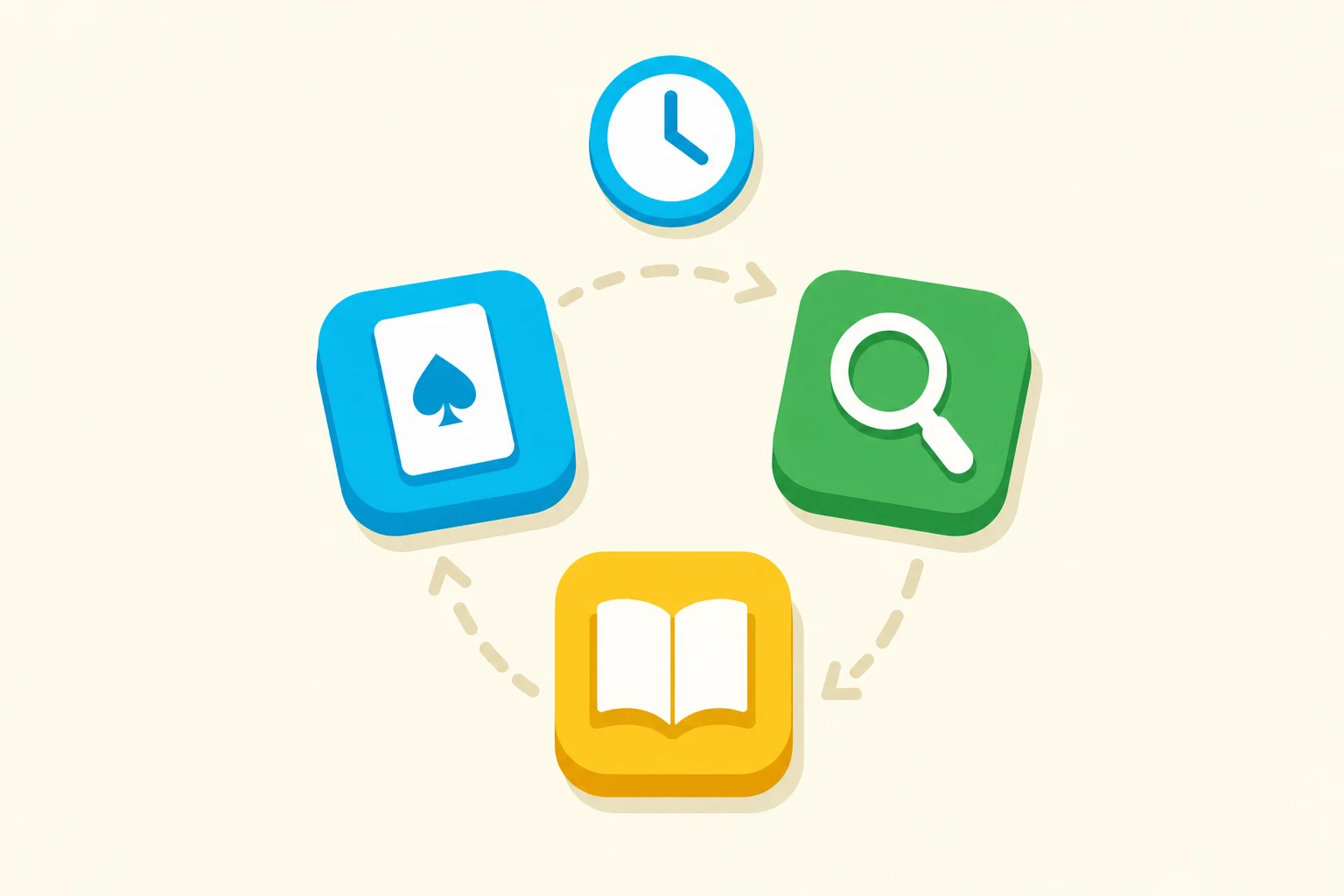
Practise poker for fifteen minutes a day, split three ways: five minutes drilling decisions, five minutes reviewing one hand you actually played, five minutes learning one concept. That is the whole routine, and done daily it beats a five-hour session done occasionally.
The minutes have to go on decisions rather than on hands. A session rewards you for surviving it; practice rewards you for being wrong in ways you can see.
Most players who stop improving have put in the hours. They spent them playing, and skill comes from practicing, a different activity. The longer, one-leak-at-a-time version of this is the deliberate practice plan; this page is the daily shape.
The 5-5-5 routine: how to practice poker in 15 minutes
Ready-made spots: fold or call, raise size, draw pricing. Commit to an answer before you see the explanation.
One hand from your last session that still itches. Walk every street asking what you knew and what the price was. Finish with one written sentence.
The idea that hand exposed, and only that idea. The reviewed hand chooses the concept; the concept sharpens tomorrow’s drills.
Block one: five minutes of decision drills. The only rule is committing to an answer before you see the explanation, because the commitment is what makes the feedback stick. Guessing along passively teaches you to nod, not to play. Short, guided drills built around real decisions are exactly what Poker Skill serves, including its Daily Puzzle for the day’s first rep, but the block works with any source of real decisions that explains itself. The poker practice apps comparison weighs which tool to get them from.
Block two: five minutes on one hand you played. Not ten hands. One. Count your outs, redo the pot odds and check whether the story you told yourself about your opponent’s range survives daylight. Write one sentence at the end: the mistake or the confirmation. That sentence is the deliverable.
Block three: five minutes on one concept. Pick a single idea, position, equity, continuation betting, whatever your reviewed hand exposed, and read or watch about only that. That loop, hand exposes leak, concept explains leak, drills rehearse the fix, is the entire engine of improvement, miniaturized.
Tonight’s routine card
Fifteen minutes, in order
Nothing here is saved or scored. The card exists so the routine fits on one screen when you sit down.
The best way to learn poker in 10 minutes a day
The best way to learn poker in 10 minutes a day is to spend the first five minutes on one small idea and the next five on decisions that use it, checking each answer against its explanation. Answering them makes you pull the idea back out of memory, and ideas you retrieve stay with you longer than ideas you only reread. The 5-5-5 routine puts the drills first, because there the concept is chosen by a hand you played. Until you have hands of your own to review, you choose the idea yourself and drill it straight after.
Learn the rules and the hand rankings first, until you can name the best five-card hand without thinking, then position and starting hands. The arithmetic comes after those. Counting your outs and applying the rule of 2 and 4 tells you roughly how often a draw gets there, and pot odds turn the price of a call into the share of the time the call has to win.
Why decisions with feedback beat volume
Poker skill is pattern recognition, and patterns are built by reps with feedback: face a decision, commit to an answer, find out why the answer was right or wrong, repeat. Playing hands gives you the reps but almost none of the feedback. You find out whether you won the pot, which is nearly useless information, because bad plays win pots all night and great plays lose them. Results arrive soaked in luck; reasons arrive clean.
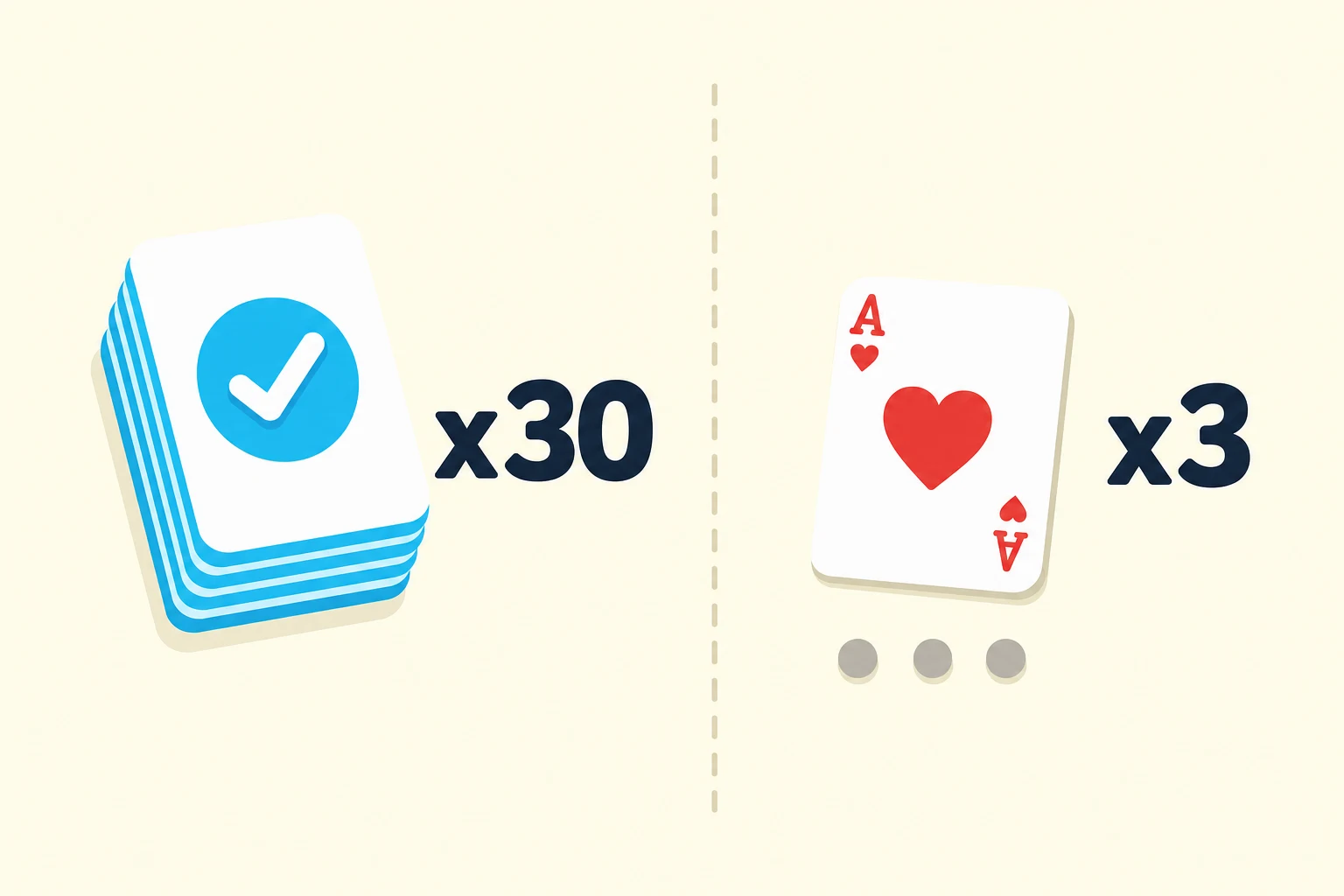
One number worth internalizing: if a drill hands you a decision every ten seconds, five minutes is thirty decisions with thirty explanations. A live hand of poker runs through at most four betting rounds and explains none of your decisions.
That is why a focused drill block compresses more learning into five minutes than an hour of loose play. It is the same reason musicians run scales instead of only playing concerts. The concert tells you how you did; the scales change what you can do.
The weekly rotation
Days repeat, weeks rotate. Left alone, everyone practices what they are already good at, the poker equivalent of playing the riff you already know. The calendar decides so your ego does not.
| Day | Focus | Why it is there |
|---|---|---|
| 1 | Preflop discipline | Playing too many hands is the leak that costs the most |
| 2 | Position | The same cards are a fold from one seat and a raise from another |
| 3 | Draw math | Counting outs until it is automatic |
| 4 | Pricing | Pot odds checked by reflex, not by arithmetic |
| 5 | Aggression | When betting beats calling |
| 6 | Hand reading | Building the range, then testing the story |
| 7 | Free day | Whatever leak the week exposed |
Beginners should over-weight days 1 to 4, because folding better and pricing draws correctly plug the leaks that cost the most, fastest. The full weekly architecture around this routine lives in how to study poker.
If fifteen minutes ever feels too small to matter, remember what it compounds into: a daily routine is ninety focused hours a year, delivered in pieces small enough that you will actually do them.
How to measure progress honestly
Do not measure by session results; luck owns those for longer than anyone believes. Measure by decisions.
| What to track | How you know it moved | What it is not |
|---|---|---|
| Drill accuracy by concept | Draw pricing climbs from 60% to 85% | A winning session |
| Your review sentences | The same mistake stops appearing | A better feeling |
| Instinct against explanation | You call the answer before you peek | A bigger bankroll |
Draw-pricing accuracy climbing from 60 to 85 percent is real, visible progress even during a losing week at the table. When your expected value instincts and the explanations start agreeing before you peek, that is what improvement actually feels like: boring, specific and cumulative. Session profits will eventually agree. They are just the last to know.
When the same mistake keeps surviving the rotation, the routine is not the right tool any more and the leak needs naming, which is what the deliberate practice plan is for.
A worked example: one review rep, start to finish
Here is what block two looks like in real life, so the five minutes feel concrete. Last night you called a river bet with second pair and lost to a flush. It still stings, so it is tonight’s hand.
Walk it forward. Preflop: fine, a normal defend. Flop: you called a bet with your pair plus a backdoor draw, and the price was good, no note. Turn: the third heart arrived, your opponent bet bigger and you called again.
Self-check: which street was the mistake?
Show answer
The turn. You were getting about 3-to-1 on a hand that now needed to be good roughly a quarter of the time against a range that had just got stronger, and this opponent had not bluffed a river all night. The river call you regretted was actually decided on the turn, which is the single most common discovery in hand reviews.
Your one sentence: “Against players who do not bluff enough, my turn calls need a plan for the river, or they are just expensive information.” Tonight’s block three is bet-sizing tells or turn play; tomorrow’s drills, you will notice, suddenly look relevant. That is the loop closing, and it took five minutes.
The three practice traps
| Trap | What it looks like | Why it fails |
|---|---|---|
| Volume | Thousands of play-money hands, no feedback | Repetition without correction fossilizes mistakes |
| Video | Hours of training content, nothing committed | Recognition is not ability until you do it under a clock |
| Results | Changing strategy because of what happened | You called with the right price and lost; the call was still right |
Chips-for-free tables teach a game where nobody folds. Watching someone else count outs transfers almost nothing until you count them yourself, which is why videos belong inside block three, five minutes, in service of a concept, rather than as the main course. And practice exists precisely to build a standard of correctness sturdier than last night’s outcomes.
Why no-money practice means more reps
For building skill, practicing without money on the line is an advantage. Stakes add stress, and stress narrows attention exactly when you want it wide open for learning. More practically, reps without stakes come fast: you can drill river decision after river decision in the time a live table takes to bring you one.
Do you need to play for money to get better?
No. Money tests your composure, not your understanding, and composure training can wait until there is understanding worth protecting. Poker Skill is free. Forever. There is no wagering anywhere in it, so a wrong decision costs you nothing but a better explanation. Learn the decisions stake-free, then add stakes when the decisions are automatic enough to survive the adrenaline.
Where this fits in your decision
If you are still learning how a hand runs and what beats what, do that first: the six-step path covers it free, and this routine is what you come back to afterwards.
Frequently asked questions
How do you practice poker every day?
Give the habit a fixed slot and a fixed shape, then let the shape do the deciding. Five minutes of drills on one decision type, five minutes on one hand you actually played, five minutes on the concept that hand exposed. The point of repeating a single decision type daily is to make it automatic, so it arrives at the table without you assembling it from scratch. Miss a day and start again the next one; the routine survives gaps far better than it survives being turned into an hour.
How long should a poker practice session be?
There is no authoritative number, and anybody who gives you one is guessing. What holds up is regularity: repetitions that happen most days accumulate, and repetitions that wait for a free weekend mostly do not happen. Fifteen minutes is the shape this page argues for, because it is short enough to survive a working week and long enough to hold three blocks. Judge a session by how many decisions you committed to and read the explanation for, not by the clock.
What should a beginner practice first?
Preflop hand selection, which is the same as practicing folding. Playing too many hands before the flop is the leak that costs new players the most, and it is the one a short daily drill block fixes fastest, because every rep is a small yes-or-no you get corrected on. If you are still learning how a hand runs and what beats what, do that first: the six-step path covers it free, and this routine is what you come back to afterwards.
How long until you see improvement?
In drill accuracy, days. In your own decisions at the table, a few weeks of daily reps, usually first as folds that got easier and prices you suddenly check by reflex. In results, longer, because variance drowns short-term signal. Trust the decision metrics; they lead everything else.
Can you practice without playing real hands?
Yes, and most efficient practice looks exactly like that: prepared decisions with feedback, reviewed hands, one concept at a time. Real hands are where you test the training, and they remain the worst place to acquire it.