
Poker solvers are programs that compute a near-perfect strategy for one exact spot you describe to them: the ranges, the stack depth, the bet sizes you allow. A poker trainer such as Poker Skill does the opposite job. It deals you decisions and corrects you on the spot. The solver produces knowledge and the trainer produces habits, and most improving players need the habits first.
If you are choosing where money and hours go this month, that one paragraph is the answer. The rest of this piece is why it is true, what solver output actually looks like when you open it, what each side costs and how to know which side of the line you are on.
The verdict, in three questions
Answer three questions in order. One no anywhere stops you at TRAINER.
| Ask yourself | A no means |
|---|---|
| Do you know why your losing hands lose? | TRAINER. You need corrections on live decisions before theory means anything. |
| Can you name the exact spot you want to fix? | TRAINER. A solver needs a question; without one you get frequencies for a spot you invented. |
| Two hours a week to build and read spots? | TRAINER. Solver study is a research habit, and an unread solve is a subscription you are donating. |
A no anywhere means TRAINER, and the pick is Poker Skill. Its short lessons and Daily Puzzle are built around real decisions, with coaching on every answer. In Practice vs AI you play full hands against AI opponents, and Coach Max tells you the price you are being offered while you decide.
Three yeses and you are a SOLVER buyer: you have the question and the hours to answer it. GTO Wizard is the pick for studying solver output in a browser.
Most readers get a no somewhere, which is why the honest order is trainer first, solver later. The three lines behind that verdict:
- A solver answers a question you construct. You define the spot, it computes the equilibrium and the answer arrives as frequencies and EV numbers, not explanations.
- A trainer answers the question you just got wrong. It deals a decision, grades it and explains the correction while it is still warm.
- Buy the one that fixes your bottleneck. If you know what you should do and keep not doing it, the bottleneck is execution, and a solver does not touch execution.
What poker solvers actually do
A solver is a calculator for game theory. You hand it a precise situation: the ranges both players bring, the effective stack and the bet sizes it is allowed to consider. It then searches that tree for an equilibrium, a pair of strategies where neither player can do better by changing their own play. What comes back is exhaustive and exact for the game you specified: raise this hand at this size some of the time, check that one, fold this other at some frequency, with the expected value attached.
Two hard truths come with that power.
First, the answer belongs to the question. You supplied the ranges and you supplied the bet sizes, so the solution describes the game you typed in, not the one you sat down in. Equilibrium is the strategy nobody can exploit, which is not the same thing as the most profitable line against a player who calls too much. Beating that player takes a deliberate deviation, and the solver will not suggest one.
Second, the output is a wall of numbers, not an explanation. It shows what balanced play looks like; the reason behind it, and the version of it a human can run with one equity estimate and thirty seconds at the table, you have to build yourself. That translation step is where most solver subscriptions quietly die.
What solver output looks like
Open a solved spot and you get a grid. Every square is a starting hand, every color is an action and the split squares are the interesting part: those are hands the solution plays two ways, some of the time each, because the two actions are worth close to the same amount. A mixed strategy is the solver telling you the decision is genuinely close.
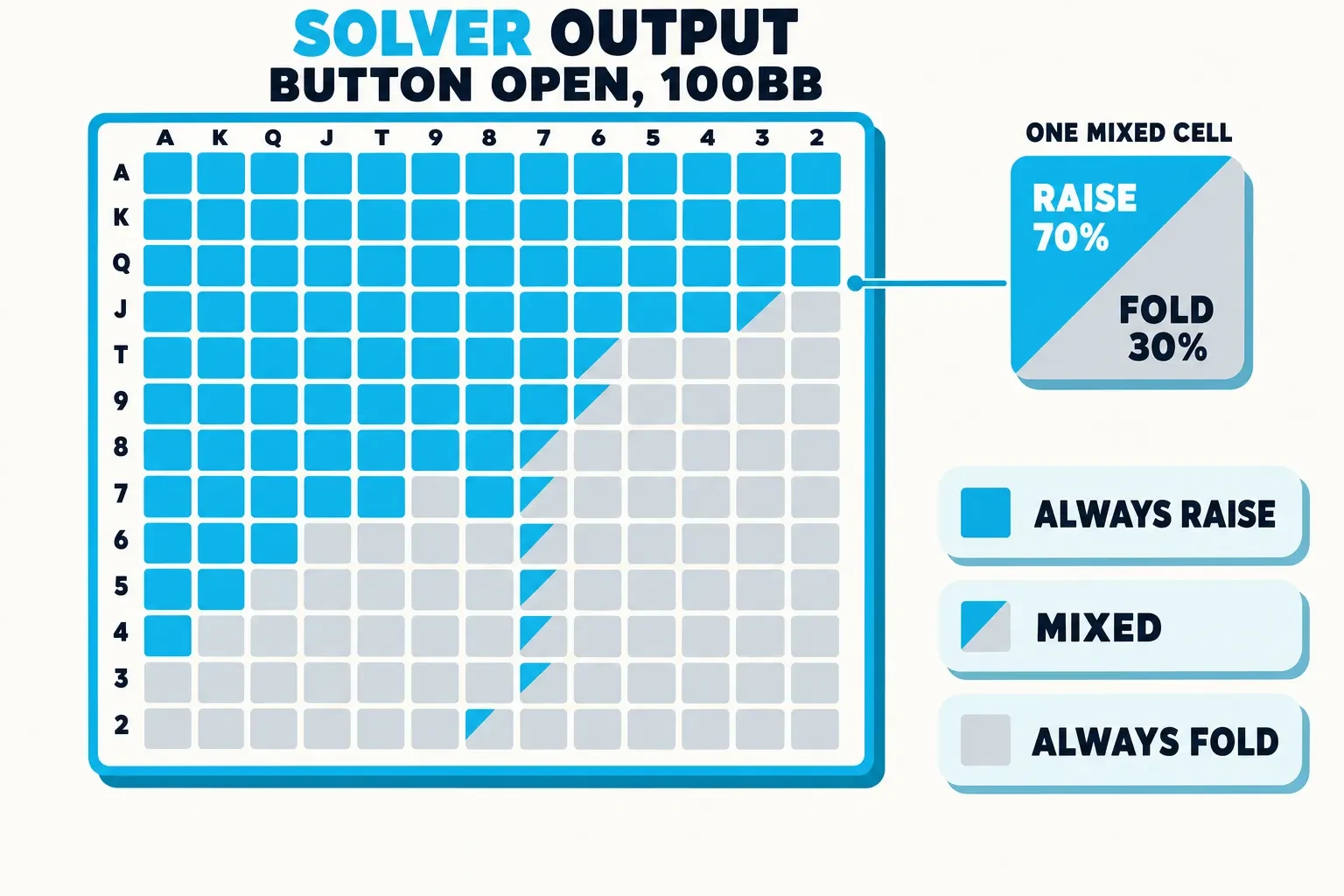
Reading it is a skill of its own. The useful question is “why does the chart say this” rather than “what does the chart say here”, because the why travels to the ten spots you will actually face tonight. Strong players study a solution, work out the logic, then compress it into a few rules they can run at speed, dropping the rare branches whose extra value costs more in mistakes than it pays. A grid you cannot compress is a grid you cannot use. A published GTO chart is somebody else’s compression of a solve, which is why charts travel further than solutions do.
To practice reading solutions before you buy a solver, we publish free solver answers for heads-up pots, each with the why in plain words.
What a trainer does that a solver will not
A poker trainer flips the loop. Instead of you interrogating a model, the tool deals you spots and demands an answer, then tells you immediately whether the decision was right and why. It is rep-based: the same muscle a musician builds with scales and an athlete builds in drills.
The feedback is the entire point. Practice only pays when the repetitions are the right ones; repeat a mistake for six months and you get better at the mistake. An hour of live poker deals about thirty hands and explains none of your decisions, while five minutes of the drills in the practice-routine article explains every one. The same drills outrun an evening of reading solver charts for the same reason: the correction lands while the decision is still warm. Trainers grade against solver-derived or GTO-informed answers under the hood, so you are absorbing the same theory, one decision at a time, in a form that survives contact with a real table.
What poker drills are, since the word covers two things: poker drills are one decision type repeated until it is automatic: pricing draws, counting outs, opening from a seat, choosing a bet size. The repetition runs the same thought process often enough that it arrives complete at the table, which memorising a chart never does. A drill with no explanation attached is repetition rather than practice, which is the difference between getting faster at a mistake and losing it. The poker practice routine is the shape of a daily drill block.
Trainer vs solver at a glance
| Trainer | Solver | |
|---|---|---|
| Core question it answers | “Was my decision right, and why?” | “What is the optimal strategy for this exact spot?” |
| What you do | Answer dealt decisions, get corrected | Define spots, read output, translate it |
| Skill required to benefit | None to start | Ranges, frequencies and patience |
| Time to first value | Minutes | Weeks of deliberate study |
| Habit it builds | Decision instincts | Theoretical understanding |
| What it costs | Free forever, with an optional Poker Skill Plus upgrade. | Nothing for open-source builds, up to several hundred euros for a desktop license |
| Who it fits | Players whose bottleneck is execution | Players whose bottleneck is knowledge |
| Where it fails | Depth: it teaches its curriculum, not your custom questions. | Transfer: knowing the chart is not playing the chart |
Neither column wins; they answer different questions. The mistake is buying the right tool for someone else’s stage of the game.
When a solver is the right buy
Solver work earns its keep when the games stop being generous. Against regulars who study, against opponents you know nothing about and every time you move up, the money starts coming from your own mistakes rather than from theirs, and equilibrium is the baseline that stops you being pulled apart. Buy one when you think in ranges already and keep hitting questions that need a solver alongside Poker Skill’s reps: how does this spot change at 60 big blinds, which bluffs does equilibrium prefer here, is my three-bet range built sanely. Those are research questions, and research instruments answer them.
The entry requirements are range fluency, review discipline and time. You have to build the tree, read frequencies without flinching and then do the translation work that turns a grid into a rule. If that sounds like your kind of study, a solver will repay it. If it sounds like a chore you would schedule and skip, it will not.
Which solver is best is the question that follows: there is no single answer, because the products solve different problems. If you want to build and solve your own trees on your own machine, PioSOLVER is the reference desktop tool for heads-up spots and its Edge edition adds preflop solving. If you would rather look up pre-solved spots in a browser and drill against them, GTO Wizard is the deepest version of that. If free matters most, TexasSolver does real solving at no cost for personal use. The best one is the one whose questions you are actually asking.
When a trainer beats a solver
Most players have the knowledge and lack the execution, and the gap between those two is where money leaks out: you know what position is worth, and you still fold a hand you meant to raise because the decision arrived faster than the thought. Nothing in a solver touches that. Reps with immediate correction do, which is why a trainer is the better buy while your bottleneck is doing rather than knowing.
The pool matters too. In soft low-stakes games, pure equilibrium play is not the most profitable strategy anyway: the immediate money comes from fixing your own recurring errors and from adjusting to opponents who make obvious ones. Both are practice problems, and reps with feedback also build the fluency any later solver session assumes you have. That is the stage a guided app like Poker Skill is built for, teaching Texas Hold’em through lessons, graded puzzle decisions and full hands in Practice vs AI.
What about GTO trainers?
The line between the two tools is blurrier than it was, because several platforms now sell both halves behind one login.
What is a GTO trainer?
A GTO trainer is a drill built on solver output. It deals you a spot, you act and it scores your action against the strategy solved for that exact node, with its stacks, its board and both ranges, instead of against a curriculum author’s opinion. What it grades you against is a balanced baseline that cannot be exploited, which is not the same thing as the most profitable line against the player in front of you.
A GTO trainer earns its price for a player who already thinks in ranges. A beginner, the player Poker Skill’s lessons start from, gets more out of feedback that explains the idea than out of a score against a frequency.
GTO Wizard is the clearest example of the shape. It runs in a browser and bundles three things: a solver of its own, hand-history analysis that flags where your play drifted from the solver’s answer and a trainer that gives instant feedback against the solution and lets you build custom drills. It also draws a line worth understanding before you buy anything in this category, between pre-solved libraries, which are ready-made answers to common spots, and custom solving, where you set the ranges, stack depths and bet sizes yourself. The first is a reference book. The second is the laboratory.
That combination fits a specific player: one who already reads range grids comfortably and wants study and reps in the same place. It is a poor first purchase for anyone who does not, because a drill scored against equilibrium still assumes you can tell why equilibrium acted that way. That is the same wall the raw solver puts in front of a beginner, moved one step later. If you want GTO without hitting that wall, our page on the best way to learn GTO poker without a solver compares five ways to study it.
Cost and effort, honestly
Solver access comes in three shapes, and the sticker price is the smaller half of the cost.
| Way in | What you get | What it costs |
|---|---|---|
| Open source | TexasSolver, an open-source Hold’em and short-deck solver you download and run on Windows, macOS or Linux | Free for personal use; your own hardware and hours |
| Subscription platform | GTO Wizard, browser-based, pre-solved libraries plus a trainer and hand-history analysis | A recurring plan; pricing varies by plan and format |
| Desktop license | PioSOLVER, a heads-up solver that runs the spots you build on your own machine, in Pro and Edge editions | Pro 450 euros and Edge 800 euros plus tax, each a purchase with a year of updates, usable on two computers |
Prices and features checked September 2026.
The rest of the bill is time. Desktop solving scales with processor cores, so the license you pick decides how long you wait: PioSOLVER’s Pro edition uses up to 16 cores, Edge up to 64 and adds preflop solving for heads-up spots. Then comes the part no product page prices, the hours spent turning grids into rules simple enough to run at the table. A trainer’s cost curve is the mirror image: near zero to start, and a ceiling set by its curriculum rather than by your patience.
Which costs more depends on the shape you buy. Trainers are usually free to use with an optional paid upgrade, while solvers can be free and open source, a subscription or a one-off license in the hundreds. The bigger difference is time: a trainer pays back in the first session, a solver after weeks of fluency-building.
One spot, both tools
Make it concrete. The spot: you defend the big blind with 9♠ 8♠, the button raiser c-bets small on K♠ 7♦ 3♠. What should you do?
The solver route: build the spot, feed it both players’ full ranges, the stack depth and the sizing menu, wait, then read output. It answers with frequencies: how often this hand folds, calls or raises at each sizing, while its neighbours in your range each get their own mix. Rich, exact and yours to interpret; extracting the transferable lesson (spade draws with backdoor equity continue against small bets) is your homework, and it takes real fluency to see it in the grid.
The trainer route: the app deals you the same class of spot cold, you choose call and it answers in one breath: correct, you have a flush draw plus a backdoor straight draw and the price is small, folding this hand to this bet would be a leak. Then it deals the next one. Less depth, instant transfer.
Multiply the difference between the two routes by a hundred spots a week and you see why the order of tools matters more than the choice: the trainer builds the fluency the solver assumes you already have. Poker Skill’s Practice vs AI puts spots like this inside full hands, heads-up or three-handed against AI opponents.
Where coaches and videos fit
The trainer-solver axis has two other stations worth placing. A human coach is the expensive hybrid: diagnosis like a review, explanation like a trainer and custom depth like a solver, priced by the hour. Coaching earns its cost when you have specific, articulate questions and the fundamentals to act on the answers, which is to say at the same stage solver study starts making sense, not before.
Videos and courses are the opposite case: cheap, rich in explanation and completely rep-free. They make excellent concept material inside a study loop and terrible primary engines, because watching someone else decide builds recognition, not reflex. A concept in a Poker Skill lesson comes with a hand you play yourself.
Do pros use solvers or trainers? Both, and away from the table. The pattern strong players describe is to study a solution, work out why it acts the way it does, then compress it into baseline ranges and a small set of rules they can run at speed, dropping rare branches whose extra value costs more in execution errors than it earns. Drilling is how those rules become automatic.
The graduation path
Run it in order. Build fundamentals with coached reps until the common spots feel boring. Somewhere in that boredom, real theoretical questions start forming, and that curiosity, not a purchase, is the sign you are ready for solver study. When you do add one, keep the trainer loop: every solver session should end by converting one insight into something you can drill, or it will be gone by the weekend. For specific tools on each side, the training-app comparison covers the current field honestly, including where Poker Skill fits.
Frequently asked questions
Do I need a solver or a trainer first?
A trainer first, for almost everyone. The mistakes that repeat every session are corrected by making the decision again with something telling you why, which is the work Poker Skill's lessons are made for. A solver answers questions you pose, which means you need questions worth posing and the range fluency to read the answer. Buy the theory tool when your leaks have stopped repeating and your questions have turned genuinely theoretical.
Are poker solvers worth it for low stakes?
Usually not as a first purchase. In soft games, the immediate money sits in fixing your own repeated mistakes and in adjusting to opponents who make obvious ones, and pure equilibrium play is not the most profitable strategy against them. Solver study starts paying when the lineup gets tougher, when you face regulars who study and when you move up.
Is there a free poker solver?
Yes, for personal use. TexasSolver is open source under the AGPL license. It runs on Windows, macOS and Linux and solves Hold'em and short deck. Free covers the software, not the work: you still build the tree, wait for the calculation and interpret the result yourself. Several training sites also publish free strategy articles, as does the Poker Skill blog, and those are a cheaper first step than any license.
Do you need a solver to get better at poker?
No, not for most of the improvement curve. The mistakes that repeat every session, loose preflop play, bad draw pricing, calling too wide, are practice problems, and feedback fixes them faster than reading does. When you face a bet in Poker Skill's Practice vs AI, Coach Max, its coach, tells you the pot odds, which is where bad draw pricing gets caught. Solvers earn their keep once those are gone and your questions turn genuinely theoretical.
What does a poker trainer actually do?
It deals you realistic decisions, makes you commit to an answer, and immediately explains why the play was right or wrong, usually grading against solver-informed strategy. The output is habits: instincts that hold up under pressure because they were built one corrected rep at a time.