
A poker training site is a subscription to a library of coaching videos and courses you watch in a browser. The right one depends on three things: the format you will actually sit through, the stakes and game you play, and whether you want a path or an archive. Four sites cover most of that ground, and none of them is us.
That last part is the reason this page exists. Comparisons like this one are usually written by someone with a course to sell or an affiliate deal riding on the answer. We build a poker practice app, not a training site, so the ranking below has no seat reserved for us and nothing to protect.
The short version
- Format beats brand. A library you never open teaches nothing, so buy the shape of study you will finish, not the biggest catalog.
- Match the content to your stakes. High-level theory is a poor first purchase for someone still tightening preflop.
- Read the billing, not the headline price. Annual plans are cheaper per month and worse if you quit in week three.
- Every site has a free layer. None of these four advertises a free trial, so the free side is the trial.
On this page
- What a poker training site is (and is not)
- How to compare training sites
- Training sites at a glance
- Best for a taught path: Upswing Lab
- Best for high-level theory: Run It Once
- Best for live and low-stakes games: Red Chip Poker
- Best free starting point: PokerCoaching
- If you want reps instead of videos
- Training sites FAQ
What a poker training site is (and is not)
A training site sells access to explanation. A coach records a hand history, a concept, or a course module, and you watch it. Most sites wrap that library in extras: preflop charts, a members-only Discord, live question sessions, sometimes quizzes. The core product is still a person talking you through poker while you sit at a desk.
Three things get mistaken for it. The difference decides where your money should go.
Trainers and practice apps hand you a decision and grade it. The teaching arrives as correction rather than as a lecture, and the sessions are minutes long instead of an evening. That is a different purchase with different terms: what a poker trainer is explains the category, and our poker training app comparison ranks the products.
Solvers compute. You define a spot, and the tool returns frequencies for the whole range. That output is a baseline to study rather than a script to copy, and turning a wall of percentages into something you can execute in thirty seconds at the table is work the solver does not do for you. Tools like GTO Wizard live on that side of the line. We wrote up the choice in trainer vs solver, and the vocabulary sits in the GTO and solver entries.
Books are the cheapest hours in poker and the only ones with no feedback at all. If that trade suits you, the beginner reading order is where to start.
Here is the awkward truth about the whole video category: watching is the weakest thing you can do with poker material. Active study, the kind where you take notes, ask a coach a question, or get tested, is worth more than working through another video. Playing acts like a test, and being tested is what makes material stick. A subscription is not knowledge. It is access to material you then have to work with.
How to compare training sites
A verdict is only as good as the standard behind it, so here is ours.
Format. Video library, guided path, or quiz-driven course. The question is not which is best in the abstract, it is which one you have ever finished. If online courses tend to die in your browser tabs after two weeks, an archive of nine thousand videos is a worse purchase than a shorter path with checkpoints.
Level and game fit. Content aimed at your actual stakes and format. For a low-stakes player the priority order is unusually settled: preflop first, then position, then simple lines that hold up under pressure. Advanced theory bought early tends to be both unnecessary and inapplicable to the game sitting in front of you.
Path or archive. Does the site publish its syllabus? A published unit-by-unit outline lets you see the ladder before you pay, and it tells you whether the site thinks in curricula or in uploads.
How the billing works. Monthly, semi-annual, annual, and what happens when you stop. Annual is the cheaper sticker per month everywhere on this page, and it is the wrong choice for anyone who has quit two subscriptions this year.
What is free. Every one of these sites publishes real material at no cost: quizzes, articles, charts, podcasts, calculators. None of the four advertises a free trial of its paid product, so that free layer is your trial. Spend a week in it before you spend anything else.
Prices and features checked September 2026.
Training sites at a glance
| Site | Format | Level | Best for |
|---|---|---|---|
| Upswing Lab | Coach-led modules with quizzes | Beginner to high stakes | A path someone else has ordered for you |
| Run It Once | Pro video library plus forums | Intermediate to high stakes | Depth of theory from working pros |
| Red Chip Poker | A to Z course, topic courses, podcast | Beginner to intermediate | Live and low-stakes cash games |
| PokerCoaching | Courses, quizzes, webinars, large free layer | Beginner to advanced | Starting free and testing yourself |
| App-based drills | Phone or browser drills that grade each answer | Beginner to advanced, by app | Reps between sessions: best poker training apps |
Those are four different jobs, plus a fifth row that is not a site at all. Prices sit in the ladder below, and each site’s own pricing page is quoted in its section. Below is what each site is genuinely good at, and who should walk past it.
What a year of study costs
Best for a taught path: Upswing Lab
Upswing sells the Lab as a route rather than a catalog. The current version, Lab 2.0, was rebuilt from the ground up by Uri Peleg, with Doug Polk and a hand-picked coaching team supplying material, and the membership bundles the module library with quizzes that give instant feedback, a preflop charts app, a members-only Discord, and live strategy sessions with the coaches.
The genuine strength is the ordering. Someone decided what you should learn second, and the quizzes make you answer before the next module rather than nodding along to it. That is the closest thing in this category to being tested, and being tested is what turns watched material into recalled material.
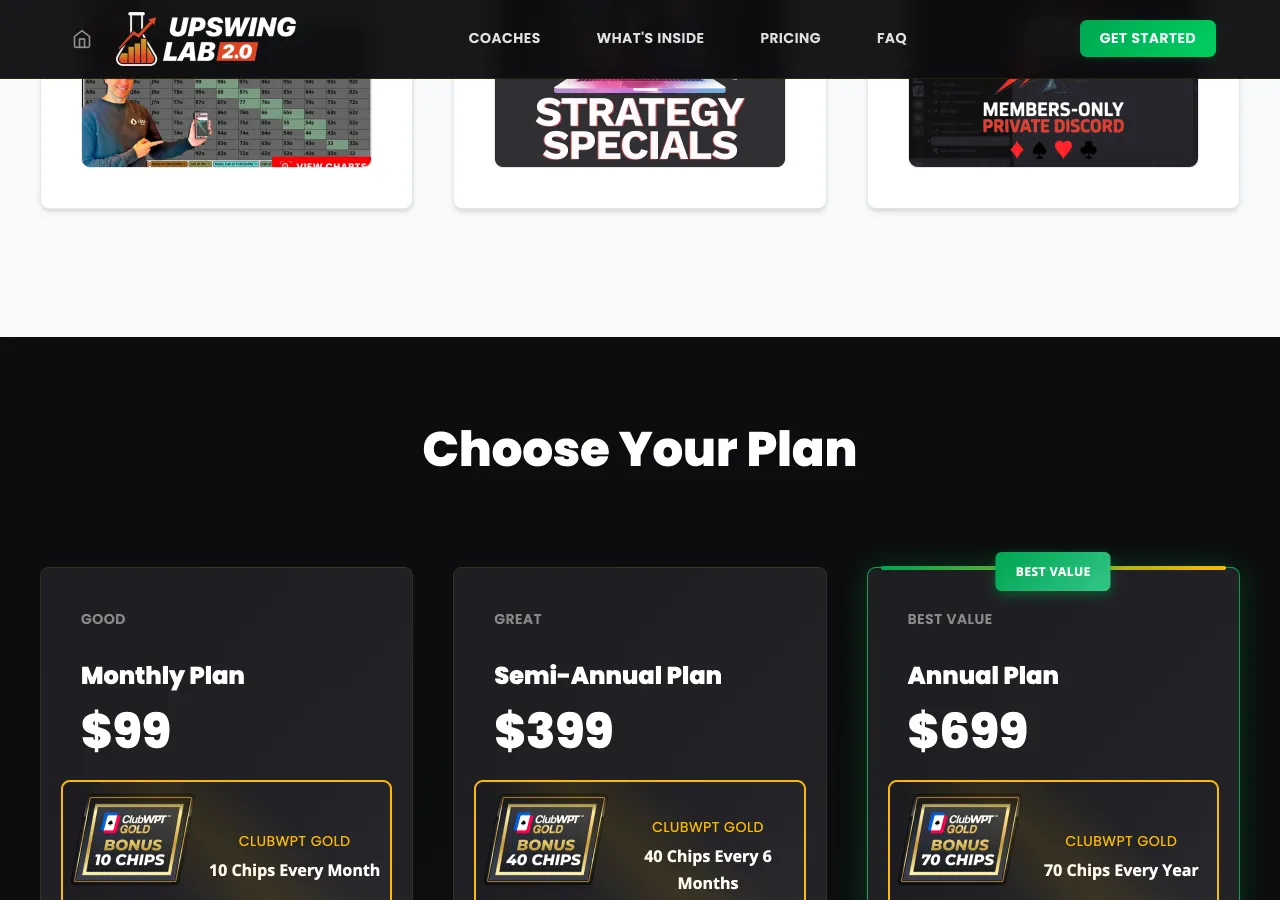
Pricing runs $99 monthly, $399 semi-annual, and $699 annual. First-time members get a 30-day satisfaction guarantee that Upswing describes as a fair-play guarantee subject to its own usage criteria, so treat it as a refund conversation, not a free trial.
Who it fits: a player who wants the curriculum decided for them and will follow it in order. Who should skip it: anyone shopping for a single spot (“how do I play a low flop in a 3-bet pot”), because you are paying for a path you do not intend to walk, and anyone whose subscriptions historically die quietly, since the annual plan is the version of this product that punishes stopping.
Compared with Poker Skill: Upswing Lab suits players who want a coach-led video course whose modules come in a set order, while Poker Skill teaches through short guided lessons with coaching on every answer.
Best for high-level theory: Run It Once
Run It Once is the deep end. The Elite tier lists a library of over 9,500 videos with two new ones added every day, produced by a roster that includes Phil Galfond, Jason Koon and Justin Bonomo, plus bootcamps, seminars, monthly question sessions with coaches, and a members-only Discord. If your question is what a top professional actually thinks about a spot, this is where the answer lives.
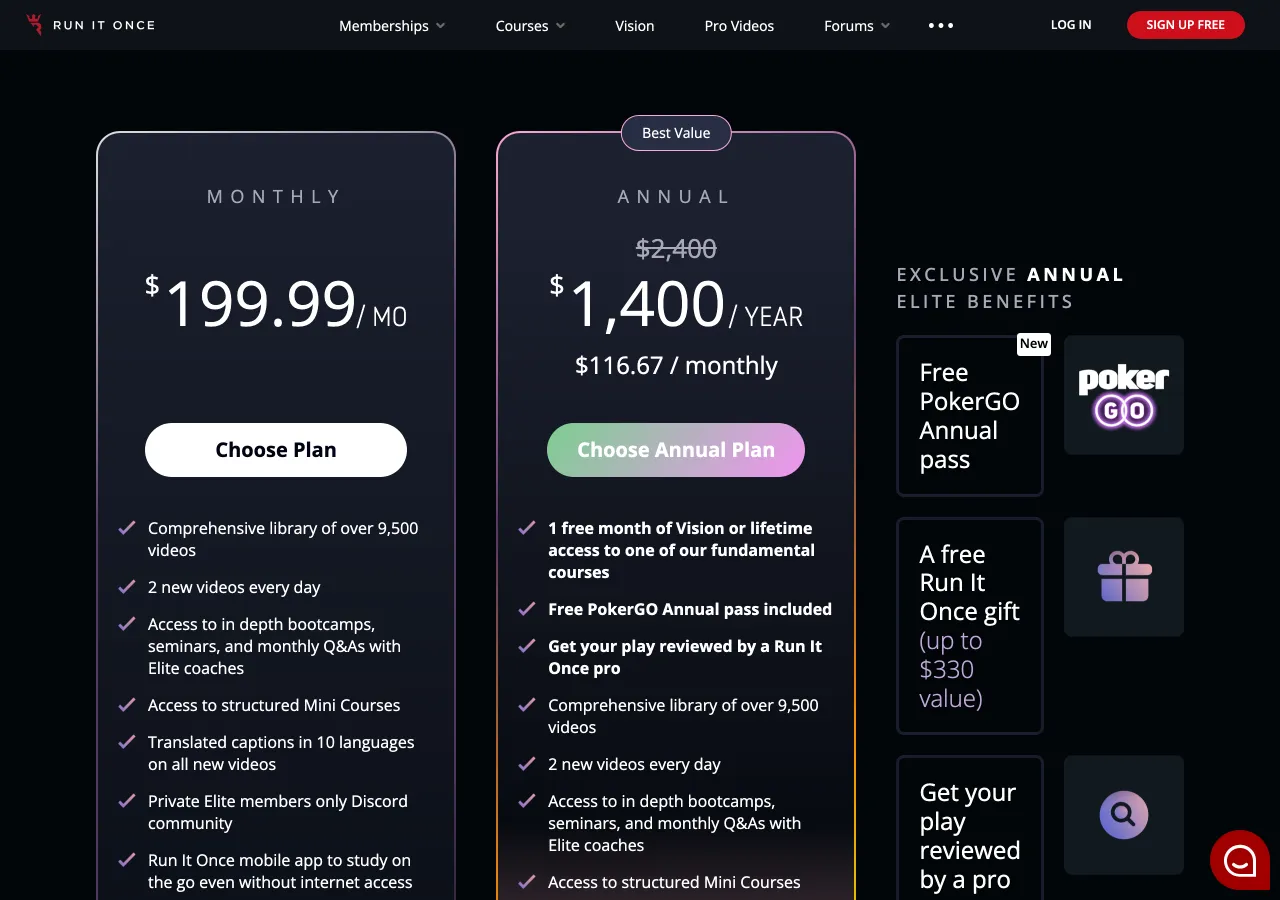
It is also the most expensive membership here: Elite is $199.99 monthly, or $1,400 for the year, which works out to $116.67 a month. The cheaper door is Essential at $24.99 monthly, with 3,713 videos, five new ones each week, and unlimited forum access. That tier is the underrated part of the site, and the forums, open even on the free BASIC account, give you somewhere to post a hand and get a real answer.
Who it fits: a player with fundamentals already in place who wants theory taught at the level above their game, and anyone who learns well by watching a strong player narrate their own decisions. Who should skip it: a beginner. Paying $199.99 a month for nosebleed theory while your preflop ranges are still guesswork is the classic way to spend a year feeling studious without moving. Start with fundamentals, then come back here when the depth is the thing you are missing.
Compared with Poker Skill: Once your fundamentals are in place, Run It Once is the better pick for high-level theory from working pros, and Poker Skill teaches those fundamentals from hand rankings up.
Best for live and low-stakes games: Red Chip Poker
Red Chip is built around the game most people reading this actually play. Its Live Cash Game Course is aimed straight at $1/$2, $2/$5 and $5/$10 tables, and its A to Z course, CORE, is written for beginner to intermediate players. The full syllabus is published on the site, unit by unit, with quizzes through its middle levels, so you can read the whole ladder before you pay for it. Being able to see what you are buying beats any sales page.
Membership is one number: PRO is $50 monthly or $495 for the year, cancel whenever, and it includes CORE along with the topic courses, ranges, and community.
The live focus matters more than it sounds. Live low-stakes poker and online poker are the same game at the level of ranges, but the practical differences are real: physical reads exist live and vanish online, online deals far more hands per hour with more aggression, and the swings that come with that volume are bigger. Material written for one and used for the other is a slow tax.
Who it fits: a live cash player at small stakes, or a newer player who wants a structured course at a price that does not need a budget meeting. Who should skip it: an online regular hunting the highest-level theory available, who will exhaust the depth here faster than at Run It Once.

Compared with Poker Skill: Red Chip Poker is the pick for small-stakes live cash games, with a full course written for them, while Poker Skill deals whole hands against AI opponents in Practice vs AI, heads-up or three-handed.
Best free starting point: PokerCoaching
Before you subscribe to anything, spend a week on PokerCoaching’s free side. The site publishes quizzes and strategy articles openly, plus downloadable preflop charts, cheat sheets, decision flowcharts, an odds calculator and e-books, and registering an account costs nothing. The quizzes are the part that tests you: you answer every hand before you see any result, and the free quiz asks for an email address before it shows your score.
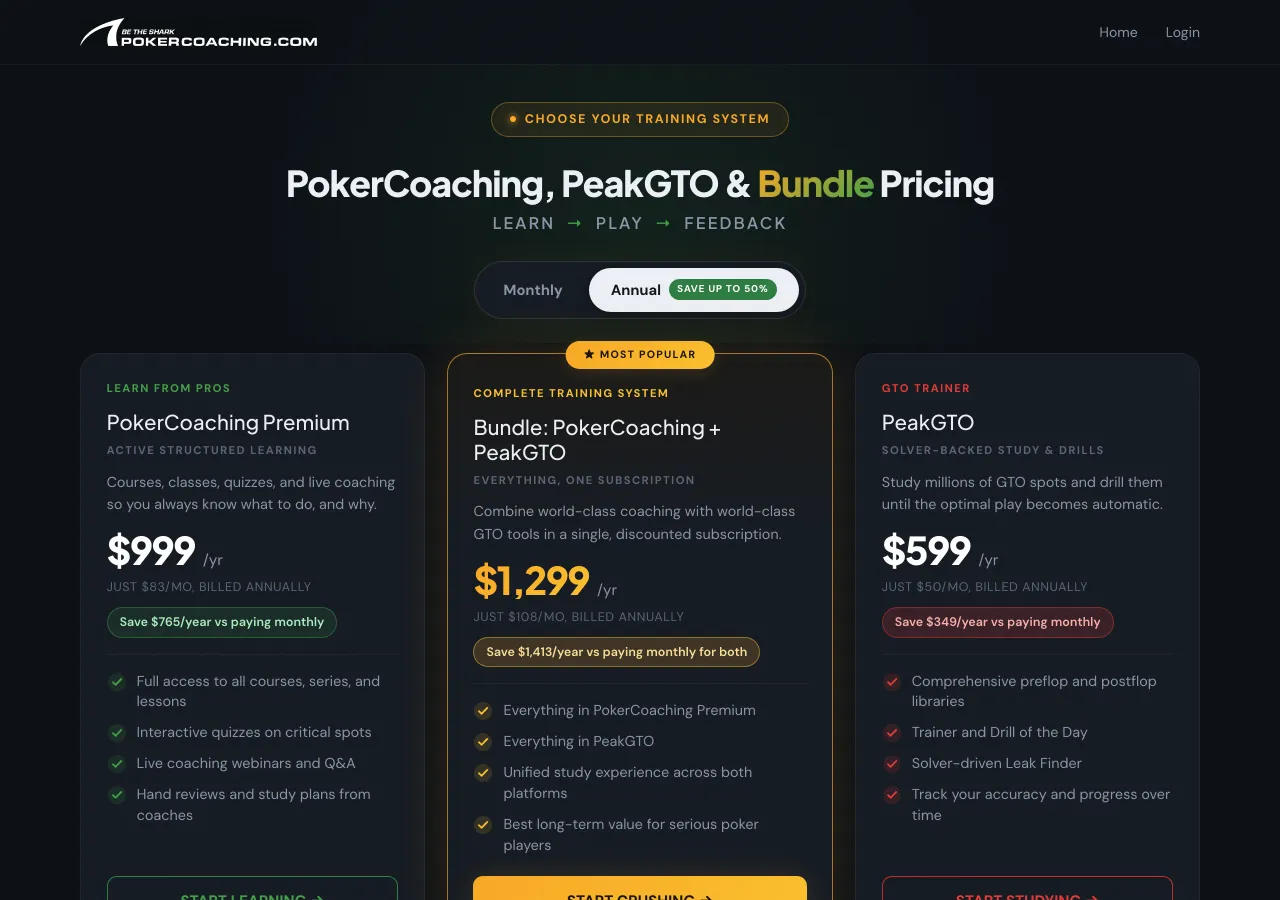
The paid ladder is where it gets expensive. Premium lists at $999 a year and covers the courses, interactive quizzes on critical spots, live coaching webinars, hand reviews and study plans from coaches. The solver side is a separate product, PeakGTO, at $599 a year, and the bundle of both is $1,299 a year. So the honest read is a large free layer attached to a coaching subscription that costs about twice Red Chip’s annual price, with the solver tools billed separately on top.
Who it fits: anyone who has not paid for training before and wants to find out how they study, and quiz-driven learners who want the coaching layer later. Who should skip the paid tier: a player who wants one flat membership covering everything, which is what Red Chip sells for well under half the bundle price.
Run It Once also has a free account and free equity calculators, and Red Chip’s podcast and article archive cost nothing. Whatever you are about to buy, the free layer is the trial you were not offered.
Compared with Poker Skill: PokerCoaching is the better pick for free study material, from quizzes and articles to preflop charts and e-books, with paid courses and live coaching behind it, while Poker Skill is a free app that explains every answer.
If you want reps instead of videos
This is our section. We make Poker Skill, which is a practice app, not a training site, and leaving ourselves out of the ranking above is the only way this comparison is worth reading.
Here is the case for the other shape of study. A video hands you an explanation. A drill hands you a decision and refuses to move until you commit, then tells you why the answer was what it was. Repetition with correction is what makes a decision automatic, and working through your own play teaches more than consuming someone else’s. Video is how you learn what a concept is. Reps are how it becomes the thing you do at 11pm on the turn without thinking.
Poker Skill is built for the second half of that. Short lessons on real decisions, a daily puzzle, and coaching on every answer including the wrong ones, free on iOS and Android with an optional upgrade, no wagering anywhere in it. What it is not: a video course library. There are no nine-thousand-video archives here and no high-stakes theory series. If you want a professional narrating a deep river spot at $5/$10, buy one of the sites above. If you want pot odds to stop being arithmetic, reps get you there faster than another lecture will, and a fifteen-minute daily routine is enough to do it.
Plenty of players end up with one of each, and that is a reasonable place to land. Just do not buy the video library expecting it to do the drilling.
Training sites FAQ
What is the best poker training site?
There is no single best one, because the four here teach in different shapes and the shape has to match how you actually study. Upswing if you want the order decided for you and quizzes that make you answer. Run It Once if you want theory from working professionals and forums to post a hand in. Red Chip if you play live or low-stakes cash and want the whole syllabus visible before you pay. PokerCoaching if you want to test yourself free before spending anything. The filter that matters is not library size: material you never work through changes nothing, whichever site sold it to you.
Best poker training sites for beginners?
For a genuine beginner, none of them yet. At small stakes the money is in preflop discipline and in pricing your draws correctly, and those get fixed by making the decision many times with something correcting you, not by watching a professional review a spot at stakes you do not play. When you do want a course, Red Chip’s CORE and PokerCoaching’s free layer are the two beginner-friendliest doors on this page. Before that, reps rather than videos will do more for the same money, which is none.
Are poker training sites worth it?
They are worth it under three conditions: you play often enough that a leak costs you real money, you will schedule the study rather than hoping it happens, and the content is aimed at the game you actually play. Fail any of those and the subscription becomes a monthly donation. The most common failure is not laziness, it is substitution: watching a coach review someone else’s hand feels like work, and it quietly replaces reviewing your own hands, which is the higher-value activity. If your study time has no structure yet, fix that first with a weekly study plan, then decide whether you need to buy more material.
What do poker training sites cost?
Across the four sites’ training memberships, monthly plans run from $24.99 to $199.99 and annual plans run from $495 to $1,400. The cheapest full membership is Red Chip at $50 a month or $495 a year, and Red Chip also sells its CORE course alone at $5 a week. The dearest training membership is Run It Once Elite at $199.99 a month or $1,400 a year, and PokerCoaching’s combined coaching and solver bundle reaches $1,299 a year. Prices and plan structures change without much notice, so check the site’s own pricing page before you buy, especially for annual terms.
Training site or training app: which one first?
If you are still building fundamentals, get the reps first. Preflop discipline, position, pot odds and hand reading are learned by making the decision many times, and they are the exact material that decides small-stakes results. Poker Skill’s lessons bring back a step you missed, so you make that decision again until it sticks. A training site earns its money later, when you have specific questions that need a coach’s explanation instead of another repetition. If it is apps you are comparing rather than sites, we ranked those separately in the poker training app comparison.