
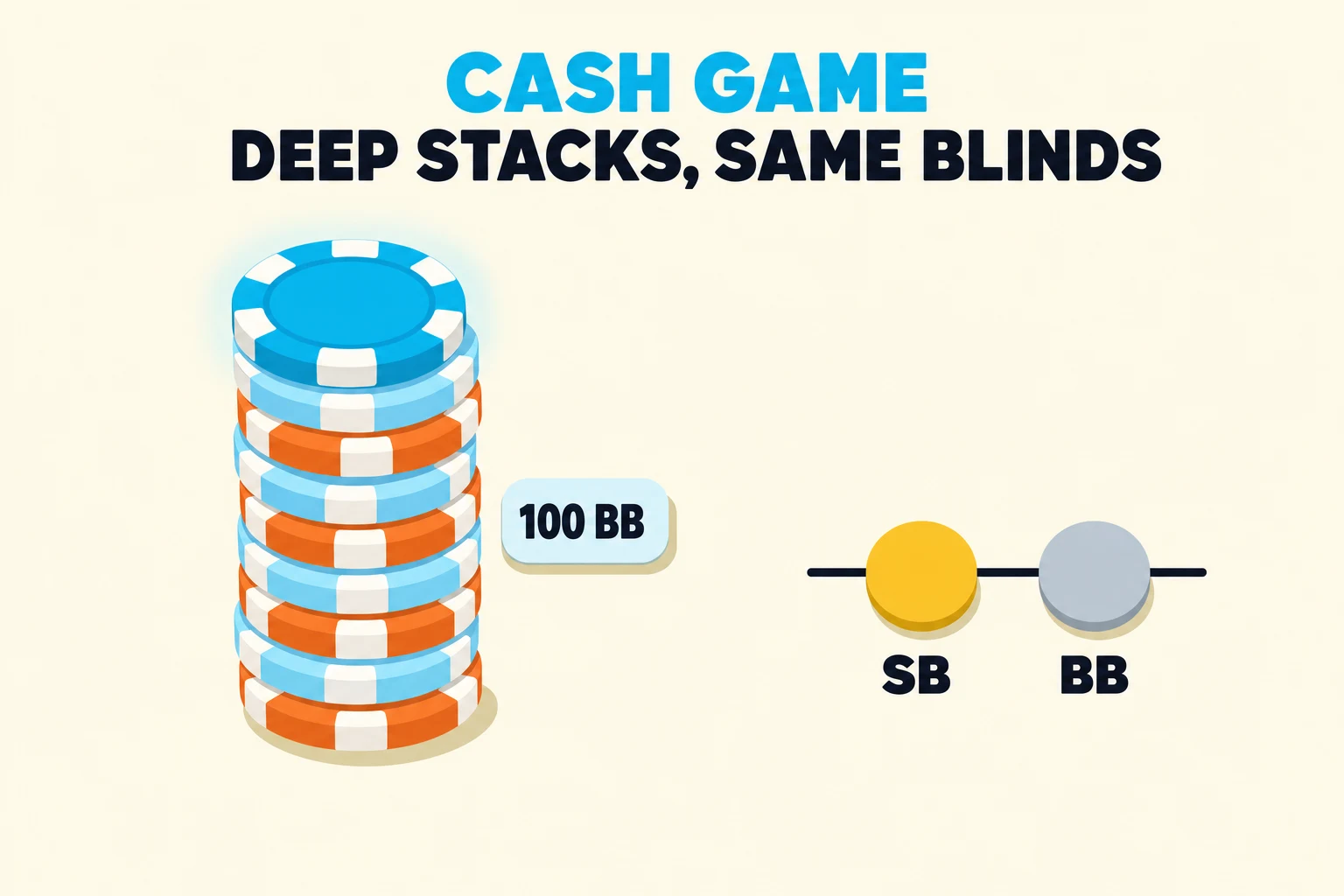
Cash game poker strategy starts with three facts about the format: your chips are money, the blinds never go up, and you can stand up or reload whenever you like. Nothing forces you to act. No clock eats your stack, no bubble taxes your calls, and busting costs a rebuy rather than your tournament. Every decision comes down to whether this particular bet, call, or fold makes money.
That freedom is why cash play rewards a different discipline than tournament poker does. What follows are the six habits that beat low-stakes games, each traced back to the format fact behind it, plus the leaks that fund everyone else’s session and one hand played the way the pillars say to play it.
The short version
- Deep stacks are the format. At 100 big blinds and more, implied odds and position matter more here than anywhere else in poker.
- Hands that can win a big pot gain value. Hands that make second-best top pairs lose it.
- The money is on the later streets, so the priciest habit in low-stakes cash is checking a hand a worse hand would have paid.
- There is no ICM tax on your calls. A close spot is a call or a fold on its own merits, nothing else.
- You picked this table for a reason. When the reason leaves, so should you.
This guide runs in order: what makes a cash game different, how depth changes which hands you play, the six pillars, a worked hand, the five common leaks, and the tournament contrast.
What makes a cash game different
A cash game is poker with the tournament structure removed, and at low stakes it is almost always no limit hold’em. Four things follow, and every pillar below comes from one of them.
Stacks are deep and stay deep. The standard buy-in is 100 big blinds and most rooms let you top back up whenever you drop below it, so you never drift toward a shove-or-fold endgame. Hands play across all four streets, which is where skill compounds.
The blinds never rise. In a tournament the clock is a second opponent that eventually forces good players into coin flips. Here the price of waiting is the same at hour six as at hour one, so patience is nearly free.
Chips are money, so chip math is the only math. Tournament chips change value near the money, which is why a tournament player folds spots that are profitable in raw equity. None of that applies here: if a call wins more than it costs, you make it.
You can leave, and you can reload. Busting a stack is a setback, not an elimination. That cuts both ways: you never play scared, and the table itself is a choice you keep making.
How 100 big blinds changes which hands you play
Depth sets every hand’s price. With 40 big blinds behind, most pots end on the flop or turn and the best hand right now wins the money. With 100 behind, the pot can grow four or five times before the river, and the hands that win it are different hands.
| Hand type | 20 to 40 big blinds | 100 big blinds and deeper | Why the value moves |
|---|---|---|---|
| Small pairs, 22 to 66 | Marginal, folded more than played | Playable when the stacks behind pay you | Set mining needs a big pot waiting on the hands you hit |
| Suited connectors, 98s to 54s | Weak, not enough room | Strong, best in position | Straights and flushes need deep stacks to cover the misses |
| Suited aces, A9s to A2s | Fine for the ace | Good for the nut flush, easy to overvalue | The nut flush gains value, the weak top pair loses it |
| Offsuit broadways, KQo to QJo | Solid opening hands | Lose ground, worst out of position | They make second-best top pairs with no flush behind them |
| Big pairs and AK | Premium | Still premium, rarely worth a full stack on one pair | One pair wins medium pots, not 200 blind pots |
The engine behind that table is implied odds: the money you expect to win after you hit. Deep stacks make that number bigger, so hands that hit rarely but hit hard get cheaper to play. It runs in reverse for the fourth row, where K-J offsuit does not miss expensively, it hits expensively. You flop top pair, get called on three streets, and the hand calling is ace-king often enough to cost a stack.
Position multiplies both effects, because more decisions remain and your opponent guesses first on every one of them. Keep this sentence if you keep nothing else: depth turns implied odds and position into the two biggest edges you have.
The six pillars of winning cash play
None of these are tips. Each falls out of a fact about the format, so they hold up when the table changes.
| Pillar | The format fact behind it |
|---|---|
| Play tight early, wide on the button | Deep stacks make position worth more, and five players act behind you under the gun |
| Value bet more than feels polite | No elimination risk, and the money lives on the turn and river |
| Check the SPR before you bloat the pot | Stack depth decides which hands can survive a big pot |
| Attack limped pots | Static blinds mean limpers give away dead money instead of defending a clock |
| Defend your big blind with a plan | Posted money changes the price, but not your position |
| Leave when your reason to sit is gone | You can quit at any time, so the table you choose is part of your strategy |
Play tight from early seats and wide on the button
At a six-seat table, open under the gun and five players can wake up with a hand behind you. Open on the button and two can. The count is why opening ranges widen as you move around the table, and why the button plays far more hands than the first seat does.
Depth sharpens it. When stacks are shallow, position matters for a decision or two. At 100 big blinds the hand runs to the river more often, and whoever acts last makes each of those decisions with more information. Under the gun your opens are for value rather than for stealing, so the range stays tight and honest. On the button you are opening to take dead money and play flops in position, so the range widens and speculative hands turn profitable. Our opening ranges guide has the seat-by-seat shape.
Value bet more than feels polite
Low-stakes cash games are full of players who call too much, and no habit costs more than failing to act on it. The priciest leak in these games is not bluffing too little. It is checking back the river with a hand that is probably best, because betting again after two calls feels like pushing your luck.
Reverse the question. Instead of asking whether you might be beaten, ask whether a worse hand can call. If the answer is yes with any regularity, bet, and pick a size that keeps those worse hands in. A value bet that is too big folds out the hands you were betting for: a smaller river bet keeps worse pairs and worse kickers in, while a near-pot bet gets called mostly by hands that already beat you. The bet sizing guide has the sizes. The habit is deciding to bet at all. Poker Skill tests that habit on the turn: K♦ T♣ on 7♦ K♣ 5♠ J♥, checked to you, bets again.
Check the SPR before you bloat the pot
Stack to pot ratio is the effective stack divided by the pot on the flop, and it tells you which hands can afford a big pot. It is set before the flop by how much money went in, so you choose it whether or not you notice.
| SPR on the flop | Where it comes from | What plays well |
|---|---|---|
| Under 5 | A raise plus two callers, or a 3-bet pot | Top pair and overpairs, happy to get the money in |
| 6 to 11 | A standard single raised pot | Top pair is good but not a stack; plan two streets, not three |
| 12 and up | Limped pots and small raises, deep | Nut potential, draws, hands that beat one pair |
The mistake this prevents is building a big pot with a hand that hates big pots. Top pair with a weak kicker at an SPR of 3 is fine to commit with; the same hand at an SPR of 12 will face two more bets it cannot call. Keep that kind of pot small on purpose, and our pot control guide covers the lines that do it.
Attack limped pots
A limp is dead money in front of a player who just announced their hand was not strong enough to raise. In a tournament, limping can be deliberate short-stack strategy. In a low-stakes cash game it is almost always weakness, and passing it up means passing up the cheapest profit at the table.
Raise, and raise big enough to matter. A useful default is four big blinds plus one more per limper, so at 1/2 with two limpers you make it 12 dollars rather than 6. That size charges them properly and usually leaves you heads up in position with the betting lead. Isolate with pairs, broadways, suited aces, and suited connectors when you have position, and tighten toward straightforward value hands when the limpers call everything. Against players who never fold, a big raise stops being a fold-them-out play and becomes a value bet, so pick the hands accordingly.
Defend your big blind with a plan, not a shrug
You already posted one big blind, so folding gives up money sitting in the pot, and you act last before the flop. Both facts make the big blind the seat where you continue most often. Neither makes every hand a call.
The price sets the width: against a small raise a wide range of suited and connected hands continues, and against a large raise that range shrinks fast. The hands that defend well make strong hands after the flop, meaning suited aces, suited connectors, pairs, and the better broadways. The hands that leak money are offsuit and disconnected: flop a weak pair, get bet at twice, fold. Out of position you will not always see the turn and river you wanted, and that gap between the equity you hold and the equity you get to use is why defending too wide costs money even at a good price. The big blind defense guide has the ranges.
Leave when your reason to sit is gone
You sat at this table for a reason, even if you never said it out loud. Two loose players were splashing around, the game was friendly, nobody was three-betting you. Whatever it was, that is your edge, and it can walk out the door at 11pm while you keep playing out of habit.
Table selection does more for your win rate than any single hand you play, because you make money from opponents’ mistakes and a table that stops making them stops paying you. Decide before you sit what ends the session: the weak players leaving, a stop time, or the moment you notice you are tired. Then honor it. The flip side matters too. Do not quit a great game because you are up; cash poker is one long session with no daily scoreboard, so when the game is good and you are sharp, keep playing.
A worked cash hand from limp to river
One hand, played by the pillars, at 1/2 with 200 dollars in front of everybody. That is 100 big blinds, the depth this guide assumes.
Preflop. Two players limp. You are on the button with A♠ Q♥ and make it 12, the four-plus-one-per-limper size from the fourth pillar. The small blind folds, the big blind calls, one limper calls, the other folds. The pot is 39 dollars with 188 behind, which puts the SPR just under 5. At that ratio, top pair with the best kicker can play for stacks without flinching, so the pot you built is the one you want.
Flop: Q♦ 7♣ 2♠. Top pair, top kicker, on a board with no flush draw and nothing closer to a straight than a backdoor. Both check. You fire a continuation bet of 20 into 39, the big blind folds, the limper calls. Pot 79, stacks 168.
Turn: T♥. The board grew a few straight draws and a queen-ten just made two pair. You bet 45 into 79 anyway, because the hands calling are still mostly worse queens, tens, and draws that pay for the privilege. He calls. Pot 169, stacks 123.
River: 3♣. The three of clubs completes nothing. Every draw the turn created just died, and he checks to you again.
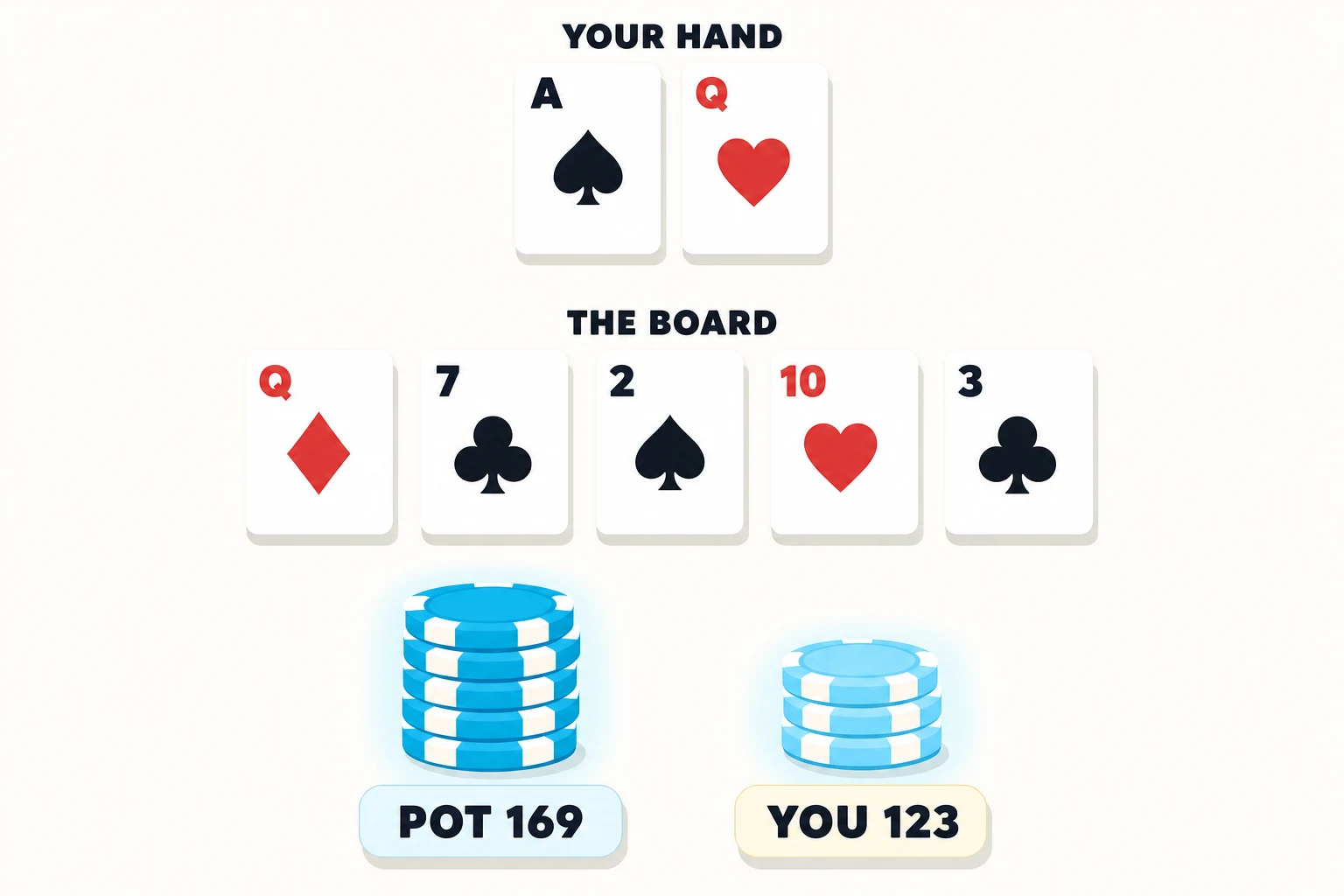
This is the decision the whole guide is about, and the popular answer is wrong. Most players check here, because a hand that called twice looks strong and a third bet feels greedy.
Bet 60. Not all of it, and not nothing. The hands beating you are sets, queen-ten, and the odd two pair, and there are few of those in the range of a player who limped, called a raise out of position, then called two more bets without raising. The hands that pay you are queens with a worse kicker, the tens that turned second pair, and the sevens that will not believe you. Sixty into 169 keeps all of them in; shoving 123 keeps in only the hands that have you beaten.
If he check-raises the river, fold. Same discipline, opposite direction: you bet because worse hands call, and you fold because his raise is not made of worse hands.
The five most common cash game leaks
Each one is the format punishing a tournament or home-game habit. The fix column names the pillar that owns it.
| Leak | What it looks like at the table | The fix |
|---|---|---|
| Playing too many hands from the wrong seats | Limping under the gun, calling raises with K-9 offsuit out of boredom | One opening list per seat, and fold or raise as the only options |
| Calling one more time instead of folding | Second pair out of position, called flop, called turn, folded river | Decide on the flop what the turn and river look like; no plan means no call |
| Never betting the river | The hand is good, he might have you beaten, checking feels safe | Ask whether a worse hand can call, then bet a size that keeps it in |
| Bloating pots with medium hands | Three-betting hands that flop one pair and then hate every big bet | Set the SPR before the flop, and keep it high with speculative hands |
| Playing past your edge | Still seated two hours after the loose players cashed out | Name the condition that ends your session before you sit down |
The middle three share one root. Deep stacks put the money on the last two streets, so any habit that avoids them hands the pot to someone whose habits do not. For the first leak, Poker Skill’s answer to 9♣ 7♦ first in from the hijack is a fold, because neither a raise nor a limp pays with a hand that thin. If you want the wider list of what to fix first, our improvement guide ranks the priorities.
No limit hold’em cash strategy versus tournaments
Same cards, two different games. Tournament chips are not money, so their value shifts as players bust and pay jumps approach, which creates the bubble, laddering, and folds that look nonsensical to a cash player. Cash chips are money at all times, so a spot that wins chips wins dollars.
Structure does the rest. Tournament blinds climb until stacks are 20 or 30 big blinds and most decisions happen before the flop. Cash stacks reset to 100 whenever you want, so postflop skill has room to matter instead of getting squeezed out. Tournaments reward stealing, surviving, and pay-jump pressure; cash rewards hand selection, position, and value from opponents who call too much. Do not carry tournament caution into a cash game, and do not carry cash aggression onto a bubble. Our tournament strategy guide covers the other side of that line phase by phase.
Drill the pillar decisions
Reading a pillar and executing it under pressure are different skills, and the second comes only from reps. These decisions are small and repeatable: raise or fold from this seat, bet or check this river, defend or release this big blind. Working through those spots with the reason attached to every answer builds the reflex faster than waiting for one to appear twice a month in your own sessions. That is what our free decision practice is for, with play chips and graded feedback instead of a bankroll, and our study plan covers the weekly version.
Frequently asked questions
What is the best strategy for live low stakes cash games?
Play a tight, straightforward range, raise big against limpers, and get paid by people who call too much. Live 1/2 and 1/3 games are full of players who limp in, call raises with weak hands, then call you down with second pair. Value betting is the most profitable habit available in those games, and bluffing the most overrated. Fold what flops second best, and bet three streets when you have it.
How many buy-ins should you have for cash games?
Treat that as a variance question rather than a shopping list. Even a solid winning player can run 20 buy-ins below expectation across tens of thousands of hands, so a swing of several buy-ins tells you nothing about how well you are playing. Short stretches are the worst feedback signal in poker, so serious players judge themselves on decisions rather than on today’s number. Poker Skill is play money and teaching, so the practical version is simple: never let a losing stretch talk you out of a strategy that was sound.
Should a beginner start with cash games or tournaments?
Start with cash games if your goal is to understand poker. Stacks stay deep, the blinds never chase you into a shove, and you play the same 100 big blind decisions until the patterns stick, which is the postflop skill everything else is built on. Tournaments teach a narrower set: short-stack shoving, pay-jump pressure, and a structure that changes every 20 minutes. Both are worth learning, but cash is the faster route to the fundamentals. If you are still weighing it up, which format should you learn first walks through the trade-offs in full, including the single-table middle path.