
A poker practice app is worth your phone storage when it hands you a decision, makes you commit to an answer, and then tells you why that answer was right or wrong. Four apps clear that bar, each for a different kind of rep: Poker Skill for guided practice with coaching, Postflop+ for solver-graded postflop drills, PokerTrainer for free drills you can start in a browser, and Preflop+ for the math itself.
We make the first one. So it gets measured against the same five criteria as the other three, with its limits written down where you can read them.
The reason this page exists at all: most software sold as poker practice is unlimited play-money hands at a table where nobody folds. That is volume, and volume is not practice. The difference is checkable before you download anything.
The short version
- A rep is a decision you commit to plus feedback that explains. Hands played without either are just hands played.
- Judge any practice app by feedback per rep, not by how many hands it can deal you.
- Play-money tables teach the mechanics honestly and the opponents dishonestly. Nothing is at stake, so nobody folds, and the reads you build there do not survive contact with players who care.
- Four picks, four jobs: coaching on every answer (Poker Skill), solver-graded postflop spots (Postflop+), free browser drills (PokerTrainer), poker math reps (Preflop+).
- Every pick has a free path you can test tonight. All four stop being free once you practice seriously, and the table below says where.
Jump to the five checks, the comparison table, or straight to a pick: Poker Skill, Postflop+, PokerTrainer, Preflop+.
What is the best way to practice poker?
The best way to practice poker is a decision you commit to, followed by something that tells you why the answer was right or wrong. Reps that get corrected move a game; hands dealt with nothing correcting you mostly rehearse whatever you already do, which is why a night of play-money volume can leave a player exactly where they started. The Daily Puzzle in Poker Skill keeps that order: you pick an action first, and then it grades every option. Free tables still earn their keep for the mechanics, hand strength and the shape of a hand, and they are honest about none of that costing anything. For the shape of a practice session, the poker practice routine splits fifteen minutes into drills, one reviewed hand and one concept. For which app supplies those reps, stay here.
Looking for the trainer category, or a full training suite?
If your question is what a poker trainer actually is and whether you need one at all, start with what a poker trainer is and how one works. If you already know and you want the broader product comparison rather than a practice habit, the training app comparison covers those. And if this is your first poker app and you want to learn the game rather than drill it, the checklist for picking a first app is the faster route. If what you are weighing is a subscription course library rather than an app, poker training sites compares those by study style.
This page is the narrow one: which app gives you practice reps that teach something.
What counts as real practice in a poker app
One rep is a spot, a commitment, and a graded answer with a reason attached. Drop any of the three and the rep stops working. A spot with no commitment is a demo you nod along to. A commitment with no reason is a coin flip you get graded on. And a reason that arrives before you answer is just reading.
Here is what a working rep feels like. The pot is 100, your opponent bets 50 on the flop, and you hold a flush draw. Calling 50 into a 200 final pot means you need roughly 25 percent equity to break even, which is the whole of pot odds in one line. Nine outs gives you about 19 percent on the next card alone, and about 35 percent if you get to see both. So the call is not automatic: it depends on whether more money goes in on the turn, and on what your opponent does with the rest of their range. An app that answers “correct” has taught you nothing you can carry to the next hand. An app that says the price asked for 25 percent and one card gives you 19 has taught you a rule you will use for the rest of your life. Coach Max, the coach in Poker Skill’s Practice vs AI, quotes that price on some call-or-fold decisions during full hands against AI opponents.
Now the trap. A play-money table costs nothing to lose, so players enter almost every pot regardless of how bad the call is, and the games run unrealistically loose from the first hand. That makes them genuinely useful for learning the mechanics, the hand ladder, and the shape of a betting round, which is real value for a beginner. It also makes them a poor place to practice decisions, because the opponent behaving unrealistically is the one your decision is aimed at. Your bluffs never work. Your loose calls get paid all night. You leave with habits you then spend money unlearning.
So the test to run before you download anything: how many decisions will this give me in five minutes, and does anything explain the answer. Everything below is that question, applied.
How we judge a practice app
Five checks, applied to every app below including ours. They are practice-specific: this is not a list of what makes good poker software in general, it is what makes reps worth doing.
| What we check | What good looks like | Why it decides the download |
|---|---|---|
| Rep types | Named drill families you can choose between: preflop decisions, counting outs and pricing them, estimating equity, reading a betting line | Different reps build different skills. An app with one rep type trains one thing, whatever its store page suggests |
| Feedback per rep | Every answer comes back with a reason, not only a verdict | The reason is the part you keep. Right or wrong is a result, and results are noisy |
| Progression | Spots get harder, or the app tracks your accuracy well enough for you to aim the next session | Practice that never moves becomes a routine you already pass |
| Free tier honesty | You can run the loop end to end before paying, and the listing says where the wall stands | All four are free to download. Free to download and free to practice are different claims |
| No gambling | No wagering, no real-money loop, no chips for sale | Practice should cost attention. A purchase loop changes what the app is built to optimize |
Prices and features checked September 2026.
The rep-types row carries more weight than it looks. Poker study has always been split into a few distinct exercises, and each one builds something different: working through opening ranges by seat builds a positional baseline and the habit of thinking in ranges rather than single hands; counting outs and turning them into a price builds draw judgment; estimating equity hand against range puts numbers under decisions that otherwise run on feel; and reconstructing a betting line teaches you to narrow an opponent to a range, which is the skill experienced players actually use instead of guessing an exact holding. An app that only drills one of those is not a bad app. It is a partial one, and knowing which part you are buying is the point of the table below.
Poker practice apps at a glance
| App | Best for | The reps | What the feedback tells you | Free path | Runs on |
|---|---|---|---|---|---|
| Poker Skill | Guided practice with coaching | Short lessons built on real decisions, plus a daily puzzle | A written explanation on every answer, right or wrong | Free forever, upgrade optional | iOS, Android |
| Postflop+ | Solver-graded postflop drills | Pre-solved postflop spots across cash, tournaments, Spin and Go, heads-up | Exact frequencies, sizings, and the EV cost of your mistake | Free to download, then $14.99 a month | iOS, Android |
| PokerTrainer | Free drills you can start in a browser | Preflop, postflop, odds, hand ranking and best-hand drills, with full hands, equity and EV in the browser | Right or wrong with a running score, plus the range chart and a short reason on a mistake | Free with a daily hand limit, then $14.99 a month in the app | Browser, iOS, Android |
| Preflop+ | Poker math reps | Pot odds, equity estimation, combinatorics, push or fold | The number behind the decision, EV included | Free to download, paid tiers beyond that | iOS, Android |
Four apps, four jobs. Pick by the rep you are short of, not by the longest feature list.
Best for guided practice with coaching: Poker Skill
This one is ours, so it goes first and it gets the same five checks. Poker Skill runs short guided lessons built around real decisions, plus a daily puzzle, and every answer gets a coaching explanation that says why a play works rather than whether you guessed it. That is the whole product thesis: feedback per rep, on purpose. There is no wagering and no real money anywhere in it.
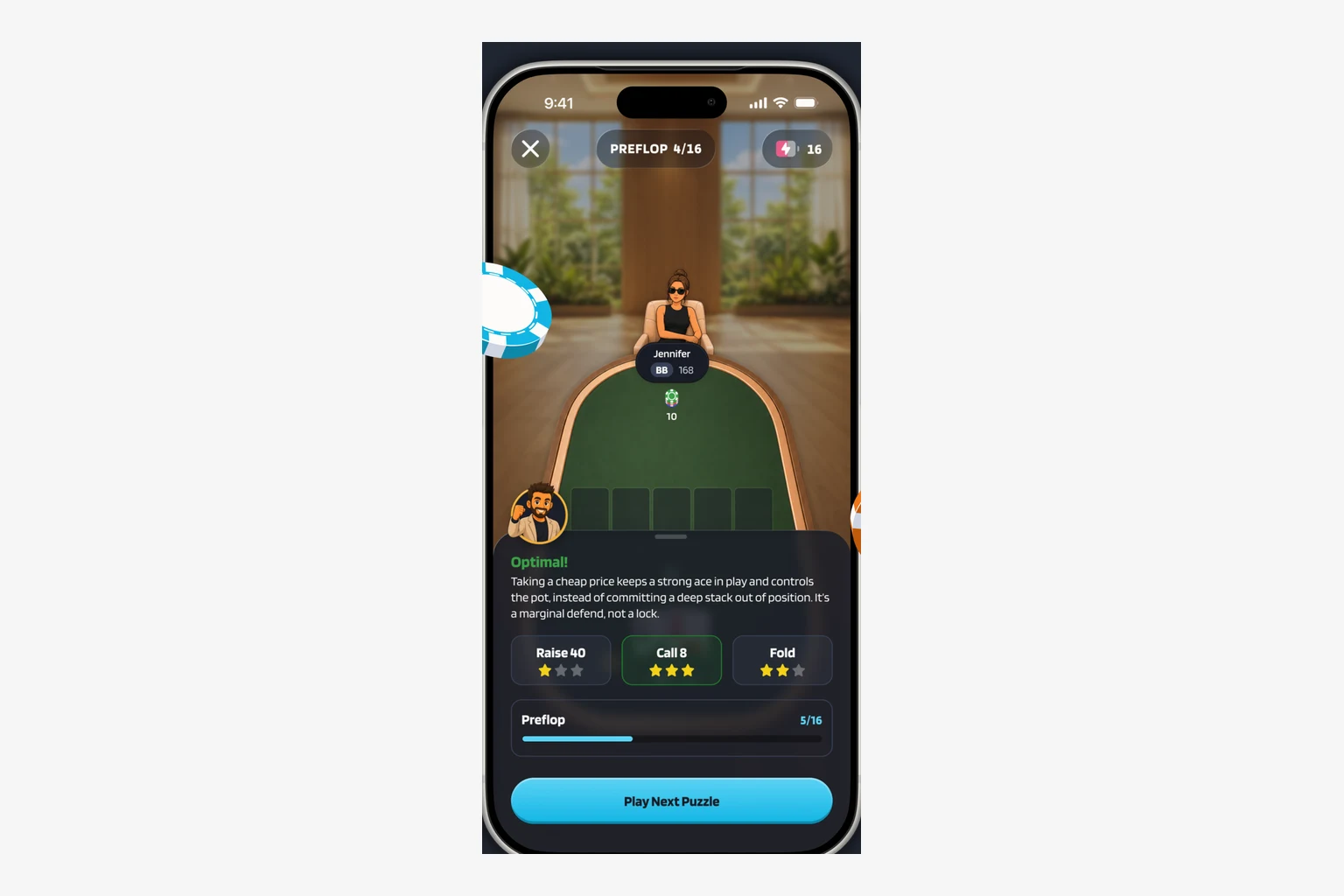
Who it fits: beginners and returning players who still guess more often than they decide, and anyone who wants the lessons in an order instead of a pile. Who it does not fit, plainly: solver-fluent players, who will find the explanations cover ground they finished years ago. It teaches Texas Hold’em and nothing else, so Omaha and stud players are in the wrong shop. And the free tier is free forever, not a trial: Poker Skill is free to use for as long as you want it, and Poker Skill Plus is the optional upgrade, which lifts the cap on play. The free tier does carry a daily cap. PokerTrainer’s free tier caps your hands each day, and a play-money table has no cap at all but explains nothing.
Best for solver-graded postflop drills: Postflop+
Postflop+ downloads pre-solved spots to your phone and lets you drill postflop decisions with no connection at all, across cash games, tournaments, Spin and Go and heads-up. The feedback is the reason it is here: beyond a verdict, you get the exact frequencies, the sizings and the expected value your line gave up, which is the tightest feedback loop on this list for postflop play.
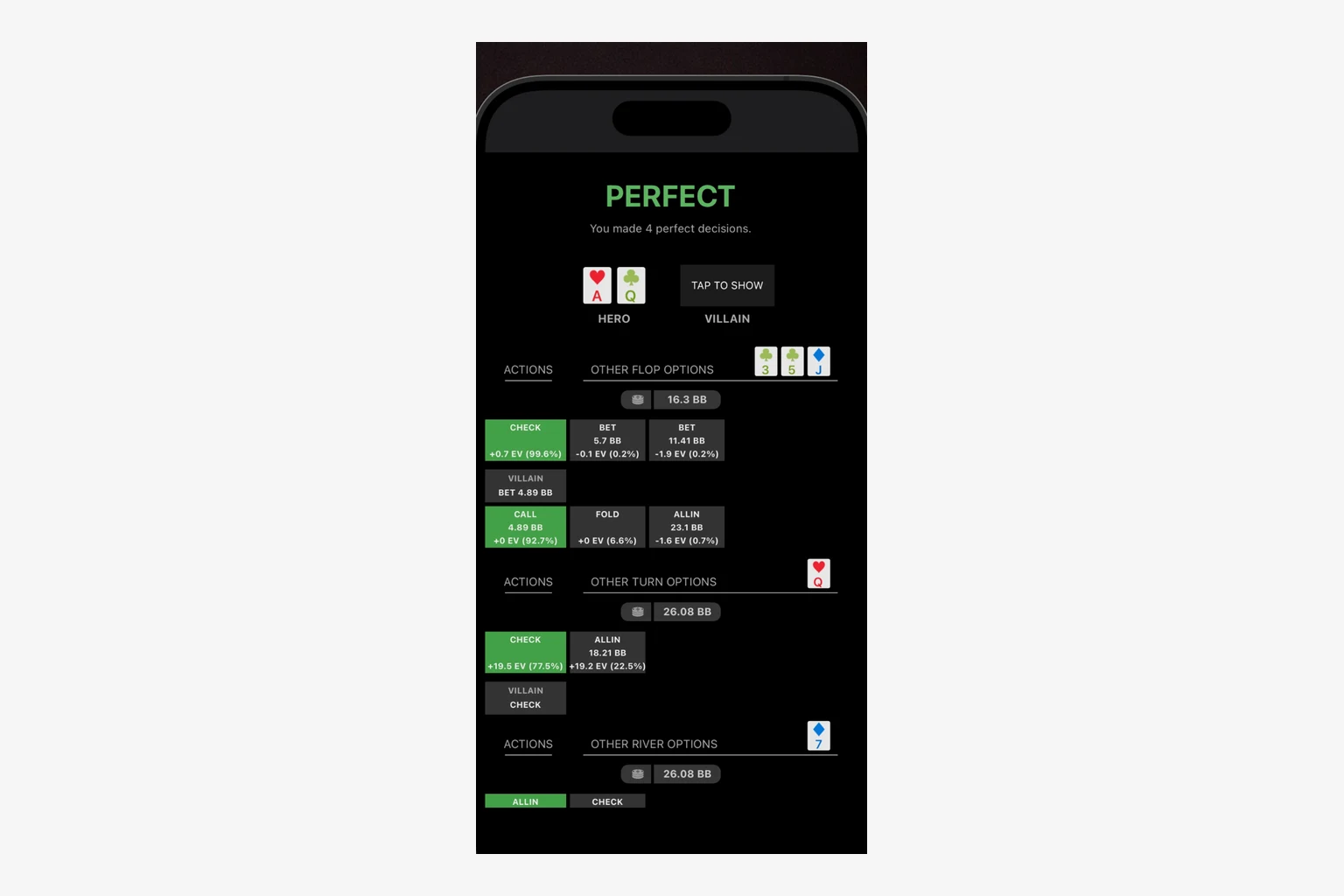
Who it fits: players who already think in ranges and want reps against solver answers on a commute, in a hotel, or between tournament levels. Who it does not fit: anyone still learning. Solver output grades you against equilibrium without teaching the idea underneath, and a new player pointed at a frequency table mostly learns that poker looks frightening. It also keeps its own rating so you can see progress, which is more than most drills offer. The app is free to download on both stores, with free drills in every game type each day and a subscription at $14.99 a month after that, and the listing does not say how many free drills you get, so treat the subscription as the likely cost of sticking with it. If solver tools are the actual question you are asking, trainer versus solver is the page for it.
Compared with Poker Skill: Postflop+ is the better pick for drilling postflop spots against solver answers, while Poker Skill teaches players who are still learning, in short guided lessons.
Best free drills you can start in a browser: PokerTrainer
PokerTrainer (pokertrainer.se) is the modest one, and that is exactly its value. The phone apps run five exercises: preflop decisions, postflop hand reading with live equity, odds, hand ranking and picking the best hand of three. Every exercise is free to use, with a daily limit on free hands, which makes it the only pick on this page where you can practice properly tonight without installing or paying anything. Premium is $14.99 a month as an in-app purchase, or $89.99 a year or $269 for life by card in the browser, and the account carries across up to three devices.
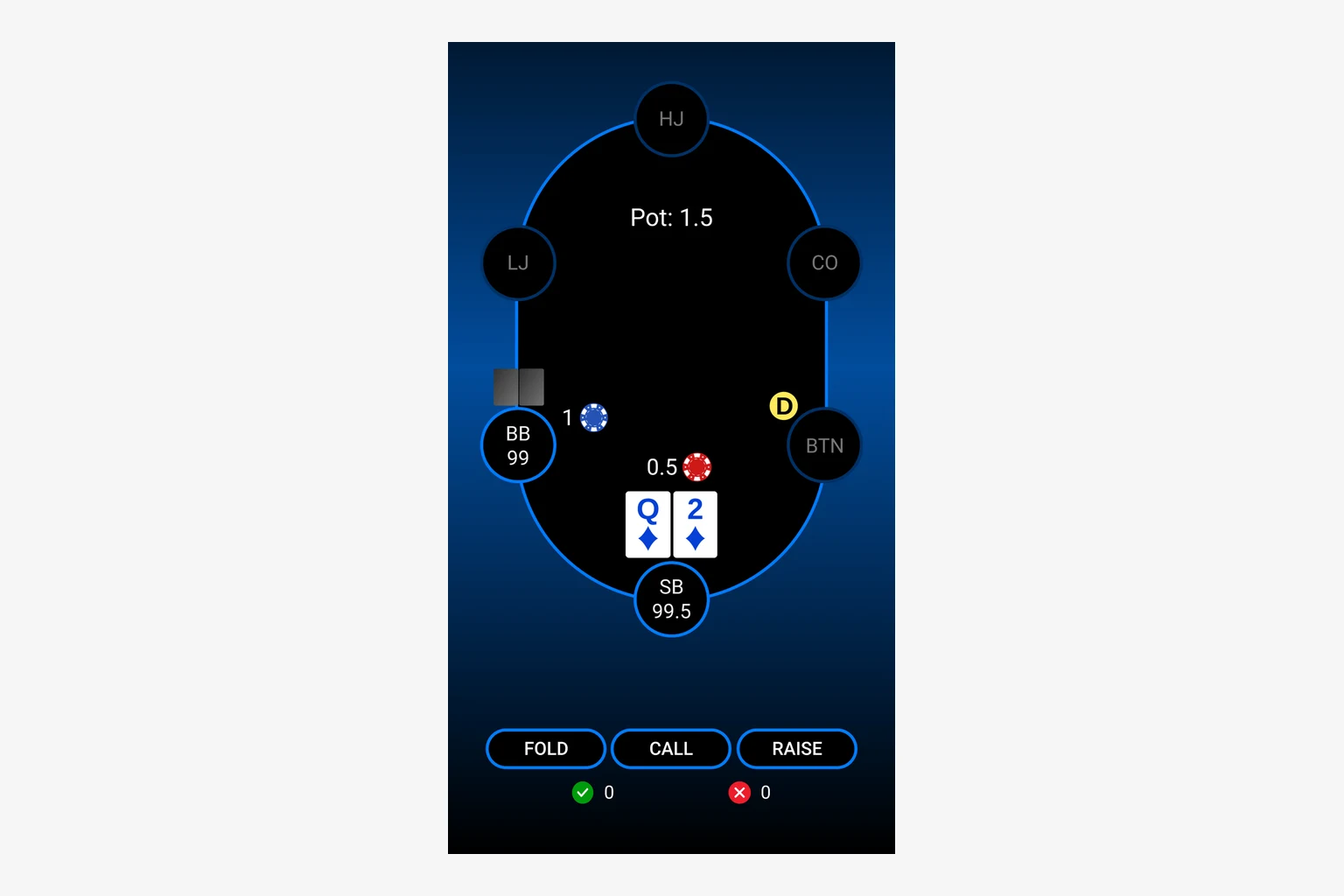
It suits anyone who wants zero-commitment reps on fundamentals, and coaches who need a free drill to hand a student. The breadth is genuinely good for a free tool, and the hand-ranking and best-hand exercises are the fastest way to make showdown reading automatic. Who it does not fit: players who want the reasoning built out. The exercises tell you what was right, keep score and give a short reason with the range chart when you miss; the fuller understanding is left to you. And the free hands are capped daily, so sustained volume eventually means paying, same as everywhere else. It runs no real-money games at all, which is the point.
Compared with Poker Skill: For free drills you can start tonight in a browser, PokerTrainer is the better pick, and by default it gives a short written reason only after a mistake, while Poker Skill explains every answer, right or wrong.
Best for poker math reps: Preflop+
Preflop+ is the one whose drills are the arithmetic itself. Alongside Nash push-fold charts and a set of calculators, it ships a pot odds trainer, equity drills for estimating your share of the pot under time pressure, and a combinatorics trainer for counting combos and blockers. Those are the reps nearly every other app skips, and they are the ones that pay off fastest in a live game where nobody waits while you do long division. Everything works offline.
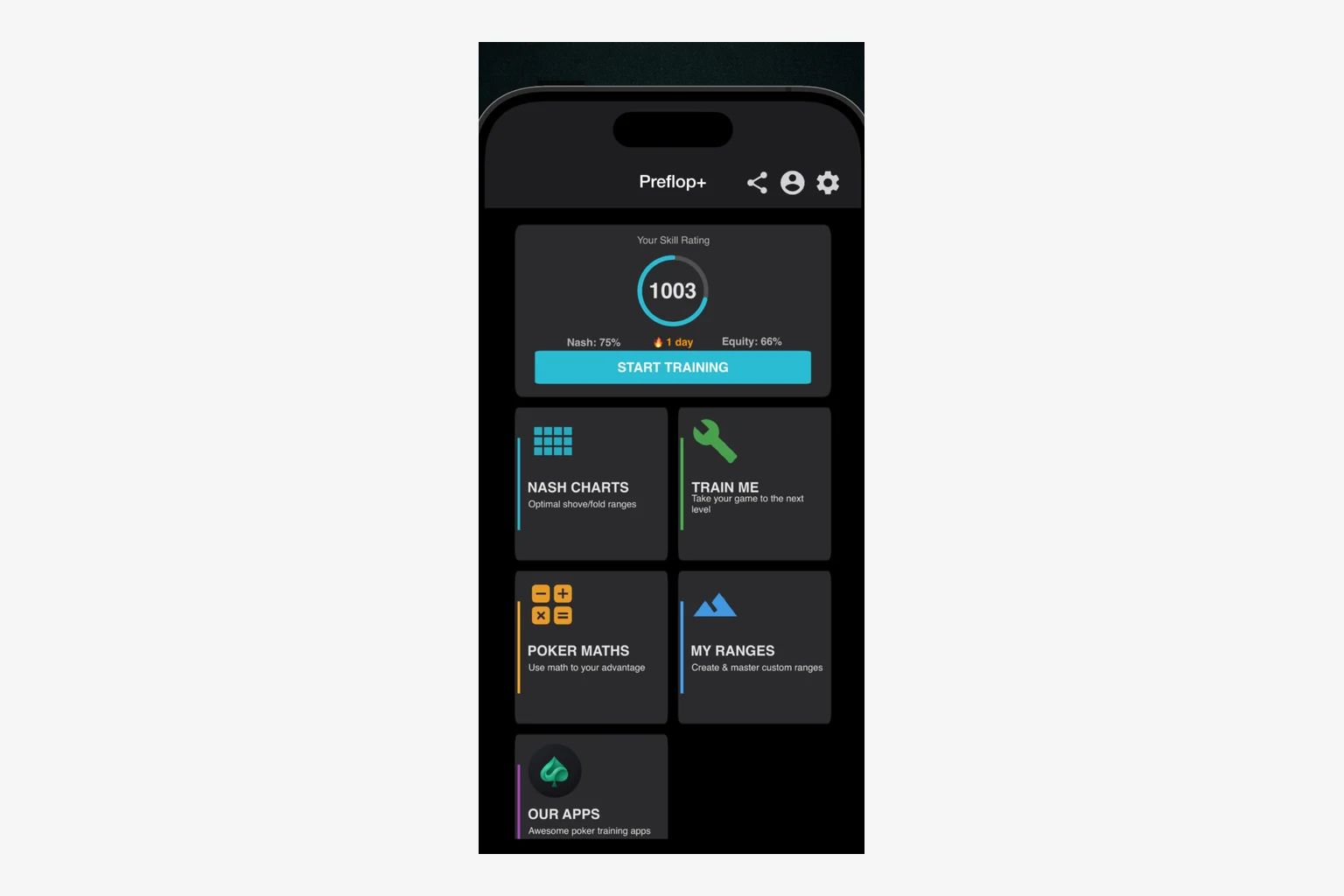
It is built for tournament players working short-stack decisions, and for live players who want their pricing instant rather than approximate. It is the wrong tool for practicing whole hands: a large part of the app is reference material, charts and calculators you look things up in, and reference is not a rep. Its center of gravity is preflop and short stacks, so a cash player grinding deep postflop spots will use half of it. Free to download on both stores, with paid tiers after that.
Compared with Poker Skill: Preflop+ goes further on poker math, drilling pot odds, equity, combos and push-fold spots on their own, while Poker Skill teaches counting outs in its lessons and deals whole hands against AI opponents in Practice vs AI.
How to practice poker by yourself
You do not need an app for any of this, and the apps only help if the session has a shape. Pick one rep family for the week rather than sampling all four. Commit to an answer out loud before you look at any explanation, because the commitment is what makes the feedback stick. Then write one sentence about the rep you got wrong, and read it before the next session.
Frequency beats duration, and no honest source will hand you a minute count, because the number that matters is how many decisions you made with the feedback actually read. Two rules survive everywhere: practice supports table time rather than replacing it, and active work, notes and questions and reviewed hands, beats reading or watching.
The daily shape that works for most people is in the 15-minute practice routine, which splits the session between drills, one reviewed hand, and one concept. Without an app, the same loop runs with a deck and a notebook: deal yourself a hand and a flop, count your outs, say the price the pot is offering, then check yourself. It is slower than a drill screen, and it works.
Practice app FAQ
What is the best app to practice poker?
The one that matches the rep you are missing. Guided practice with an explanation on every answer: Poker Skill, ours. Solver-graded postflop spots: Postflop+. Free drills with no download: PokerTrainer. Pot odds, equity and combos: Preflop+. The comparison table is the two-minute version of that answer, and any of the four is a better use of an evening than another play-money session.
Is there a free poker practice app?
Yes, more than one, and they are free in different ways. Every exercise on the browser pick above is free to use with a daily limit on hands. The two solver-side apps are free to download with paid tiers after that. Ours is free to use, with a cap on how much you play in a day, and the daily puzzle costs nothing. None of them asks for a deposit, because none of them is a real-money game. The test that sorts them is the one this page opened with: get a spot wrong on purpose and see whether the free version explains it.
How can I practice poker for free?
Two free routes, and they teach different things. Free drills hand you a decision and then explain it, which is the route the picks above cover. Free tables give you unlimited hands and no explanation at all, which makes them fine for learning the mechanics and close to useless for learning how opponents behave, because nothing is at stake for anyone. If you want the drill route with no money involved anywhere, poker decision practice is the shortest way in, and it costs nothing to try tonight.
Can you practice poker without money?
Yes, and without gambling at all. Every app on this page runs on practice hands rather than wagering, so nothing here asks for a deposit and nothing pays out. That is a different thing from play-money poker rooms, where free chips buy you a seat at a table nobody folds at. If you want the free-practice route in one place, our poker decision practice page is the shortest path into drills that answer back.
How much should I practice poker?
Short and regular beats long and occasional. The measure that matters is not minutes on a timer, it is how many decisions you faced and whether you read the explanation for the ones you got wrong. A few focused reps most days plus one hand reviewed after each session you play will move a game; fifteen minutes is a realistic daily floor for someone with a job, and the practice routine breaks that quarter hour into three blocks. Poker Skill’s Daily Puzzle is one of those reps, a new spot each morning.