


A poker variance calculator went around in July 2026 and produced, within hours, the most useful confusion of the week. A player ran their own numbers and posted this:
“That poker variance calculator has me questioning my 20BI downswing. Says it’s a .1% chance but I’ve had this a couple times so something seems wrong. Maybe it’s my win rate during those downswings?”
That last sentence is the right instinct, and almost nobody follows it far enough. Follow it and you end up somewhere more useful than “run good, run bad.”
What a variance calculator actually knows
It knows three numbers, and you typed all of them.
A variance calculator takes a win rate, a standard deviation, and a sample size. From those it produces a distribution of possible outcomes and reports where your result sits inside it. It has no access to your hand histories, your game selection, your table, or the stretch you are actually asking about. Every probability it returns is a statement about the model you described, not about you.
So when the answer disagrees with your experience, there are only three candidate explanations:
- You got very unlucky.
- Your memory of what happened is wrong.
- One of the numbers you typed is wrong.
Most players stop at the first one, because it feels like the humble answer. It is usually the least likely of the three, and you can check that with arithmetic.
Checking the unlucky explanation
Say the calculator is right that a stretch like yours is a 0.1% event over a given sample of hands, and say you have played 20 separate samples of that size across your career. What is the chance you hit one of them?
Chance of avoiding it in one sample: 0.999 Chance of avoiding it in all twenty: 0.999^20 = 0.9802 Chance of hitting it at least once: 1 minus 0.9802 = 2.0%
So one occurrence is unusual but nothing exotic. Careers are long and rare things happen inside them.
Now the actual claim, which was two occurrences:
Chance of exactly one: 20 × 0.001 × 0.999^19 = 0.0196 Chance of two or more: 1 minus 0.9802 minus 0.0196 = 0.019%, or roughly 1 in 5,300
That calculation treats the twenty samples as independent, which is generous to the unlucky explanation, since real overlapping stretches are correlated in ways that make repeat clusters somewhat more likely than the clean binomial suggests. Even with the arithmetic tilted in its favor, “I got unlucky twice” comes out at around 1 in 5,000.
Which means explanation three is doing the work. One of your inputs is wrong.
The input that is usually wrong
It is almost always the win rate, and the reason is circular in a way that is worth sitting with.
Your win rate is not a fact you look up. It is an estimate you computed from your own results, and it inherits every weakness of the sample it came from. Short samples are dominated by variance rather than edge. The larger the sample, the more the noise averages out; the smaller the sample, the more the number you are holding is mostly noise wearing a decimal point.
This is not a small effect. Modern Poker Theory makes the point with tournaments: even after 2,000 of them, results can still sit a long way from expectation. Cash samples behave the same way with different constants.
So the loop closes like this. You estimate a win rate from a sample that is too small. You feed that optimistic number into a calculator. The calculator, obediently, tells you that your very normal losing stretch was a freak event. You conclude the game is broken, or that you are.
The original poster’s own hypothesis, “maybe it’s my win rate during those downswings,” is a version of the same correction and worth stating precisely: your true edge may be lower than your estimate, or it may have genuinely changed because the games got tougher or your game selection slipped. A calculator cannot tell those apart. You can, by looking at what you were actually doing.
What a normal stretch actually looks like
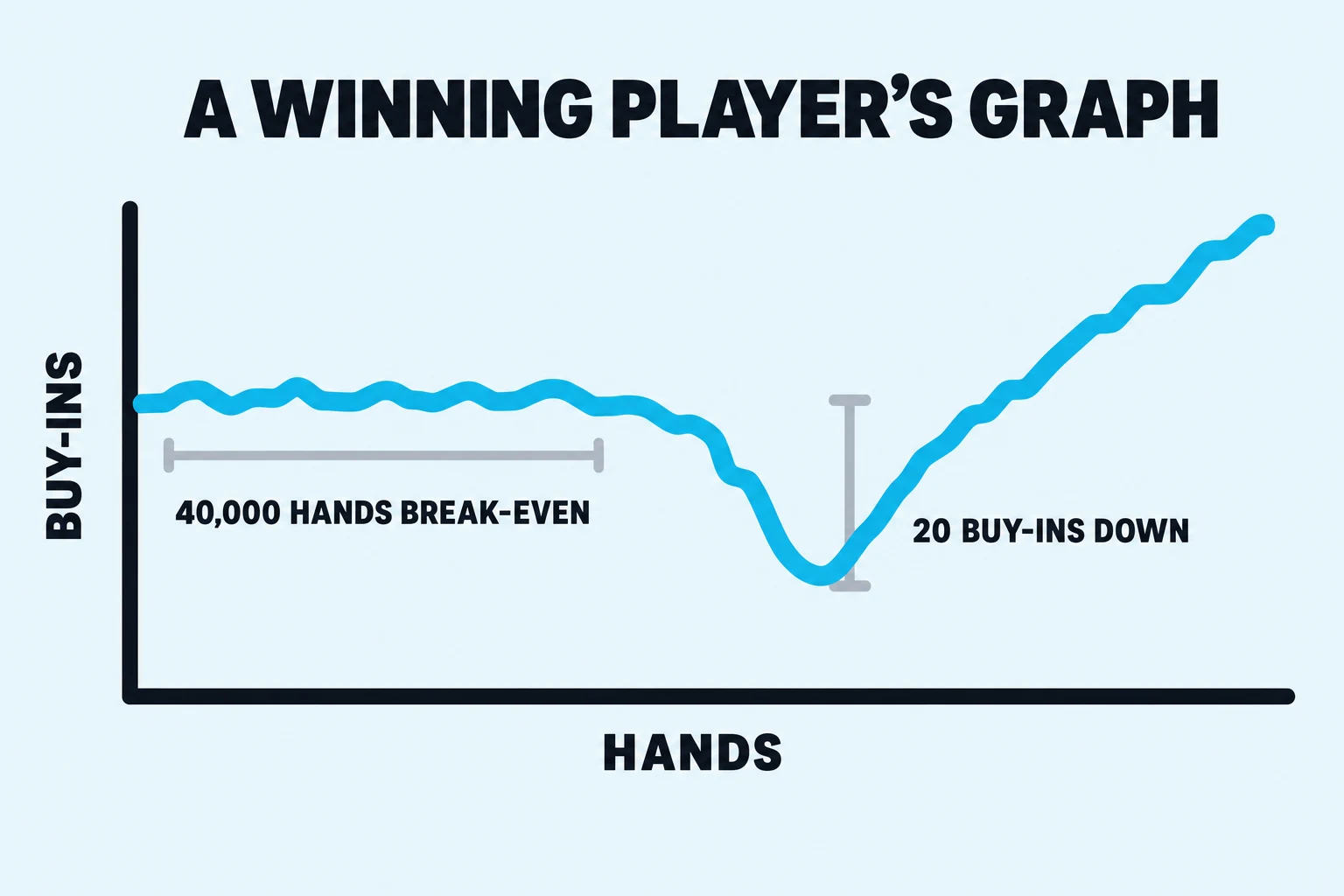
Published examples are more sobering than most players expect. Mastering Small Stakes No-Limit Hold’em walks through a genuinely winning player who was break-even for roughly 40,000 hands, whose worst downswing was around 20 buy-ins, on a graph that still climbs over the full sample.
Read that twice. Forty thousand hands of nothing, a twenty buy-in hole, and the player was winning the whole time.
That is the honest answer to “how long can a downswing last.” Long enough that it will not feel like variance while you are inside it, because nothing about the experience distinguishes a normal bad stretch from a genuine collapse in edge. They feel identical from the inside. That is the actual difficulty, and no amount of bankroll arithmetic removes it.
Why this is a tilt problem, not just a math problem
Tilt is usually described as a reaction to a bad beat, and the acute version is, which is why a practical cooldown protocol is worth having ready before you need it. The chronic version is quieter and starts with a misread probability. If you believe your stretch was a one-in-a-thousand event, you are believing something is broken. Something broken demands a fix, so you start changing things: opening wider to get even, moving up to recover faster, abandoning a line that was fine because it lost three times in a row.
Every one of those is a strategy change made from a sample too small to justify it, which is the same error that produced the wrong win rate in the first place. The math mistake and the emotional spiral are the same mistake, running twice.
The intervention is not deep breathing. It is refusing to let a results graph be your feedback signal, because results are too noisy to learn from at the scale a session provides. Bankroll management is the structural half of that: enough buy-ins that a normal bad stretch cannot force a decision. The reviewing half, what you do with the hands once the session ends, is covered in our guide to how to study poker. What remains is where your sense of whether you are playing well actually comes from.
Judge the decision, not the runout
If results are unreliable feedback over any sample you can observe in a week, you need feedback that does not depend on results at all.
That means asking, hand by hand, whether the decision was right given what you knew when you made it. A call that was correct on expected value and lost is a good call. A call that was wrong and won is still a leak, and it is a more dangerous one, because the result trained you to repeat it.
This is exactly why Poker Skill scores your decisions rather than your outcomes. The runout is the noisiest possible signal about your play, and it is the one everyone instinctively uses. Swap the signal and a twenty buy-in downswing stops being a verdict on your ability and goes back to being what it is, which is a stretch of hands where the cards did not cooperate while you kept getting the decisions right.
You will still hate it. You just will not learn the wrong lesson from it.