
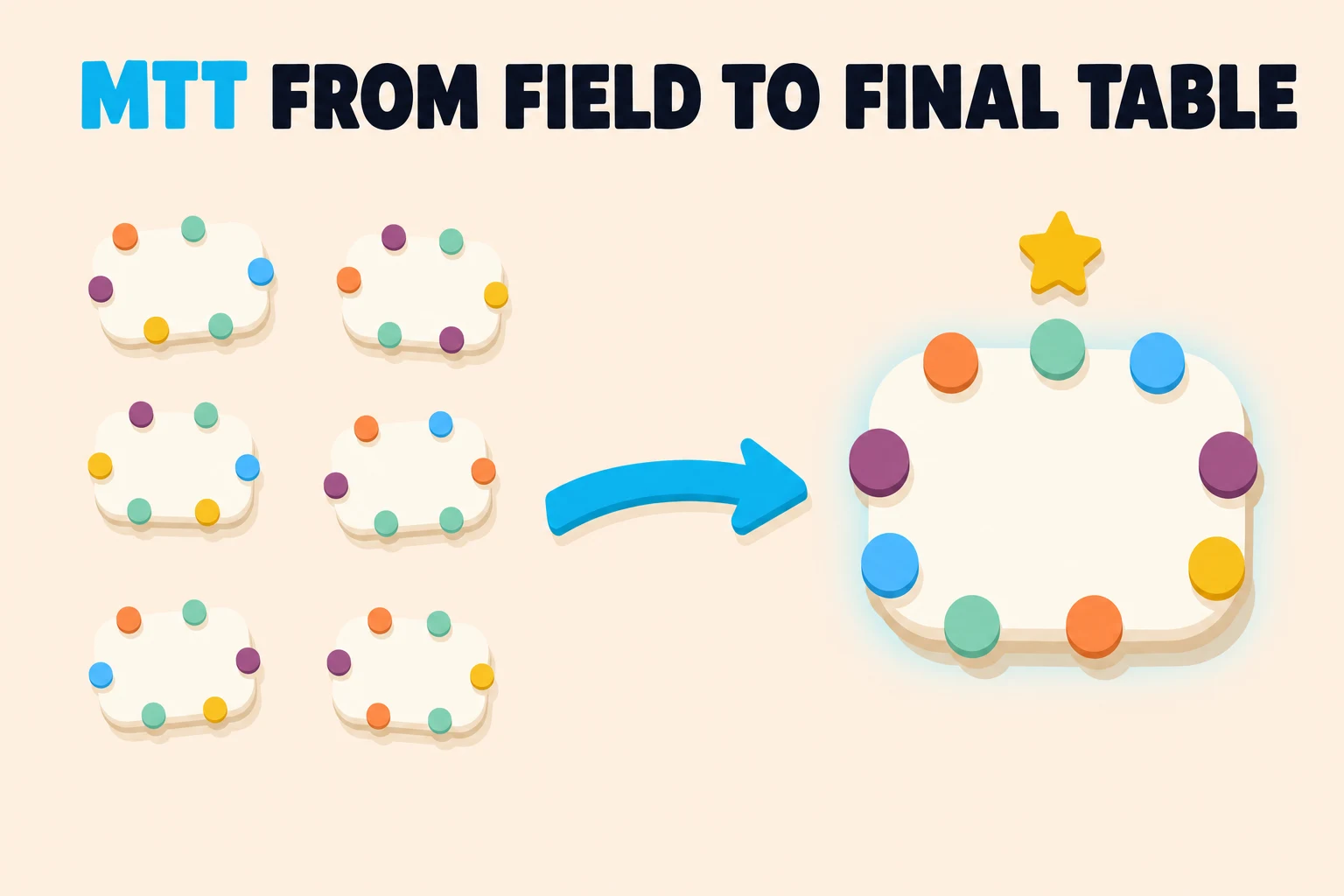
An MTT is a multi-table tournament: everyone starts with the same chips, blinds rise on a schedule, and the field shrinks until one player holds everything. Roughly the top 10 to 15 percent get paid. The same skills at one table, on a much shorter clock, are covered in sit and go strategy. Strategy is not one thing in an MTT; it changes as stacks get shallower and payouts get closer, and the players who go deep are the ones who change with it.
The whole map in one table
| Phase | Typical depth | The adjustment | The leak to avoid |
|---|---|---|---|
| Early | 80-150 bb | Play solid, take cheap flops with hands that can win stacks | Gambling big pots without the goods |
| Middle (antes on) | 30-60 bb | Steal and defend noticeably wider | Playing the same tight ranges as hour one |
| The bubble | Varies wildly | Let stack sizes pick your spots | Treating chips like cash when busting costs everything |
| In the money | 15-40 bb | Reset toward accumulation | Coasting after the min-cash |
| Final table | Often under 25 bb | Weigh every pay jump | Ignoring the ladder in close spots |
The depth column is the honest one. Phases are not clock readings; they are stack depths wearing costumes. Count your stack in big blinds every orbit and you always know where you actually are.
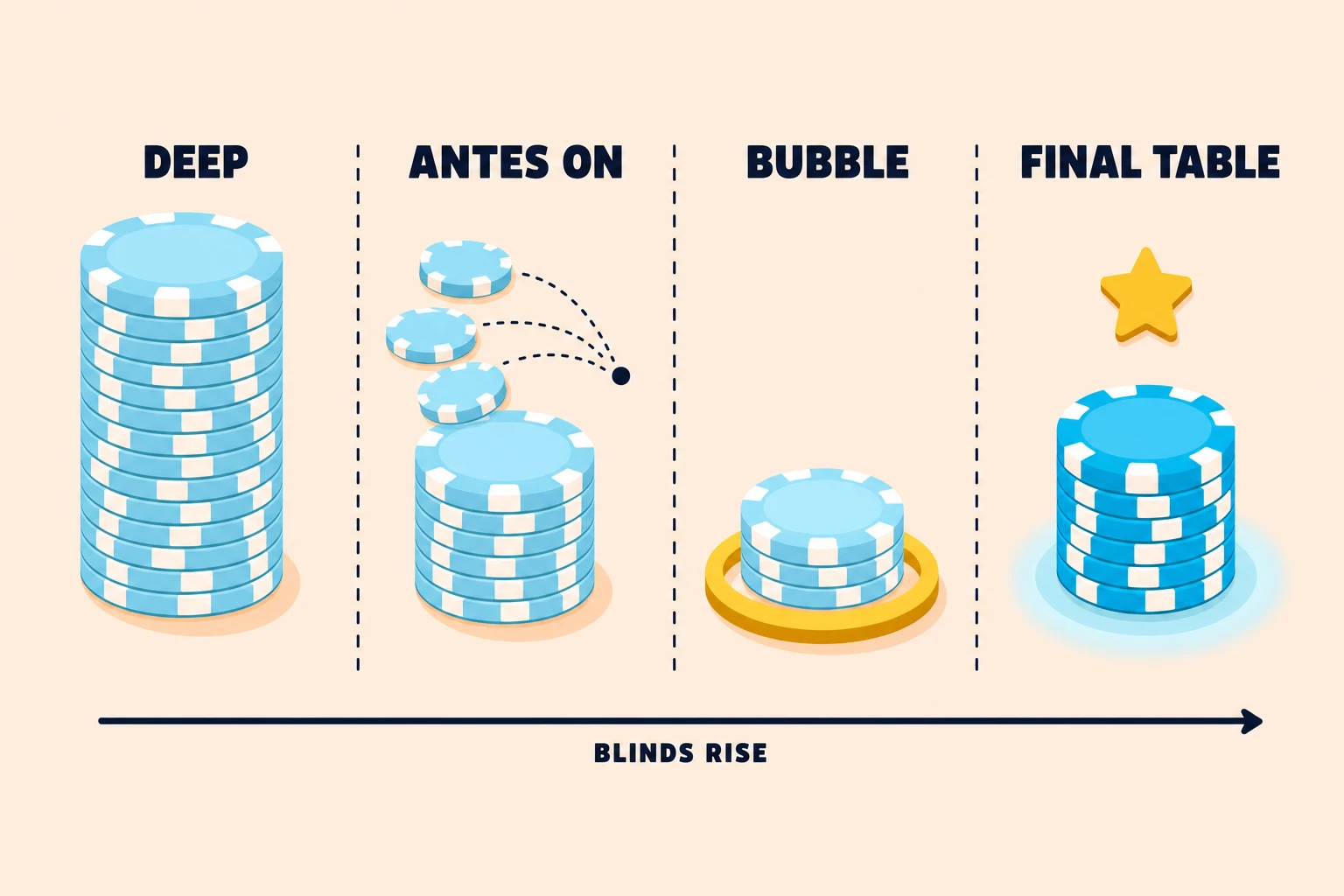
Early phase: deep and disciplined
With a hundred big blinds or more, an MTT plays close to a cash game, and the correct style is patient and solid. Deep stacks reward hands that can win big pots honestly: pocket pairs that can flop sets, suited connectors with real implied odds, big cards that make big pairs. Nobody wins the tournament in the first hour, but plenty of players lose it there, usually by treating an early double-up as urgent when nothing about hour one rewards urgency: the blinds are tiny, patience is cheap, and a coin flip for your whole stack throws away every edge you planned to use later. The other early job is free: watch. Who limps, who never folds a blind, who has raised four hands in a row. That information compounds for the next six hours.
Middle phase: the antes change the price of everything
When antes arrive, every pot starts with dead money from all nine seats, and the preflop pot grows by roughly two thirds. That one structural change rewrites the math. A steal raise that needed to work about 60 percent of the time now needs to work about half the time, so stealing becomes mandatory, not optional, and defending your own blind gets cheaper for the same reason. The full arithmetic lives in the antes article; the tournament consequence fits in one sentence: from the ante era onward, the player who keeps hour-one ranges is quietly paying for everyone else’s dinner.
Here is the worked version. Blinds 1,000/2,000 with a 2,000 big blind ante, and it folds to you on the button with K♦8♠ and 40 big blinds. There is 5,000 in the middle before anyone plays a hand. A raise to 4,400 risks 4,400 to win 5,000, so it breaks even when both blinds fold about 47 percent of the time, before your king-high ever sees a flop or a good runout. Without the ante the same raise needs about 59 percent folds. That 12-point discount is why K8 offsuit is a fine button open here and only a marginal one in hour one.
The bubble: chips stop being worth their face value
Near the money, busting costs you your entire tournament while doubling up only adds chips, and that asymmetry has a name: ICM, the model that converts stacks into real-money equity. The push/fold and ICM charts show what it does to a shoving range. Its practical output is the bubble factor: calls need meaningfully more equity than the chip math says, and the pressure lands unevenly. Big stacks should attack relentlessly, because the medium stacks who can hurt them are the exact players who cannot afford to fight back. Medium stacks tighten the most; a marginal call that would be routine in a cash game becomes a disaster when losing means bubbling. Short stacks get one gift: everyone expects them to fold into the money, so a well-timed shove into medium stacks prints, right up until it runs into aces.
The test hand: you hold A♣J♦ with 18 big blinds, two off the money, and the table’s big stack shoves on you. In chips alone this is a call, because a big stack shoves wide here and A-J is ahead of most of that range. On the bubble it is usually a fold, because the equity you need has quietly moved from “a coin flip” to “clearly ahead.” Fold, cash, and go fight with the ladder behind you.
In the money: cash the relief, then reset
The min-cash changes the psychology twice in ten minutes. The moment the bubble bursts, half the short stacks shove the next hand they see, liberated, and the correct response is to call them wider than feels polite, because their ranges just exploded. Then the game settles, and the most common leak of the whole tournament appears: coasting. A min-cash returns your buy-in and change; the real money starts three pay jumps from the final table and compounds from there. Between the bubble and the serious jumps, chip accumulation matters more than laddering one spot, so the correct posture snaps back toward aggression: steal, re-steal, and attack the players who visibly relaxed when the money hit. From the small blind against a cutoff open, Poker Skill teaches pressure or fold, with suited high cards 3-betting to push the big blind out and claim the dead money. Save the tight folds for when the next pay jump is actually large, which brings the ladder logic back.
The final table: every elimination is money
Once the pay jumps get steep, the ladder logic from the bubble returns and intensifies. With 15 to 25 big blinds, most meaningful decisions happen preflop, and the game tightens toward shove-or-fold as you drop: mixed raises and shoves from 15 down to 10, close to pure shove-or-fold below that. The push-fold charts tell you which hands go in at each of those depths. A little deeper, small opens still have a place, and folding the weakest of them to a re-shove is a normal part of that plan. Around 10 big blinds, wide shoving from late position is the profitable default; ace-anything, king-anything reasonable, pairs and suited connectors all go in before the blinds eat you. The ICM section of Poker Skill’s push/fold charts shows real pay jumps pulling that back, starting the under-the-gun shove at pocket threes instead of deuces at a final table. Between pay jumps, fold the close ones when short stacks are about to bust elsewhere; press hard when you cover the table. At the final table, the difference between fourth and second is often more money than everything you won to get there.
When this map lies to you
Three honest caveats. First, ICM discipline taken too far becomes the blind-out spiral: folding everything to ladder one spot is its own leak, because a five-blind stack has almost no fold equity left and wins tournaments only in stories. Second, re-entry and rebuy formats blunt the early-phase caution; when busting costs one more buy-in instead of everything, the gambles get better. Third, the phase table assumes full tables; short-handed play late in a tournament widens every range another notch, and the players who miss that fold themselves out of the endgame.
A live-play pattern
Once per orbit, run the same three-beat check: count your stack in big blinds, name the phase that depth puts you in, and say the phase’s one adjustment before the next hand is dealt. Forty blinds with antes running means steal more. Eighteen blinds near the bubble means pick fights only with the stacks that fear you. Nine blinds anywhere means find a shove. The rhythm takes ten seconds and replaces the most expensive habit in tournament poker: playing the phase you were in two hours ago.
Frequently asked questions
What does MTT stand for in poker? Multi-table tournament: an event that starts with more players than one table holds, consolidates tables as players bust, and pays a percentage of the field from the prize pool. The World Series of Poker Main Event is the famous one; the structure is the same at every stake.
How is MTT strategy different from cash game strategy? Cash chips are money, so every decision maximizes chip expectation. Tournament chips are not money, because payouts depend on outlasting people rather than stacking chips. That single difference creates ICM, bubble play, and ladder pressure, none of which exist in a cash game. If you have not committed to a format yet, which format should you learn first covers what each one teaches a new player.
At what stack depth should you switch to shove or fold? Below about 10 big blinds, shoving or folding is close to the whole game. From 10 to 15, a mixed approach that includes some limps and small raises works from the blinds, but shove-or-fold remains the safe default. Above 20, normal raising play resumes. When shoving is your only good move explains why the middle options stop working at those depths.
Does ICM matter before the bubble? Barely, and then suddenly. Through the early and middle phases, chip accumulation and survival point the same direction, so plain chip math serves fine. The moment pay implications become visible, ICM starts taxing every close call, and it never stops again until heads-up.