


For most of a week in July 2026, the loudest argument in tournament poker was about chip denominations: whether rooms should take small chips out of play as aggressively as they do.
It sounds like a logistics complaint, and part of it is. Buried inside it is a strategy question that almost nobody teaches beginners properly. When you decide how much to raise, what exactly are you deciding?
The argument, as it was actually made
Alex Foxen put the technical objection on the record:
“the color-up obsession has technical drawbacks as well. Playing 1500bb with no 100s in play forces players to 2x, 2.33x, or 2.67x. Almost no one would choose these sizes if unrestricted.”
Andy Bloch took the other side:
“Forcing people to use different opening bet sizes is a GOOD thing. It makes playing ‘GTO’ harder and the game more interesting, not less.”
Foxen replied: “So you are under the impression that limiting the options for bet sizing makes GTO harder to achieve? Interesting”
Both of those are public posts, and both players are describing something real. They are also not quite arguing about the same thing, which is why the exchange ran for days without landing. Foxen’s claim is about the menu: with a coarse chip set, the sizes available to you are not the sizes you would pick. Bloch’s claim is about difficulty: a constrained menu makes equilibrium play harder to execute, and he treats that as a feature. Whether a smaller menu makes correct play harder or easier is genuinely unsettled, and nothing in the exchange settles it.
Both of them are standing on the same premise, though, and that premise is the part worth your attention. The size you pick is a decision, and changing it changes the hand.
Where those three numbers come from
Foxen’s example is precise, so it is worth doing the arithmetic out loud.
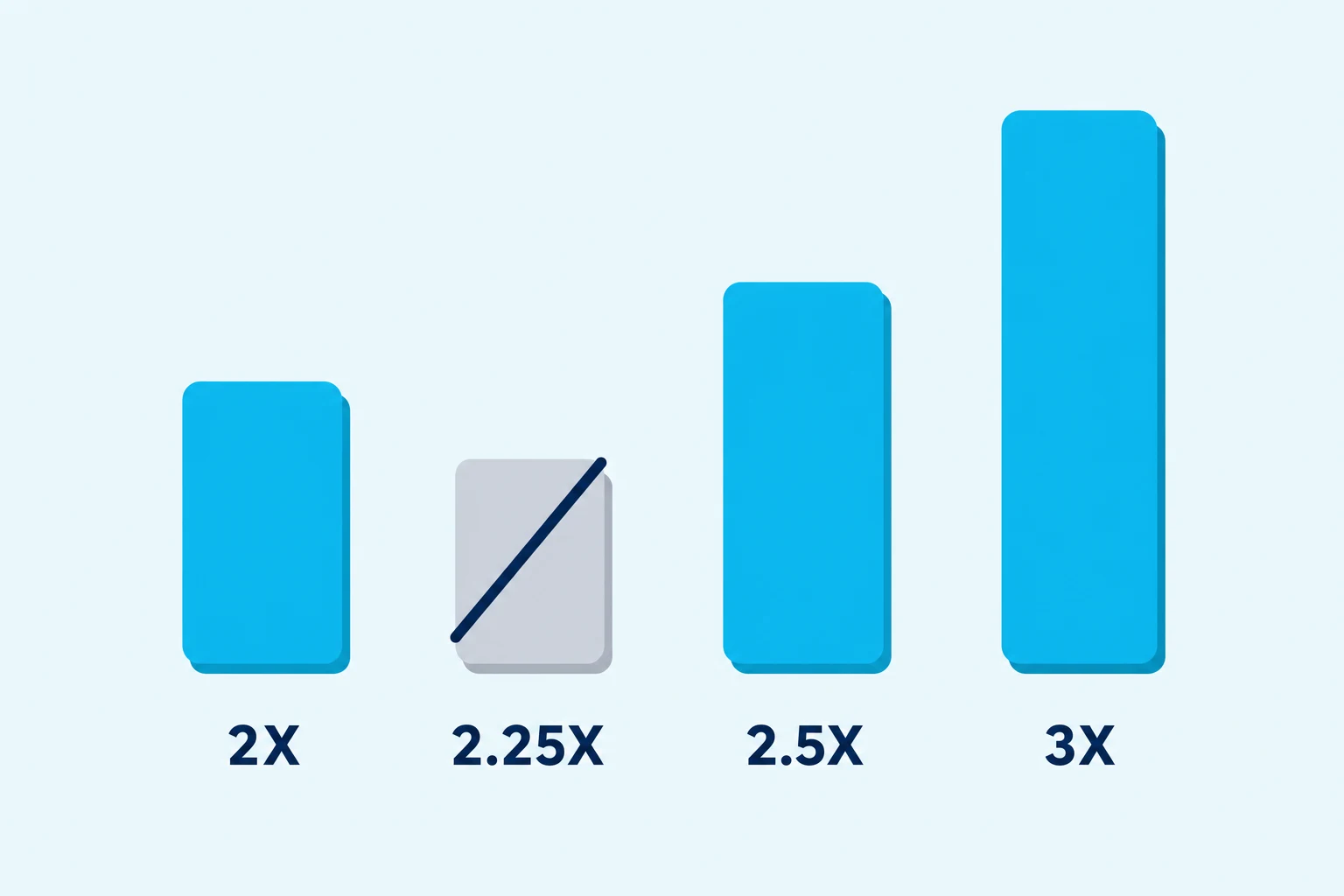
The big blind is 1,500. The smallest chip still in play is a 500, because the 100s have been colored up and removed. Every bet you make has to be built out of 500s. So your opening raise can be 3,000, or 3,500, or 4,000. In big blinds, that is 2x, 2.33x, or 2.67x.
There is no 3,300. A 2.2x open, which is a completely ordinary modern size, cannot be constructed. The chip set deleted it.
What the number actually does
A bet size sets the price your opponent is being offered, and the price determines which hands can profitably call.
Move up one level so every number divides cleanly and you can check the work. Blinds are 1,000 and 2,000, no ante, and the smallest chip left in play is a 1,000. You open from late position and only the big blind is left to act. They already have 2,000 in front of them, so what they have to add depends entirely on the size you chose.
| Your open | BB must add | Final pot if they call | Equity they need to break even |
|---|---|---|---|
| 4,000 (2x) | 2,000 | 9,000 | 2,000 / 9,000 = 22.2% |
| 5,000 (2.5x) | 3,000 | 11,000 | 3,000 / 11,000 = 27.3% |
| 6,000 (3x) | 4,000 | 13,000 | 4,000 / 13,000 = 30.8% |
| 4,500 (2.25x, unavailable) | 2,500 | 10,000 | 2,500 / 10,000 = 25.0% |
The bottom row is the Foxen effect in miniature. A 2.25x open is a perfectly normal size and you cannot make it, because 4,500 is not a multiple of 1,000.
Read the right-hand column. Between your smallest legal size and your largest, the equity your opponent needs to call swings by 8.6 percentage points. Hands that are a clear call getting 22.2% become marginal or losing at 30.8%, and the range that continues against you shrinks accordingly.
This is the mechanism underneath every sizing discussion, and it is well established: bet size controls the pot odds an opponent receives, larger bets make it incorrect for more of their hands to continue, and larger raises also cut into the implied odds that make speculative hands playable. Smaller sizes lay a better price and let a wider range come along.
Neither direction is automatically better. A wider calling range is exactly what you want when you have a hand that beats most of it. A narrower one is what you want when you are trying to take the pot down now, or when you would rather not play a big pot out of position. The number is how you express that preference.
The part that catches out newer players
If the size is a decision, the most common mistake is not choosing at all. Three versions of the same leak:
Always raising the same amount. Picking 2.5x and using it from every position, at every stack depth, against every opponent, is a reasonable place to start and a bad place to stay. It tells observant opponents nothing, which is fine, and it also tells you nothing, which is the expensive part.
Sizing to the hand instead of the situation. Raising bigger with aces and smaller with suited connectors is the single most readable pattern in live poker. Position, stack depth, and who is left to act should drive the size. What you are holding should not.
Defaulting to the minimum raise. A min-raise lays the best price at the table. Sometimes that is exactly the intent. Usually it is someone who wanted to raise and did not want to commit chips, which is two decisions fighting each other.
Fixing this does not require memorizing a chart. It requires noticing that you made a choice, and being able to say what you wanted the choice to do.
Why chip denominations reach the strategy at all
Stack depth is what drives most of your strategy, and a color-up leaves stack depth alone. Trade twelve small chips for four large ones at equal value and you have exactly as many big blinds as before.
What changes is the resolution of the menu. When the smallest chip in play is small relative to the big blind, your sizing options are close to continuous and you can pick more or less any price you want. When the smallest chip is large relative to the big blind, the options collapse into a short list of steps, and everyone at the table is choosing from the same handful.
That effect is mild deep-stacked and gets sharper as blinds rise, which is also when the smallest denominations are most likely to have been removed. By the time stacks are short enough for push-fold territory, sizing granularity has stopped mattering because there is only one size left. The squeeze is in the middle, which is where most tournament decisions actually happen. If you want the wider frame, our guide to tournament strategy by stage covers how the same hand changes value as the structure moves.
One neutral fact worth knowing, because it gets invoked on both sides of the Foxen and Bloch exchange: a solver does not evaluate every conceivable bet size. It solves over a set of allowed sizes that a human specifies in advance, and each extra size you add expands the game tree and the time the solve takes. So a game with fewer available sizes really is a smaller tree. Whether a smaller tree is easier or harder for a human to play well is precisely the thing the two of them disagreed about, and it does not follow from the tree size alone.
What to take to the table
You will not get to choose the chip denominations. You do get to choose, on every single street, from whatever menu the room hands you.
Before you put chips out, answer one question: what am I trying to make happen? Fold out the hands behind me. Get called by worse. Set up a stack-size relationship for the turn. Charge a draw. Any of those is a legitimate goal, and each one points at a different number. Poker Skill’s betting capstone asks that question on every flop it deals, and the answers come out as a check when a bet has no job, a normal size to keep worse hands calling and the big size when draws should pay.
Then judge the decision on whether it made sense with what you knew, rather than on what the river did with it. Results alone are too noisy to learn a sizing habit from, which is why the honest scoring has to happen at the moment you chose. A 2.67x open that gets snapped off by a hand you had crushed was still the right price against that range. A 2x that happened to win was still too cheap.