
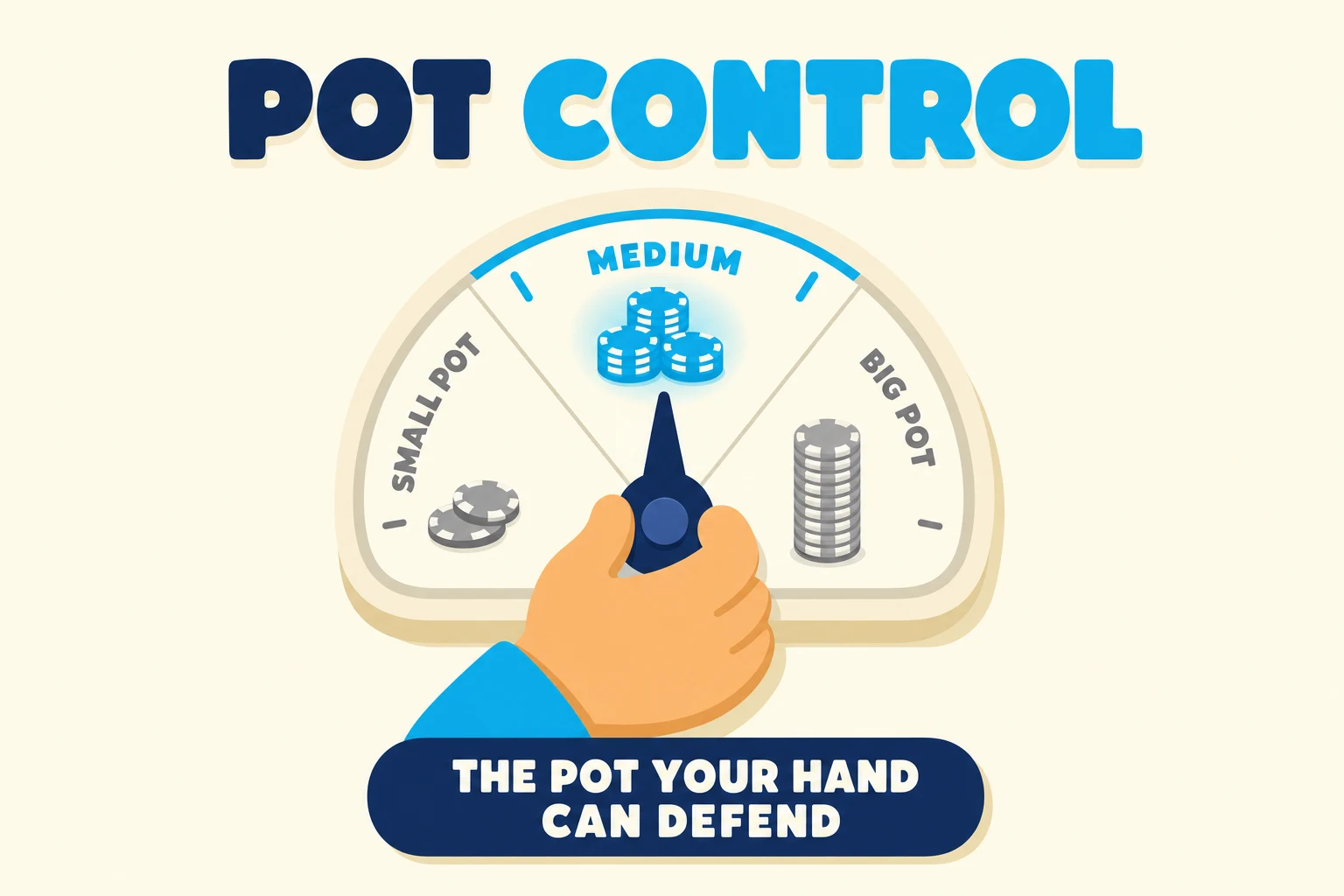
Pot control means deliberately keeping the pot at a size your hand can defend: big pots for big hands, medium pots for medium hands, small pots for the rest. It is a chosen line, not a nervous check. The difference between the two is a plan, and this article is the plan.
What pot control actually is
Every hand you hold belongs to a strength class, and every strength class has a pot size it profits in. The monsters want stacks in the middle. The air wants the pot as small as possible or handed over. The interesting class is the middle: top pair with a modest kicker, second pair with a good one, a decent one-pair hand that is often best now but rarely best once four bets go in. Those hands win medium pots and lose big ones, so the skill is steering the pot toward medium. That steering, done on purpose with the streets and positions available to you, is pot control. Done from fear, the same checks and calls are just passivity wearing a strategy’s name, and the difference shows up in what you do when your opponent bets: the planner has already decided; the scared player is improvising. In Poker Skill’s pot-control lesson, 7♣6♣ on Q♠7♥2♦ calls a bet to keep the pot small, and 8♦8♥ on 9♣8♣2♦ raises so the draws pay.
The ladder: hand class to pot size
| Hand class | Target pot | Typical line |
|---|---|---|
| Nuts and near-nuts | As big as stacks allow | Bet, raise, build every street |
| Strong one pair, top two | Large but not all-in deep | Bet for value, reassess at heavy resistance |
| Medium: decent top pair, strong second pair | Medium | One street checked somewhere, calls over raises |
| Weak showdown value | Small | Check it down, catch bluffs cheap |
| Air and busted draws | Smallest, or win it now | Bluff the right spots, otherwise release |
The middle rows are where pot control lives. The top rows are where invoking it becomes a leak.
The mechanics, worked
You open K♦J♠ from the cutoff, the big blind calls, and the flop comes K♠8♥4♦. You bet small, they call. The turn is the 9♣, and they check. Here is the pot-control decision in its natural habitat. A second bet mostly gets action from hands that beat you or run close: king-queen and ace-king play on, the flop’s stubborn middle pairs fold, and the 9♣ quietly improved slices of their range, turning 9x into pairs and hands like Q-T and 7-6 into straight draws. Top pair with a middling kicker gains little by building that pot.
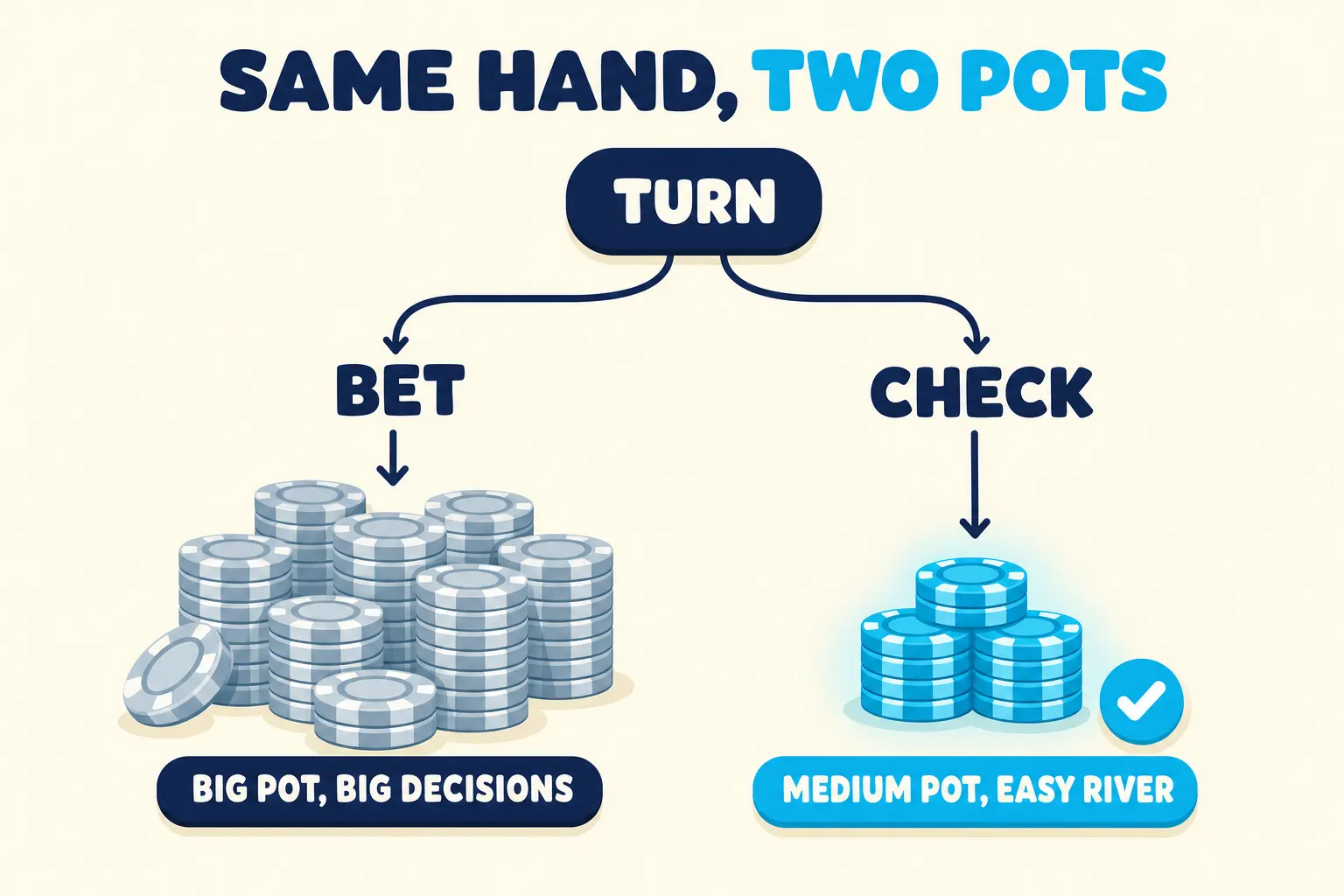
Checking back does three jobs at once. It keeps the pot at a size a good-but-not-great top pair can defend. It lets busted draws and weaker pairs bluff the river or pay off a bet they would have folded the turn to. And it caps what a check-raise can ever cost you. You act after them on the river with the pot still medium, call a reasonable bet or value bet a check, and the hand stays the size your hand class earns. Notice what made the check cheap: position. In position, pot control costs one street of initiative. Out of position, the same idea runs through check-calling, which is harder and pricier, and sometimes the honest answer out of position is that no line controls the pot against an opponent who keeps betting.
Way ahead or way behind
The classic pot-control spot has a name. You hold A♠K♦ on an A♥7♣2♦ flop against one tight opponent, and their range is mostly aces with worse kickers or pocket pairs below: hands you beat soundly, plus the occasional set that beats you soundly. You are way ahead or way behind, and betting three streets accomplishes little in either branch: the worse aces might call once, the sets never fold, and the pocket pairs give up. Checking a street, often the turn, keeps the pot medium, loses the minimum against the sets, and invites the pocket pairs to pay a street they would have folded to. When the hand cannot change much and the money moves only when you are beaten, a smaller pot is not caution; it is the profitable size.
When pot control is a leak
Three failure modes, all common. First, controlling the pot with hands that want value: checking back top pair top kicker on a normal board “to be safe” gives free cards to every draw and skips a street of profit. Strong hands bet, all the way up to the boats that Zeebo’s theorem says opposing full houses will pay at any size. Second, pot control against live draws: on a wet board, a check that keeps the pot medium also prices in every flush draw for free, and the medium pot you protected gets taken from you on the river anyway. Wet boards charge; dry boards control. Third, using pot control as an alibi for never value betting thin: if every marginal hand checks twice, observant opponents stop paying your big bets, and the whole strategy leaks from a different seam. The test each time is the same question: does checking here serve the hand’s target pot size, or does it just feel safer than betting?
When this lies to you
Stack depth rewrites the targets. At 200 big blinds deep, “medium” is a real zone and pot control across two streets meaningfully changes what a river mistake costs. At 30 big blinds, one raise, one call, and a single flop bet already put a third of the stack in the middle; there is no medium left to steer toward, SPR has collapsed, and one-pair hands commit rather than control. Check the stacks before choosing the tool: pot control is a deep-stack instrument, and shallow poker is a shoving game wearing table manners.
A live-play pattern
When the flop lands, name your hand’s class out loud in your head: monster, strong, medium, showdown value, air. Then name the pot that class wants: stacks, large, medium, small, none. Every action for the rest of the hand either serves that number or contradicts it, and the contradiction is always information: either your class changed with the board, which is fine, or you are betting from boredom or checking from fear, which is not. Two words per street is the whole overhead, and it turns “should I bet?” into the easier question “what size pot am I building, and for what?”
Where this fits
Pot control is one instrument in the postflop toolkit, the counterpart to the aggression frameworks: the c-bet decision picks when to fire, showdown value logic picks what checks behind, and pot control picks the destination pot those choices are steering toward. Class first, target second, streets third.
Frequently asked questions
Is pot control just checking? No. Checking is one of its tools, alongside calling instead of raising and betting small instead of big. What makes it pot control is the target: a chosen pot size the hand can defend, decided before the action rather than after the fear.
Which hands want pot control? The medium class: decent top pairs, strong second pairs, way-ahead-way-behind hands against tight ranges. Hands clearly stronger want value; hands clearly weaker want cheap showdowns or the pot right now.
Does pot control work out of position? Less well. In position you control the pot by acting last; out of position you can only check-call and hope the bets stay reasonable. Out of position against an aggressive opponent, medium hands often just face medium-hand problems no line fully solves.
What is the difference between pot control and slow playing? Direction. Slow playing hides a monster to grow the pot later; pot control caps the pot for a hand that cannot defend a big one. Same checks, opposite destinations.