
Push/fold charts by stack depth (5bb to 20bb)
Short stack, tournament, folded to you: the charts below say which hands go all in from which seat at 10 big blinds, at 5, at 15 and at 20, and a fifth says which hands can call one. Every chart is on the page as a table and every chart downloads as a printable image. No email, no account.
Shove width by stack depth
The lesson underneath all five charts is one shape: the shorter your stack, the more hands go all in. Four seats, four depths, drawn from the same ranges the tables below publish.
- UTG 24.3%
- Cutoff 45.1%
- Button 54.4%
- Small blind 83.1%
- UTG 17.9%
- Cutoff 34.2%
- Button 43.6%
- Small blind 68.6%
- UTG 14.6%
- Cutoff 27.0%
- Button 35.7%
- Small blind 56.0%
- UTG 11.5%
- Cutoff 20.7%
- Button 27.9%
- Small blind 42.1%
Under the gun goes from about a quarter of hands at 5 big blinds to roughly one hand in nine at 20. The small blind is the widest seat at every depth, because only one player is left to beat and the blinds are already worth almost a third of a 5 big blind stack. That gap between the first seat and the last is the whole short-stack game, and it is why folding the button and the small blind is the most expensive habit at this depth.
Get the charts, free
The PDF holds all five charts at print size, split across pages so the hands stay readable on paper. The images are the same charts if you would rather keep them on your phone.
The 10 big blind push/fold chart
Read your seat, find your hand, and if it is colored in, the chip goes in. Everything here assumes the pot is unopened when the action reaches you, the table is 9-handed, there are no antes, and you are counting chips rather than prize money.
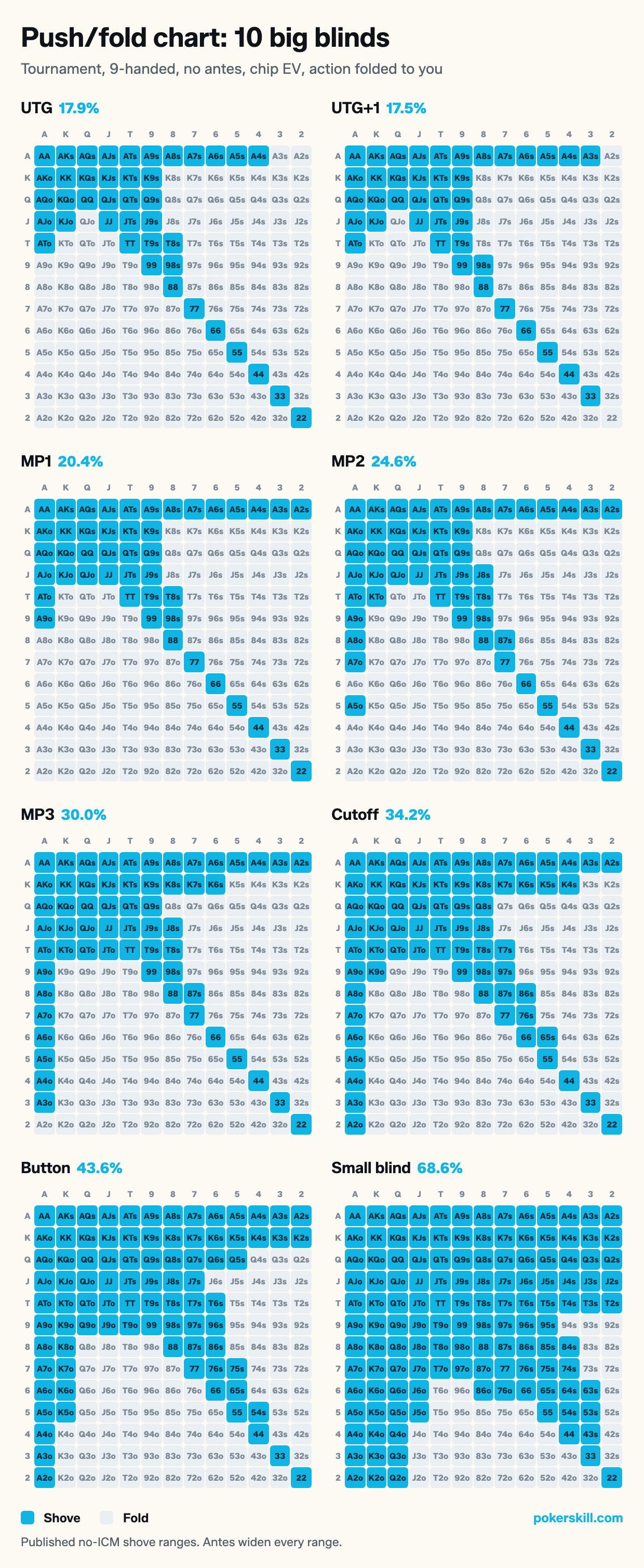
| Seat | Shove | Hands |
|---|---|---|
| UTG | 17.9% | 22+, A4s+, ATo+, K9s+, KJo+, Q9s+, J9s+, T8s+, 98s |
| UTG+1 | 17.5% | 33+, A3s+, ATo+, K9s+, KJo+, Q9s+, J9s+, T9s, 98s |
| MP1 | 20.4% | 22+, A2s+, A9o+, K9s+, KJo+, Q9s+, QJo, J9s+, T8s+, 98s |
| MP2 | 24.6% | 22+, A2s+, A7o+, A5o, K9s+, KTo+, Q9s+, QJo, J8s+, T8s+, 98s, 87s |
| MP3 | 30.0% | 22+, A2s+, A3o+, K6s+, KTo+, Q9s+, QTo+, J8s+, JTo, T8s+, 98s, 87s |
| Cutoff | 34.2% | 22+, Ax, K4s+, K9o+, Q8s+, QTo+, J8s+, JTo, T7s+, 97s+, 86s+, 76s, 65s |
| Button | 43.6% | 22+, Ax, K2s+, K5o+, Q5s+, Q9o+, J7s+, J9o+, T6s+, T9o, 96s+, 86s+, 75s+, 65s, 54s |
| Small blind | 68.6% | 22+, Qx+, J2s+, J5o+, T2s+, T7o+, 95s+, 97o+, 84s+, 86o+, 74s+, 76o, 63s+, 53s+, 43s |
The spread is the point. Under the gun shoves about 18% of hands with eight players left to get through. The small blind shoves about 69%, because only one player is left and the blinds already make up 15% of your stack. If you take one habit from this page, take that one: at 10 big blinds, folding the button and the small blind is a bigger leak than any hand you might shove too light.
ICM: when to fold hands the chart shoves
Every chart on this page counts chips. A tournament pays money, and chips turn into money unevenly: the ones you lose busting out cost you more than the ones you win are worth. That conversion has a name, ICM, and it is the reason a shove that is correct on this page can be a mistake at the table.
Here is the shape of it. On a chart like the 10 big blind one above, under the gun shoves every pocket pair down to deuces. Move the same seat to a final table with real pay jumps and the published ICM range starts at pocket threes instead. Deuces did not get worse. The money behind them got more expensive, and the same hand crosses from a shove to a fold without a single card changing.
| Where you are | What tightens | What does not |
|---|---|---|
| The money bubble | Calling ranges tighten hard, and medium stacks are the most constrained | The chip leader can shove wider, because everyone else has to call tight |
| A final table with big pay jumps | The range keeps its rough size but its contents shift toward big cards and suited hands | Small pairs, weak suited connectors and weak unsuited aces lose value |
| A pay jump you can reach by folding | Marginal all-ins that are barely profitable in chips | Clear value hands, which are still shoves |
The practical rule is short. Near the money, the hands you can call an all-in with shrink faster than the hands you can shove with, because calling gives up the fold equity that made the shove profitable. If you want the whole tournament picture around these decisions, the tournament strategy guide is the longer read.
Drill short-stack decisions in the app
Poker Skill turns short-stack decisions into short daily reps and tells you why an answer was right. Free forever, no wagering.
The 5 big blind push/fold chart
Half the stack, and every range on the chart gets wider, which is the part most players have backwards. Down at five big blinds the instinct is to wait for a hand worth dying with. The blinds do not wait: posting both of them costs nearly a third of what you have left every orbit, so folding costs you more than shoving a mediocre hand does. Same conditions as the chart above, folded to you, 9-handed, no antes, counting chips.
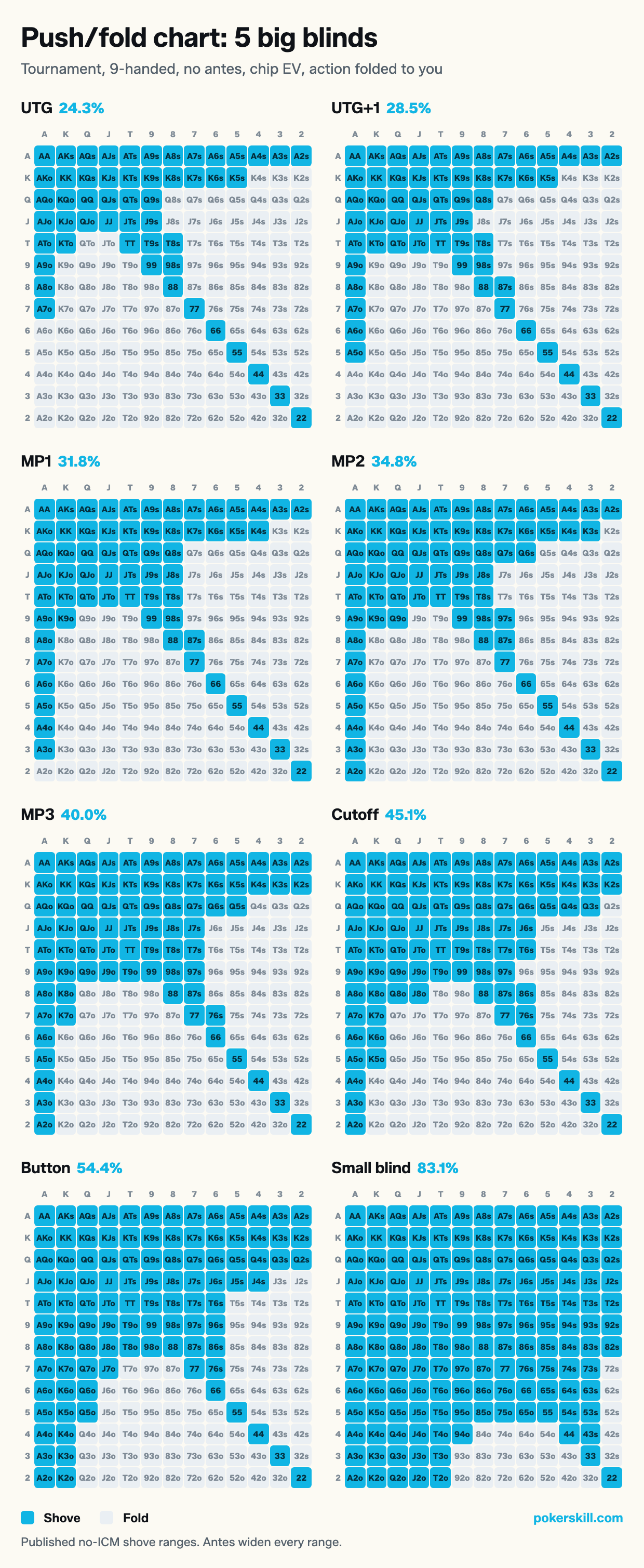
| Seat | Shove | Hands |
|---|---|---|
| UTG | 24.3% | 22+, A2s+, A7o+, K5s+, KTo+, Q9s+, QJo, J9s+, T8s+, 98s |
| UTG+1 | 28.5% | 22+, A2s+, A5o+, K5s+, KTo+, Q8s+, QTo+, J9s+, JTo, T8s+, 98s, 87s |
| MP1 | 31.8% | 22+, A2s+, A3o+, K4s+, K9o+, Q8s+, QTo+, J8s+, JTo, T8s+, 98s, 87s |
| MP2 | 34.8% | 22+, Ax, K3s+, K9o+, Q6s+, Q9o+, J8s+, JTo, T8s+, 97s+, 87s |
| MP3 | 40.0% | 22+, Ax, K2s+, K7o+, Q5s+, Q9o+, J7s+, J9o+, T7s+, T9o, 97s+, 87s, 76s |
| Cutoff | 45.1% | 22+, Ax, K2s+, K5o+, Q3s+, Q8o+, J6s+, J8o+, T6s+, T9o, 97s+, 86s+, 76s |
| Button | 54.4% | 22+, Kx+, Q2s+, Q5o+, J4s+, J7o+, T6s+, T8o+, 96s+, 98o, 86s+, 76s |
| Small blind | 83.1% | 22+, Tx+, 92s+, 94o+, 82s+, 85o+, 73s+, 75o+, 63s+, 65o, 53s+, 43s |
Hold the two charts next to each other and you can see how far each seat moves. Under the gun goes from about 18% of hands to about 24%. The button goes from 44% to 54%. The small blind reaches 83%, and at that width the shortcut beats the chart: it folds 22 hands out of 169, and not one of them holds a card higher than a nine. That puts ten-deuce offsuit among the shoves, a hand Poker Skill's small blind lesson calls an easy fold at 100 big blinds. From the small blind at five big blinds, a ten or anything above it is a shove.
The 15 big blind push/fold chart
Five more big blinds and every seat gets choosier. The reward for shoving is the same blinds it always was, the risk is half a stack larger, so the marginal hands come out of the range first: the weak offsuit aces, the small suited gappers, the hands that were only ever shoving because folding cost more. These ranges are the published 10 big blind chart tightened by about a fifth, which is where 15 big blinds sits between the two depths the books actually publish. They are the hands that are still a clear all-in at this depth.
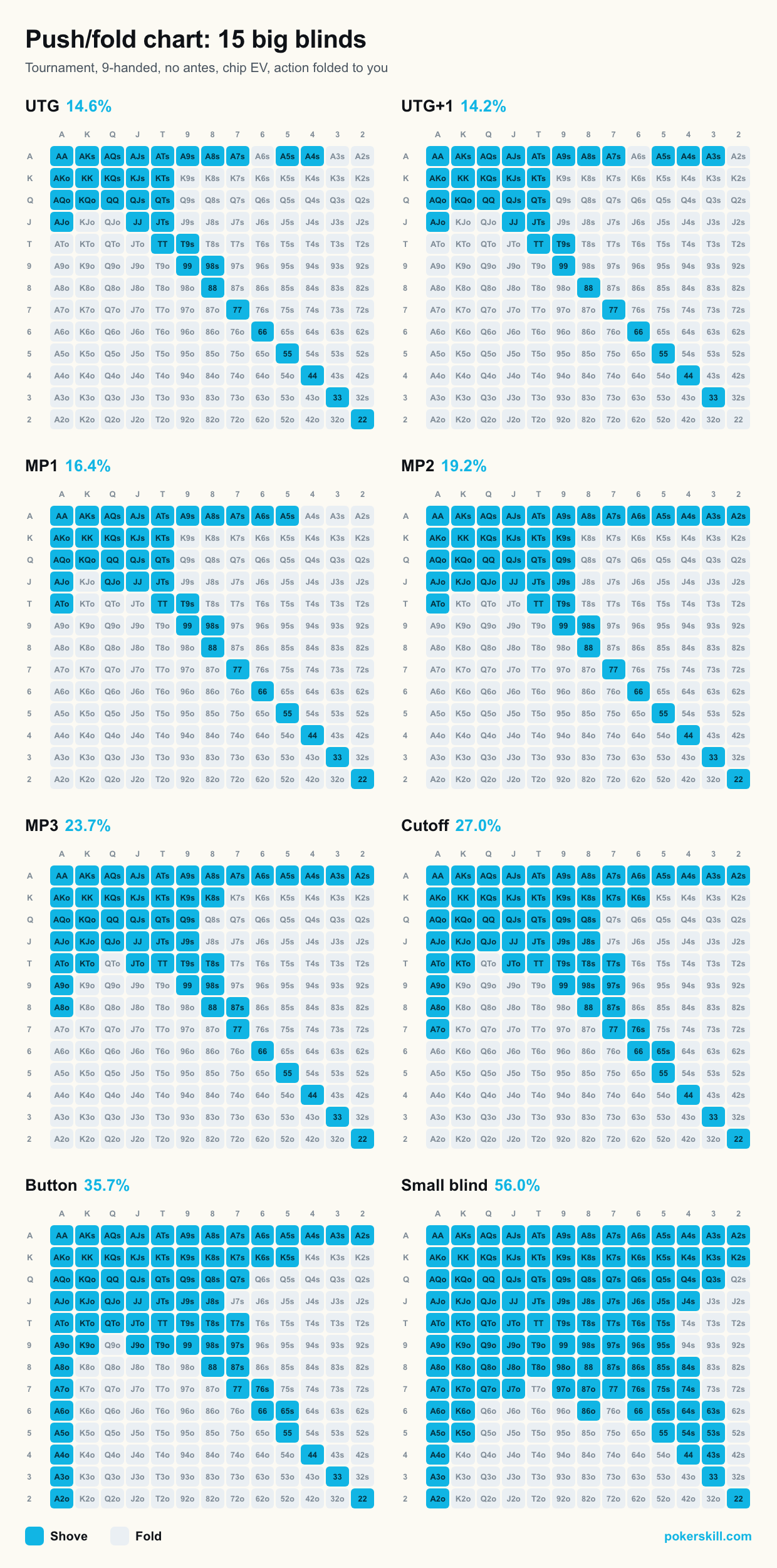
| Seat | Shove | Hands |
|---|---|---|
| UTG | 14.6% | 22+, A7s+, A5s-A4s, AJo+, KTs+, KQo, QTs+, JTs, T9s, 98s |
| UTG+1 | 14.2% | 33+, A7s+, A5s-A3s, AJo+, KTs+, KQo, QTs+, JTs, T9s |
| MP1 | 16.4% | 22+, A5s+, ATo+, KTs+, KQo, QTs+, QJo, JTs, T9s, 98s |
| MP2 | 19.2% | 22+, A2s+, ATo+, K9s+, KJo+, Q9s+, QJo, J9s+, T9s, 98s |
| MP3 | 23.7% | 22+, A2s+, A8o+, K8s+, KTo+, Q9s+, QJo, J9s+, JTo, T8s+, 98s, 87s |
| Cutoff | 27.0% | 22+, A2s+, A7o+, K6s+, KTo+, Q8s+, QJo, J8s+, JTo, T7s+, 97s+, 87s, 76s, 65s |
| Button | 35.7% | 22+, Ax, K5s+, K9o+, Q7s+, QTo+, J8s+, J9o+, T7s+, T9o, 97s+, 87s, 76s, 65s |
| Small blind | 56.0% | 22+, Ax, K2s+, K5o+, Q3s+, Q7o+, J4s+, J7o+, T5s+, T8o+, 95s+, 97o+, 84s+, 86o+, 74s+, 63s+, 53s+, 43s |
At this depth the books that go further do not add a raise, they add a limp: the small blind at 10 to 15 big blinds plays push, limp or fold, and non-all-in raise sizes only start to appear around 17 big blinds. That is worth knowing before you treat a two-colour chart as the complete answer at 15.
The 20 big blind push/fold chart
At 20 big blinds, open-shoving stops being the default and open-raising takes over, so read this chart as the shove-only baseline rather than as a plan for the seat. The ranges are the 10 big blind chart cut by about a third, which is the reduction the literature describes between those two depths. Later seats still shove much wider than early ones, and the range at this depth is not premium hands only: suited aces, suited broadways and offsuit broadways are all in it. For the seats and stacks where raising is the better tool, use the standard opening charts.
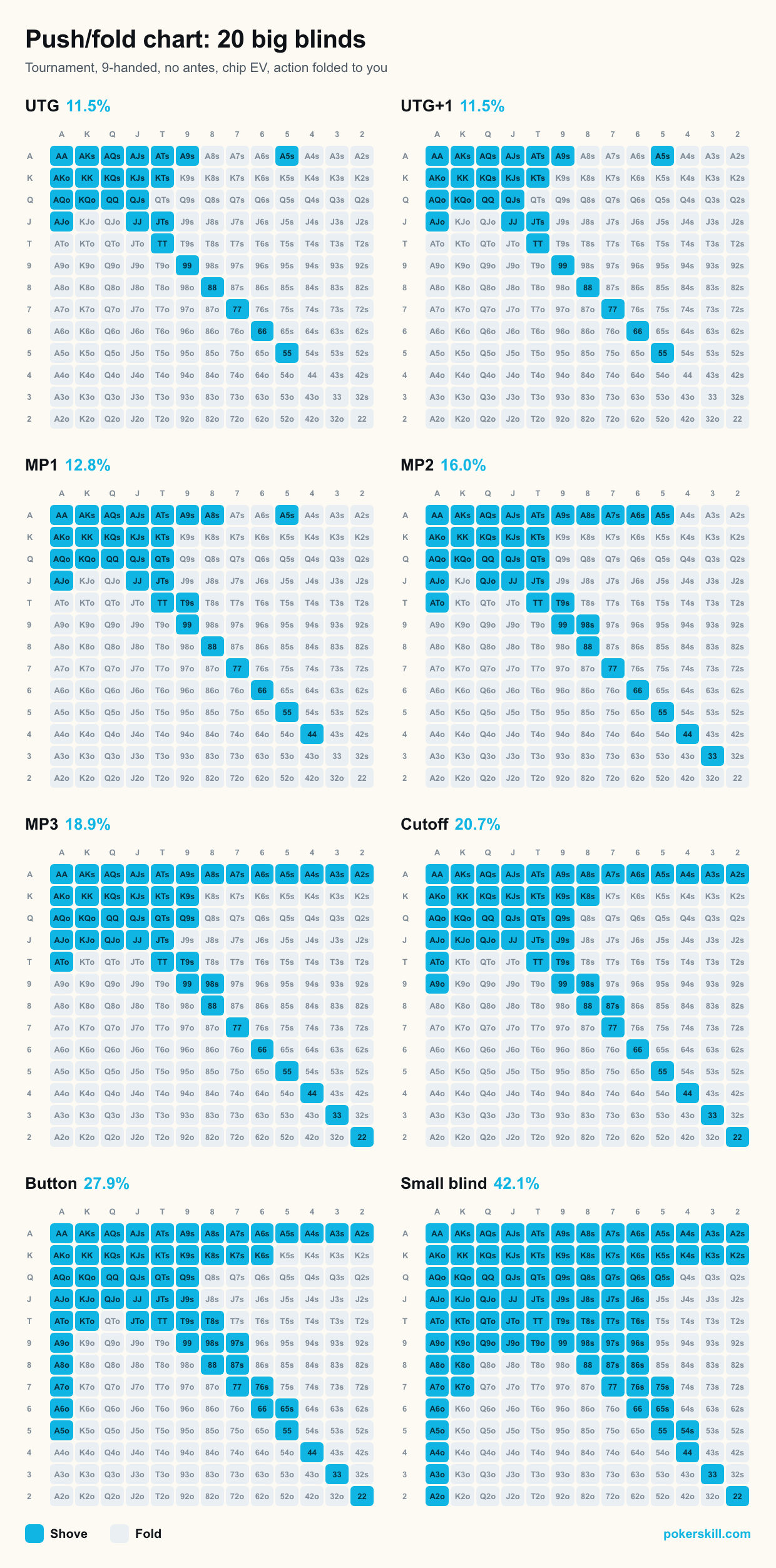
| Seat | Shove | Hands |
|---|---|---|
| UTG | 11.5% | 55+, A9s+, A5s, AJo+, KTs+, KQo, QJs, JTs |
| UTG+1 | 11.5% | 55+, A9s+, A5s, AJo+, KTs+, KQo, QJs, JTs |
| MP1 | 12.8% | 44+, A8s+, A5s, AJo+, KTs+, KQo, QTs+, JTs, T9s |
| MP2 | 16.0% | 33+, A5s+, ATo+, KTs+, KQo, QTs+, QJo, JTs, T9s, 98s |
| MP3 | 18.9% | 22+, A2s+, ATo+, K9s+, KJo+, Q9s+, QJo, JTs, T9s, 98s |
| Cutoff | 20.7% | 22+, A2s+, A9o+, K8s+, KJo+, Q9s+, QJo, J9s+, T9s, 98s, 87s |
| Button | 27.9% | 22+, A2s+, A5o+, K6s+, KTo+, Q9s+, QJo, J9s+, JTo, T8s+, 97s+, 87s, 76s, 65s |
| Small blind | 42.1% | 22+, A2s+, A2o+, K2s+, K7o+, Q5s+, Q9o+, J6s+, J9o+, T6s+, T9o, 96s+, 86s+, 75s+, 65s, 54s |
One adjustment matters more than the chart here. If the players behind you call wide, tighten, because a shove earns most of its money from the folds and those folds are what a loose table takes away.
Calling a shove: why your range is tighter
Here is the asymmetry nobody explains up front, and it is the reason most short-stack money is lost. When you shove, you can win the pot two ways: everyone folds, or you win a showdown. When you call a shove, the first way is gone. Your hand has to be good enough on its own against the range that just went all in, so the range you can call with is far tighter than the range you can shove with.
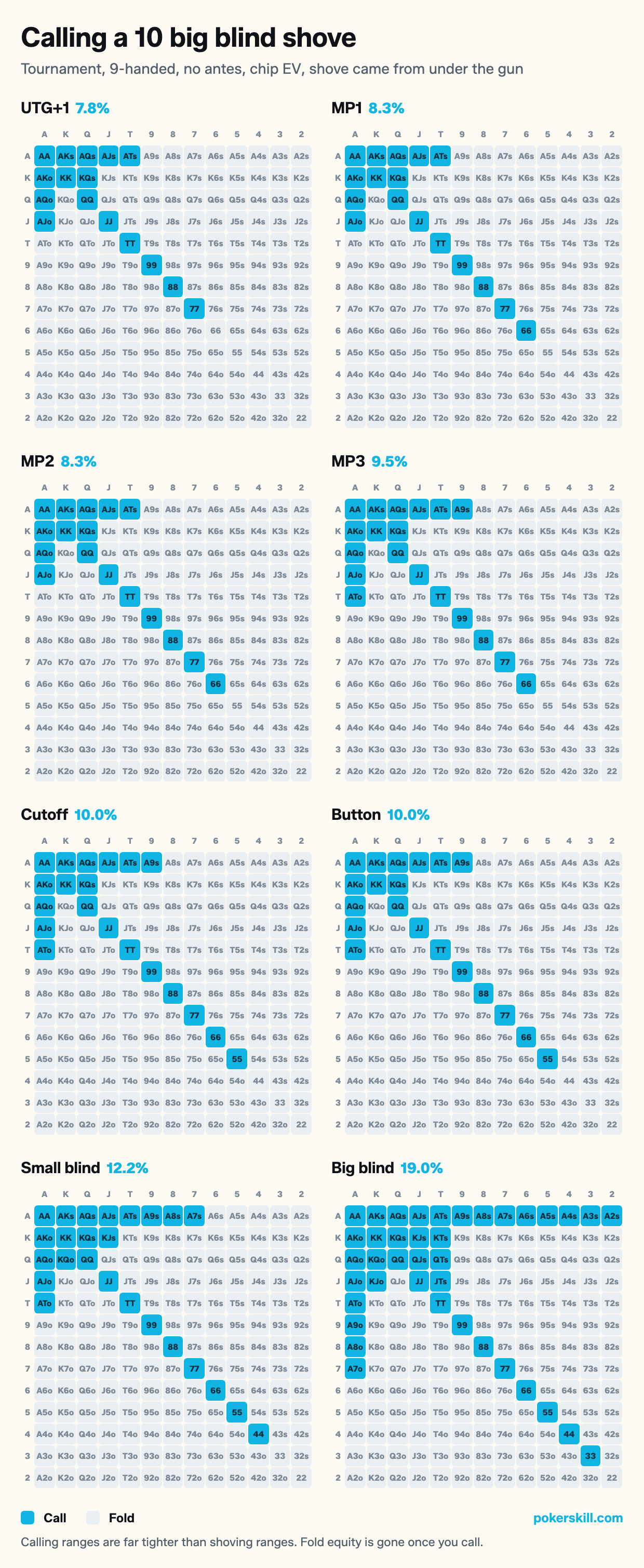
| Seat | Call | Hands |
|---|---|---|
| UTG+1 | 7.8% | 77+, ATs+, AJo+, KQs |
| MP1 | 8.3% | 66+, ATs+, AJo+, KQs |
| MP2 | 8.3% | 66+, ATs+, AJo+, KQs |
| MP3 | 9.5% | 66+, A9s+, ATo+, KQs |
| Cutoff | 10.0% | 55+, A9s+, ATo+, KQs |
| Button | 10.0% | 55+, A9s+, ATo+, KQs |
| Small blind | 12.2% | 44+, A7s+, ATo+, KJs+, KQo |
| Big blind | 19.0% | 33+, A2s+, A7o+, KTs+, KJo+, QTs+, JTs |
Put the two charts side by side and the gap is stark. Under the gun shoves about 18% of hands. The seat directly behind can call with about 8%, and it is calling a range that already knows it will get looked up. The big blind calls widest of anyone, around 19%, only because it is getting a price nobody else at the table gets. ATo is a call in one seat and a fold in another for exactly that reason.
How to use push/fold charts
What these charts assume
Four conditions sit behind every chart here: the action folds to you, the table is 9-handed, there are no antes, and the numbers count chips rather than prize money. Antes change that arithmetic in your favor, because more dead money improves the reward side of the shove, so treat the chart as a floor once antes start, not a ceiling.
When does push/fold start?
Around 12 big blinds is the cleanest line the poker literature draws. Below it, all in or fold is close enough to optimal that the simplification costs you almost nothing. Between about 10 and 15 you are in a mixed zone where small raises and small-blind limps appear alongside shoves. Above 15, open raising is the better default from most seats, which is why the 15 and 20 charts here are a baseline rather than a whole strategy. Above 20 the answer is an opening range and a plan for the flop, which is what the preflop chart library is for. A chart stops at the lookup either way, and if you would rather drill these shoves until the answer arrives on its own, we compare the best poker training apps honestly, ours included.
Check yourself. Ten big blinds, 9-handed, no antes, folded to you on the button. You look down at K♦ 7♣. Shove or fold?
Show the answer
Shove. The button's 10 big blind range on this page runs to K5o and better, so K7o is inside it with room to spare, and the seat is shoving about 43.6% of all hands at that depth. Folding it is the leak the spread in the table is warning you about.
Practice short-stack decisions
A chart answers the question when you have time to look. At 10 big blinds with a clock running and two players still to act, you do not. Poker Skill drills short-stack spots as decisions, with feedback on each one, so the answer arrives before you have to reason it out. Free to start, no wagering.
Push/fold FAQ
What is a push/fold chart based on?
Charts like these come out of equilibrium solutions for the short-stack game, where both players are playing as well as possible against each other and neither can improve by changing. Nash push/fold is the name you will see for it, and push/fold has the plain definition. The practical reading: the chart is what works against a competent opponent, before you adjust for the one you have.
Do push/fold charts work in cash games?
Not really, and the reason is structural. In a cash game you can top up between hands, so at 10 big blinds the better move is to rebuy rather than start shoving. Some players do buy in short on purpose, but short stacks are mostly a tournament condition. The one honest exception is a game where you cannot reload, and there these charts are a reasonable guide with one caveat: cash tables are often 6-handed, so the early seats fall away.
Should you ever limp or min-raise under 10 big blinds?
There are spots where it is right, mostly from the small blind, and strong tournament players do use them. They are also the hardest version of short-stack play to execute, because a limp keeps you in the hand with a decision to make and a shove does not. Learn the shove chart first: most of the value, none of the risk of getting the follow-up wrong.
Should you use a shove chart at 15 or 20 big blinds?
Use it as a floor, not as the whole plan. At those depths a shove is still correct with a real range of hands, and the charts above show which. What a two-colour chart cannot show is the third option: the books describe limping from the small blind at 10 to 15 big blinds, and non-all-in raise sizes appear around 17. Shove the chart, and learn the raising game as your stack grows.
What is an ICM chart?
A push/fold chart adjusted for prize money rather than chips. It answers the same question, which hands go all in from which seat, but it prices busting out at what busting out actually costs you at that point in the tournament. The ICM section above covers what changes.
What stack size should you start using push/fold charts?
Around 10 to 15 big blinds is where these charts do most of their work, and under about 12 the simplification costs you almost nothing. Above that they are a floor rather than a strategy: the 20 big blind chart on this page is the shove-only baseline for a depth where raising is usually better.
Are these charts GTO?
They come from equilibrium work rather than from anyone's opinion, and they carry every assumption listed above. What the label does and does not promise is worth understanding before you lean on any chart, which is the subject of GTO poker charts.