
Poker 3-bet ranges when you face a raise
Updated October 10, 2026 By Poker Skill How we built these 3-bet charts
| A | K | Q | J | T | 9 | 8 | 7 | 6 | 5 | 4 | 3 | 2 | |
|---|---|---|---|---|---|---|---|---|---|---|---|---|---|
| A | AA 3-bet | AKs 3-bet | AQs call | AJs call | ATs call | A9s call | A8s call | A7s call | A6s call | A5s 3-bet | A4s 3-bet | A3s 3-bet | A2s 3-bet |
| K | AKo 3-bet | KK 3-bet | KQs 3-bet | KJs 3-bet | KTs call | K9s call | K8s fold | K7s fold | K6s fold | K5s fold | K4s fold | K3s fold | K2s fold |
| Q | AQo call | KQo call | QQ 3-bet | QJs call | QTs call | Q9s call | Q8s fold | Q7s fold | Q6s fold | Q5s fold | Q4s fold | Q3s fold | Q2s fold |
| J | AJo call | KJo call | QJo call | JJ 3-bet | JTs call | J9s call | J8s fold | J7s fold | J6s fold | J5s fold | J4s fold | J3s fold | J2s fold |
| T | ATo fold | KTo fold | QTo fold | JTo fold | TT call | T9s call | T8s call | T7s fold | T6s fold | T5s fold | T4s fold | T3s fold | T2s fold |
| 9 | A9o fold | K9o fold | Q9o fold | J9o fold | T9o fold | 99 call | 98s call | 97s fold | 96s fold | 95s fold | 94s fold | 93s fold | 92s fold |
| 8 | A8o fold | K8o fold | Q8o fold | J8o fold | T8o fold | 98o fold | 88 call | 87s call | 86s fold | 85s fold | 84s fold | 83s fold | 82s fold |
| 7 | A7o fold | K7o fold | Q7o fold | J7o fold | T7o fold | 97o fold | 87o fold | 77 call | 76s 3-bet | 75s fold | 74s fold | 73s fold | 72s fold |
| 6 | A6o fold | K6o fold | Q6o fold | J6o fold | T6o fold | 96o fold | 86o fold | 76o fold | 66 call | 65s 3-bet | 64s fold | 63s fold | 62s fold |
| 5 | A5o fold | K5o fold | Q5o fold | J5o fold | T5o fold | 95o fold | 85o fold | 75o fold | 65o fold | 55 call | 54s 3-bet | 53s fold | 52s fold |
| 4 | A4o fold | K4o fold | Q4o fold | J4o fold | T4o fold | 94o fold | 84o fold | 74o fold | 64o fold | 54o fold | 44 call | 43s fold | 42s fold |
| 3 | A3o fold | K3o fold | Q3o fold | J3o fold | T3o fold | 93o fold | 83o fold | 73o fold | 63o fold | 53o fold | 43o fold | 33 call | 32s fold |
| 2 | A2o fold | K2o fold | Q2o fold | J2o fold | T2o fold | 92o fold | 82o fold | 72o fold | 62o fold | 52o fold | 42o fold | 32o fold | 22 call |
- 3-bet
- Call
- Fold
- 19.8% of hands played
- 22+
- 22 and every pair above it
- 22-TT
- every pair from 22 up to TT
- ATs+
- ATs and every suited ace with a higher kicker, up to AKs
- A5s-A2s
- every hand from A5s down to A2s
- s, o
- suited, offsuit
Facing a raise on the button after a cutoff open
5.7% of hands 3-bet
6-max cash game, about 100 big blinds deep, facing a cutoff open.
3-bet (5.7% of hands): JJ+, AKs, AKo, A5s-A2s, KQs, KJs, 76s, 65s, 54s
Call (14.0% of hands): 22-TT, A9s-A6s, AQs, AJs, ATs, KTs, K9s, QJs, QTs, Q9s, JTs, J9s, T9s, T8s, 98s, 87s, AQo, AJo, KQo, KJo, QJo
Fold: everything else
Get the charts
Free. No email or account needed.
Drill these 3-bet spots in the app
Poker Skill turns these 3-bet spots into short daily reps and tells you why an answer was right. Free forever, no wagering.
A 3-bet range is the set of hands you re-raise with after somebody else has already raised. It is a different question from which hands you open, because the raiser has told you something first, and the answer moves with who raised and where you are sitting. If you want the concept rather than the grid, what a 3-bet is covers it.
Two charts below, both for a cash game around 100 big blinds deep, the first 6-handed and the second 9-handed. Both print from one PDF.
Button versus a cutoff open
The most common 3-bet spot in a 6-handed game: the cutoff raises, you are next on the button and both blinds are still behind. You have the best seat at the table for the rest of the hand, so this is the widest 3-bet chart on the page at 5.7% of hands, with another 14.0% called rather than raised.
| A | K | Q | J | T | 9 | 8 | 7 | 6 | 5 | 4 | 3 | 2 | |
|---|---|---|---|---|---|---|---|---|---|---|---|---|---|
| A | AA 3-bet | AKs 3-bet | AQs call | AJs call | ATs call | A9s call | A8s call | A7s call | A6s call | A5s 3-bet | A4s 3-bet | A3s 3-bet | A2s 3-bet |
| K | AKo 3-bet | KK 3-bet | KQs 3-bet | KJs 3-bet | KTs call | K9s call | K8s fold | K7s fold | K6s fold | K5s fold | K4s fold | K3s fold | K2s fold |
| Q | AQo call | KQo call | QQ 3-bet | QJs call | QTs call | Q9s call | Q8s fold | Q7s fold | Q6s fold | Q5s fold | Q4s fold | Q3s fold | Q2s fold |
| J | AJo call | KJo call | QJo call | JJ 3-bet | JTs call | J9s call | J8s fold | J7s fold | J6s fold | J5s fold | J4s fold | J3s fold | J2s fold |
| T | ATo fold | KTo fold | QTo fold | JTo fold | TT call | T9s call | T8s call | T7s fold | T6s fold | T5s fold | T4s fold | T3s fold | T2s fold |
| 9 | A9o fold | K9o fold | Q9o fold | J9o fold | T9o fold | 99 call | 98s call | 97s fold | 96s fold | 95s fold | 94s fold | 93s fold | 92s fold |
| 8 | A8o fold | K8o fold | Q8o fold | J8o fold | T8o fold | 98o fold | 88 call | 87s call | 86s fold | 85s fold | 84s fold | 83s fold | 82s fold |
| 7 | A7o fold | K7o fold | Q7o fold | J7o fold | T7o fold | 97o fold | 87o fold | 77 call | 76s 3-bet | 75s fold | 74s fold | 73s fold | 72s fold |
| 6 | A6o fold | K6o fold | Q6o fold | J6o fold | T6o fold | 96o fold | 86o fold | 76o fold | 66 call | 65s 3-bet | 64s fold | 63s fold | 62s fold |
| 5 | A5o fold | K5o fold | Q5o fold | J5o fold | T5o fold | 95o fold | 85o fold | 75o fold | 65o fold | 55 call | 54s 3-bet | 53s fold | 52s fold |
| 4 | A4o fold | K4o fold | Q4o fold | J4o fold | T4o fold | 94o fold | 84o fold | 74o fold | 64o fold | 54o fold | 44 call | 43s fold | 42s fold |
| 3 | A3o fold | K3o fold | Q3o fold | J3o fold | T3o fold | 93o fold | 83o fold | 73o fold | 63o fold | 53o fold | 43o fold | 33 call | 32s fold |
| 2 | A2o fold | K2o fold | Q2o fold | J2o fold | T2o fold | 92o fold | 82o fold | 72o fold | 62o fold | 52o fold | 42o fold | 32o fold | 22 call |
- 3-bet
- Call
- Fold
- 19.8% of hands played
3-bet (5.7% of hands): JJ+, AKs, AKo, A5s-A2s, KQs, KJs, 76s, 65s, 54s
Call (14.0% of hands): 22-TT, A9s-A6s, AQs, AJs, ATs, KTs, K9s, QJs, QTs, Q9s, JTs, J9s, T9s, T8s, 98s, 87s, AQo, AJo, KQo, KJo, QJo
Fold: everything else
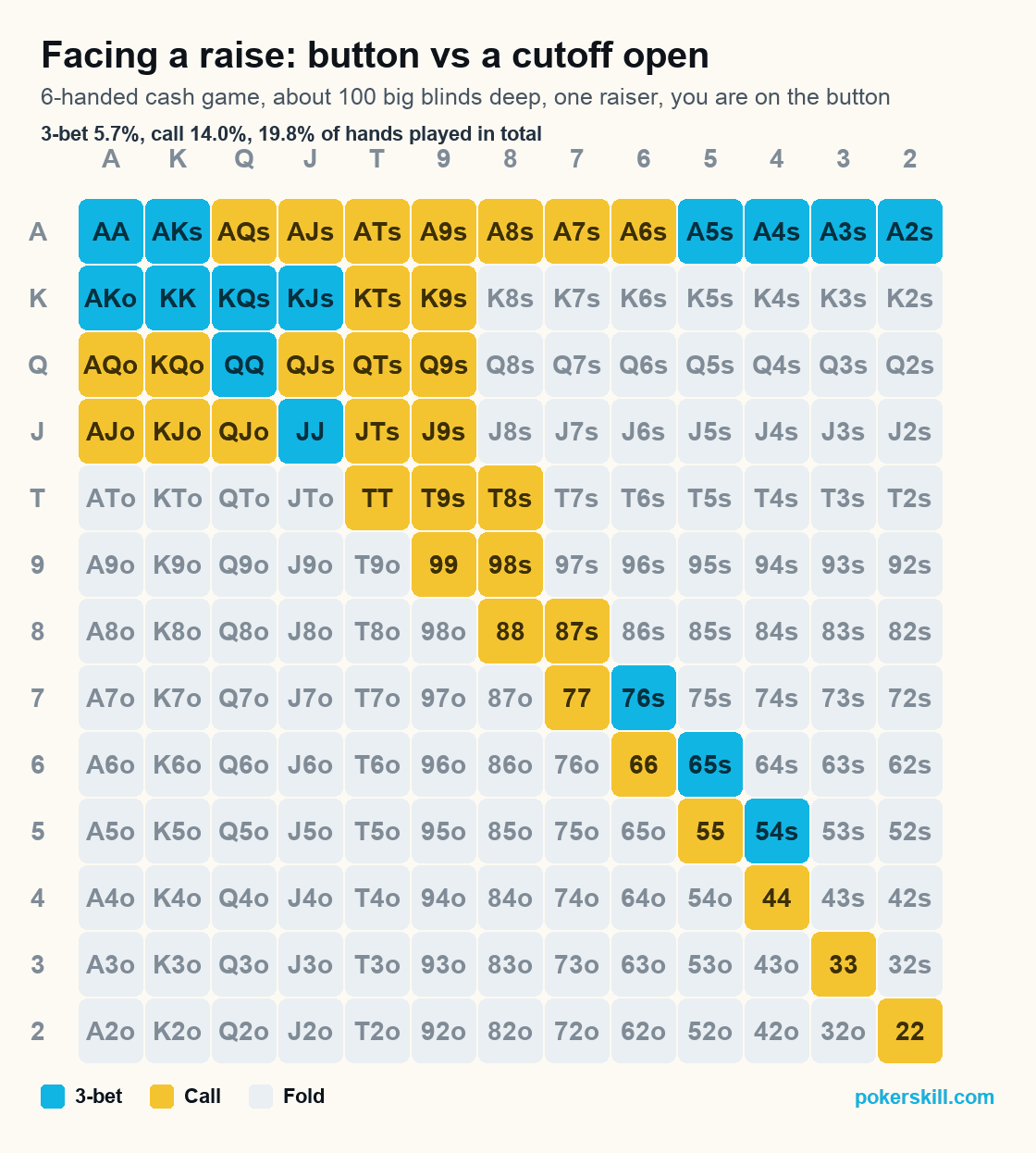
The shape is worth more than the hand list. The raising group is split in two: pairs from jacks up and both ace-king hands, suited and offsuit, which want a bigger pot, and then small suited aces and the suited connectors, plus king-queen and king-jack suited, which are there because they can keep going when the cutoff calls. The hands in between, ace-queen offsuit, king-queen offsuit, the middle pairs, mostly call. They are strong enough to play a pot and not strong enough to want the biggest one, and calling with them in position is the cheapest way to keep the cutoff's weaker hands in.
This is the same grid the preflop charts publish in their facing-a-raise section, character for character.
A blind versus an early-position open
The other end of the same question. An early raiser holds a strong range, you will act first on every street after the flop and the big blind is still behind you when you act from the small blind. So the chart tightens hard, to 4.8% of hands.
| A | K | Q | J | T | 9 | 8 | 7 | 6 | 5 | 4 | 3 | 2 | |
|---|---|---|---|---|---|---|---|---|---|---|---|---|---|
| A | AA 3-bet | AKs 3-bet | AQs 3-bet | AJs 3-bet | ATs fold | A9s fold | A8s fold | A7s fold | A6s fold | A5s 3-bet | A4s 3-bet | A3s 3-bet | A2s 3-bet |
| K | AKo 3-bet | KK 3-bet | KQs fold | KJs fold | KTs fold | K9s fold | K8s fold | K7s fold | K6s fold | K5s fold | K4s fold | K3s fold | K2s fold |
| Q | AQo fold | KQo fold | QQ 3-bet | QJs fold | QTs fold | Q9s fold | Q8s fold | Q7s fold | Q6s fold | Q5s fold | Q4s fold | Q3s fold | Q2s fold |
| J | AJo fold | KJo fold | QJo fold | JJ 3-bet | JTs fold | J9s fold | J8s fold | J7s fold | J6s fold | J5s fold | J4s fold | J3s fold | J2s fold |
| T | ATo fold | KTo fold | QTo fold | JTo fold | TT fold | T9s fold | T8s fold | T7s fold | T6s fold | T5s fold | T4s fold | T3s fold | T2s fold |
| 9 | A9o fold | K9o fold | Q9o fold | J9o fold | T9o fold | 99 fold | 98s fold | 97s fold | 96s fold | 95s fold | 94s fold | 93s fold | 92s fold |
| 8 | A8o fold | K8o fold | Q8o fold | J8o fold | T8o fold | 98o fold | 88 fold | 87s fold | 86s fold | 85s fold | 84s fold | 83s fold | 82s fold |
| 7 | A7o fold | K7o fold | Q7o fold | J7o fold | T7o fold | 97o fold | 87o fold | 77 fold | 76s fold | 75s fold | 74s fold | 73s fold | 72s fold |
| 6 | A6o fold | K6o fold | Q6o fold | J6o fold | T6o fold | 96o fold | 86o fold | 76o fold | 66 fold | 65s fold | 64s fold | 63s fold | 62s fold |
| 5 | A5o fold | K5o fold | Q5o fold | J5o fold | T5o fold | 95o fold | 85o fold | 75o fold | 65o fold | 55 fold | 54s fold | 53s fold | 52s fold |
| 4 | A4o fold | K4o fold | Q4o fold | J4o fold | T4o fold | 94o fold | 84o fold | 74o fold | 64o fold | 54o fold | 44 fold | 43s fold | 42s fold |
| 3 | A3o fold | K3o fold | Q3o fold | J3o fold | T3o fold | 93o fold | 83o fold | 73o fold | 63o fold | 53o fold | 43o fold | 33 fold | 32s fold |
| 2 | A2o fold | K2o fold | Q2o fold | J2o fold | T2o fold | 92o fold | 82o fold | 72o fold | 62o fold | 52o fold | 42o fold | 32o fold | 22 fold |
- 3-bet
- Fold
- 4.8% of hands
3-bet (4.8% of hands): JJ+, AKo, AJs+, A5s-A2s
Fold: everything else
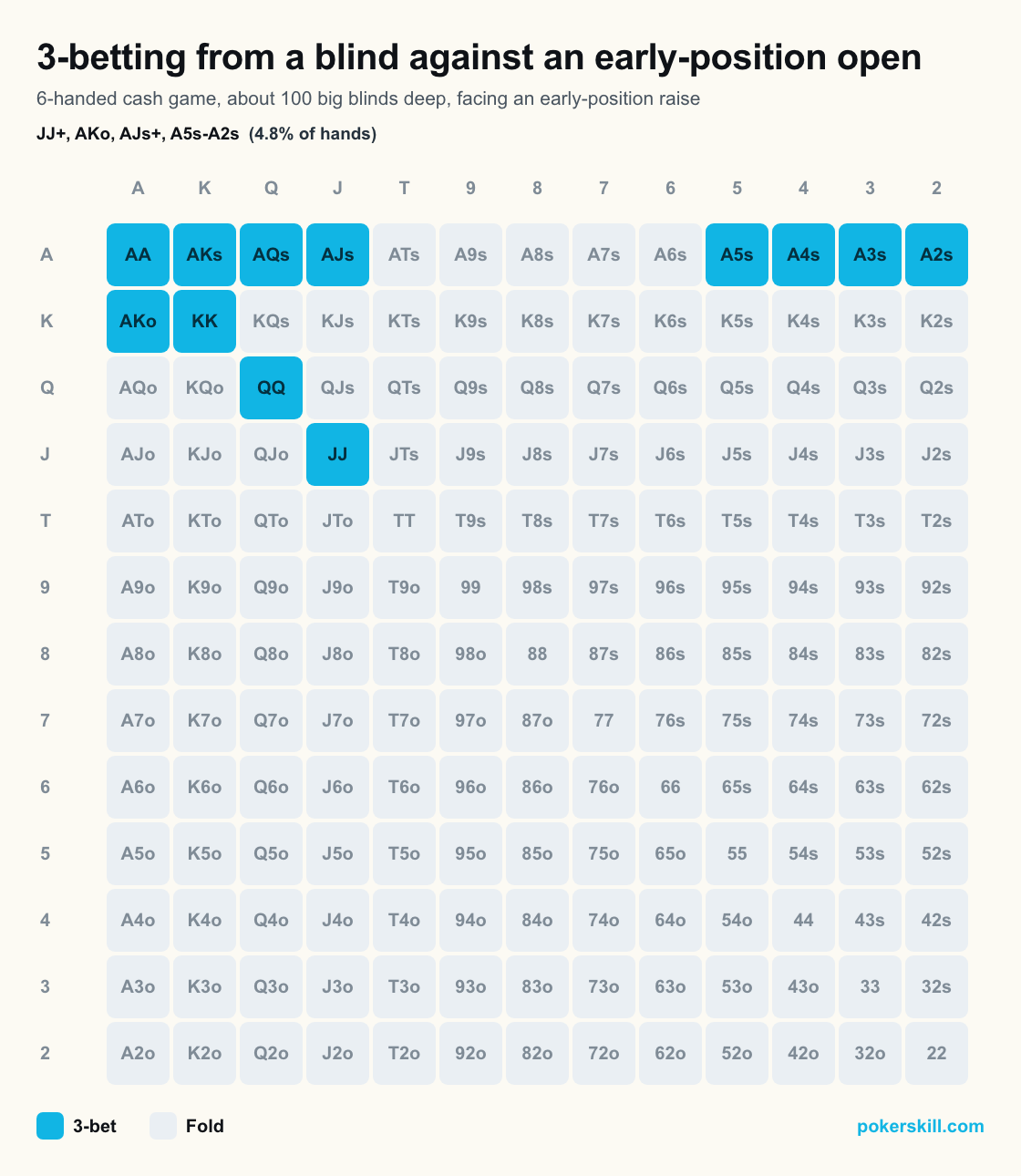
Where this chart comes from, plainly. The value half, jacks and better plus ace-king plus the strong suited aces from ace-jack up, is taken from Advanced Concepts in No-Limit Hold'em, which describes the small blind facing an early raise as re-raising with jacks or better, ace-king, ace-jack suited and better, plus a handful of small suited aces. The book's spot is a 3 big blind open from the third of three early seats at a 9-handed table, which this chart calls UTG+2. The handful is where the source stops being specific, so the four wheel aces on this chart, ace-five suited down to ace-deuce suited, are our reading of it rather than the source's own list. They are the standard choice for the job: an ace in your hand makes it less likely the raiser holds one, and the same card can still make a nut flush or a wheel.
Two notes before you print it. From the small blind, everything outside the coloured cells is a fold rather than a call, because the big blind is still behind you and a call invites it in cheap while you play the rest of the hand out of position. From the big blind some of those hands are calls, because you close the action at a better price. Queen-jack suited is one: this chart leaves it blank, and you call with it against an under-the-gun open in Poker Skill's big blind lesson. Against this chart's 3 big blind open from UTG+2, the book's big blind 3-bets fewer hands than the small blind, only queens or better, ace-king suited and ace-queen suited. And if the raise came from late position rather than early, this chart is too tight: that raiser holds a much wider range, and the button chart above is the closer model.
Email me the 3-bet ranges pack
We will email you this pack. Confirm in that email to also get occasional poker study tips. One click unsubscribes, any time.
What this page does not draw
A complete 3-bet library would be one chart for every pair of opener and re-raiser, and at a 6-handed table that is fifteen grids, since only a player who acts after the opener can re-raise. This page has two, and the gap is deliberate. The second is for a 9-handed table, the one its source gives.
Our rule for a chart page is that every grid names its source: either it is already published in our chart library, or it comes from poker writing we can point at. Two spots clear that bar today. Drawing the other fourteen 6-handed grids would mean inventing hand lists and printing them at the same size and confidence as the sourced ones, and a reader cannot tell those apart. So we would rather ship two charts you can trust than fifteen you cannot.
For the neighbouring questions: opening ranges for every seat are on poker opening ranges by position, the wider facing-a-raise library is on the preflop charts, and if the raise came from a seat this page does not cover, the honest move at the table is to play the top of your range for value and fold the rest. One spot these charts leave out is a raise with a caller already in the pot. You face it on the button in Poker Skill's squeeze lesson, where pocket queens re-raise and hands like seven-six suited and deuces fold because, in the lesson's words, calling costs the full raise and pushes nobody out.
3-bet sizing
Two numbers cover almost every no-limit cash spot at these depths. In position, raise to about three times the original raise. Out of position, raise to about four times it. That is the price of the seat: acting first for the rest of the hand costs you something, so you charge more to make the opener pay for it.
The other half of sizing is what you do afterwards. A 3-bet builds a pot you have to keep playing, so pick the size you are comfortable barrelling on the flop with, and use the same size with the value hands and the bluffs. A range that raises bigger with aces than with ace-four suited is readable in one session.
How to read these charts
Both grids run ace to deuce, left to right and top to bottom. Suited hands sit above the diagonal, offsuit hands below it, and the pairs run down the diagonal itself. Find your two cards, check the colour, act.
A chart is a starting point rather than a verdict. It assumes the cash game it was drawn for (6-handed or 9-handed, roughly 100 big blinds deep) and an opponent whose raise means about what a raise usually means. Change any of that and the chart bends: against a player who opens everything, more hands become 3-bets; against one who only raises premiums, almost nothing does.
How we built these 3-bet charts
The button chart is the grid the preflop charts publish for facing a cutoff open, a range we simplified ourselves. The blind chart takes its value hands from the small blind's range in Advanced Concepts in No-Limit Hold'em, against a 3 big blind open from the third early seat at a 9-handed table: JJ+, AK and AJs+. Its four small suited aces are our reading of that writing.
3-bet range FAQ
What hands should you 3-bet?
It depends entirely on who raised and where you are sitting. On the button against a cutoff open, the chart on this page re-raises 5.7% of hands: the strong pairs and big aces for value, plus small suited aces and suited connectors as the hands that can keep going when called. From a blind against an early open the second chart tightens to 4.8%, because an early raiser holds a stronger hand on average.
What is a good 3-bet range from the blinds?
Tighter than in position, and for two reasons. The early raiser's range is strong, and you will play every street after the flop first. The chart on this page keeps the pairs from jacks up, ace-king and the strong suited aces for value, plus the four small suited aces, which can bluff and still make the nut flush. That chart is the small blind's against a 3 big blind open from UTG+2. Advanced Concepts in No-Limit Hold'em gives its value hands and a few unnamed small suited aces, and the four on the chart are our reading. Against the same open the book's big blind 3-bets only queens or better, ace-king suited and ace-queen suited.
How big should a 3-bet be?
About three times the original raise when you have position, and about four times when you do not. Out of position you are paying for the disadvantage: a bigger raise makes it more expensive for the opener to call and see a flop with the better seat.
Why are there only two charts on this page?
Because we will not draw a grid we cannot source. A full 6-max matrix is fifteen pairs of opener and re-raiser, and the two on this page, the second for the 9-handed table its book uses, are the ones the site's own chart library and the poker literature behind it will carry. The rest would be invented numbers wearing a chart's clothes, which is worse than no chart at all.