
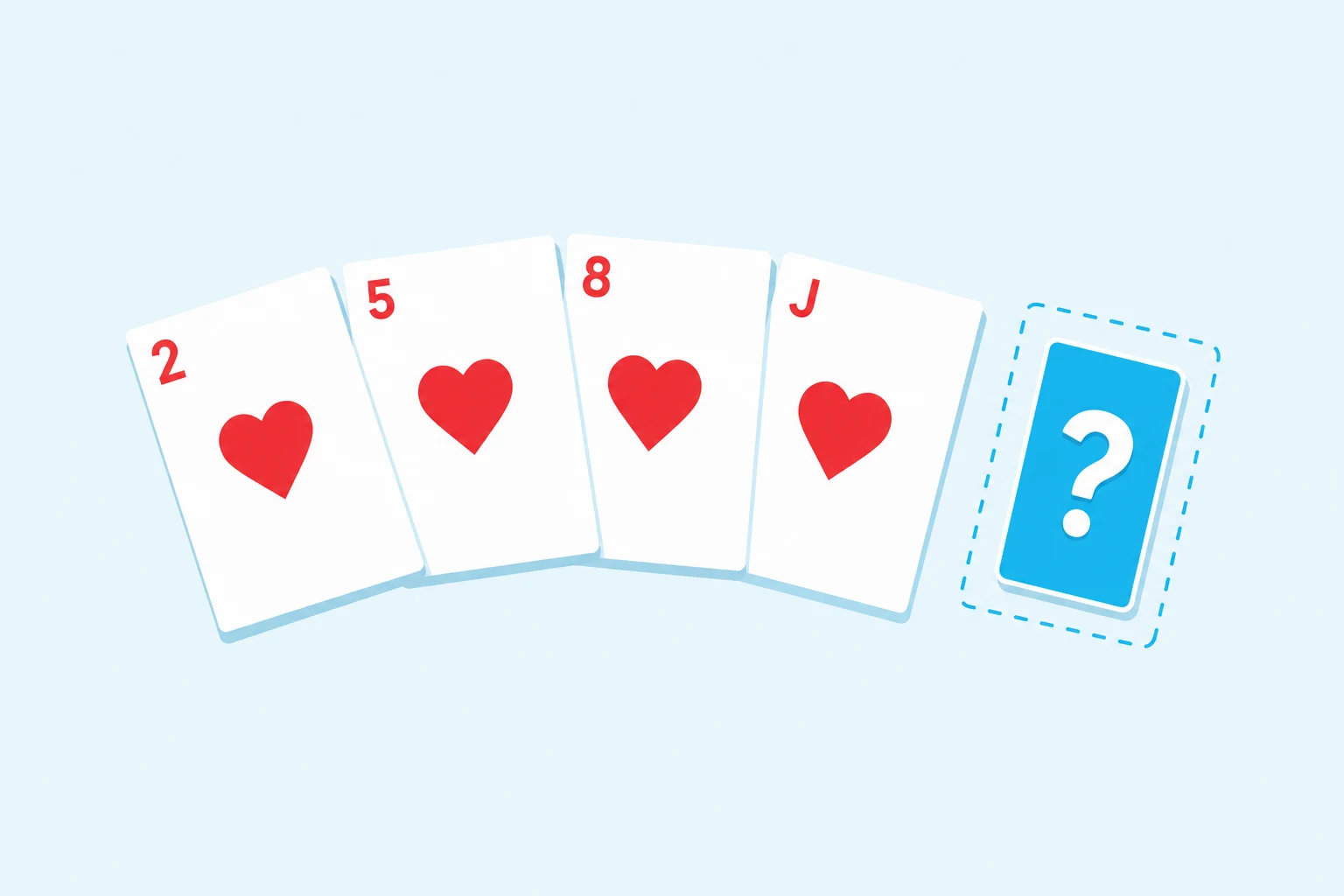
Four cards of the same suit are worth nothing at showdown. A flush requires five, and poker gives no credit for almost. If the hand ends right now, your four hearts count only as whatever else you hold, usually a lonely high card.
That is the answer to the question, and it surprises a lot of new players, because four out of five feels like it should be worth something. It is worth something, just not at showdown. Four suited cards before the river is one of the strongest draws in hold’em, and the gap between those two sentences, worthless made hand versus powerful draw, is exactly what this article unpacks.
Why there is no consolation prize
Every showdown hand in hold’em is exactly five cards, ranked against the standard hand rankings. The best five rule means you pick the strongest five-card combination available from your two hole cards and the board, and that combination either is a flush or it is not. Four hearts plus an off-suit king is just king-high. Four hearts plus a pair of nines is just a pair of nines.
There is no partial credit because hand ranks are categories, not scores. You are not 80 percent of the way to a flush at showdown any more than two cards toward a straight is 40 percent of a straight. The category either completes or it does not exist.
The confusion usually comes from lowball and draw games people half-remember, or from video poker, where four to a flush is a named situation with its own strategy chart. In hold’em and every other high-hand poker game, the rule is blunt: five or nothing.
What four suited cards actually are: a four-flush
While there are still cards to come, four suited cards have a proper name: a four-flush, better known as a flush draw. And a flush draw is genuinely strong, not because of what it is, but because of what it becomes. Poker Skill’s first draw lesson defines it that way, four cards of one suit waiting on one more, and counts three of a suit as no flush draw at all.
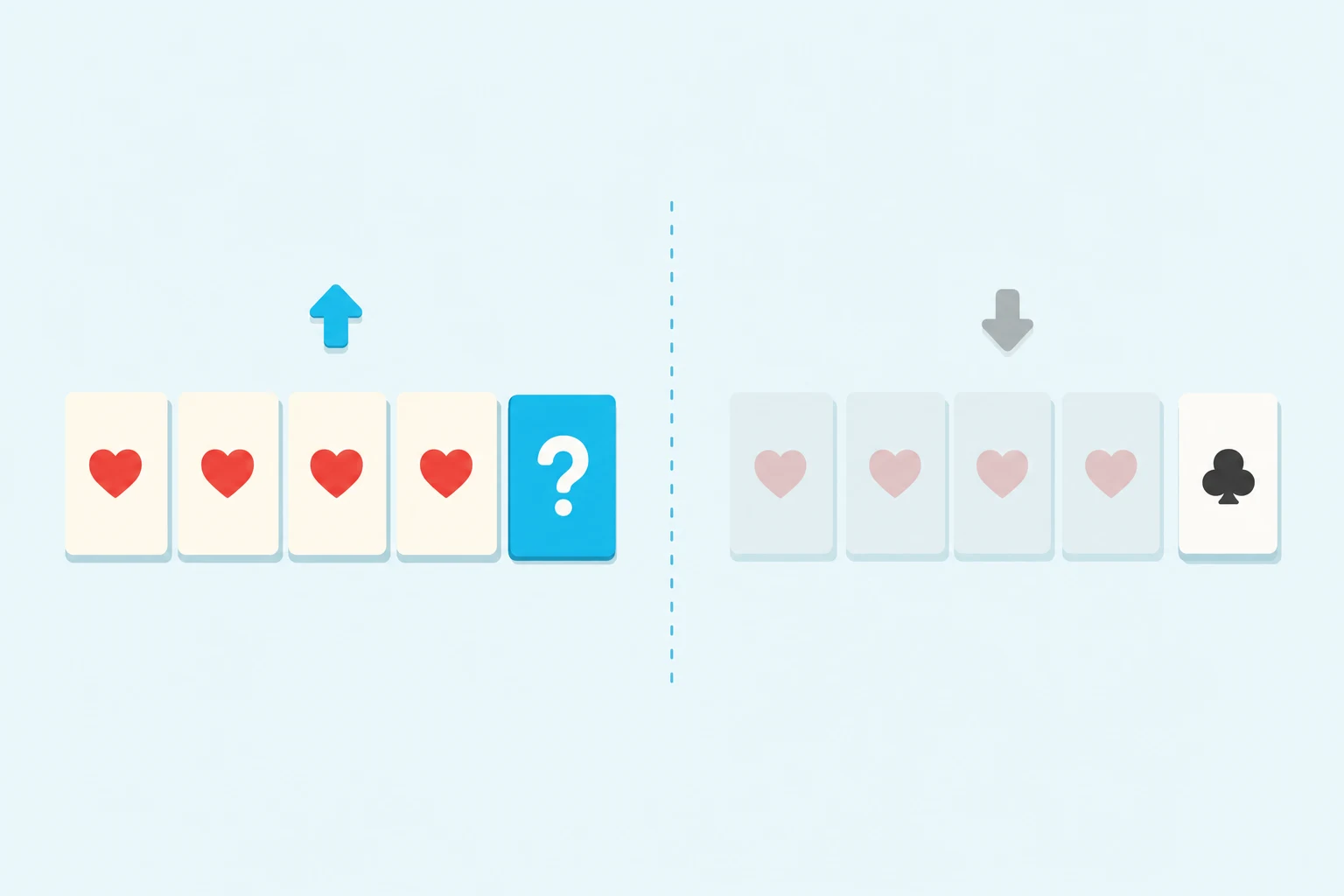
Nine cards complete it. Thirteen of each suit exist, you can see four of them, so nine hearts remain among the unseen cards. Nine outs is the biggest common draw in the game, bigger than an open-ended straight draw’s eight, and each of those nine cards turns your nothing into a hand that beats every pair, every two pair, every set, and every straight on the board.
The word “four-flushing” even escaped poker into old slang, where it meant bluffing or faking it, someone holding four suited cards and acting like they had the fifth. That is a fair summary of the hand’s character: it is a threat wearing a costume, and played well the costume itself makes money.
The draw math you should carry in your head
Use the rule of 2 and 4 and the numbers become automatic. Nine outs times four with two cards to come: about 36 percent to finish the flush from the flop. Nine outs times two with one card to come: about 18 percent on the turn alone. The exact figures are 35 percent and 19.6 percent, close enough that the shortcut never costs you real money.
Roughly one time in three, then, your flopped flush draw arrives. That number is the whole personality of the hand. It means you will miss more often than you hit, so calling any price is a leak. It also means you hit often enough that, combined with a fair price or some fold pressure, the draw plays itself profitably.
The turn is where discipline gets tested. Miss once and you are down to 18 percent with one card to come, while the bets are usually getting bigger. The draw that was worth a call on the flop is frequently worth a fold on the turn at a worse price. Players who treat those two streets as the same decision pay for the difference.
Playing the four-flush: price and pressure
Two honest ways to make money with a flush draw. The first is passive and mathematical: call when the pot odds beat the draw’s chance of arriving, fold when they do not. At 36 percent from the flop you can profitably call surprisingly large bets; at 18 percent on the turn the bar roughly doubles.
The second way is the semi-bluff, and it is why strong players love this hand. Bet or raise with the draw and you win two ways: sometimes everyone folds now, and when they do not, you still hit your flush a third of the time. Aggression with nine outs is not recklessness, it is owning both halves of the equation. The hands that should worry you are the ones where neither half works, no fold coming and a bad price, which is exactly the spot the math above tells you to release.
One caution worth its own sentence: the ace matters. A king-high flush loses to an ace-high flush, and draws to the third-best flush are how careful players still go broke. Drawing to the nut flush is a different, far more comfortable game than drawing to the fifth-best one.
A worked hand: pricing the draw
You hold A♥ 9♥ and the flop comes K♥ 7♥ 2♣. Four hearts, the nut flush draw. The pot is $10 and your opponent bets $5, making the pot $15 with $5 to call.
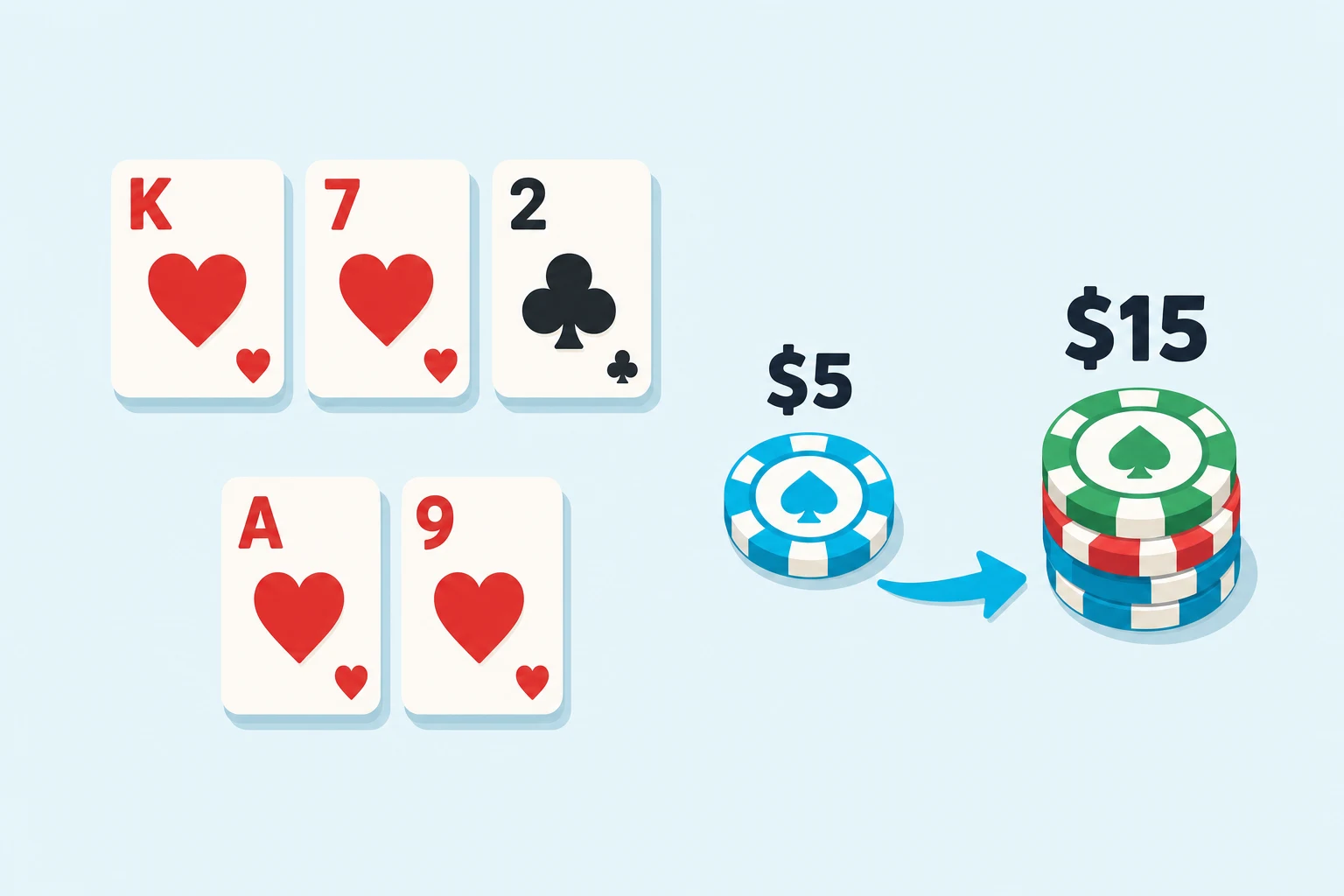
Price first. You are paying $5 to win $15, so you need to win about one time in four to break even. The draw alone arrives 36 percent of the time from here, better than one in three, so the call is comfortably profitable before you even count the times an ace pairs you into the best hand. Easy call, and against most opponents an easy raise, since fold pressure adds a second way to win with the ace blocking their strongest flushes.
Now change one card: your hand is 9♥ 8♥ on the same flop, and the bet is $15 into $10, a pot-sized barrel. You are paying $15 to win $25, needing about 37 percent, and your draw arrives 36 percent of the time to a flush that is not even the nut flush. The naked call is now losing money, and every heart that helps you might be making someone a bigger flush. This is a raise-or-fold spot, and against a player who never folds, it is a fold. Same four suited cards, opposite decisions, and the only thing that changed was the price and the rank of your draw.
The misread that costs real money
The expensive mistake is not chasing the draw. It is arriving at the river with four suited cards, missing, and then calling a bet with king-high because the hand still “feels” strong from all the streets it spent being a big draw. It is not strong. It completed as nothing, and the only question left is whether king-high bluff-catches profitably against this opponent, which is a different and much rarer reason to call.
Say the sentence to yourself when the river bricks: the draw is dead, what is my actual hand? Answering that question honestly, every time, is worth more than any chart.
Where this fits in your game
Flush draws are among the most common significant decisions in hold’em; you will face one every session of your life. The rep worth drilling is the three-step read: count the outs, price the draw with the rule of 2 and 4, then check whether aggression adds a second way to win. Run those three steps until they take five seconds, because live they need to.
Does four of the same suit beat a pair?
No. Four suited cards are not a hand category at all. At showdown you have whatever your best five cards make without the flush, which is usually high card and occasionally a pair. Any made pair beats a missed flush draw.
What are the odds of finishing a flush from four suited cards?
With two cards to come, about 35 percent. With one card to come, about 19 percent. Nine outs remain, since thirteen cards of the suit exist and four are visible to you.
What is a four-flush?
Four cards of one suit, one short of a flush: the hand better known as a flush draw. The old slang “four-flusher” meant a bluffer for exactly this reason, someone representing the flush they did not yet have.